

When people search for a portable bluetooth speaker, a wireless bluetooth speaker, or even compare products marketed as bluetooth speakers best bass, they often struggle to describe exactly what they want. Instead of talking about frequency response curves or driver specifications, most listeners use simple phrases:
- "I want fuller sound."
- "I want richer bass."
- "This speaker sounds thin."
- "That speaker sounds weak."
- "I want music to feel bigger."
Interestingly, these observations are often more meaningful than technical specifications. Two speakers may have similar power ratings, similar driver sizes, and similar price points, yet one sounds rich, immersive, and satisfying while the other sounds small, flat, and uninspiring.
So what actually creates that difference?
The answer involves a combination of acoustic engineering, frequency balance, cabinet design, resonance management, sound dispersion, driver quality, air movement, and room interaction. A speaker's ability to sound full is rarely determined by one component alone. Instead, it is the result of many engineering decisions working together.
In this guide, we'll explore the science behind rich, room-filling sound and explain why some speakers consistently outperform others in creating a more natural and immersive listening experience.
Why "Full Sound" Means More Than Just Bass
One of the biggest misconceptions in audio is that fullness equals bass.
While bass certainly contributes to perceived richness, simply increasing low frequencies does not automatically create better sound.
In fact, excessive bass can make music sound:
- Bloated
- Muddy
- Fatiguing
- Unbalanced
A truly full speaker maintains balance across the entire frequency spectrum.
Listeners perceive richness when:
- Bass provides foundation
- Midrange remains clear
- Treble adds detail
- No frequency dominates excessively
The best listening experiences occur when every part of the spectrum works together.
Understanding Frequency Balance
Every speaker reproduces three primary frequency regions:
Low Frequencies (Bass)
Typically 20Hz–250Hz
Responsible for:
- Weight
- Warmth
- Impact
- Energy
Mid Frequencies
Typically 250Hz–4kHz
Responsible for:
- Vocals
- Instruments
- Clarity
- Presence
High Frequencies (Treble)
Typically 4kHz–20kHz
Responsible for:
- Detail
- Sparkle
- Airiness
- Precision
A speaker sounds thin when one or more of these regions is underrepresented.
For example:
Weak Bass
Results in:
- Lack of body
- Reduced warmth
- Smaller perceived sound
Weak Midrange
Results in:
- Hollow vocals
- Reduced emotional connection
Weak Treble
Results in:
- Dull presentation
- Reduced detail
The goal is balance.
Why Bass Creates the Foundation of Rich Sound
Bass plays a unique psychological role.
Humans often associate low frequencies with:
- Power
- Warmth
- Scale
- Realism
This is why buyers frequently search for:
However, quality bass differs from exaggerated bass.
Good bass should:
- Extend deep
- Remain controlled
- Support the music
- Avoid overwhelming other frequencies
The most satisfying speakers deliver bass that feels natural rather than artificially boosted.
Why Many Small Speakers Sound Thin
Compact speakers face a difficult challenge.
Producing bass requires moving air.
Smaller cabinets naturally contain less internal air volume.
Without careful engineering, this often leads to:
- Reduced bass extension
- Limited dynamics
- Smaller soundstage
- Thin presentation
Manufacturers often compensate by applying DSP-based bass boosting.
While effective in demonstrations, excessive digital boosting can sometimes introduce:
- Distortion
- Compression
- Listening fatigue
This is why enclosure engineering becomes so important.
Cabinet Design: The Hidden Factor Behind Rich Sound
Most consumers focus on drivers.
Audio engineers often focus on the enclosure.
The cabinet affects:
- Resonance behavior
- Air pressure management
- Vibration control
- Bass efficiency
Even exceptional drivers can underperform inside a poorly designed cabinet.
Why Traditional Box Speakers Have Limitations
The majority of speakers use rectangular enclosures.
This approach is practical and cost-effective.
However, flat internal surfaces create acoustic challenges.
Inside a box:
- Sound waves reflect repeatedly
- Standing waves develop
- Pressure accumulates unevenly
These effects can color the sound.
The result may include:
- Muddy bass
- Reduced clarity
- Less natural presentation
The Importance of Resonance Control
Every cabinet vibrates.
The challenge is controlling those vibrations.
Excessive resonance causes:
- Bass smearing
- Distortion
- Reduced detail
- Listening fatigue
High-quality speaker design focuses heavily on minimizing unwanted resonance.
This improves perceived richness because listeners hear more music and less cabinet behavior.
Why Spherical Cabinets Behave Differently
A sphere distributes internal pressure differently than a box.
Unlike rectangular enclosures:
- No parallel walls exist
- Standing waves are reduced
- Internal reflections become less problematic
These characteristics help create cleaner acoustic behavior.
For decades, engineers have recognized the theoretical advantages of spherical structures.
Modern manufacturing techniques now make such designs more practical.
How the UB+ dB1 Approaches Full Sound Differently
Many speakers attempt to create richness through DSP enhancement.
The UB+ dB1 DoubleBass takes a different approach.
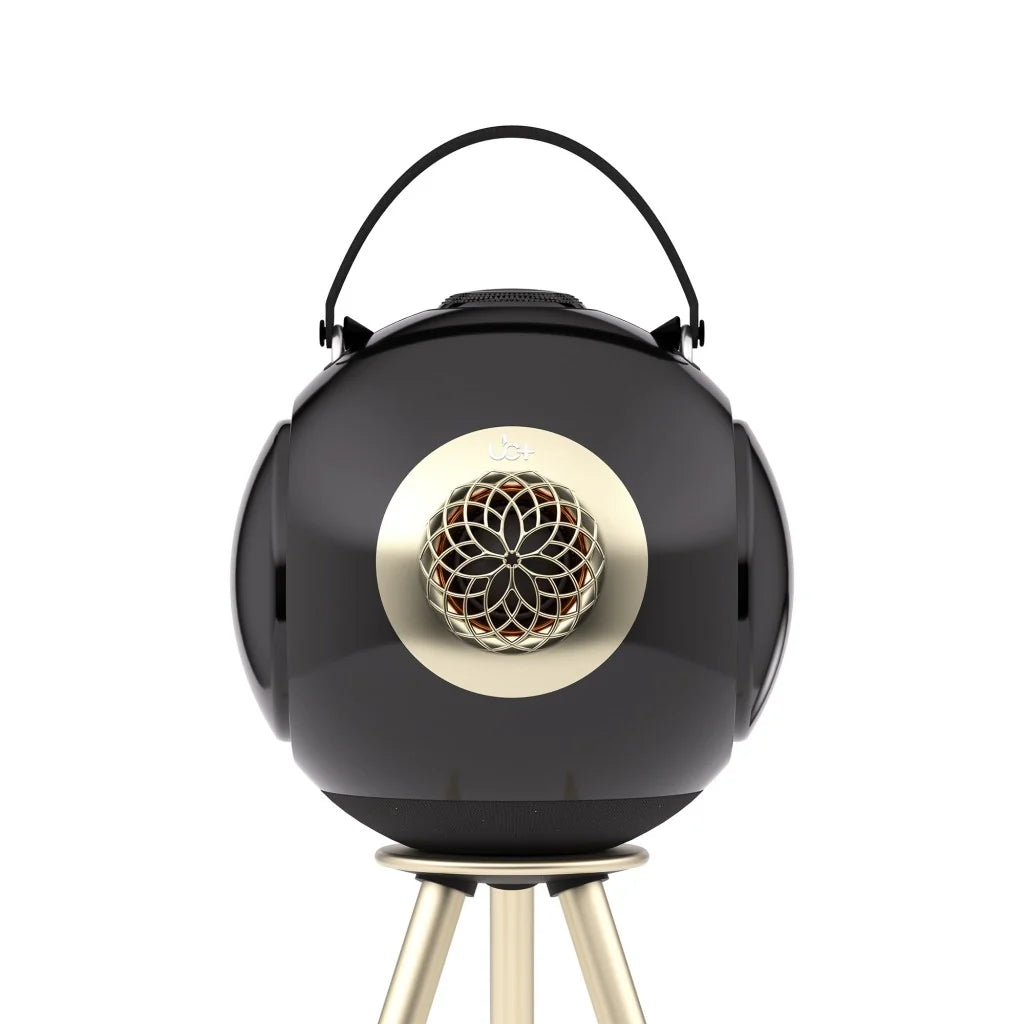
Its design centers around a Helmholtz-inspired spherical acoustic chamber.
Rather than relying solely on digital processing, the system uses acoustic physics to enhance bass performance and overall sound quality.
Understanding the Helmholtz-Inspired Spherical Acoustic Chamber
The spherical chamber serves several purposes.
It helps:
- Manage internal pressure
- Reduce standing waves
- Improve resonance control
- Increase acoustic efficiency
By creating a more uniform pressure environment, the chamber supports cleaner and deeper bass reproduction.
This contributes directly to the perception of fullness.
Mechanical Bass Amplification vs DSP Boosting
Many Bluetooth speakers rely heavily on software.
DSP algorithms artificially emphasize low frequencies.
While this creates immediate impact, it can also introduce limitations.
The dB1 instead emphasizes:
- Internal pressure dynamics
- Acoustic efficiency
- Mechanical bass amplification
This approach allows the speaker to generate substantial low-frequency energy naturally.
The result is bass that feels more authentic and less exaggerated.
Dual Symmetrical Passive Radiators
One of the most important contributors to fullness is air movement.
The dB1 incorporates:
- Two large passive radiators
- Mounted opposite each other
- Operating in symmetrical motion
As internal pressure changes:
- Both radiators respond simultaneously
- Additional air is displaced
- Bass output increases
Importantly, this occurs without requiring a larger cabinet.
Why 3.5× Radiator Surface Area Matters
The combined passive radiator area in the dB1 is approximately:
3.5 times larger than the active woofer surface area.
This provides significant advantages.
More radiator surface area means:
- Greater air movement
- Stronger bass perception
- Improved low-frequency efficiency
This is one reason the speaker sounds larger than its dimensions suggest.
Self-Cancelling Vibration Architecture
Bass performance is not simply about producing energy.
It is also about controlling energy.
In many speakers:
- Cabinets vibrate
- Tables shake
- Bass becomes less precise
The dB1's dual radiator system helps balance mechanical forces.
Because both sides move together:
- Vibrational forces counteract one another
- Cabinet movement decreases
- More energy becomes usable sound
This contributes to cleaner and more controlled bass.
Technical Comparison Table: Thin Sound vs Full Sound
|
Characteristic |
Thin Speaker |
Full-Sounding Speaker |
|
Bass Extension |
Limited |
Deep and Controlled |
|
Midrange Presence |
Weak |
Natural and Detailed |
|
Treble Balance |
Harsh or Dull |
Smooth and Clear |
|
Cabinet Resonance |
High |
Controlled |
|
Soundstage |
Narrow |
Spacious |
|
Air Movement |
Limited |
Efficient |
|
Listening Comfort |
Fatiguing |
Relaxed |
|
Room Coverage |
Uneven |
Consistent |
Dispersion: The Overlooked Ingredient of Rich Sound
Many listeners assume fullness comes solely from bass.
In reality, dispersion also plays a major role.
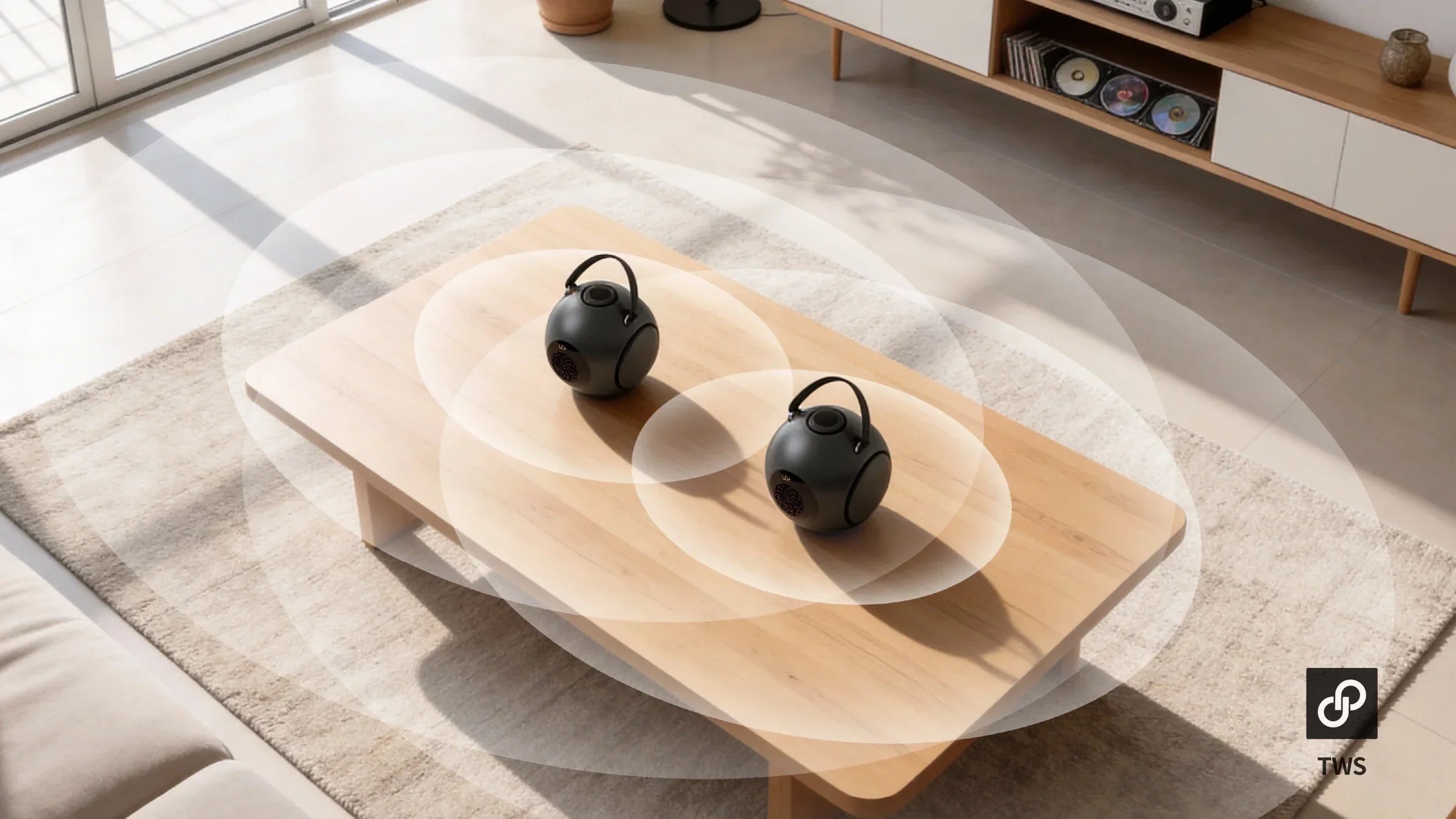
Dispersion describes how sound spreads throughout a room.
Poor dispersion creates:
- Hot spots
- Dead zones
- Uneven listening experiences
Wide dispersion creates:
- Greater immersion
- More natural coverage
- Enhanced spaciousness
A speaker often sounds larger simply because it distributes sound more effectively.
What Is Soundstage?
Soundstage refers to the perceived size and dimensionality of sound.
A strong soundstage allows listeners to perceive:
- Width
- Depth
- Instrument placement
When soundstage is limited:
- Music feels trapped inside the speaker
When soundstage expands:
- Music feels larger than the enclosure
This contributes significantly to richness.
Why Driver Quality Matters
Even the best enclosure cannot compensate for poor drivers.
The dB1 incorporates several high-end driver technologies.
90mm Neodymium Magnet
A powerful magnet improves:
- Driver control
- Efficiency
- Accuracy
35mm Long-Stroke Voice Coil
Allows:
- Greater excursion
- Improved bass capability
- Enhanced dynamic performance
20mm Piston Movement
Supports substantial air displacement despite the compact cabinet.
Aluminum Shorting Ring
Reduces distortion while improving linearity.
Benefits include:
- Cleaner midrange
- Better detail
- More accurate reproduction
Extra-Wide 18mm Surround
Helps maintain:
- Stable cone movement
- Controlled excursion
- Reduced mechanical distortion
Frequency Balance and Human Perception
Humans are particularly sensitive to midrange frequencies.
This includes:
- Voices
- Guitars
- Pianos
A speaker can have powerful bass but still sound weak if midrange reproduction is poor.
Richness requires proper integration of:
- Bass
- Midrange
- Treble
No single region can compensate for deficiencies elsewhere.
Why Room Interaction Changes Everything
Even the best speaker interacts with its environment.
Room characteristics affect:
- Bass response
- Reflections
- Clarity
- Imaging
This is why placement remains critical.
Simple adjustments can dramatically improve perceived fullness.
Typical Bluetooth Speaker vs Physics-Driven Design
|
Feature |
Typical Bluetooth Speaker |
UB+ dB1 DoubleBass |
|
Cabinet Shape |
Rectangular |
Helmholtz-Inspired Sphere |
|
Bass Enhancement |
DSP Boosting |
Mechanical Amplification |
|
Passive Radiators |
Single or None |
Dual Symmetrical |
|
Pressure Management |
Conventional |
Optimized |
|
Vibration Control |
Limited |
Self-Cancelling |
|
Radiator Surface Area |
Standard |
3.5× Woofer Area |
|
Distortion Management |
Moderate |
Advanced |
|
Sound Philosophy |
Software Driven |
Physics Driven |
Why Rich Sound Creates Emotional Engagement
The best speakers do more than reproduce audio.
They create emotional connection.
Full, balanced sound allows listeners to:
- Feel immersed
- Relax longer
- Experience greater realism
Thin sound often feels detached.
Rich sound feels alive.
This emotional response explains why certain speakers become favorites despite having similar specifications to competitors.
Choosing a Speaker That Sounds Full
When evaluating a speaker, look beyond marketing numbers.
Consider:
Frequency Balance
Does the speaker sound natural?
Cabinet Design
How effectively does it manage resonance?
Air Movement
How efficiently does it create bass?
Dispersion
How well does it fill a room?
Engineering Philosophy
Does it rely on physics or excessive processing?
These factors often determine long-term satisfaction more than wattage ratings alone.
Final Thoughts
A speaker sounds full and rich when multiple engineering elements work together.
Frequency balance creates tonal accuracy.
Cabinet design controls resonance.
Dispersion expands soundstage.
Driver quality improves detail.
Air movement strengthens bass.
The most successful designs combine all these factors into a cohesive system.
The UB+ dB1 DoubleBass demonstrates how modern speaker engineering can achieve this balance through a Helmholtz-inspired spherical acoustic chamber, dual symmetrical passive radiators, self-cancelling vibration architecture, and premium driver technologies. Rather than relying solely on digital enhancement, it uses acoustic physics to create deeper, cleaner, and more natural sound.
Ultimately, richness is not about making a speaker louder.
It is about making sound feel more complete.
Frequently Asked Questions
Why does one speaker sound fuller than another even if both have similar power ratings?
Power ratings only indicate how much electrical energy a speaker can handle. They do not reveal how efficiently that energy is converted into sound. Factors such as cabinet design, driver quality, resonance control, and frequency balance often have a much greater impact on perceived richness and overall sound quality.
Does more bass automatically mean better sound?
Not necessarily. Excessive bass can overwhelm vocals and instruments, creating a muddy or fatiguing listening experience. A full-sounding speaker maintains balance across bass, midrange, and treble frequencies so that every element of the music remains clear and natural.
Why does cabinet design affect audio performance?
The cabinet influences how sound waves behave inside the speaker. Poorly designed enclosures can create unwanted resonance and standing waves that color the sound. Advanced cabinet designs help manage pressure, reduce distortion, and improve overall clarity.
What role do passive radiators play in sound quality?
Passive radiators increase bass efficiency by using internal air pressure to move additional surfaces. This allows a speaker to produce deeper low frequencies without requiring a significantly larger enclosure. When implemented properly, passive radiators help create fuller and richer sound.
How does the UB+ dB1 create such strong bass from a compact enclosure?
The dB1 combines a Helmholtz-inspired spherical acoustic chamber, dual symmetrical passive radiators, self-cancelling vibration architecture, and a high-performance driver system. Together, these technologies improve air movement, reduce distortion, and create mechanical bass amplification that delivers powerful low-frequency performance without relying heavily on digital processing.
Discover What Full, Rich Sound Really Feels Like
If you're searching for a portable bluetooth speaker, wireless bluetooth speaker, or best value bluetooth speaker that prioritizes acoustic engineering over marketing gimmicks, explore the UB+ dB1 DoubleBass.
Experience the difference created by:
- Helmholtz-inspired spherical acoustic chamber
- Dual symmetrical passive radiators
- 3.5× passive radiator surface area
- Self-cancelling vibration architecture
- Mechanical bass amplification
- 90mm neodymium magnet
- 35mm long-stroke voice coil
- 20mm piston movement
- Aluminum shorting ring
- 18mm wide surround


Hinterlasse einen Kommentar
Diese Website ist durch hCaptcha geschützt und es gelten die allgemeinen Geschäftsbedingungen und Datenschutzbestimmungen von hCaptcha.