

If you’ve ever compared a compact portable bluetooth speaker to a larger system, you’ve probably wondered:
How can something so small produce such deep, punchy bass?
The answer, in many modern designs, comes down to one critical component:
Passive radiators.
They’re often mentioned in product descriptions, sometimes treated like a marketing feature but in reality, passive radiators are one of the most important innovations in making best small bluetooth speakers sound far bigger than they look.
This guide breaks down how passive radiators actually work, why they matter, and how advanced designs especially when combined with spherical enclosures and Helmholtz-inspired chambers deliver bass that feels powerful, controlled, and natural.
What Is a Passive Radiator?
A passive radiator is a component inside a speaker that looks similar to a driver but it doesn’t have a motor, voice coil, or magnet.
Instead, it moves purely in response to air pressure changes inside the speaker enclosure.
In simple terms:
- The main driver pushes air
- Internal pressure builds
- That pressure moves the passive radiator
- The radiator reinforces low frequencies
So instead of generating sound directly, it amplifies bass using physics.
Why Small Speakers Need Passive Radiators

Producing bass requires moving air lots of it.
Large speakers can do this with:
- bigger drivers
- larger enclosures
- more internal volume
But compact wireless bluetooth speakers don’t have that luxury.
They need a way to:
- extend bass response
- avoid distortion
- stay efficient
Passive radiators solve this by:
- increasing effective air movement
- reducing strain on the main driver
- enhancing low-frequency output
Passive Radiator vs Bass Port: What’s the Difference?
Before passive radiators became popular, most speakers used bass reflex ports (small openings or tubes).
Bass Port System:
- air moves in and out of a port
- tuned to enhance certain frequencies
Limitations:
- port noise (“chuffing”)
- reduced control at high volume
- less efficient in compact designs
Passive Radiator System:
- sealed enclosure
- no open port
- air pressure moves a diaphragm instead
Advantages:
- quieter operation
- better control
- deeper bass in small spaces
Passive Radiators vs Bass Ports
|
Feature |
Bass Port |
Passive Radiator |
|
Air Movement |
Through open port |
Through radiator diaphragm |
|
Noise |
Can produce port noise |
Silent operation |
|
Efficiency |
Moderate |
High in small enclosures |
|
Bass Depth |
Limited |
Deeper extension |
|
Control |
Less precise |
More controlled |
|
Suitability |
Larger speakers |
Compact speakers |
The Physics Behind Passive Radiators
Passive radiators operate based on resonance and air pressure dynamics.
Inside the speaker:
- The driver moves forward and backward
- Air pressure inside the enclosure increases and decreases
- The passive radiator responds to these pressure changes
- It vibrates at tuned frequencies
This creates:
- stronger low-frequency output
- improved efficiency
- reduced distortion
Helmholtz Resonance: The Foundation of Modern Bass Design
Passive radiator systems are closely related to the Helmholtz resonator principle.
This concept involves:
- trapping air in a chamber
- controlling how it moves
- reinforcing specific frequencies
When applied to speaker design:
- bass is amplified naturally
- energy is used efficiently
- sound remains balanced
Why Enclosure Shape Matters
Passive radiators don’t work in isolation.
Their performance depends heavily on the enclosure design.
Traditional Box Enclosures
Most best budget bluetooth speakers use rectangular boxes.
Inside these:
- parallel walls reflect sound
- pressure builds unevenly
- resonance becomes unpredictable
This can lead to:
- muddy bass
- distortion
- inconsistent performance
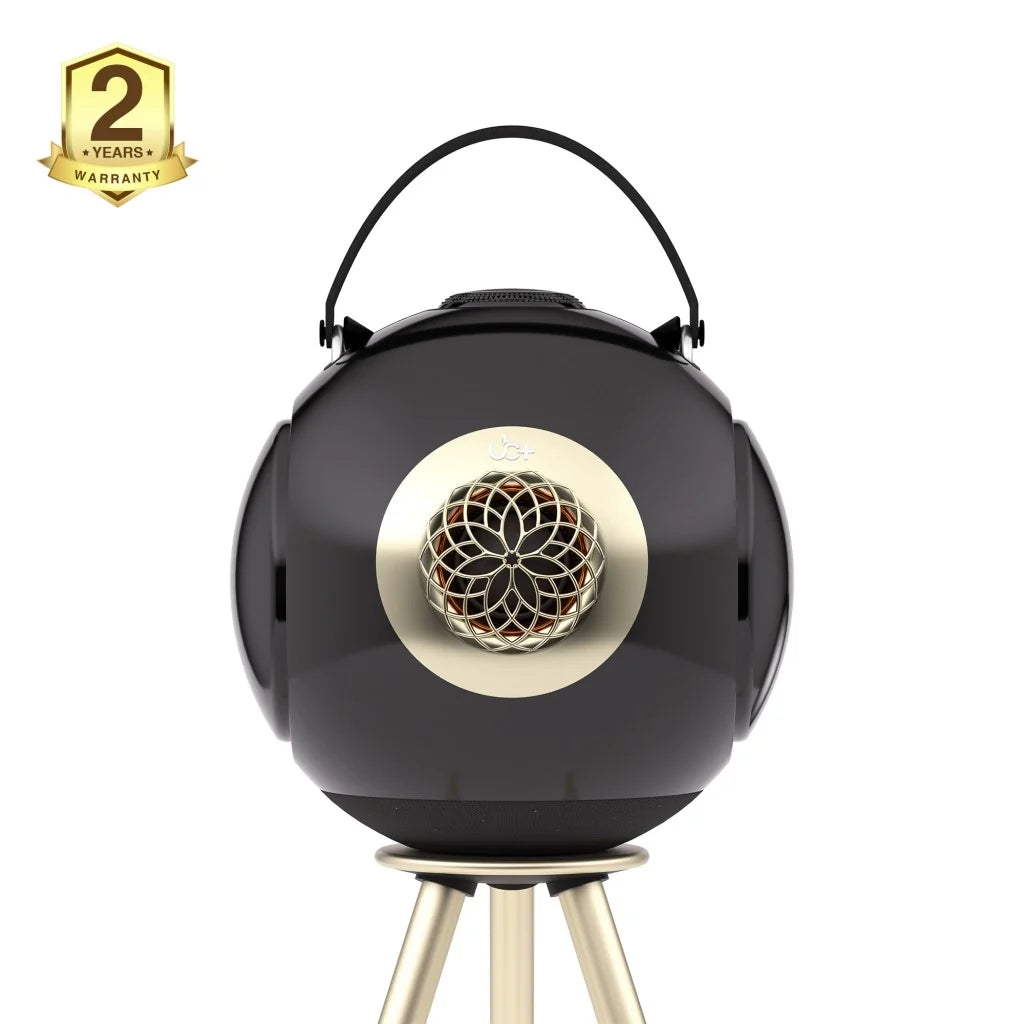
Spherical Enclosures: A Smarter Approach
Advanced speakers use spherical designs to improve performance.
A sphere:
- has no parallel surfaces
- distributes pressure evenly
- reduces internal interference
This creates the ideal environment for passive radiators to work efficiently.
Dual Passive Radiators: Why Symmetry Matters
Many entry-level speakers use a single passive radiator.
But higher-end designs use dual radiators placed symmetrically.
How It Works:
- radiators are positioned on opposite sides
- they move in equal and opposite directions
- forces cancel each other out
Benefits:
- reduced vibration
- stable enclosure
- efficient energy conversion
This is known as self-cancelling vibration.
3.5× Air Movement: Amplifying Bass Without More Power
One of the most important advantages of passive radiator systems is increased air movement.
In advanced designs:
- total radiator surface area can be 3.5× larger than the main driver
This allows:
- more air displacement
- deeper bass
- less strain on the driver
Downward-Firing Drivers: Enhancing the System
Some speakers combine passive radiators with downward-firing drivers.
Instead of projecting sound outward:
- the driver energizes internal air
- pressure builds evenly
- radiators release that energy
This creates:
- smoother bass
- wider sound dispersion
- more natural listening experience
Basic vs Advanced Passive Radiator Systems
|
Feature |
Basic System |
Advanced System |
|
Radiator Count |
Single |
Dual symmetrical |
|
Air Movement |
Limited |
3.5× enhanced |
|
Vibration |
Noticeable |
Self-cancelling |
|
Enclosure |
Rectangular |
Spherical |
|
Bass Quality |
Boosted |
Controlled and deep |
|
Listening Comfort |
Fatiguing |
Long-session friendly |
Why Passive Radiators Sound More Natural
Unlike DSP-based bass boosting, passive radiators:
- rely on physical movement
- respond dynamically to music
- preserve tonal balance
This results in:
- bass that integrates with mids
- less artificial sound
- more realistic listening experience
DSP vs Mechanical Bass
Many portable bluetooth speakers rely heavily on DSP.
DSP Approach:
- boosts low frequencies digitally
- simulates bass
Downsides:
- distortion at high volume
- compressed dynamics
- listener fatigue
Mechanical Approach (Passive Radiators):
- uses real air movement
- enhances natural resonance
- maintains clarity
Why Passive Radiators Are Ideal for Portable Speakers
For travel and daily use, passive radiators offer:
- compact design
- efficient performance
- consistent sound
This is why they’re found in many of the best sounding bluetooth speakers today.
Real-World Listening Benefits
When passive radiators are properly implemented, you’ll notice:
- deeper bass without increasing volume
- cleaner mids
- stable sound at higher levels
Bass feels:
- present
- controlled
- physical
Not just loud.
Common Misconceptions
“More Radiators = Better Sound”
Not always.
What matters is:
- tuning
- placement
- enclosure design
“Passive Radiators Replace Subwoofers”
They don’t replace subwoofers but they reduce the need for one in small spaces.
“They Are Just Marketing Features”
In reality, they are a core engineering solution for compact audio.
When Passive Radiators Make the Biggest Difference
They are most effective in:
- compact speakers
- portable designs
- small to medium rooms
Especially when paired with:
- efficient enclosure geometry
- controlled resonance systems
Choosing the Right Speaker
If you’re evaluating a rechargeable bluetooth speaker, look beyond specs.
Focus on:
- how bass is produced
- whether passive radiators are used
- enclosure design
Why Some Small Speakers Sound Bigger Than Others
It comes down to:
- air movement efficiency
- resonance control
- system integration
Not just size or power.
The Future of Compact Audio
Speaker design is shifting toward:
- physics-based solutions
- efficient acoustic systems
- smarter use of space
Passive radiators are a key part of this evolution.
Final Thoughts: Bigger Bass, Smarter Design
Passive radiators prove that you don’t need a large speaker to achieve deep, satisfying bass.
When combined with:
- Helmholtz-inspired acoustic chambers
- dual symmetrical radiator systems
- 3.5× air movement efficiency
- spherical enclosures
- downward-firing drivers
they transform compact speakers into powerful, balanced sound systems.
This is how today’s best audiophile bluetooth speakers deliver performance that once required much larger setups.
Explore Smarter Sound Design
→ Compare dB1 vs dB Mini
→ See color options
→ Check current price
Because great bass isn’t about forcing more power.
It’s about using air, space, and design to make every note feel real.



Hinterlasse einen Kommentar
Diese Website ist durch hCaptcha geschützt und es gelten die allgemeinen Geschäftsbedingungen und Datenschutzbestimmungen von hCaptcha.