
Understanding the Right Wireless Audio Technology for Your Listening Style
Wireless speakers have transformed the way we enjoy music. Whether you're working from home, relaxing in the living room, or taking your favorite playlist outdoors, cables are no longer a requirement for high-quality audio. As wireless technology has evolved, buyers are often faced with a common question: should you choose a Bluetooth speaker or a Wi-Fi speaker?
At first glance, the decision appears straightforward. Bluetooth is known for convenience, while Wi-Fi is often associated with higher-quality streaming and multi-room audio. However, the real answer depends on how and where you listen.
If you're searching for a portable bluetooth speaker to move between your home office, patio, and travel bag, Bluetooth offers clear advantages. On the other hand, if your goal is to build a permanent home audio ecosystem with synchronized playback across multiple rooms, Wi-Fi may be the better choice.
The challenge is that marketing materials often oversimplify the differences. Instead of focusing on practical listening experiences, they emphasize technical specifications that don't always translate into real-world performance.
This guide explains how Bluetooth and Wi-Fi speakers differ in terms of latency, stability, ease of use, sound quality, portability, and everyday convenience. More importantly, it explores why acoustic engineering remains far more important than the wireless technology itself. A well-designed speaker with advanced driver technology and intelligent cabinet engineering will almost always outperform a poorly engineered speaker, regardless of whether it uses Bluetooth or Wi-Fi.
Understanding Bluetooth Audio
Bluetooth is the most widely used wireless audio technology today. It creates a direct connection between your playback device such as a smartphone, tablet, or laptop and the speaker without requiring an internet connection.
This simplicity has made Bluetooth the preferred option for millions of listeners.
Some of its biggest advantages include:
- Quick pairing
- Excellent portability
- No router required
- Easy compatibility with most devices
- Reliable performance while traveling
These benefits explain why many consumers searching for a wireless bluetooth speaker prioritize Bluetooth over other wireless solutions.
Modern Bluetooth technology has improved dramatically compared with earlier generations. Better codecs, stronger connections, and lower power consumption allow today's premium speakers to deliver impressive audio quality while maintaining excellent battery life.
Understanding Wi-Fi Speakers
Wi-Fi speakers operate differently.
Instead of connecting directly to your phone, they communicate through your home wireless network.
This approach enables additional features, including:
- Multi-room playback
- Voice assistant integration
- Higher streaming bandwidth
- Cloud music services
- Whole-home audio systems
Because the audio travels through the home network rather than directly from the phone, Wi-Fi speakers often provide greater flexibility inside permanent home installations.
However, these advantages come with additional complexity. Users must configure the speaker through a wireless network, maintain a stable internet connection, and sometimes rely on dedicated mobile applications.
For listeners who simply want to play music immediately, Bluetooth often remains the more convenient option.
Bluetooth vs Wi-Fi: Ease of Use
One of Bluetooth's greatest strengths is its simplicity.
Most users can connect within seconds.
Turn on the speaker.
Select it from your phone.
Start listening.
Wi-Fi systems generally require:
- Initial network setup
- App installation
- Firmware updates
- Router compatibility
Although this setup only happens once, it introduces extra steps that may discourage less technical users.
For buyers looking for the best portable bluetooth speaker, convenience is usually one of the deciding factors.
Bluetooth allows music to follow you almost anywhere without depending on a local network.
Latency: Why It Matters
Latency refers to the delay between the audio source and what you actually hear.
While listening to music, small delays are usually unnoticeable.
However, latency becomes much more important during:
- Movies
- Gaming
- Video conferencing
- Online meetings
Modern Bluetooth technology has significantly reduced latency compared with earlier versions, especially when paired with compatible devices and codecs.
Wi-Fi systems may achieve even lower latency in some home-network environments, particularly when integrated into dedicated ecosystems.
For most everyday users, however, today's premium Bluetooth speakers provide more than enough responsiveness for music, streaming, and casual video playback.
Stability Depends on More Than Wireless Technology
Many buyers assume Wi-Fi is automatically more stable.
In reality, stability depends on multiple factors:
- Signal strength
- Network congestion
- Physical obstacles
- Device compatibility
- Software optimization
Bluetooth avoids many of these variables because it establishes a direct connection between devices.
A high-quality Bluetooth implementation often provides extremely dependable playback within its intended operating range.
This reliability is one reason professionals frequently choose Bluetooth speakers for offices, hotels, travel, and temporary workspaces.
Sound Quality Begins with Engineering
One of the biggest misconceptions in consumer audio is that wireless technology determines sound quality.
It doesn't.
Bluetooth transports audio.
Wi-Fi transports audio.
Neither technology creates sound.
The speaker itself determines what you hear.
Driver quality, enclosure design, cabinet resonance, amplifier tuning, and vibration control have a much greater influence on overall performance than whether the signal arrives through Bluetooth or Wi-Fi.
This is why premium manufacturers invest heavily in acoustic engineering rather than relying solely on wireless features.
The Importance of Cabinet Design
The enclosure is one of the most overlooked aspects of speaker engineering.
Traditional rectangular cabinets contain parallel internal surfaces that encourage standing waves and uneven internal pressure.
These unwanted reflections can color the sound and reduce overall clarity.
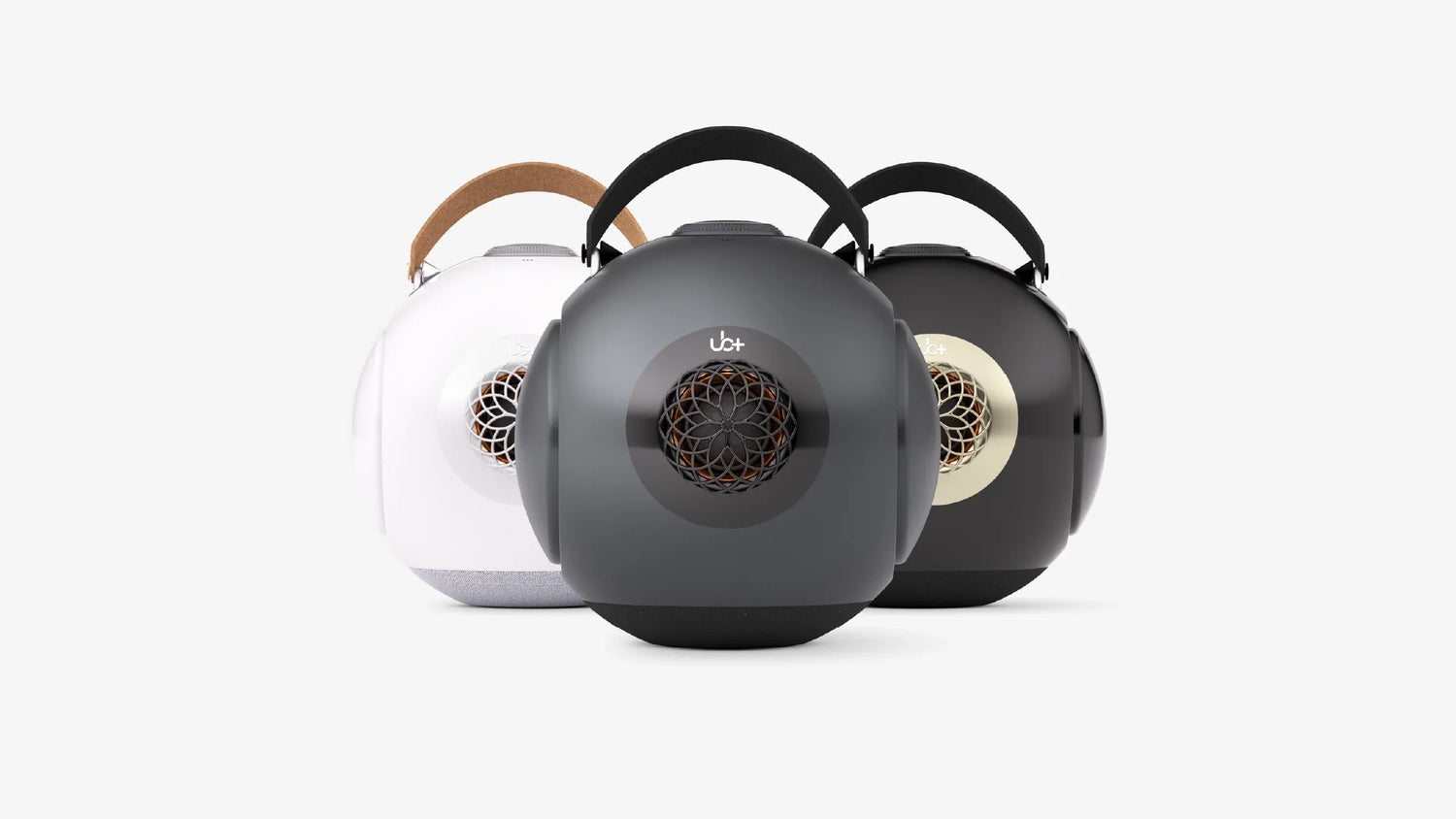
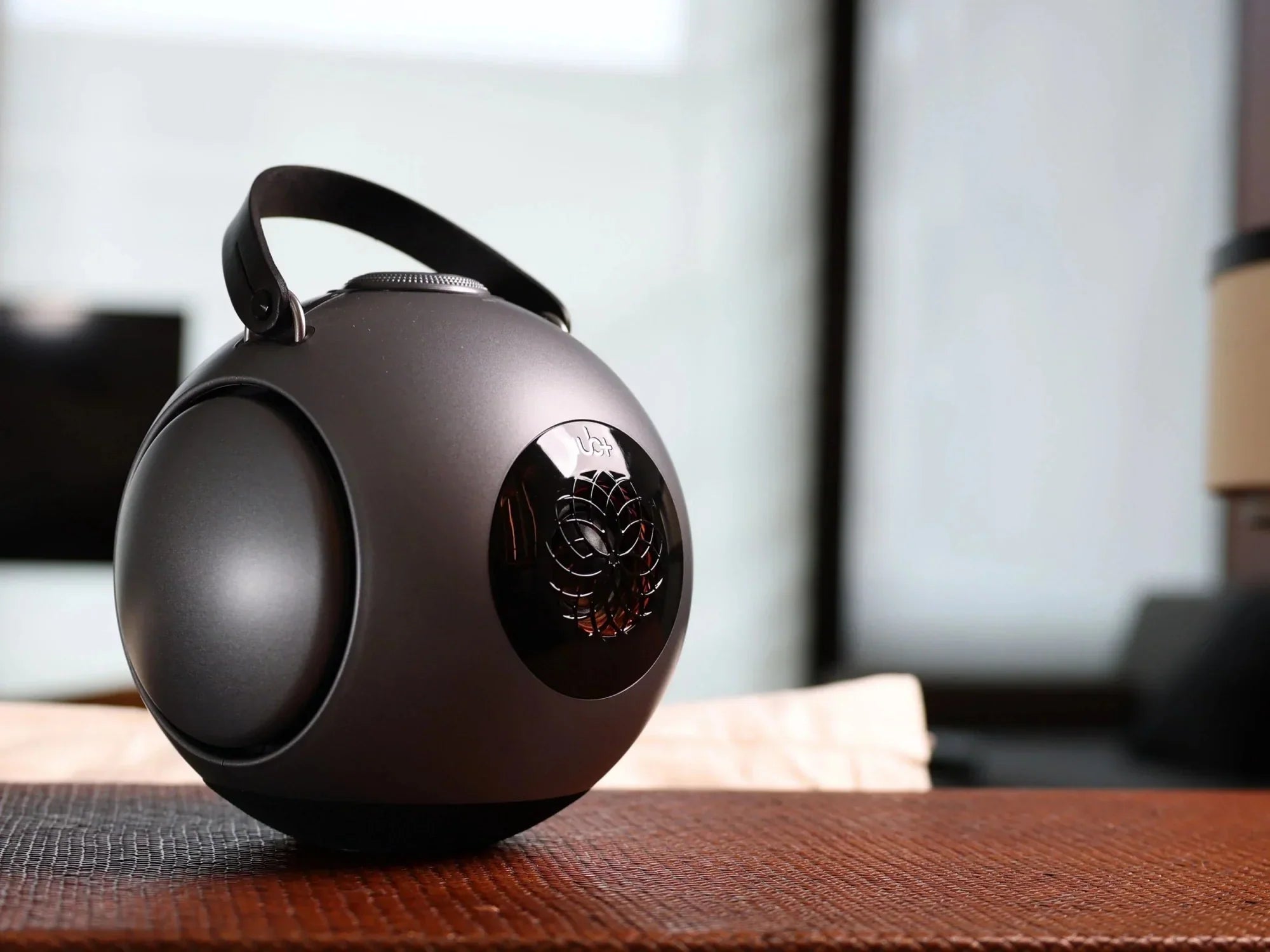
The UB+ dB1 DoubleBass approaches cabinet design differently through its Helmholtz-inspired spherical acoustic chamber.
Instead of treating the enclosure simply as a housing, the spherical design actively contributes to sound quality by promoting more even pressure distribution and reducing internal standing waves.
The result is cleaner bass, improved tonal balance, and a more natural listening experience.
Engineering Bass Through Physics
Many compact speakers rely heavily on digital signal processing to simulate larger bass output.
While DSP can enhance low frequencies, excessive processing sometimes produces bloated or artificial bass.
The UB+ dB1 emphasizes mechanical bass amplification.
Its centrally positioned downward-firing driver works together with dual symmetrical passive radiators, allowing bass to develop naturally through acoustic physics rather than aggressive electronic enhancement.
These passive radiators provide approximately 3.5× the passive radiator surface area of the active woofer, allowing the speaker to move significantly more air than many similarly sized designs.
This engineering philosophy produces bass that feels deeper, tighter, and more controlled.
Premium Driver Technology
High-quality components remain essential regardless of the wireless technology used.
The UB+ dB1 incorporates premium engineering features including:
- 90 mm neodymium magnet
- 35 mm long-stroke voice coil
- 20 mm piston movement
- Aluminum shorting ring
- Extra-wide 18 mm surround
Together, these components improve efficiency, reduce distortion, and maintain precise driver control across a broad frequency range.
Whether connected through Bluetooth or another source, these mechanical advantages contribute directly to better sound reproduction.
Bluetooth vs Wi-Fi at a Glance
|
Feature |
Bluetooth Speaker |
Wi-Fi Speaker |
|
Initial Setup |
Very Easy |
More Complex |
|
Portability |
Excellent |
Limited |
|
Internet Required |
No |
Usually Yes |
|
Travel Friendly |
Excellent |
Poor |
|
Multi-Room Audio |
Limited |
Excellent |
|
Ease of Pairing |
Excellent |
Moderate |
|
Outdoor Use |
Excellent |
Depends on Network |
|
Everyday Convenience |
Excellent |
Good |
Choosing the Right Technology Starts with Your Lifestyle
Neither Bluetooth nor Wi-Fi is universally better.
Instead, the right choice depends on how you plan to use your speaker.
If you value flexibility, portability, and instant connectivity, a premium Bluetooth speaker remains one of the most practical solutions available. Combined with advanced acoustic engineering, thoughtful cabinet design, and premium driver components, modern Bluetooth speakers are capable of delivering exceptional sound quality without sacrificing convenience.
Does Wi-Fi Always Sound Better?
One of the biggest myths in wireless audio is that Wi-Fi automatically delivers superior sound quality. While Wi-Fi has the advantage of higher bandwidth and can support lossless or high-resolution streaming services, this does not guarantee a better listening experience.
The speaker itself remains the most important factor.
Imagine streaming a lossless audio file to a poorly designed speaker. Despite the excellent source quality, the sound may still lack clarity, dynamics, and accurate bass because the drivers, cabinet, and tuning limit its performance.
Conversely, a premium Bluetooth speaker with outstanding acoustic engineering can produce remarkably detailed, natural sound that many listeners will prefer over a mediocre Wi-Fi speaker.
When evaluating sound quality, consider the complete system:
- Driver quality
- Cabinet construction
- Amplifier tuning
- Distortion control
- Acoustic engineering
- Wireless technology
Wireless transmission is only one part of the equation.
Battery Life and Everyday Convenience
Battery-powered speakers have become the preferred choice for modern lifestyles. Whether you're working in a home office, relaxing on the patio, or traveling, portability offers freedom that fixed home audio systems cannot match.
A rechargeable bluetooth speaker allows you to enjoy music wherever you are without depending on power outlets or network coverage.
Wi-Fi speakers, on the other hand, are often designed as stationary products. Many require continuous power and are intended to remain connected to a home network.
If flexibility is your priority, Bluetooth remains the more practical option.
Which Technology Is Better for Different Listening Scenarios?
Different lifestyles require different solutions.
Home Office
Bluetooth provides fast pairing with laptops, tablets, and smartphones, making it ideal for switching between work calls and music.
Travel
Bluetooth clearly wins. No internet connection is required, making it perfect for hotels, vacation rentals, and outdoor adventures.
Living Room
Either technology can perform well. If you want a dedicated multi-room ecosystem, Wi-Fi offers additional flexibility. If you value simplicity and portability, Bluetooth remains an excellent choice.
Outdoor Listening
Bluetooth is generally the better option because it operates independently of a wireless network.
Why Engineering Matters More Than Connectivity
Whether audio reaches the speaker through Bluetooth or Wi-Fi, it still needs to be reproduced accurately.
This is where engineering makes the greatest difference.
The UB+ dB1 DoubleBass demonstrates this philosophy through its innovative acoustic architecture.
Instead of using a conventional rectangular enclosure, it features a Helmholtz-inspired spherical acoustic chamber. The spherical form helps minimize standing waves and distributes internal air pressure more evenly, allowing the driver to operate under more controlled conditions.
At the center of the enclosure is a downward-firing driver that directs sound energy into the chamber before interacting with the passive radiator system.
Unlike many compact speakers that depend heavily on digital processing to create artificial bass, the dB1 uses mechanical bass amplification. This approach allows bass to develop naturally through acoustic design rather than software enhancement.
Its dual symmetrical passive radiators provide approximately 3.5× the passive radiator surface area of the active woofer, enabling impressive air movement from a compact cabinet while maintaining excellent control.
The opposing radiator arrangement also creates self-cancelling vibration architecture, reducing cabinet movement and preserving clarity.
Premium Components Behind the Performance
Great engineering requires great components.
The UB+ dB1 includes:
- 90 mm neodymium magnet for efficient magnetic control.
- 35 mm long-stroke voice coil for extended cone travel.
- 20 mm piston movement to move substantial air.
- Aluminum shorting ring that reduces distortion.
- Extra-wide 18 mm surround for stable, controlled movement.
Together, these features help produce balanced sound with low distortion, making the speaker equally suitable for music, movies, podcasts, and work-from-home environments.
Which Wireless Technology Fits You?
|
Listening Need |
Bluetooth Speaker |
Wi-Fi Speaker |
|
Travel |
⭐⭐⭐⭐⭐ |
⭐ |
|
Home Office |
⭐⭐⭐⭐⭐ |
⭐⭐⭐⭐ |
|
Outdoor Listening |
⭐⭐⭐⭐⭐ |
⭐⭐ |
|
Easy Setup |
⭐⭐⭐⭐⭐ |
⭐⭐⭐ |
|
Multi-Room Audio |
⭐⭐ |
⭐⭐⭐⭐⭐ |
|
Battery Operation |
⭐⭐⭐⭐⭐ |
⭐⭐ |
|
Everyday Flexibility |
⭐⭐⭐⭐⭐ |
⭐⭐⭐ |
|
Permanent Home Installation |
⭐⭐⭐ |
⭐⭐⭐⭐⭐ |
Buying Checklist
Before deciding between Bluetooth and Wi-Fi, consider these questions:
- Will you use the speaker in different rooms?
- Do you travel frequently?
- Do you need battery-powered portability?
- Is quick pairing more important than multi-room playback?
- Are you looking for premium sound quality rather than simply more features?
- Do you value engineering and build quality over marketing specifications?
For many users, these questions make the decision surprisingly simple. If portability, convenience, and everyday versatility matter most, Bluetooth is often the better long-term investment.
Frequently Asked Questions
1. Is a Bluetooth speaker good enough for everyday music listening?
Absolutely. Modern Bluetooth technology delivers excellent audio quality for most listeners. When paired with a well-engineered speaker, Bluetooth provides impressive clarity, stable connectivity, and convenient portability for everyday use.
2. Should I choose Wi-Fi if I only listen at home?
Not necessarily. If you want multi-room audio throughout your house, Wi-Fi is a strong option. However, if you mainly listen in one room and appreciate the flexibility to move your speaker anywhere, Bluetooth remains an excellent choice.
3. Does Bluetooth reduce sound quality?
Current Bluetooth technology has improved significantly over earlier versions. For the vast majority of users, the differences are minimal, especially when the speaker itself is engineered to reproduce sound accurately.
4. Why is cabinet design more important than wireless technology?
Wireless technology determines how audio reaches the speaker, but the cabinet, drivers, and acoustic tuning determine how that audio is reproduced. Better engineering consistently delivers better sound regardless of the connection method.
5. Can a compact Bluetooth speaker replace a larger home audio system?
For many homes, yes. A premium compact speaker with advanced acoustic engineering can provide room-filling sound, deep bass, and excellent clarity while occupying far less space than traditional stereo systems.
Conclusion
The debate between Bluetooth and Wi-Fi speakers often focuses on connectivity, but real-world performance depends on much more than the wireless protocol. Convenience, portability, ease of use, and—most importantly—acoustic engineering all contribute to the listening experience.
For listeners who value flexibility, effortless setup, and premium sound from a compact design, a thoughtfully engineered Bluetooth speaker offers exceptional value. Features such as advanced driver technology, intelligent enclosure design, and vibration control have a far greater impact on everyday enjoyment than connection type alone.
Smarter Engineering Creates Better Sound
Choosing between Bluetooth and Wi-Fi is important—but choosing a speaker with exceptional engineering is even more important.
The UB+ dB1 DoubleBass is designed around a Helmholtz-inspired spherical acoustic chamber, downward-firing central driver, dual symmetrical passive radiators, and mechanical bass amplification to deliver powerful, natural sound from a compact enclosure. Combined with 3.5× passive radiator surface area, self-cancelling vibration architecture, a 90 mm neodymium magnet, 35 mm long-stroke voice coil, 20 mm piston movement, aluminum shorting ring, and an 18 mm wide surround, it demonstrates how acoustic innovation can outperform conventional box-speaker design.
See which UB+ speaker best matches your room size, listening habits, and lifestyle.
Explore premium finishes designed to complement modern homes, workspaces, and entertainment areas.
View the latest specifications, availability, and pricing directly from UB+.
Because the best speaker isn't always the biggest one.
It's the one designed to move sound naturally.



Laisser un commentaire
Ce site est protégé par hCaptcha, et la Politique de confidentialité et les Conditions de service de hCaptcha s’appliquent.