
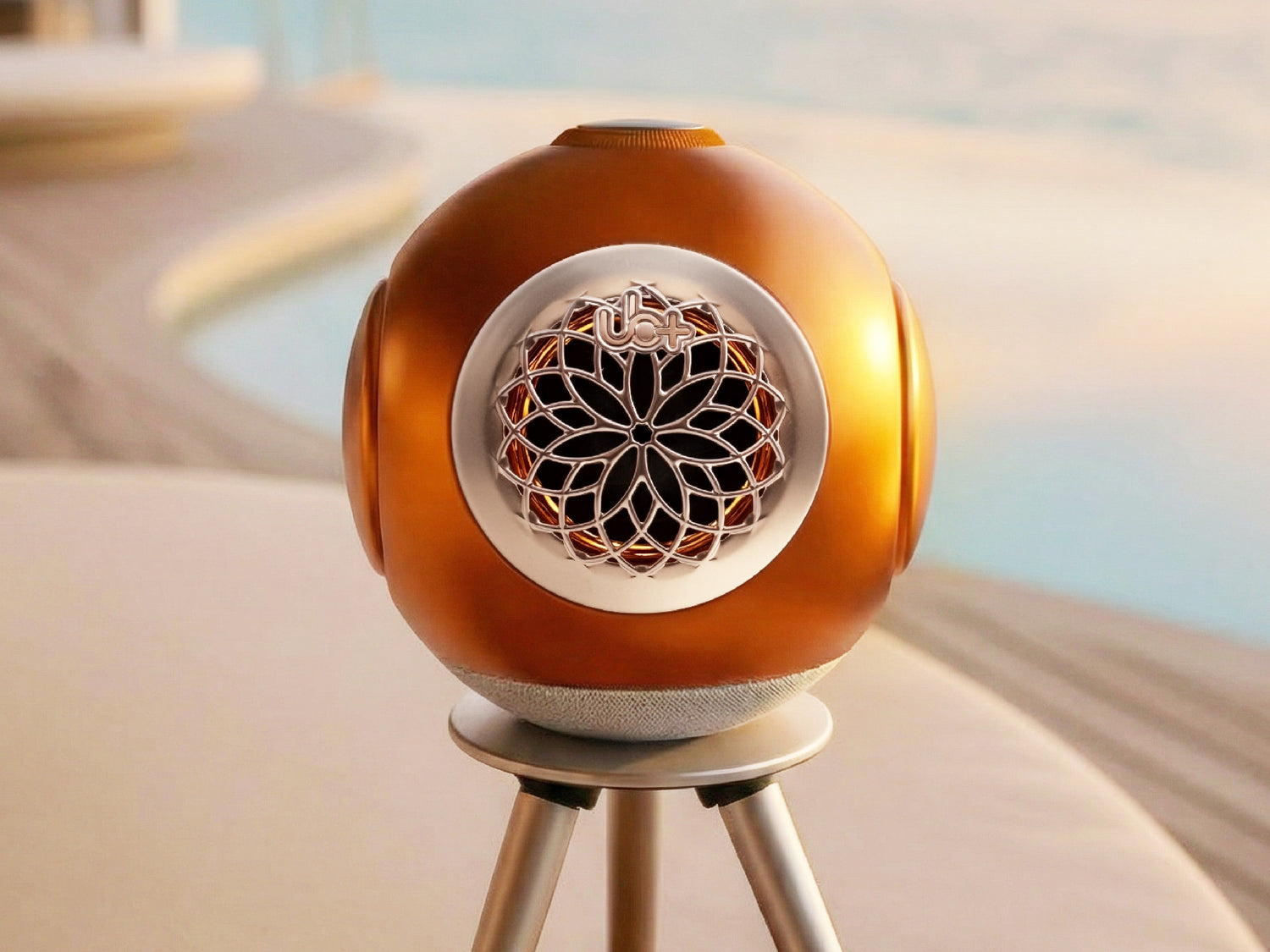
When people search for wireless speakers with good bass or the best audiophile bluetooth speakers, they usually compare specs wattage, frequency range, battery life. But one of the most important factors in sound quality is rarely discussed:
The shape of the speaker itself.
It might seem like a design choice. Rectangular boxes dominate the market because they are easy to manufacture and stack. But acoustically, shape is not neutral. It directly affects how sound waves behave inside the speaker and ultimately, how you hear music in your room.
This is where spherical and round designs begin to stand apart.
This guide explores how speaker shape influences:
- internal sound wave reflection
- resonance and distortion
- bass performance and efficiency
- sound dispersion in real spaces
We’ll also connect these principles to modern designs used in best audiophile speakers, including how spherical enclosures are redefining expectations for bluetooth speaker bass sound and compact systems like the smallest bass speaker category.
Why Speaker Shape Matters More Than Specs
A speaker is not just a driver pushing air. It is a complete acoustic system, where the enclosure plays an active role.
Every sound you hear is shaped by:
- how air moves inside the enclosure
- how waves reflect and interact
- how pressure builds and releases
This means the cabinet is not just a container it is part of the instrument.
And like any instrument, its shape defines its sound.
The Problem with Traditional Box Speakers
Most speakers use rectangular enclosures. While practical, this shape introduces inherent acoustic problems.
Parallel Surfaces and Standing Waves
Inside a box, sound waves bounce between parallel walls.
This creates:
- standing waves (reinforced frequencies)
- uneven pressure distribution
- frequency peaks and dips
In simple terms:
Some notes become too strong, while others disappear.
Internal Reflections and Phase Distortion
Flat surfaces reflect sound in predictable directions.
This leads to:
- delayed reflections
- phase interference
- blurred midrange clarity
This is why some speakers sound:
- muddy
- boomy
- or overly colored
Reactive Engineering Instead of Preventive Design
To fix these issues, manufacturers add:
- damping materials
- internal bracing
- digital correction (DSP)
But these are after-the-fact solutions.
They don’t remove the root cause the shape itself.
Spherical Design: Solving Problems at the Source
A spherical enclosure takes a completely different approach.
Instead of correcting problems, it prevents them from forming.
No Parallel Surfaces
A sphere has:
- no flat walls
- no opposing surfaces
This means:
- standing waves are minimized
- reflections are dispersed evenly
Even Pressure Distribution
Inside a sphere:
- air pressure builds uniformly
- resonance behaves predictably
This results in:
- smoother frequency response
- cleaner bass reproduction
- more natural tonal balance
Reduced Phase Distortion
Because reflections are scattered rather than focused:
- sound waves remain coherent
- phase alignment improves
This leads to:
- clearer vocals
- better instrument separation
- more accurate imaging
The Helmholtz Principle: Where Shape Meets Physics
Modern spherical designs often take inspiration from the Helmholtz resonator principle.
This classical acoustic concept works by:
- trapping air inside a chamber
- controlling how it moves in and out
- reinforcing specific low frequencies
When applied to speaker design:
- the enclosure becomes a tuned acoustic system
- bass is amplified mechanically
- efficiency increases without extra power
This is a key reason why some budget audiophile speakers with advanced design outperform larger, more powerful systems.
Internal Sound Wave Behavior: Box vs Sphere
To understand the difference, imagine sound waves moving inside each shape.
In a Box
- waves bounce back and forth
- reflections collide
- energy builds unevenly
In a Sphere
- waves spread outward evenly
- reflections disperse
- energy remains balanced
This fundamental difference shapes everything you hear.
Internal Acoustic Behavior
|
Feature |
Rectangular Speaker |
Spherical Speaker |
|
Internal Surfaces |
Parallel |
Non-parallel |
|
Standing Waves |
Strong |
Minimal |
|
Pressure Distribution |
Uneven |
Even |
|
Internal Reflections |
Focused |
Dispersed |
|
Phase Coherence |
Lower |
Higher |
|
Sound Character |
Colored |
Natural |
Why Shape Affects Bass Performance
Bass is the most demanding part of sound reproduction.
Low frequencies require:
- large air movement
- stable pressure
- controlled resonance
In box speakers:
- uneven pressure leads to boomy bass
- reflections distort low frequencies
In spherical speakers:
- pressure builds evenly
- resonance is smoother
- bass integrates naturally with mids
Mechanical Bass vs Digital Bass
Many compact speakers rely on DSP to create bass.
This involves:
- boosting low frequencies digitally
- simulating depth
But this often results in:
- distortion
- listening fatigue
- artificial sound
A well-designed spherical system uses:
- physical air movement
- controlled resonance
This creates bass that feels:
- deeper
- more natural
- more physical
Dual Passive Radiators: Enhancing Spherical Performance
Advanced spherical speakers often include dual passive radiators.
These components:
- respond to internal air pressure
- move without direct electrical input
In symmetrical designs:
- radiators are placed on opposite sides
- they move in equal and opposite motion
This creates:
- vibration cancellation
- stable enclosure behavior
- efficient energy transfer
3.5× Air Movement: Why Size Isn’t Everything
One of the most important innovations in modern compact speakers is increasing effective air movement.
By using larger passive radiator surfaces:
- more air is displaced
- bass becomes stronger
- distortion is reduced
This is how some designs achieve performance comparable to much larger speakers.
Downward-Firing Drivers: Using the Enclosure as an Instrument
Another innovation is the downward-firing driver.
Instead of projecting sound directly outward:
- it energizes the internal air volume
- pressure builds evenly
- sound is released through the system
This approach:
- improves efficiency
- reduces driver strain
- enhances bass extension
Sound Dispersion: Why Round Speakers Fill a Room Better
Speaker shape also affects how sound spreads into a room.
Traditional Speakers
- directional output
- narrow listening zone
- dependent on positioning
Spherical Speakers
- even sound distribution
- wider listening area
- consistent experience
This is especially important for:
- shared spaces
- background listening
- home environments
Sound Dispersion and Real-World Experience
|
Feature |
Traditional Speaker |
Spherical Speaker |
|
Sound Direction |
Forward |
360° |
|
Listening Zone |
Narrow |
Wide |
|
Room Coverage |
Uneven |
Even |
|
Placement Sensitivity |
High |
Low |
|
Movement Around Room |
Sound changes |
Sound stays consistent |
|
Listening Fatigue |
Higher |
Lower |
Why This Matters for Everyday Listening
Most people don’t sit in a fixed position.
They:
- move around
- multitask
- listen casually
A speaker that only sounds good in one spot is limiting.
A spherical design creates:
- a shared listening experience
- consistent sound across the room
- less need for adjustment
Compact Size vs Acoustic Performance
Many people search for the smallest bass speaker expecting both portability and performance.
The challenge is:
- small size limits air movement
- limited volume reduces bass capability
But with efficient design:
- air movement can be amplified
- resonance can be controlled
- performance can be improved
This is how compact systems can compete with larger ones.
Why Audiophile Design Is Moving Beyond the Box
In high-end audio, there is a growing shift toward:
- curved enclosures
- non-parallel surfaces
- resonance control
This reflects a deeper understanding:
Sound quality is not just about components it’s about how those components interact with space.
Choosing the Right Speaker Shape for You
When evaluating speakers, consider:
- your room size
- listening habits
- placement flexibility
If you value:
- natural sound
- balanced bass
- wide dispersion
then enclosure shape becomes a critical factor.
Final Thoughts: Shape Is Sound
Speaker shape is not a cosmetic detail.
It is a fundamental acoustic decision that affects:
- how sound waves behave
- how bass is produced
- how audio fills a space
Spherical designs represent a shift toward:
- physics-driven sound
- efficient air movement
- natural listening experiences
Whether you’re exploring best audiophile bluetooth speakers or searching for wireless speakers with good bass, understanding enclosure geometry gives you a deeper way to evaluate performance.
Explore the Difference
→ Compare dB1 vs dB Mini
→ See color options
→ Check current price
Because great sound doesn’t just come from power or specs.
It comes from how sound moves and the shape that allows it to move naturally.




Laisser un commentaire
Ce site est protégé par hCaptcha, et la Politique de confidentialité et les Conditions de service de hCaptcha s’appliquent.