

Small Bluetooth speakers face a fundamental acoustic challenge: producing convincing low-frequency sound from a compact enclosure. Traditional ported designs use an opening to move air and reinforce bass, while passive-radiator systems use an additional unpowered diaphragm that responds to internal air pressure. Both approaches can improve low-frequency output, but their performance depends on enclosure volume, tuning, driver movement, and the way the complete system is engineered.
The discussion around Passive Radiators vs Ported Boxes is especially important in portable audio because limited cabinet space leaves little room for inefficient acoustic designs. A speaker needs to move enough air to reproduce bass while controlling distortion, unwanted resonance, and mechanical vibration. Simply adding a larger port or a passive radiator does not guarantee better sound.
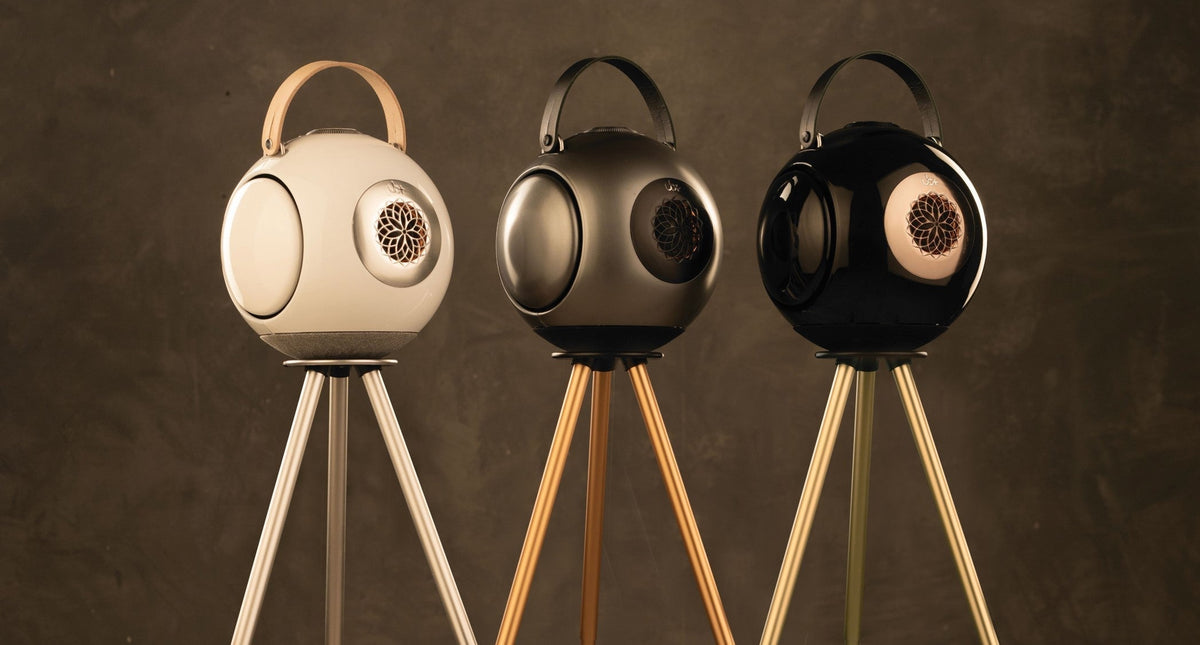
UB+ approaches this challenge through different product designs, including the spherical acoustic architecture of the UB+ dB1 DoubleBass. Its patented spherical chamber is inspired by the Helmholtz resonator principle and works with two symmetrical passive-radiator plates to manage internal air pressure and low-frequency movement.
Understanding the differences between these acoustic systems makes it easier to evaluate portable speakers based on their actual engineering rather than appearance or marketing claims.
How a Ported Speaker Produces Bass

A ported speaker uses an opening in its enclosure to create a tuned acoustic system. The air inside the cabinet interacts with the air mass moving through the port, producing a resonance that can reinforce output around a selected low-frequency range.
This arrangement is commonly called a bass-reflex design.
When the main driver moves, it changes the pressure inside the enclosure. The air inside the port responds to those pressure changes, contributing additional sound output near the enclosure's tuning frequency. Instead of relying entirely on the driver to produce low-frequency energy, the port helps the system generate more output around its designed operating range.
The advantages include:
- Improved bass efficiency: A correctly tuned port can increase low-frequency output without requiring the driver to produce all the acoustic energy independently.
- Lower driver excursion near tuning: The port contributes more output around its operating frequency, potentially reducing the driver's movement in that region.
- Relatively simple construction: Ported enclosures can be manufactured using established acoustic design methods.
- Flexible tuning: Port dimensions and enclosure volume can be adjusted to target different bass characteristics.
However, ported designs also have limitations.
A port must have an appropriate diameter and length for the required tuning frequency. In a small speaker, available internal space can make this difficult. A narrow port may produce turbulence or audible air noise when the speaker operates at higher output levels.
Port tuning also affects performance outside its intended range. Below the tuning frequency, the driver can lose acoustic support and experience increased excursion. This may contribute to distortion or mechanical stress if the system is driven beyond its intended limits.
The enclosure itself also remains an important part of the equation. Internal reflections, panel vibration, and poorly controlled resonances can affect the final sound.
For a broader explanation of enclosure behavior, see Understanding the Science Behind Premium Audio Technology.
How Passive Radiators Work

A passive radiator performs a similar acoustic role to a port, but it uses a moving diaphragm instead of a column of air inside an opening.
Unlike an active speaker driver, a passive radiator has no voice coil or electrical connection. It responds mechanically to pressure changes created by the powered driver inside the enclosure.
As the active driver moves, it compresses and releases the air inside the cabinet. This pressure causes the passive radiator to move. Its movement contributes additional low-frequency output and helps the speaker produce bass without requiring a conventional port.
A passive-radiator system typically includes:
- An active driver that converts electrical signals into mechanical movement.
- An enclosed air volume that responds to the driver's movement.
- One or more passive diaphragms that move in response to internal pressure.
- A suspension and moving mass designed around the target acoustic tuning.
This arrangement is useful for compact speakers because the passive radiator can provide low-frequency reinforcement without requiring a long port tube.
It can also avoid some of the airflow noise associated with small, narrow ports. However, passive radiators have their own operating limits. Their available excursion, suspension design, moving mass, and tuning determine how effectively they perform.
A passive radiator is not automatically superior to a port. Both systems require careful engineering, and neither can overcome the physical limits of enclosure volume and driver displacement.
For a more detailed technical explanation, read How Passive Radiators Work in Bluetooth Speakers.
 Radiators vs Ported Boxes: The Main Acoustic Differences
The most useful way to compare these systems is to examine how they move air, how they behave inside compact enclosures, and what limitations appear at higher playback levels.
|
Design factor |
Ported enclosure |
Passive-radiator enclosure |
|
Bass reinforcement |
Uses air movement through a tuned opening |
Uses movement of an unpowered diaphragm |
|
Main components |
Enclosure, active driver, tuned port |
Enclosure, active driver, passive radiator |
|
Internal space |
Requires room for an appropriately sized port |
Requires space and mounting area for the radiator |
|
Airflow noise |
Can occur around narrow or highly loaded ports |
Avoids conventional port airflow noise |
|
Mechanical limits |
Port airflow and driver excursion are important |
Radiator excursion and suspension limits are important |
|
Tuning |
Depends on port dimensions and enclosure volume |
Depends on radiator mass, suspension, and enclosure volume |
|
Compact-speaker application |
Can be challenging when the required port is too long or narrow |
Can offer more flexible packaging in limited space |
|
Performance outcome |
Depends on port design and system integration |
Depends on radiator design and system integration |
Neither architecture guarantees deeper bass, greater loudness, or lower distortion. The final result depends on how the active driver, enclosure, acoustic tuning, and signal processing work together.
For readers comparing different enclosure approaches, Passive Radiators vs Ported Boxes: Spherical Speaker Bass provides additional context on the relationship between enclosure geometry and low-frequency performance.
Why Enclosure Shape Matters in Small Speakers

The shape of a speaker enclosure influences how sound behaves inside it. Conventional rectangular cabinets contain parallel surfaces that can support internal standing-wave patterns. Depending on enclosure dimensions and damping, these patterns may produce uneven internal pressure and unwanted resonances.
A spherical enclosure changes this internal geometry.
Because a sphere does not have the same arrangement of parallel opposing walls as a conventional rectangular cabinet, it changes the distribution of internal reflections and resonance patterns. This does not eliminate every standing wave or resonance, but it provides a different acoustic environment for the driver and internal air volume.
A spherical design also allows sound to disperse more evenly around the enclosure when the driver and acoustic openings are appropriately arranged.
Important design considerations include:
- Internal pressure distribution: Enclosure geometry affects how pressure changes propagate through the cabinet.
- Internal reflections: Curved surfaces change the reflection patterns compared with parallel-wall enclosures.
- Resonance behavior: Different enclosure dimensions and shapes produce different acoustic resonances.
- External dispersion: Driver orientation and enclosure geometry influence how sound radiates into the surrounding space.
- Mechanical stability: The shape and mounting arrangement affect how forces are distributed through the cabinet.
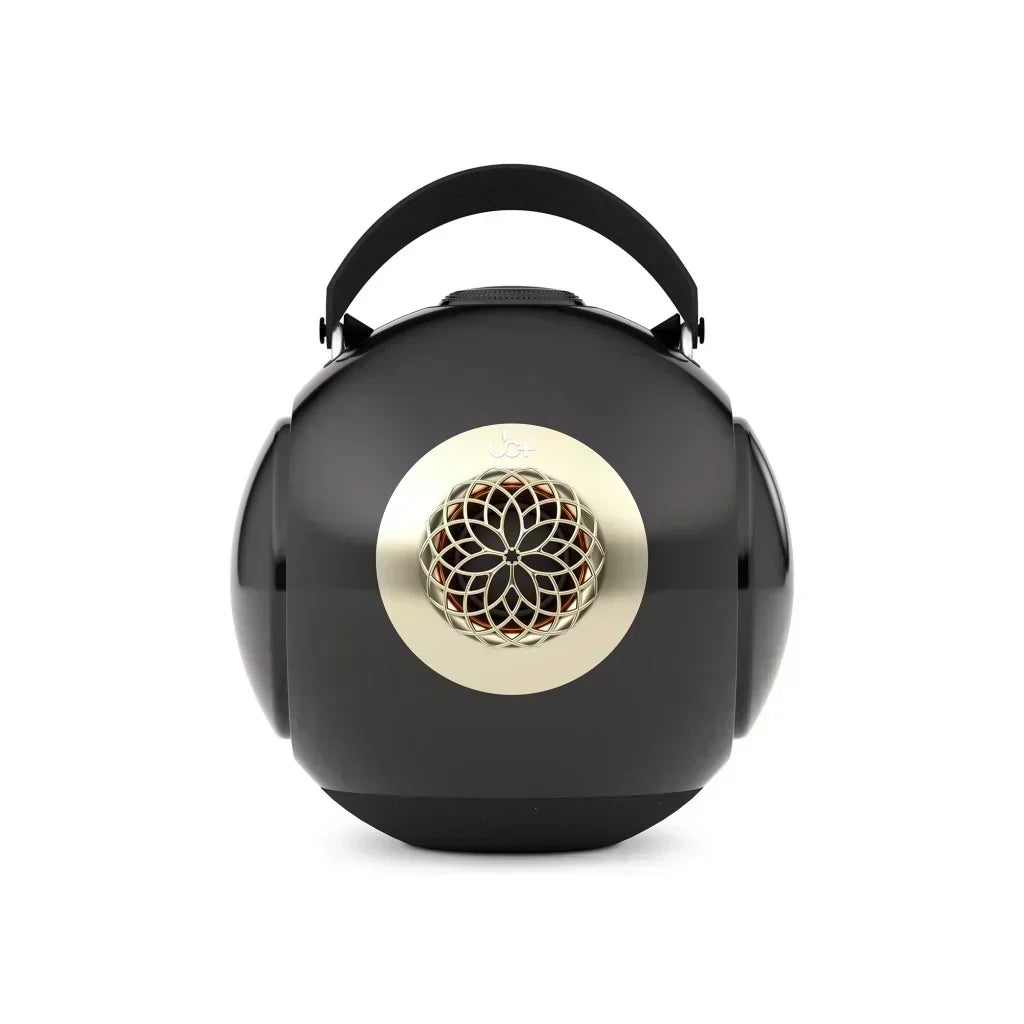
The UB+ dB1 DoubleBass uses a true spherical acoustic chamber inspired by the Helmholtz resonator principle. The concept uses the relationship between an enclosed air volume and a controlled opening to influence acoustic resonance.
The purpose is not simply to create a round speaker. The chamber is part of the acoustic system, designed to work with the driver and passive radiators rather than acting as a decorative enclosure.
For more information about the relationship between spherical geometry and portable audio, see Spherical Bluetooth Speaker Design: DoubleBass.
How the UB+ dB1 DoubleBass Combines Spherical Architecture and Passive Radiators

The UB+ dB1 DoubleBass combines a spherical acoustic chamber with a central 4.5-inch mid-bass driver and two passive-radiator plates mounted opposite each other.
This arrangement is different from a conventional small ported cabinet. Instead of using a narrow opening to provide bass reinforcement, the system uses internal air pressure to drive two symmetrical passive radiators.
The central driver generates the pressure changes inside the spherical chamber. Those changes cause both passive-radiator plates to move outward and inward in response to the audio signal.
The combined surface area of the two passive radiators is approximately 3.5 times the area of the active woofer. This larger radiating area gives the system additional capacity to move air, subject to the radiators' excursion and the overall tuning of the enclosure.
The Helmholtz-Inspired Spherical Chamber
The chamber draws inspiration from the Helmholtz resonator principle, in which an enclosed air volume interacts with air moving through a controlled opening. This relationship can create a resonant response at a particular frequency.
In the dB1, the spherical chamber is a central part of the acoustic architecture. Its geometry changes the way internal pressure and reflections behave compared with a conventional box-shaped enclosure.
The engineering objective is to manage the interaction between the active driver, enclosed air, and passive radiators so that low-frequency output remains controlled.
This matters because a compact speaker cannot rely on enclosure size alone to create convincing bass. The internal air volume, moving surfaces, driver characteristics, and acoustic tuning must work as one system.
Symmetrical Passive-Radiator Movement
The two passive-radiator plates are mounted on opposite sides of the enclosure. Their symmetrical arrangement is intended to counterbalance certain mechanical forces created during operation.
When the radiators move in opposite directions, some reaction forces can counteract one another. This self-balancing approach can reduce certain forms of enclosure movement and transmitted vibration, although it does not eliminate all vibration under every operating condition.
The design offers several potential advantages:
- More effective use of passive-radiator surface area.
- Mechanical bass reinforcement without a conventional narrow port.
- Symmetrical movement intended to reduce certain cabinet-reaction forces.
- A spherical enclosure architecture designed around internal pressure behavior.
- A coordinated acoustic system rather than an isolated bass component.
The principle behind the design can be summarized simply: most speakers try to push harder. dB1 lets air do the work.
Driver Engineering and Signal Control
The dB1's active driver uses a 4.5-inch woofer with an oversized 90mm neodymium magnet, a 35mm long-stroke voice coil, approximately 20mm of piston movement, an aluminum shorting ring, and an extra-wide 18mm surround.
These components contribute to the driver's ability to manage movement and operate within the intended acoustic system.
Digital signal processing also plays a role. DSP supports response shaping, tonal balance, and driver protection. The objective is to complement the mechanical acoustic design, not to suggest that electronics alone create the bass performance.
The dB1 is specified with a frequency range of approximately 40Hz–20kHz and a maximum SPL of approximately 93dB. Actual results depend on measurement conditions, placement, signal content, and operating level.
You can explore the complete design on the UB+ dB1 DoubleBass product page.
Why Mechanical Bass Reinforcement Matters
Bass reproduction requires moving air. At low frequencies, producing meaningful sound pressure from a compact enclosure can require substantial driver movement.
A small speaker with limited radiating area may need greater excursion to generate the desired output. As movement increases, the driver approaches its mechanical and thermal limits. This can affect distortion, compression, and overall sound quality.
Mechanical bass reinforcement provides another way to increase low-frequency output. A passive radiator uses pressure inside the enclosure to move an additional diaphragm, allowing the system to share the work of producing bass.
The distinction is important: adding more amplifier power is not the same as improving acoustic efficiency.
A well-integrated passive-radiator system can contribute useful output around its tuning range without asking the active driver to do everything. However, the radiator must have sufficient excursion and must be matched correctly to the enclosure and active driver.
In the dB1, the combination of the spherical chamber and two large symmetrical passive radiators is intended to support controlled low-frequency reproduction while managing mechanical forces.
For more background on the relationship between low-frequency output and speaker performance, read Bass Extension Explained: The Hz Guide to Speakers.
What Happens When Small Speakers Are Pushed Too Hard?
A compact speaker can sound impressive at moderate volume but behave differently when pushed toward its limits. This is where enclosure design, driver excursion, and acoustic tuning become especially important.
Several problems can appear when a speaker is operating beyond its intended range.
Port turbulence: A narrow port may produce audible air noise when airflow becomes excessive.
Driver over-excursion: Below the tuning frequency of a ported or passive-radiator system, the active driver may experience increased movement. If the signal is too demanding, distortion or mechanical stress can result.
Passive-radiator limitations: A passive radiator has a finite movement range. If it reaches its mechanical limits, distortion and reduced output quality can occur.
Cabinet vibration: Mechanical forces from the driver and enclosure can cause unwanted movement or vibration, particularly in lightweight portable designs.
Thermal compression: Extended high-output operation can heat the voice coil, affecting its electrical and mechanical behavior.
These limitations explain why a speaker's bass performance cannot be judged from driver diameter or passive-radiator size alone.
A complete evaluation should consider:
- Frequency response and its measurement tolerance.
- Maximum output at relevant frequencies.
- Driver and radiator excursion.
- Distortion at different playback levels.
- Enclosure resonance and vibration.
- DSP behavior and driver protection.
For a deeper explanation of unwanted artifacts, see Speaker Distortion Explained.
Choosing a Compact Speaker: What Should You Look For?
When comparing portable speakers, it is useful to look beyond whether a model uses a port, passive radiator, or spherical enclosure. The most important question is how well the complete design performs for the intended listening environment.
1. Examine the Bass Architecture
Look for a clear explanation of how the speaker produces low-frequency output.
- A ported design should have a properly engineered opening and enclosure tuning.
- A passive-radiator design should use a radiator matched to the driver and cabinet volume.
- A more unusual enclosure shape should have a clear acoustic purpose.
- Marketing descriptions should not replace measurable performance information.
2. Consider Enclosure Size and Placement
A speaker's bass response can change depending on where it is placed. Walls, corners, shelves, and tables influence the sound reaching the listener.
A speaker designed for portable use may behave differently in an open outdoor environment than it does in a small room.
3. Check Distortion and Output
A speaker that produces strong bass at moderate volume may not maintain the same quality at maximum output. Look for distortion measurements or credible listening tests at different volume levels.
4. Evaluate the Entire Listening Experience
Bass is only one part of sound reproduction. Midrange clarity, treble balance, stereo imaging, dispersion, and tonal consistency all contribute to the listening experience.
A well-designed portable speaker should provide a balanced presentation rather than relying on exaggerated low-frequency output.
5. Match the Product to Your Priorities
The UB+ dB1 DoubleBass is the model to examine when spherical acoustic architecture and its passive-radiator system are central to your buying decision.
For a more compact portable option, the UB+ dB Mini offers a different product direction. Its compact design makes it worth considering when portability and everyday convenience matter more than selecting a speaker specifically for the dB1's spherical acoustic system.
The dB Mini should be evaluated on its own design and specifications rather than assumed to share the dB1's chamber or radiator architecture.
UB+ dB1 DoubleBass vs UB+ dB Mini
Both models belong to the UB+ portable speaker range, but they serve different buying priorities. The dB1 is the relevant choice for listeners interested in its spherical acoustic chamber and symmetrical passive-radiator arrangement. The dB Mini is a compact alternative for people who prioritize a smaller portable format.
|
Comparison factor |
UB+ dB1 DoubleBass |
UB+ dB Mini |
|
Product design |
Spherical acoustic architecture |
Compact portable design |
|
Acoustic approach |
Helmholtz-inspired spherical chamber with two symmetrical passive radiators |
Separate model design; do not assume the dB1 architecture |
|
Primary buying consideration |
Interest in its specialized bass architecture |
Compact everyday portability |
|
Maximum playback time |
Up to 20 hours |
Up to 20 hours |
|
Best evaluation approach |
Examine its chamber, driver, and passive-radiator integration |
Review its own product specifications and intended use |
You can compare both products directly:
Frequently Asked Questions
Are passive radiators better than ported enclosures?
Neither system is universally better. Passive radiators can be useful when a conventional port would be too long or narrow for a compact enclosure. Ported designs can also deliver excellent bass when correctly engineered. The result depends on tuning, enclosure volume, driver performance, and operating limits.
Do passive radiators make a speaker produce deeper bass?
They can help reinforce low-frequency output around the system's tuning range. However, a passive radiator does not automatically extend bass response to lower frequencies. Its performance depends on moving mass, suspension, excursion, enclosure volume, and integration with the active driver.
Why do some portable speakers use two passive radiators?
Two radiators can provide additional radiating surface area and allow designers to distribute mechanical movement across the enclosure. In a symmetrical arrangement, opposing movement can also counterbalance certain reaction forces. The actual benefit depends on the complete mechanical and acoustic design.
What is the benefit of a spherical speaker enclosure?
A spherical enclosure changes the internal reflection and resonance behavior compared with a conventional rectangular cabinet. It also allows designers to approach external sound dispersion differently. It does not eliminate all internal resonances, but it offers another way to manage enclosure acoustics.
Does the UB+ dB1 DoubleBass use DSP?
Yes. DSP supports tonal balance, response shaping, and driver protection. Its role complements the mechanical acoustic system rather than replacing the spherical chamber and passive-radiator design.
Explore the UB+ Approach to Compact-Speaker Bass
Ported enclosures and passive-radiator systems solve a similar acoustic problem through different mechanical approaches. The right design depends on how effectively it manages air movement, driver excursion, enclosure resonance, and vibration.
The UB+ dB1 DoubleBass is particularly relevant to this discussion because its spherical chamber and symmetrical passive-radiator arrangement are designed as one integrated acoustic system. For listeners interested in a compact speaker with a different design priority, the UB+ dB Mini offers another option within the range.
Explore the UB+ dB1 DoubleBass to review its acoustic architecture, playback features, and current product details. If portability is your main consideration, compare it with the UB+ dB Mini before choosing the model that best fits your listening habits.


Commenta
Questo sito è protetto da hCaptcha e applica le Norme sulla privacy e i Termini di servizio di hCaptcha.