
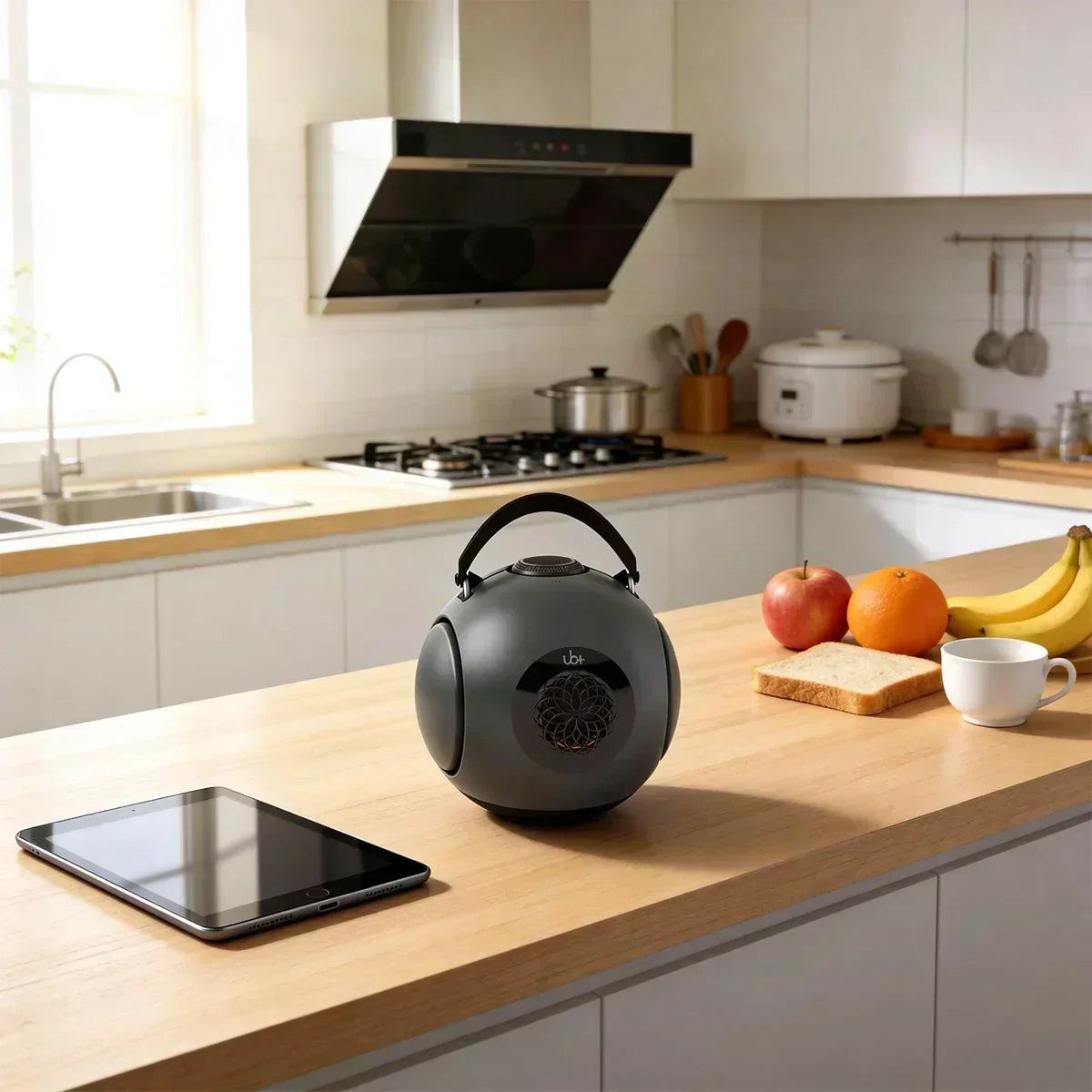
A speaker can look impressive on a product page, but its real character becomes clear when it enters an actual room. A desk, apartment, bedroom, kitchen, studio, or outdoor balcony can all change how sound is experienced.
That is why choosing a portable Bluetooth speaker is not simply about comparing battery life, wattage, or driver size. The relationship between the speaker, its enclosure, and the surrounding space can have just as much influence on everyday listening.
The UB+ dB1 DoubleBass takes a particularly different approach to that relationship. Its true spherical acoustic chamber, Helmholtz-inspired design, centrally positioned mid-bass driver, and dual symmetrical passive radiators are designed as one mechanical acoustic system. Rather than treating the enclosure as a container for the electronics, the design makes the enclosure itself part of the sound-producing architecture.
That makes the dB1 interesting in real environments where people do not always sit in one fixed listening position.
A home office may need even background sound. A small apartment may need controlled bass without taking over the room. An open-plan living space may benefit from broader sound distribution. A balcony may require portability and battery power.
These ten room scenarios show how different environments can influence the way a speaker is used and why acoustic design matters beyond the specification sheet.
Why Real Rooms Matter More Than a Specification Sheet

Speaker specifications provide useful information, but they cannot describe the entire listening experience.
The same speaker can sound different when moved from a desk to a shelf, from an open room to a corner, or from a furnished apartment to an open outdoor space. Walls reinforce certain frequencies. Furniture absorbs others. Hard surfaces create reflections, while soft materials reduce them.
This is the basic reason room acoustics matter.
For a deeper explanation of how the surrounding environment changes perceived sound, see Room Acoustics Basics: Why the Same Speaker Sounds Different.
The speaker itself is still the starting point. Its enclosure geometry, driver position, bass architecture, and dispersion pattern determine how it interacts with that environment.
The dB1 approaches this through a spherical enclosure rather than a conventional rectangular cabinet. The internal chamber is designed around more uniform pressure distribution, while the two passive radiators work in opposing directions to help balance mechanical forces.
The result is an acoustic system designed around air movement rather than simply increasing electronic bass processing.
The Minimalist Home Office

A home office is one of the easiest places to notice the difference between sound that is merely present and sound that integrates naturally into a space.
Desks tend to have hard surfaces. Monitors, walls, shelves, and flooring can all contribute reflections. At the same time, a speaker that is too large can become visually distracting in a compact workspace.
A spherical speaker can take a different role.
Placed on a desk or nearby surface with sufficient open space around it, the dB1 DoubleBass provides broad sound distribution rather than requiring the listener to remain directly in front of the enclosure.
Its symmetrical passive-radiator architecture also helps reduce unwanted cabinet movement. Instead of allowing bass energy to produce unnecessary enclosure vibration, the opposing radiators move symmetrically as part of the acoustic system.
For people building a clean workspace around both appearance and function, a related guide on minimalist desk setups and powerful sound offers additional placement considerations.
The important point is not that every desk needs a spherical speaker. It is that the physical design of the speaker should match how the space is actually used.
The Small Apartment Living Room

Small apartments create a difficult acoustic combination.
There may be little distance between a speaker and a wall. Furniture can limit placement options, and corners can reinforce bass more strongly than expected.
This is where a compact speaker has to do more than simply produce volume.
The dB1's spherical chamber and mechanical bass architecture are designed to produce controlled low-frequency output without depending entirely on aggressive digital bass enhancement. Its dual passive radiators have a combined surface area approximately 3.5 times the area of the active woofer, allowing the system to move a significant amount of air.
That does not eliminate room acoustics. A corner will still behave like a corner, and a wall will still reinforce low frequencies. But the speaker's own mechanical behavior becomes part of the equation.
For listeners dealing with limited floor space, the existing guide to portable Bluetooth speakers for small apartments provides a useful companion to this discussion.
In a small room, the goal is rarely maximum volume. It is usually a combination of useful bass, clear vocals, manageable reflections, and flexible placement.
The Open-Plan Loft
Large open spaces create almost the opposite problem.
Instead of too much reinforcement, sound can spread into a larger area before reaching listeners. A strongly directional speaker may sound convincing directly in front of it while becoming less consistent as people move around.
This is where the dB1's 360° presentation becomes relevant.
Its spherical architecture is designed to distribute sound around the speaker rather than concentrating the entire listening experience along one forward-facing axis.
That makes this type of speaker particularly useful in spaces where people are not sitting in one predetermined listening position.
An open-plan room can contain a sofa on one side, a dining table on another, and a kitchen area farther away. A speaker designed around broader dispersion can make the listening experience less dependent on one particular seat.
The important distinction is that 360° sound does not mean the room stops affecting the sound. Walls, furniture, distance, and listener position still matter. It simply changes the way the speaker distributes its acoustic output.
The Bedroom Listening Corner
Bedrooms tend to be quieter and smaller than living rooms, so excessive bass can become noticeable very quickly.
A speaker that sounds impressive for five minutes may become tiring after several hours if the low end is exaggerated or the upper frequencies become aggressive.
The dB1 approaches bass differently from a speaker that simply increases electronic low-frequency output.
Its centrally positioned driver energizes the spherical chamber. Internal air pressure then interacts with the two passive radiator plates, which move symmetrically.
This architecture is intended to produce physical low-frequency movement while maintaining mechanical balance.
For bedroom listening, placement still matters. Keeping the speaker away from tight corners and enclosed furniture generally gives the room more opportunity to respond naturally.
Listeners specifically building a bedroom setup can also explore Best Bluetooth Speaker Bedroom Setup for additional room-specific considerations.
The objective is simple: enough bass to give music weight without allowing the room to turn that bass into a constant resonance.
The Bookshelf Alternative
Bookshelf speakers are traditionally associated with fixed stereo listening. They can produce excellent imaging when two speakers are positioned correctly relative to the listener.
But not every room supports that arrangement.
A small apartment, multipurpose room, or design-focused interior may not have space for speaker stands, separate channels, and carefully measured listening positions.
A single spherical speaker provides a different approach.
The dB1 is not designed to reproduce a conventional two-speaker stereo image from one enclosure. Instead, its spherical architecture focuses on broad sound distribution and a flexible listening environment.
That makes it relevant to people who want a simpler system that can sit on a shelf, side table, desk, or other surface without creating a traditional stereo installation.
For a broader comparison of these categories, see Bookshelf vs Portable vs 360° Speakers: Which Fits Your Room and Lifestyle?.
The choice ultimately depends on listening habits. A dedicated stereo listener may prioritize imaging and channel separation. Someone who moves around the room may prioritize dispersion and flexibility.
The Creative Studio Setup
A creative workspace introduces another requirement: the speaker needs to remain useful across different types of content.
Music production, video editing, podcasts, streaming, and general listening all place different demands on the system.
The dB1 uses a high-end driver architecture that includes a 90 mm neodymium magnet, 35 mm long-stroke voice coil, and aluminum shorting ring. These components are intended to support controlled driver movement and reduce distortion.
That matters because bass should not overwhelm the midrange.
A kick drum, bass guitar, spoken voice, and acoustic instrument occupy different portions of the frequency spectrum. If low-frequency reproduction becomes uncontrolled, it can mask information that listeners need to hear.
The dB1's acoustic architecture is therefore not only about producing deeper bass. It is about controlling how the entire mechanical system behaves while reproducing that bass.
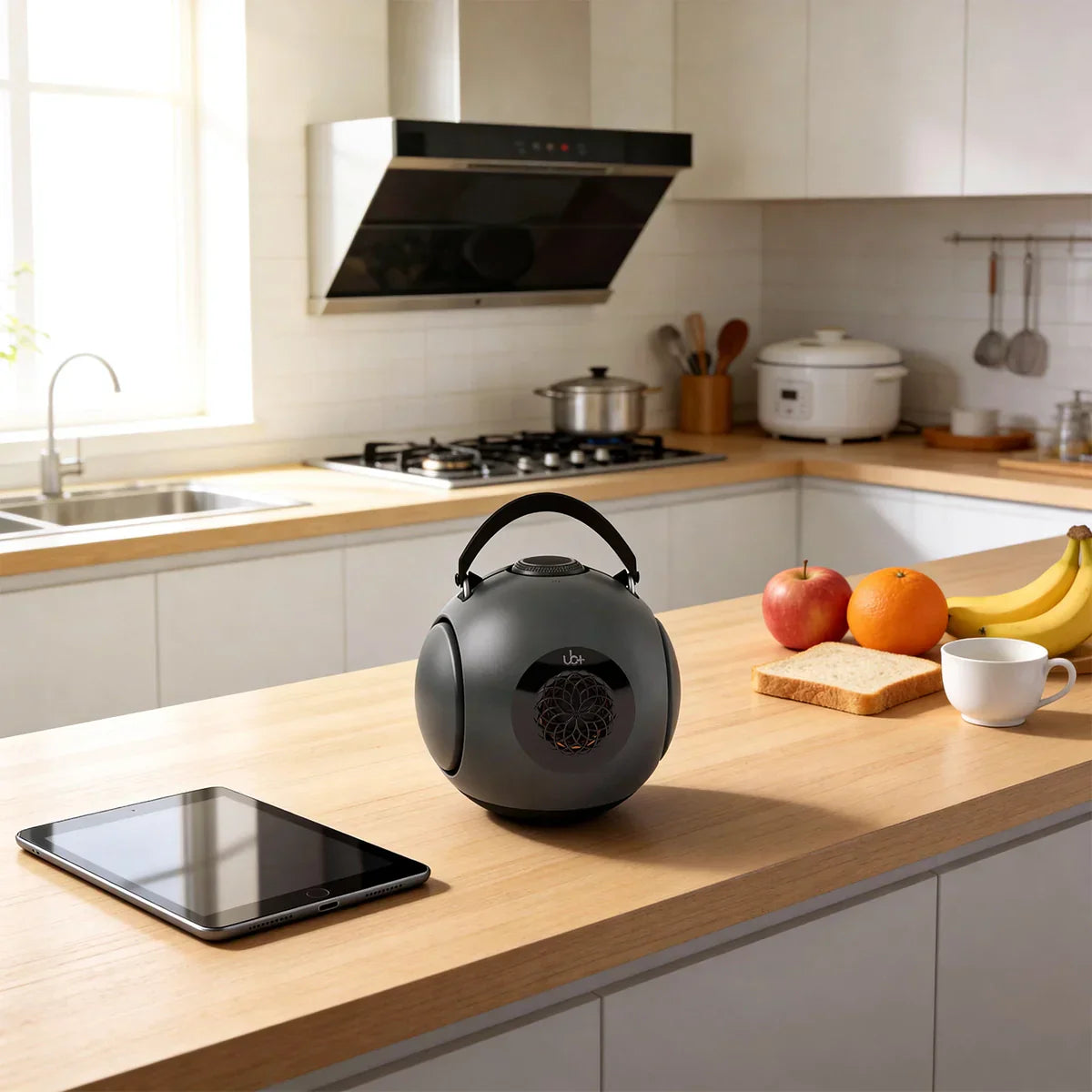
The Social Kitchen Space
Kitchens are acoustically unusual listening environments.
Tile, glass, stone, countertops, cabinets, and appliances create numerous hard reflective surfaces. A speaker that already produces an aggressive presentation can sound even more forward in such a space.
A broad-dispersion speaker can be useful because people rarely remain in one listening position while cooking or entertaining.
Someone may be preparing food near the counter while another person is sitting at a table. The speaker does not need to be aimed repeatedly toward each listener.
The dB1's spherical architecture is designed around this type of shared listening environment.
Its shape is also visually different from the rectangular boxes commonly used in portable audio. Instead of hiding the speaker inside furniture, the spherical form can function as part of the room's visual environment.
The Outdoor Balcony
A balcony creates a completely different acoustic condition because there are fewer boundaries to reinforce low frequencies.
Indoors, walls and floors can increase the perception of bass. Outdoors, much of that reinforcement disappears.
That makes efficient acoustic output important.
The dB1 combines its mechanical bass architecture with a rechargeable battery and IPX5 splash resistance, allowing it to move between indoor and outdoor environments.
A balcony setup can therefore be less restrictive than a permanent home-audio installation.
However, outdoor listening still requires realistic expectations. Open-air sound behaves differently from room-based sound, and listener distance, background noise, speaker height, and available output all influence the result.
The goal should be consistent usable sound rather than trying to reproduce the acoustic behavior of a closed room outdoors.
The Multi-Purpose Family Room
A family room may be the most demanding environment because the speaker needs to handle several types of listening.
Music may play during the afternoon. A movie may be streamed later. Someone may use the speaker for casual background audio while others are talking.
This kind of space benefits from a speaker that does not require a highly specific listening position.
The dB1's spherical presentation gives it flexibility in shared spaces, while its mechanical bass system provides low-frequency energy without making bass the only defining characteristic.
A speaker should be able to reproduce dialogue, vocals, percussion, effects, and bass without forcing listeners to constantly change the EQ.
This is also where enclosure stability becomes relevant. The dB1's opposing passive radiators are designed to counterbalance their mechanical forces, helping direct energy toward acoustic output rather than unnecessary enclosure movement.
The Design-First Interior
Some rooms are designed carefully enough that conventional technology can feel visually out of place.
A large rectangular speaker can dominate a minimalist interior. A collection of cables and separate components can also work against a clean design.
The dB1 takes a different visual approach through its spherical form.
But the shape is not merely decorative.
The sphere is central to the acoustic design. Its geometry is part of the way the internal chamber manages air pressure and part of how the speaker distributes sound into the surrounding environment.
This is where design and engineering overlap.
The speaker can function as an object within the room while its physical form also serves an acoustic purpose.
For a broader look at the relationship between appearance and audio engineering, Designer Speaker Benefits: Sound Quality, Bass, and Design explores the subject in more detail.
What These Room Setups Have in Common
The ten environments are different, but the same principle appears repeatedly: the room should be considered part of the listening system.
A speaker does not operate in isolation.
Its enclosure determines how air behaves internally. Its driver determines how electrical energy becomes mechanical movement. Its passive radiators influence low-frequency air displacement. Its dispersion pattern determines how sound reaches different listeners.
Then the room takes over.
Walls reinforce some frequencies. Furniture absorbs others. Corners change bass behavior. Open spaces reduce boundary reinforcement.
That is why a speaker that performs well on paper may not necessarily produce the same experience in every environment.
The best setup begins by considering how the speaker will actually be used.
How the dB1's Acoustic Architecture Fits Different Rooms
|
Feature |
Conventional Portable Speaker |
UB+ dB1 DoubleBass |
|
Enclosure |
Typically rectangular |
True spherical acoustic chamber |
|
Bass approach |
Often combines DSP, ports, or passive radiators |
Mechanical bass architecture using spherical chamber and dual passive radiators |
|
Passive radiator arrangement |
Model-dependent |
Two opposing symmetrical radiators |
|
Radiating surface |
Model-dependent |
Approximately 3.5× woofer area |
|
Mechanical balance |
Depends on enclosure design |
Symmetrical radiator movement helps counterbalance forces |
|
Sound distribution |
Often directional |
Designed around 360° dispersion |
|
Placement flexibility |
Depends on design |
Broad presentation supports multiple listening positions |
|
Portability |
Model-dependent |
Rechargeable portable design |
|
Outdoor use |
Model-dependent |
IPX5 splash resistance |
|
Acoustic philosophy |
Varies by product |
Enclosure, driver, and air movement designed as one system |
The comparison is not meant to suggest that every conventional portable speaker performs the same way. Speaker architecture varies considerably between products.
The important difference is that the dB1 treats enclosure geometry and mechanical bass generation as fundamental parts of its design.
Let the Room Work With the Speaker
A good room setup does not necessarily require complicated acoustic treatment.
Small changes can have meaningful effects.
Avoid placing a speaker inside a tightly enclosed cabinet. Give the enclosure room to radiate. Experiment with distance from walls rather than automatically pushing the speaker into a corner. Listen from several positions instead of judging the sound from one chair.
If bass becomes too strong, move the speaker away from boundaries. If the sound feels thin, moderate boundary reinforcement may help.
The principle is straightforward: change placement before assuming the hardware needs more processing.
This is particularly relevant to spherical designs because their broader dispersion changes how listeners interact with the speaker.
For a deeper look at the relationship between passive radiators, ports, and low-frequency reproduction, see Passive Radiators vs. Ported Boxes: How Spherical Speakers Produce Bass.
Choosing Between dB1 and dB Mini for Different Spaces
Not every room requires the same type of speaker.
The UB+ dB Mini is designed around compact portability and can make sense where size and easy movement are the primary concerns.
The UB+ dB1 DoubleBass takes a larger acoustic approach, using its spherical chamber, dual passive radiators, and driver architecture to focus more heavily on room-filling sound and controlled bass.
If you're deciding between the two, you can compare them directly through the dB1 vs dB Mini comparison.
You can also explore the UB+ dB1 DoubleBass and dB Mini product pages to match the physical design to your space and listening habits.
Common Room-Setup Mistakes
Even a well-engineered speaker can sound different when placed poorly.
One common mistake is putting a speaker directly into a corner simply because that is where there is available space. Corner placement can reinforce bass substantially.
Another is blocking the speaker with furniture. A portable speaker may be compact, but its acoustic output still needs space.
A third mistake is judging sound from only one listening position. If a speaker is intended for shared listening, walk around the room and listen from different locations.
Finally, avoid assuming that more bass automatically means better performance. Bass should have definition, timing, and integration with the rest of the frequency range.
The goal is not to make the room shake.
The goal is to make the room sound right.
Real Rooms Reveal What Specifications Cannot
A specification sheet can tell you about a driver's size, Bluetooth version, battery capacity, or frequency response. It cannot tell you exactly how the speaker will interact with your desk, walls, furniture, or listening position.
That is why real-world setups are so useful.
The minimalist office emphasizes low visual impact and broad listening. The apartment highlights boundary interaction. The loft exposes dispersion differences. The bedroom demonstrates the importance of controlled bass. The studio emphasizes driver behavior. The balcony reveals the difference between indoor and outdoor acoustics.
Each environment asks different questions of the same product.
The dB1's answer is to make its enclosure part of the solution.
Frequently Asked Questions
Does speaker placement really change sound quality?
Yes. Walls, floors, furniture, and corners affect how sound waves reflect and reinforce one another. Low frequencies are particularly sensitive to room boundaries, so moving a speaker can change perceived bass significantly.
Is a spherical speaker easier to place than a traditional box speaker?
A spherical speaker can offer broader sound distribution, which may make it more flexible in shared listening environments. However, it is still affected by room boundaries and should not be placed inside enclosed furniture or directly in problematic corners without testing the result.
Why does the UB+ dB1 use two passive radiators?
The dB1 uses two opposing passive radiator plates as part of its mechanical bass architecture. Their symmetrical movement helps counterbalance mechanical forces while providing a large radiating surface for low-frequency air movement.
Is the dB1 suitable for a small apartment?
The dB1 can work well in compact spaces because it provides broad sound distribution without requiring a traditional multi-speaker setup. Placement remains important, especially near corners and walls where bass reinforcement can become pronounced.
Can the dB1 be used outdoors?
Yes. The dB1 has a rechargeable battery and IPX5 splash resistance, making it suitable for appropriate outdoor environments such as balconies, patios, and casual gatherings. Outdoor acoustics are different from indoor acoustics, so expectations for bass and coverage should account for the open environment.
Should I choose the dB1 or dB Mini?
It depends on how you use the speaker. The dB Mini is focused on compact portability, while the dB1 uses a larger spherical acoustic architecture with dual passive radiators and a high-end driver system. Compare the two based on your room size, portability needs, bass requirements, and typical listening environment.
Sound That Belongs in the Room
A speaker upgrade does not have to mean adding more equipment.
Sometimes the more meaningful improvement comes from choosing a speaker whose physical design works naturally with the way you live.
The ten setups above show why there is no single ideal room. A home office, bedroom, apartment, studio, kitchen, loft, and balcony all create different acoustic conditions.
The UB+ dB1 DoubleBass approaches those environments through a combination of spherical enclosure geometry, a Helmholtz-inspired acoustic chamber, centrally positioned driver architecture, and dual symmetrical passive radiators.
The result is a speaker designed not simply to produce sound, but to interact with the surrounding space in a deliberate way.
Not every room needs the same speaker.
But every room deserves a speaker designed with the room in mind.
Explore UB+ dB1 DoubleBass
→ Explore the UB+ dB1 DoubleBass
→ Compare dB1 vs dB Mini
→ See color options
→ Check current price



コメントを書く
このサイトはhCaptchaによって保護されており、hCaptchaプライバシーポリシーおよび利用規約が適用されます。