

Why the Round Bluetooth Speaker Is More Than Just a Design Trend
The round bluetooth speaker has become one of the most distinctive products in modern audio design. Unlike traditional rectangular speakers, spherical models immediately stand out with their sculptural appearance, making them popular choices for homes, offices, and premium interiors. However, the growing popularity of the round speaker isn't driven by aesthetics alone. Behind the unique shape lies a fascinating combination of acoustic science and engineering that can significantly influence how a speaker performs.
For decades, most loudspeakers have been built using rectangular cabinets because they are easier and less expensive to manufacture. While practical, these box-shaped enclosures also introduce acoustic compromises that affect clarity, resonance, and overall sound quality. As speaker engineering has advanced, manufacturers have explored alternative enclosure shapes to solve these long-standing challenges.
This has led to renewed interest in the sphere speaker, where the enclosure itself becomes an active part of the acoustic system instead of simply housing the internal components. By reducing unwanted internal reflections and improving sound dispersion, spherical designs can offer meaningful acoustic advantages over conventional box speakers.
In this guide, we'll explore the science behind spherical speaker design, explain how enclosure shape affects audio performance, and examine whether a round speaker truly delivers better sound or simply offers a unique appearance.
Why Speaker Cabinet Shape Matters
Many people assume that the drivers alone determine sound quality.
In reality, the enclosure surrounding those drivers has an enormous impact on what reaches your ears.
A speaker cabinet influences:
- Internal air pressure
- Sound wave reflections
- Resonance
- Cabinet vibration
- Dispersion
- Frequency balance
Even the most advanced driver cannot perform at its full potential if the enclosure introduces unwanted acoustic problems.
This is why cabinet design remains one of the most important aspects of premium loudspeaker engineering.
The Problem with Traditional Box Speakers
Rectangular cabinets have remained the industry standard for decades.
They're efficient to manufacture, easy to stack during shipping, and simple to integrate into furniture.
Acoustically, however, they present several challenges.
Inside every rectangular enclosure are multiple parallel surfaces.
When sound waves reflect between these flat walls, they create standing waves.
Standing waves cause certain frequencies to build up while others partially cancel out.
The result may include:
- Reduced clarity
- Uneven bass
- Resonance
- Blurred imaging
- Less accurate tonal balance
These unwanted reflections occur before the sound even exits the cabinet.
Although careful damping materials can reduce these effects, they cannot eliminate them entirely.
How a Sphere Speaker Changes Internal Acoustics
A spherical enclosure approaches the problem differently.
Because a sphere contains no parallel internal walls, sound waves are reflected in a much more uniform manner.
Instead of repeatedly bouncing between opposing flat surfaces, internal energy disperses more evenly throughout the enclosure.
This helps reduce:
- Standing waves
- Localized resonance
- Uneven air pressure
- Internal reflections
The result is a cleaner acoustic environment for the driver to operate within.
Rather than fighting against the enclosure, the driver works with it.
Helmholtz Resonance Inspires Modern Spherical Design
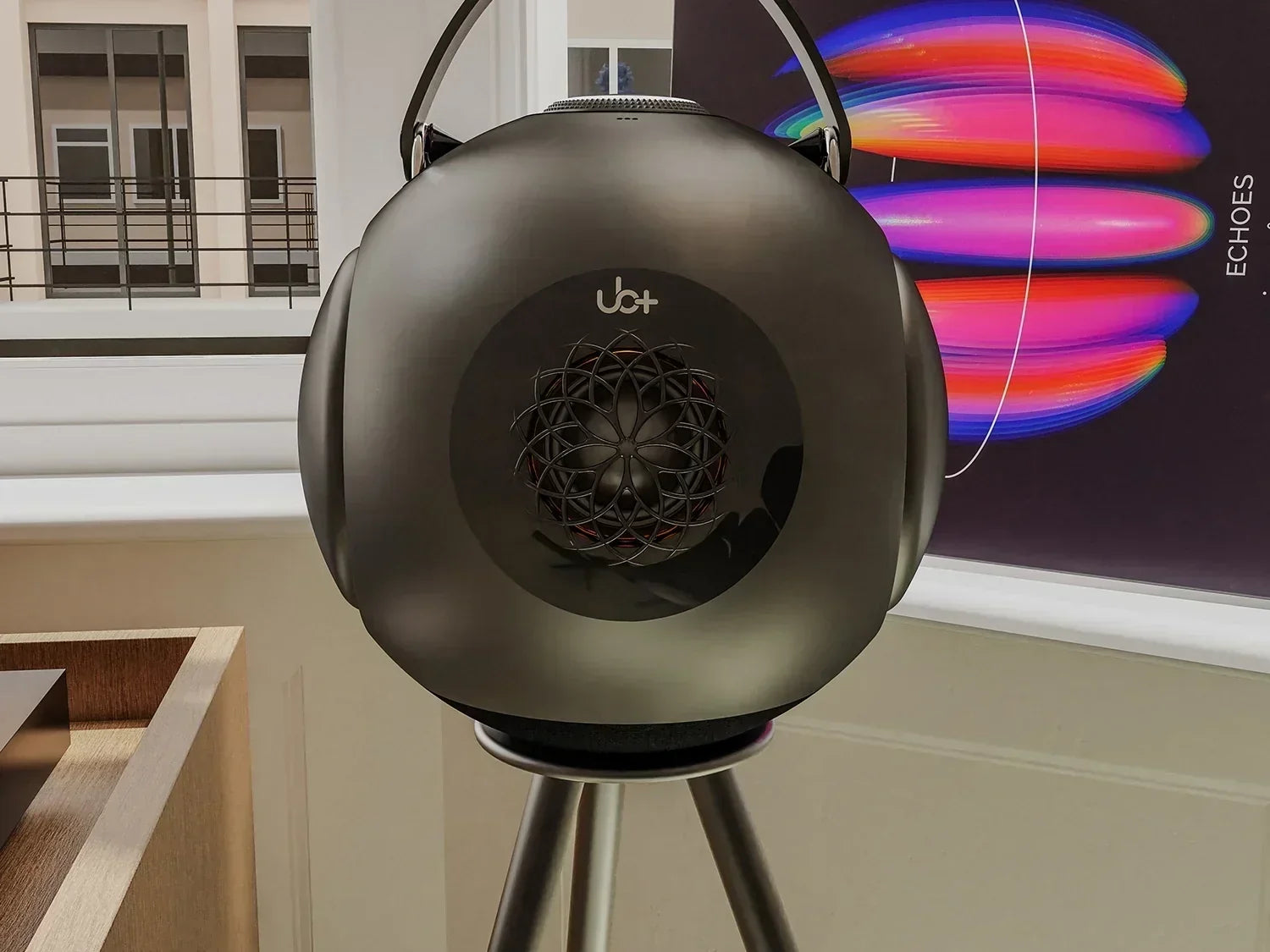
One of the most innovative examples of spherical acoustic engineering is found in the UB+ dB1 DoubleBass.
Instead of using a conventional cabinet, the speaker incorporates a patented spherical acoustic chamber inspired by the Helmholtz Resonance principle.
Inspired by the physics of the Helmholtz Resonator, the spherical enclosure distributes internal air pressure evenly while significantly reducing standing waves that commonly occur inside traditional rectangular cabinets.
This engineering helps:
- Minimize internal resonance
- Reduce phase distortion
- Improve harmonic reproduction
- Preserve instrument separation
- Deliver cleaner vocal clarity
Instead of functioning as a simple protective shell, the enclosure becomes an active acoustic component that contributes directly to overall sound quality.
Why Even Air Pressure Produces Better Sound
One overlooked advantage of spherical cabinets is how they manage internal air movement.
In conventional box speakers, uneven air pressure can create localized areas where energy accumulates.
These pressure differences may contribute to unwanted resonance and reduced efficiency.
A round speaker distributes internal pressure much more uniformly.
As air moves through the enclosure, it encounters continuous curved surfaces rather than abrupt corners.
This allows pressure to develop more evenly throughout the chamber.
The result is greater driver stability and more consistent acoustic performance.
Mechanical Engineering Instead of Electronic Compensation
Many modern Bluetooth speakers rely heavily on Digital Signal Processing (DSP) to compensate for limitations created by compact enclosures.
While DSP can improve performance, excessive digital enhancement often introduces artificial coloration and masks musical detail.
The UB+ dB1 approaches low-frequency reproduction through mechanical engineering instead.
At the center of the speaker is a 4.5-inch downward-firing long-throw mid-bass driver positioned inside the spherical chamber.
As the driver moves, evenly distributed air pressure activates dual symmetrical passive radiators mounted on opposite sides of the enclosure.
This patented architecture creates mechanical bass amplification, allowing acoustic physics not software to produce deep, controlled bass.
The combined passive radiator surface area is approximately 3.5× larger than the active woofer, enabling significantly greater air movement than many conventional compact speakers.
Rather than relying primarily on electronic enhancement, the speaker's physical design becomes the foundation of its low-frequency performance.
Self-Cancelling Vibration Improves Precision
Another advantage of the spherical system is how it controls vibration.
Whenever a driver moves, equal and opposite forces naturally push against the enclosure.
Traditional speakers often transfer some of this energy into cabinet movement.
That movement represents energy that is no longer producing sound.
The UB+ dB1 minimizes this through its self-cancelling vibration architecture.
Its dual symmetrical passive radiators move simultaneously in opposite directions.
As a result:
- Cabinet vibration is significantly reduced.
- More energy is converted into bass output.
- Distortion decreases.
- Bass remains tighter and more controlled.
This mechanical balance contributes to a cleaner overall presentation.
Premium Components Support the Acoustic Design
Innovative cabinet engineering works best when combined with equally advanced internal components.
The UB+ dB1 includes:
- 90 mm oversized neodymium magnet
- 35 mm long-stroke voice coil
- 20 mm piston movement
- 18 mm extra-wide surround
- Aluminum shorting ring
Together, these premium components improve efficiency, reduce distortion, and maintain accurate driver control across the frequency spectrum.
Combined with:
- 40 Hz–20 kHz frequency response
- 93 dB SPL
- Bluetooth 5.3
- Up to 20 hours of battery life
the speaker demonstrates how mechanical engineering and premium components work together to create exceptional wireless audio.
Is Every Round Speaker Automatically Better?
The simple answer is no.
A spherical enclosure provides significant acoustic advantages, but shape alone doesn't guarantee excellent sound.
A premium round bluetooth speaker must also include:
- High-quality driver engineering
- Intelligent acoustic tuning
- Effective vibration control
- Premium materials
- Balanced frequency response
- Reliable wireless performance
Without these elements, a spherical cabinet becomes little more than an attractive industrial design.
When engineering and enclosure design work together, however, a sphere speaker can deliver measurable acoustic improvements over conventional box-shaped alternatives.
How a Spherical Speaker Improves Sound Dispersion
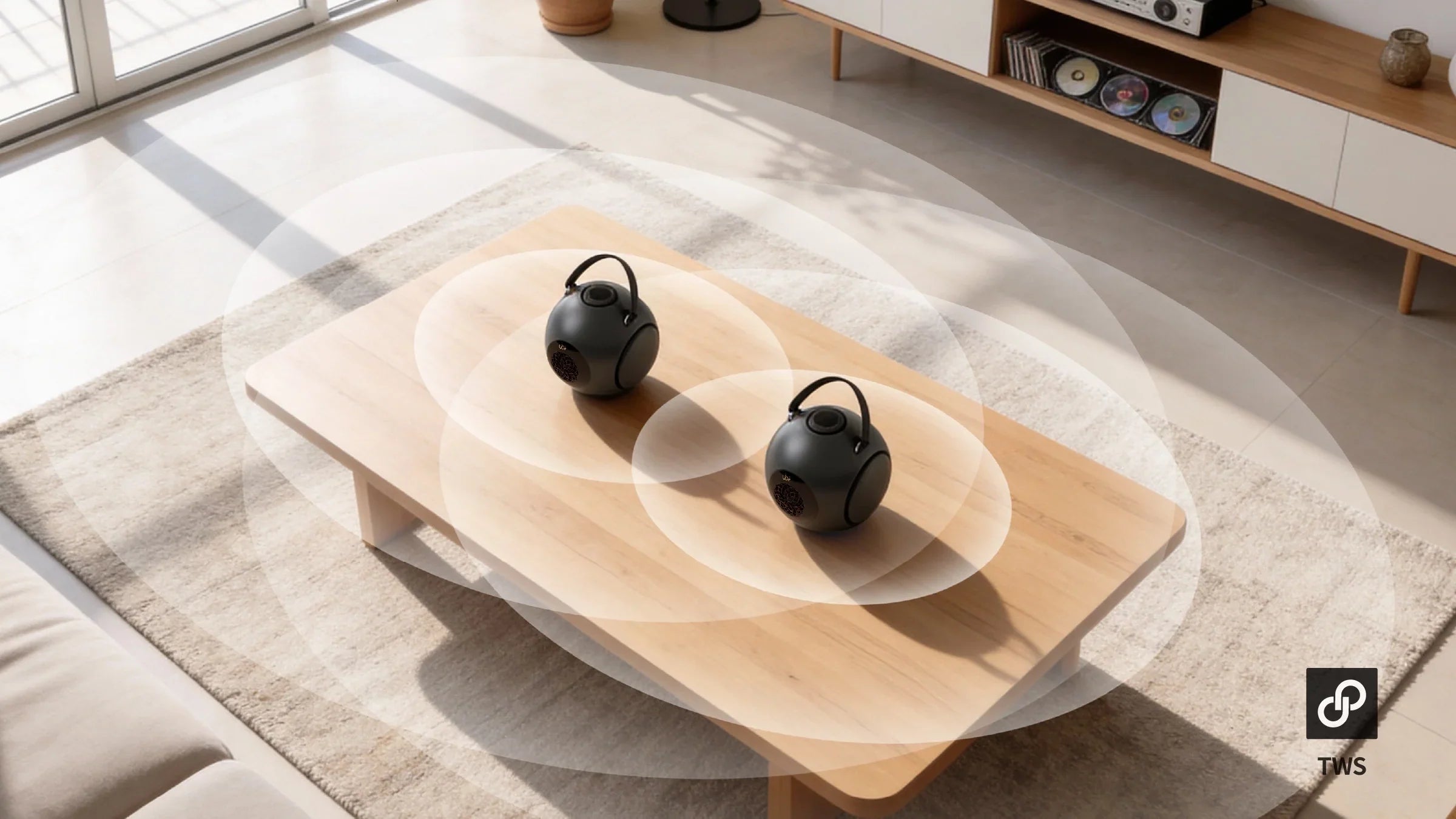
One of the biggest advantages of a well-engineered round bluetooth speaker is how it distributes sound throughout a room.
Traditional rectangular speakers often project sound more directionally. While this can be beneficial in some listening environments, it also means the listening experience changes noticeably as you move away from the speaker's optimal position.
A carefully designed sphere speaker helps create a more consistent listening experience from multiple angles.
Instead of relying on flat cabinet surfaces that reflect sound unevenly, a spherical enclosure encourages smoother acoustic behavior around the cabinet.
The benefits include:
- More even sound distribution
- Improved listening across a wider area
- Better tonal consistency
- Reduced "sweet spot" limitations
- More natural room-filling sound
Although no single-driver speaker produces a perfect 360-degree sound field, spherical cabinet geometry helps reduce directional irregularities that are common in traditional box-shaped designs.
For everyday listening, this means music remains balanced whether you're sitting directly in front of the speaker or moving around the room.
Fewer Resonance Points Mean Cleaner Audio
Every speaker cabinet stores and releases acoustic energy.
The goal of premium engineering is to minimize unwanted resonance so listeners hear the recording not the cabinet.
Traditional box speakers contain:
- Corners
- Flat internal panels
- Parallel walls
These structural characteristics create multiple resonance points where sound energy can accumulate.
By comparison, a spherical enclosure distributes stress and internal pressure much more evenly.
This reduces localized resonance while allowing the driver to perform more accurately.
The result is:
- Cleaner vocals
- Better instrument separation
- Improved tonal balance
- More natural transient response
- Greater overall clarity
These improvements become especially noticeable during acoustic recordings, jazz, classical music, and vocal performances where fine detail matters.
Why the UB+ dB1 Uses a Spherical Acoustic Chamber
The UB+ dB1 DoubleBass demonstrates how spherical design can become a genuine acoustic advantage rather than simply an industrial design statement.
Its patented spherical acoustic chamber inspired by the Helmholtz Resonance principle was developed to improve how air pressure behaves inside the enclosure.
Inspired by the physics of the Helmholtz Resonator, the spherical chamber distributes internal air pressure evenly while significantly reducing standing waves that naturally occur inside conventional rectangular cabinets.
This engineering helps:
- Reduce cabinet resonance
- Minimize phase distortion
- Improve harmonic reproduction
- Preserve vocal detail
- Enhance instrument separation
Instead of forcing digital processing to compensate for cabinet limitations, the enclosure itself contributes to cleaner sound reproduction.
Mechanical Bass Built Around Acoustic Physics
Deep bass remains one of the greatest engineering challenges for compact wireless speakers.
Many manufacturers compensate by using aggressive Digital Signal Processing (DSP) to electronically exaggerate low frequencies.
Although this approach creates impressive specifications, it often sacrifices detail and introduces distortion during demanding musical passages.
The UB+ dB1 follows a different philosophy.
At the center of the speaker sits a 4.5-inch downward-firing long-throw mid-bass driver.
As the driver moves, pressure builds evenly inside the spherical chamber before activating dual symmetrical passive radiators positioned on opposite sides.
This patented configuration produces mechanical bass amplification, allowing acoustic physics not artificial software to create deep, controlled bass.
The combined passive radiator surface area is approximately 3.5× larger than the active woofer, enabling substantially greater air movement than many conventional compact speakers.
At the same time, the opposing passive radiators create a self-cancelling vibration architecture, reducing cabinet movement while directing more energy toward useful bass output.
The onboard DSP continuously monitors system performance and protects the drivers, but it does not artificially generate bass, preserving a natural and balanced sound signature.
Premium Components Complete the Acoustic System
Advanced cabinet engineering delivers its full potential only when paired with premium internal components.
The UB+ dB1 incorporates:
- 90 mm oversized neodymium magnet
- 35 mm long-stroke voice coil
- 20 mm piston movement
- 18 mm extra-wide surround
- Aluminum shorting ring
These carefully engineered components improve efficiency, maintain precise cone control, and reduce distortion across the audible frequency range.
Combined with:
- 40 Hz–20 kHz frequency response
- 93 dB SPL
- Bluetooth 5.3
- Up to 20 hours of battery life
the result is a speaker designed to deliver premium sound consistently in both indoor and outdoor environments.
Round Speaker vs. Traditional Box Speaker
|
Feature |
Traditional Box Speaker |
Round Bluetooth Speaker |
|
Cabinet Shape |
Rectangular |
Patented Spherical Acoustic Chamber |
|
Internal Walls |
Parallel Surfaces |
Curved Continuous Surface |
|
Standing Waves |
More Likely |
Significantly Reduced |
|
Air Pressure Distribution |
Uneven |
Evenly Distributed |
|
Phase Distortion |
Higher |
Reduced |
|
Harmonic Reproduction |
Standard |
Enhanced |
|
Bass Design |
DSP Enhancement |
Mechanical Bass Amplification |
|
Driver Layout |
Conventional |
4.5-inch Downward-Firing Mid-Bass Driver |
|
Passive Radiators |
Small or Single |
Dual Symmetrical Passive Radiators |
|
Radiator Surface Area |
Standard |
3.5× Larger Than Active Woofer |
|
Cabinet Vibration |
Noticeable |
Self-Cancelling Vibration Architecture |
|
Wireless Technology |
Older Bluetooth Versions |
Bluetooth 5.3 |
|
Battery Life |
Average |
Up to 20 Hours |
Buyer's Checklist: Is a Round Bluetooth Speaker Right for You?
Before choosing a round speaker, ask yourself:
✔ Do you want cleaner, more natural sound rather than exaggerated bass?
✔ Is reduced cabinet resonance important to you?
✔ Would you benefit from wider sound dispersion throughout the room?
✔ Do you appreciate innovative acoustic engineering?
✔ Do you want premium build quality with distinctive industrial design?
✔ Will you use the speaker in multiple environments, including indoors and outdoors?
If these priorities match your listening habits, a thoughtfully engineered spherical speaker can provide meaningful advantages over many conventional box-shaped alternatives.
Frequently Asked Questions
1. Does a round Bluetooth speaker sound better than a rectangular speaker?
Not automatically. However, a well-designed round bluetooth speaker can reduce standing waves, improve air pressure distribution, and minimize resonance, contributing to cleaner and more natural sound.
2. Why are spherical speakers becoming more popular?
Beyond their distinctive appearance, spherical speakers offer genuine acoustic benefits, including improved internal wave control, better harmonic reproduction, and reduced cabinet resonance.
3. What is the advantage of fewer resonance points?
Fewer resonance points reduce unwanted coloration, allowing vocals and instruments to sound clearer while improving tonal accuracy across the frequency range.
4. Is a sphere speaker suitable for everyday listening?
Yes. Whether you're listening to music, podcasts, movies, or streaming content, a well-engineered sphere speaker provides balanced sound that performs consistently in a wide range of environments.
5. Is cabinet shape more important than driver size?
Both are important. Even an excellent driver cannot reach its full potential inside a poorly designed enclosure. Premium sound results from combining advanced drivers with intelligent cabinet engineering.
Conclusion
Choosing a round bluetooth speaker is about much more than aesthetics. When supported by intelligent engineering, a spherical enclosure offers real acoustic advantages, including reduced standing waves, more even internal air pressure, cleaner harmonic reproduction, and a broader listening experience.
While shape alone doesn't guarantee exceptional sound, combining a spherical cabinet with premium driver technology, mechanical bass engineering, and high-quality materials creates a speaker capable of delivering performance that extends far beyond conventional box designs.
Smarter Engineering Creates Better Sound
The UB+ dB1 DoubleBass transforms spherical design into a true acoustic advantage. Its patented Helmholtz Resonance-inspired spherical acoustic chamber, based on the principles of the Helmholtz Resonator, distributes internal air pressure evenly to reduce standing waves, minimize phase distortion, and improve harmonic reproduction, allowing music to sound cleaner, more detailed, and more natural.
A 4.5-inch downward-firing mid-bass driver works with dual symmetrical passive radiators featuring a combined surface area approximately 3.5× larger than the active woofer. This patented system produces mechanical bass amplification and a self-cancelling vibration architecture, converting energy into deep, controlled bass rather than cabinet movement. Supported by a 90 mm oversized neodymium magnet, 35 mm long-stroke voice coil, 20 mm piston movement, 18 mm extra-wide surround, aluminum shorting ring, 40 Hz–20 kHz frequency response, 93 dB SPL, Bluetooth 5.3, and up to 20 hours of battery life, the dB1 demonstrates how thoughtful acoustic engineering can elevate both design and performance.
Find the UB+ speaker that best matches your listening style, space, and portability needs.
Discover premium finishes that combine award-winning industrial design with innovative acoustic engineering.
Explore the latest specifications, pricing, and availability directly from UB+.
Because the best speaker isn't defined by its shape alone.
It's defined by how intelligently that shape is engineered to move sound naturally.


コメントを書く
このサイトはhCaptchaによって保護されており、hCaptchaプライバシーポリシーおよび利用規約が適用されます。