

When a compact speaker produces surprisingly deep bass, the result is rarely determined by driver size or amplifier power alone. Low-frequency performance depends on how the driver, enclosure, air volume, resonance system, and radiating surfaces work together.
That is why comparing a conventional ported speaker with a passive-radiator design is useful. Both approaches are designed to improve low-frequency output, but they manage air in different ways.
The difference becomes even more interesting when the passive-radiator system is integrated into a spherical enclosure.
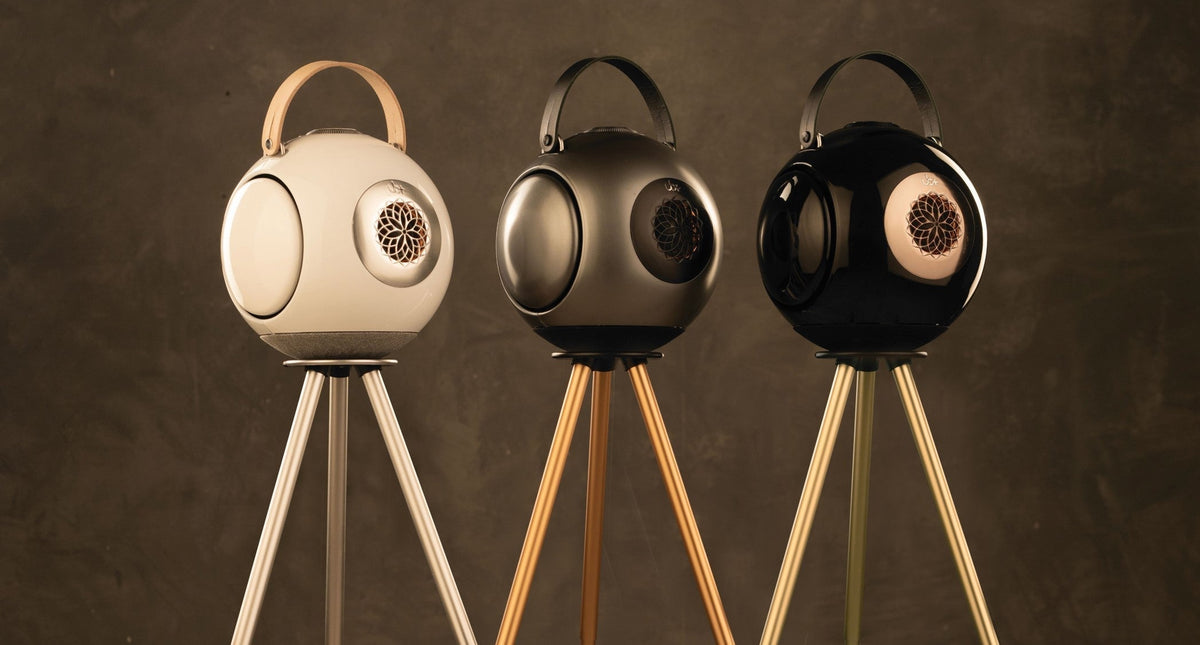
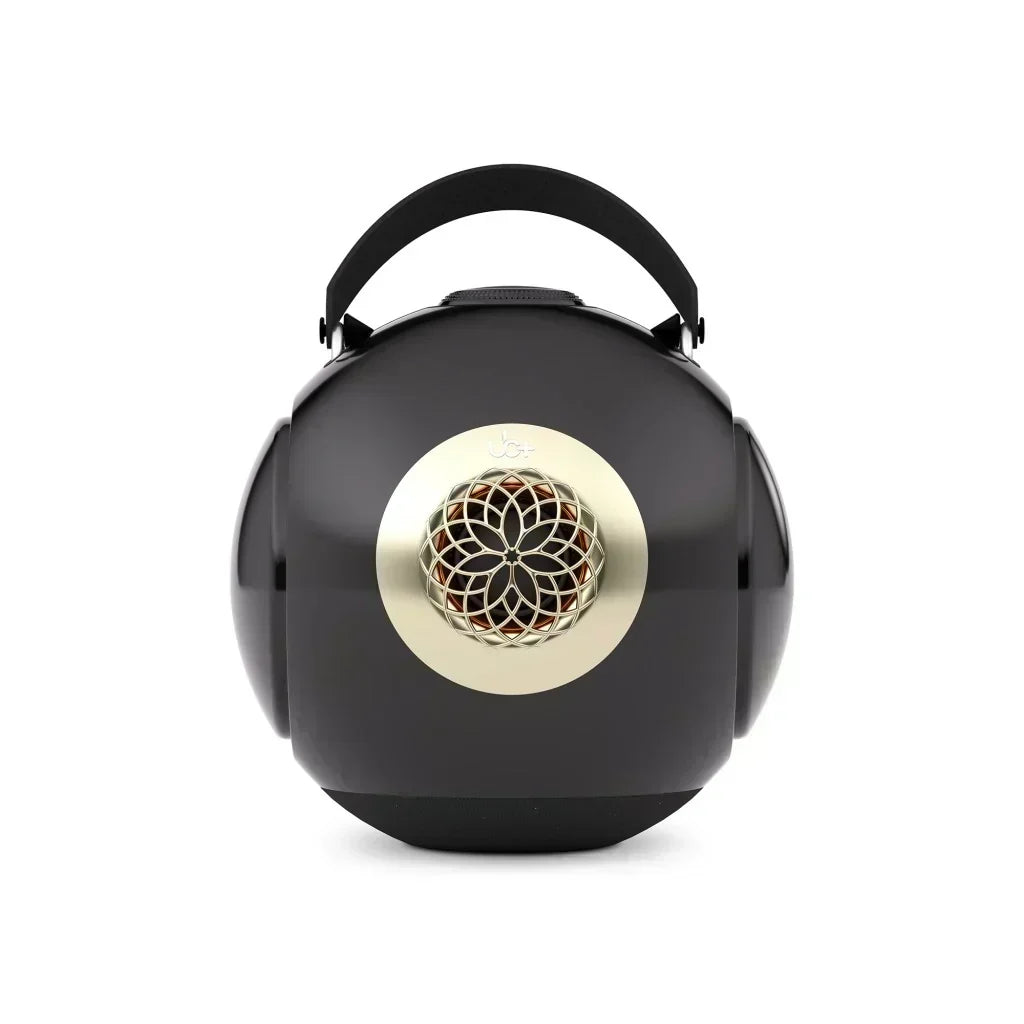
The UB+ dB1 DoubleBass uses a spherical acoustic chamber, a downward-firing mid-bass driver, and two symmetrical passive radiators to create a mechanical bass system designed around controlled air movement rather than simply increasing electronic bass output.
For anyone researching a spherical Bluetooth speaker, understanding this architecture explains why enclosure design can have such a significant influence on perceived bass.
Ported Boxes: How Traditional Bass Extension Works
A conventional ported enclosure uses an opening, or port, to connect the air inside the cabinet with the outside environment.
The air inside the enclosure and the air mass within the port form a resonant system related to the principles of a Helmholtz resonator. When the enclosure and port are correctly tuned, the system can reinforce a specific range of low frequencies and increase bass output without requiring the main driver to produce all of that energy by itself.
This approach has been used successfully across generations of loudspeakers.
However, ported systems also introduce engineering considerations.
Air moving rapidly through a port can create turbulence, particularly when a compact speaker is pushed toward higher output. Poorly designed ports can also introduce audible noise. Below the enclosure's tuning frequency, the acoustic loading provided by the port changes significantly, and driver excursion can increase rapidly.
The internal geometry of the enclosure matters too.
A conventional box contains flat surfaces and, depending on its dimensions, parallel walls. These surfaces can contribute to internal reflections and standing-wave patterns that designers need to manage through enclosure dimensions, damping, driver positioning, and digital processing.
A port can therefore provide efficient bass extension, but it is only one part of a larger acoustic system.
Passive Radiators: Another Way to Move Air

A passive radiator approaches the same basic problem from a different direction.
Instead of using an open port, a passive radiator uses a diaphragm that responds to changes in air pressure inside the enclosure. It has no voice coil and does not receive an amplified electrical signal directly.
The active driver creates pressure changes inside the cabinet. Those pressure changes cause the passive radiator to move, allowing it to contribute additional low-frequency acoustic output.
The principle is straightforward:
The active driver creates pressure → internal air pressure moves the passive radiator → the passive radiator contributes additional bass output.
This makes passive radiators particularly useful in compact speakers where designers want low-frequency extension without allocating physical space to a long or large port.
There is another practical advantage: because the system does not depend on air rushing through a port opening, it avoids the port turbulence associated with poorly controlled high-velocity airflow.
But passive radiators still need to be carefully engineered.
Their mass, compliance, excursion, enclosure volume, and tuning all influence the final result. The physical arrangement of the radiators can also affect how mechanical forces act on the cabinet.
That is where the DoubleBass architecture of the dB1 becomes important.
Why the dB1 Uses Two Symmetrical Passive Radiators

The UB+ dB1 DoubleBass does not use a single passive radiator positioned on one side of the cabinet.
It uses two large passive radiators positioned opposite each other.
The purpose is not simply to add another radiating surface.
When the two radiators move in symmetrical, opposing directions, their mechanical forces counteract one another. Instead of transferring as much unwanted movement into the enclosure, the system is designed to balance those forces.
This creates an important distinction between acoustic output and mechanical vibration.
The passive radiators are contributing to the movement of air, while their opposing arrangement helps reduce the tendency of the enclosure itself to move in response.
The combined passive-radiator surface area is approximately 3.5 times the area of the active woofer, giving the system substantial radiating area for low-frequency air movement.
The result is a mechanical approach to bass reproduction in which the enclosure, air volume, active driver, and passive radiators operate together.
The Sphere Changes the Acoustic Environment

Passive radiators alone do not explain the dB1's design.
The enclosure itself is equally important.
The UB+ dB1 DoubleBass uses a spherical acoustic chamber inspired by principles associated with Helmholtz resonance. A sphere creates a fundamentally different internal geometry from a conventional rectangular cabinet.
There are no long, parallel internal walls facing one another in the same way as a typical box enclosure.
That matters because internal sound energy does not simply bounce repeatedly between opposing flat surfaces. Instead, the curved chamber creates a more symmetrical internal acoustic environment.
For a deeper explanation of the broader concept, see How spherical speaker design changes modern home audio.
The sphere therefore isn't simply an unusual exterior shape. It is part of the acoustic architecture.
Spherical vs. Box Enclosures
A useful way to understand the difference is to consider what happens inside each type of enclosure.
|
Design Element |
Conventional Ported Box |
UB+ dB1 Spherical System |
|
Enclosure geometry |
Box-shaped |
Spherical |
|
Bass mechanism |
Tuned port |
Dual passive radiators |
|
Internal air movement |
Port and enclosure interaction |
Spherical chamber + radiator interaction |
|
Radiating system |
Active driver + port |
Active driver + two passive radiators |
|
Mechanical balance |
Depends on enclosure design |
Opposing radiator arrangement |
|
Internal wall geometry |
Flat/parallel surfaces may create reflections |
Curved spherical chamber |
|
Bass philosophy |
Port-assisted acoustic output |
Mechanical air loading and passive-radiator output |
This does not mean that every ported speaker has poor bass or that every spherical speaker automatically performs better.
The important difference is how the acoustic system is engineered.
For a broader discussion of enclosure geometry, see Spherical vs. Box Speakers: Sound Comparison.
The Downward-Firing Driver Is Part of the System
The dB1's active driver is also positioned differently from the front-facing driver arrangement common in many compact speakers.
The downward-firing mid-bass driver directs its energy into the spherical chamber.
This allows the internal air volume to become part of the acoustic process before the resulting pressure is translated into output through the passive radiators.
The driver is therefore not working in isolation.
Its behavior is connected to:
- The volume of the spherical chamber
- The acoustic loading of the enclosure
- The two passive radiators
- The mechanical balance of the system
- The final sound dispersion
That integration is one of the defining characteristics of the dB1.
Helmholtz Principles Without Simply Copying a Ported Box
The term Helmholtz resonator is often associated with a bottle or a ported speaker enclosure.
The basic principle involves a resonant air volume and a controlled opening or air mass. In loudspeaker design, this principle is commonly used to tune an enclosure for low-frequency reinforcement.
The dB1 takes inspiration from this broader acoustic principle while using a different physical implementation.
Instead of relying on a conventional port as the primary low-frequency element, its spherical chamber works with the active driver and passive radiators to manage internal pressure and resonance.
This is why the dB1's design should not be reduced to simply calling it a "round speaker."
The geometry, driver orientation, air volume, and passive-radiator arrangement are connected.
For another look at this design philosophy, see Why UB+ Chose the Sphere: The Design and Engineering Story Behind dB1.
Why Symmetry Matters for Bass
Bass reproduction involves substantial physical movement.
Whenever a driver or passive radiator moves, mechanical forces are generated. If those forces are not balanced, some of the energy can appear as cabinet movement rather than useful acoustic output.
The dB1's two passive radiators are positioned on opposite sides of the spherical enclosure to address this mechanical problem.
As one radiator moves outward, the opposing radiator moves in the opposite direction. The resulting forces work against one another.
This is the mechanical foundation behind the DoubleBass concept.
The objective isn't simply to make the speaker move more.
It is to make more of the system's energy contribute to controlled acoustic output.
That distinction is important because louder bass and better-controlled bass are not necessarily the same thing.
Why More Bass Does Not Always Mean Better Bass
Small speakers can create an immediate impression of powerful bass through aggressive equalization or DSP.
That can make music sound exciting for a short period, but excessive low-frequency emphasis can also mask vocals, instruments, and other details in the mix.
Controlled bass has a different goal.
The low frequencies should provide weight and depth while remaining integrated with the midrange.
This is particularly important with:
- Bass guitar
- Kick drums
- Electronic music
- Piano
- Lower vocal frequencies
- Movie soundtracks
- Orchestral recordings
The objective is not simply to maximize bass output. It is to produce low-frequency energy that remains coherent with the rest of the recording.
For more detail on how passive-radiator systems work in compact wireless speakers, see How Passive Radiators Work in Bluetooth Speakers.
The 3.5× Passive-Radiator Surface Area
One of the more distinctive elements of the dB1 architecture is the combined surface area of its two passive radiators.
Together, the radiators provide approximately 3.5× the surface area of the active woofer.
Why does surface area matter?
A larger radiating surface can move more air without requiring the same excursion from a smaller diaphragm. In a compact speaker, that can be particularly useful because the system has to produce meaningful low-frequency output within strict physical limits.
The passive radiators effectively become additional acoustic surfaces working with the active driver.
The important point is that this isn't simply about adding larger components. It is about creating an integrated acoustic system where the driver excites the enclosure's air volume and the passive radiators translate that pressure into additional low-frequency output.
Bass Extension Toward 40Hz
The dB1 is designed with a stated frequency response reaching toward 40Hz.
That figure should be understood in the context of the entire acoustic system rather than treated as a standalone specification.
Low-frequency performance depends on factors including:
- Driver excursion
- Enclosure volume
- Passive-radiator tuning
- Air loading
- Acoustic environment
- Output level
- DSP and system protection
The spherical enclosure and DoubleBass system are intended to help the speaker achieve meaningful low-frequency extension without relying exclusively on excessive driver excursion.
That is where the engineering approach becomes more interesting than a simple frequency-response number.
360° Sound and the Relationship Between Bass and Space
Bass is only one part of the dB1's architecture.
The spherical design also supports a 360° sound presentation, which changes how the speaker interacts with listeners positioned around it.
This is useful when the speaker isn't being used from one fixed listening position.
A living room, dining area, kitchen, office, or outdoor gathering may have people listening from multiple directions. Instead of constantly turning the speaker toward a listener, a spherical approach is designed to distribute sound around the enclosure.
You can explore this concept further in 360° vs. Front-Firing Speakers.
The result is a speaker designed not just around one listening axis, but around the surrounding environment.
What Happens at Higher Volume?
A bass system has to maintain control as output increases.
With a compact speaker, simply demanding more volume from the active driver can push the system toward greater excursion and distortion.
The dB1's architecture distributes some of the acoustic workload across the spherical chamber and passive radiators.
The passive radiators contribute low-frequency output, while the symmetrical arrangement helps maintain mechanical balance.
The goal is to preserve composure as the speaker works harder.
That does not mean distortion disappears or that physical limits do not exist. Every compact speaker has output limits. The engineering objective is to manage those limits effectively rather than relying solely on driver excursion or aggressive electronic bass enhancement.
Passive Radiators vs. Ported Boxes: The Practical Difference
For buyers, the technical comparison can be simplified into a few important distinctions.
|
Consideration |
Ported Enclosure |
Passive-Radiator System |
|
Low-frequency reinforcement |
Tuned port |
Passive diaphragm |
|
Airflow through opening |
Yes |
No conventional bass port |
|
Port turbulence |
Possible at high airflow |
Avoids conventional port airflow |
|
Compact enclosure use |
Common |
Particularly useful where port size is constrained |
|
Tuning |
Port dimensions + enclosure volume |
Radiator mass/compliance + enclosure volume |
|
Mechanical forces |
Depends on overall design |
Can be balanced with opposing radiators |
|
dB1 implementation |
— |
Two symmetrical passive radiators |
Again, neither architecture is universally superior. Both can be engineered effectively.
The dB1's distinction is that passive radiators are combined with spherical geometry and symmetrical mechanical design rather than used as an isolated component.
Why the Enclosure Is More Than a Cabinet
The most important lesson from the dB1 design is that a speaker enclosure isn't merely a protective shell around the electronics.
It determines how air behaves.
It affects internal pressure.
It influences resonance.
It interacts with the driver.
And in a passive-radiator design, it directly affects how the radiators respond.
That is why the sphere is central to the dB1 concept.
The enclosure becomes part of the acoustic system instead of being treated as a neutral container.
Mechanical Bass vs. Digital Bass
There is also an important distinction between mechanical acoustic reinforcement and digital bass enhancement.
DSP can shape frequency response, protect the driver, improve linearity, and help a compact speaker operate within its physical limits. It is an important tool in modern speaker engineering.
But DSP cannot create unlimited physical bass from a driver and enclosure.
The dB1's approach is to use the physical acoustic system first: the spherical chamber, air loading, active driver, and passive radiators.
DSP can then support the system rather than being the only mechanism responsible for creating the impression of deeper bass.
That philosophy is part of what makes the dB1 different from a conventional compact speaker design.
Why the dB1 DoubleBass Design Matters
The UB+ dB1 DoubleBass brings several engineering concepts together:
- Spherical acoustic enclosure
- Helmholtz-inspired air loading
- Downward-firing 4.5-inch mid-bass driver
- Two opposing passive radiators
- Approximately 3.5× woofer-area passive-radiator surface
- Mechanical force balancing
- 360° sound presentation
- Frequency response reaching toward 40Hz
None of these elements should be viewed independently.
The sphere influences the internal air environment.
The driver energizes that environment.
The air pressure drives the passive radiators.
The opposing radiators help balance mechanical forces.
The resulting acoustic output spreads around the speaker.
That is the DoubleBass concept as a complete system.
Who Is This Design For?
A spherical passive-radiator speaker can be particularly interesting for listeners who care about the relationship between bass depth, enclosure engineering, and room coverage.
It can make sense for someone who wants a portable wireless speaker but does not want the acoustic architecture to be an afterthought.
It can also be relevant for shared listening environments where 360° sound distribution is useful.
The key point is that the dB1 is not simply trying to make a small speaker sound louder.
It is designed around a different way of moving and controlling air.
Frequently Asked Questions
Is a passive radiator better than a port?
Neither system is automatically better in every application. A port and passive radiator both provide ways of extending low-frequency output, but they use different physical mechanisms. A passive radiator replaces the conventional open port with a tuned diaphragm.
Why does the dB1 use two passive radiators?
The dB1 uses two opposing passive radiators to provide additional radiating area while helping balance the mechanical forces generated during operation.
Does a spherical enclosure automatically produce deeper bass?
No. Enclosure shape alone does not determine bass performance. The dB1's low-frequency behavior comes from the interaction between its spherical chamber, driver, passive radiators, air volume, and system tuning.
What is the advantage of the dB1's 3.5× passive-radiator area?
The combined passive-radiator surface area provides a large acoustic radiating surface relative to the active woofer, helping the system move air efficiently at low frequencies.
Does the dB1 use DSP?
DSP can support modern speaker systems by helping with linearity, protection, and tonal balance. The dB1's bass architecture, however, is fundamentally built around its physical acoustic system rather than relying solely on electronic bass boosting.
Final Thoughts
The difference between a ported box and a passive-radiator system is ultimately a difference in how the speaker manages air.
A port uses a tuned column of air moving through an opening. A passive radiator uses a tuned diaphragm responding to pressure inside the enclosure.
The UB+ dB1 DoubleBass takes the passive-radiator approach further by combining two opposing radiators with a spherical acoustic chamber and downward-firing driver.
That combination creates a system where the enclosure, air pressure, mechanical forces, and acoustic output are designed to work together.
For listeners exploring a spherical Bluetooth speaker, the important question isn't simply whether the speaker has more bass.
It is how that bass is produced, controlled, and integrated with the rest of the sound.
Explore the UB+ dB1
→ Explore the UB+ dB1 DoubleBass
→ Compare dB1 vs dB Mini
→ Explore UB+ Speakers
→ Check Current Price


댓글 남기기
이 사이트는 hCaptcha에 의해 보호되며, hCaptcha의 개인 정보 보호 정책 과 서비스 약관 이 적용됩니다.