
Why Choosing the Best Audiophile Bluetooth Speakers Requires Looking Beyond Marketing
The market for premium wireless audio has grown rapidly over the last few years. From compact desktop speakers to flagship portable systems, nearly every manufacturer claims to offer "audiophile-quality" sound. Unfortunately, the term is often used as a marketing buzzword rather than a meaningful description of acoustic performance. If you're searching for the best audiophile bluetooth speakers, it's important to understand what truly defines high-fidelity sound and what specifications actually matter.
Many buyers focus on large wattage numbers, oversized drivers, or exaggerated bass claims. While these features may look impressive on a product page, they rarely tell the complete story. True audiophile performance comes from a combination of intelligent acoustic engineering, premium driver components, cabinet design, low distortion, balanced frequency response, and the ability to reproduce music naturally over long listening sessions.
If you're comparing the best audiophile speakers available today, the goal shouldn't simply be louder sound. Instead, you should look for a speaker that accurately reproduces the original recording, allowing vocals, instruments, and subtle musical details to remain clear without becoming fatiguing.
In this guide, we'll explain what separates genuine audiophile-grade Bluetooth speakers from marketing hype, explore the engineering behind premium sound reproduction, and help you identify the features that provide lasting value.
What Makes a Speaker "Audiophile-Grade"?
The word "audiophile" isn't defined by price alone.
An audiophile-grade speaker is designed to reproduce music as faithfully as possible while minimizing unwanted coloration.
Rather than emphasizing one frequency range, it strives for balance across the entire audible spectrum.
The best audiophile speakers generally prioritize:
- Accurate tonal balance
- Wide soundstage
- Excellent channel separation
- Low distortion
- Natural vocals
- Detailed midrange
- Smooth, refined treble
- Controlled, articulate bass
- Consistent performance at different listening volumes
These characteristics allow listeners to enjoy music exactly as the recording engineer intended.
Why Balanced Sound Is Better Than Artificial Excitement
Many Bluetooth speakers are tuned to impress during short demonstrations.
Manufacturers often boost bass and treble because these frequencies immediately grab attention in retail stores.
However, excessive tuning can quickly become tiring.
Over-emphasized bass may overwhelm vocals.
Aggressive treble can introduce listening fatigue.
A genuine audiophile speaker focuses instead on balance.
When every frequency is reproduced accurately:
- Vocals sound natural.
- Instruments remain distinct.
- Fine musical details become easier to hear.
- Long listening sessions remain enjoyable.
This balanced presentation often becomes more satisfying than exaggerated sound after extended use.
The Importance of Soundstage
One of the defining characteristics of premium audio is soundstage.
Soundstage describes the perceived width, depth, and openness of a musical performance.
Instead of hearing every instrument originate from the same location, listeners experience a more realistic sense of space.
A well-designed soundstage allows:
- Vocals to occupy the center.
- Guitars to extend outward.
- Percussion to feel layered behind the performers.
- Ambient details to remain audible.
Even with a compact Bluetooth speaker, thoughtful acoustic engineering can improve spatial presentation significantly.
Why Channel Separation Matters
Another hallmark of the best audiophile bluetooth speakers is effective channel separation.
When stereo channels remain distinct, recordings sound cleaner and more immersive.
Poor separation causes instruments to blend together.
Good separation allows listeners to identify individual performances more easily.
Benefits include:
- Greater musical realism
- Improved imaging
- Better instrument placement
- Enhanced listening immersion
This becomes especially noticeable in jazz, classical, acoustic recordings, and live performances.
Cabinet Design Plays a Bigger Role Than Most Buyers Realize
Many buyers focus primarily on driver size.
Yet the enclosure surrounding the drivers has a profound influence on sound quality.
Traditional rectangular cabinets contain parallel internal walls.
As sound waves reflect between these flat surfaces, they create standing waves that introduce unwanted resonance and reduce clarity.
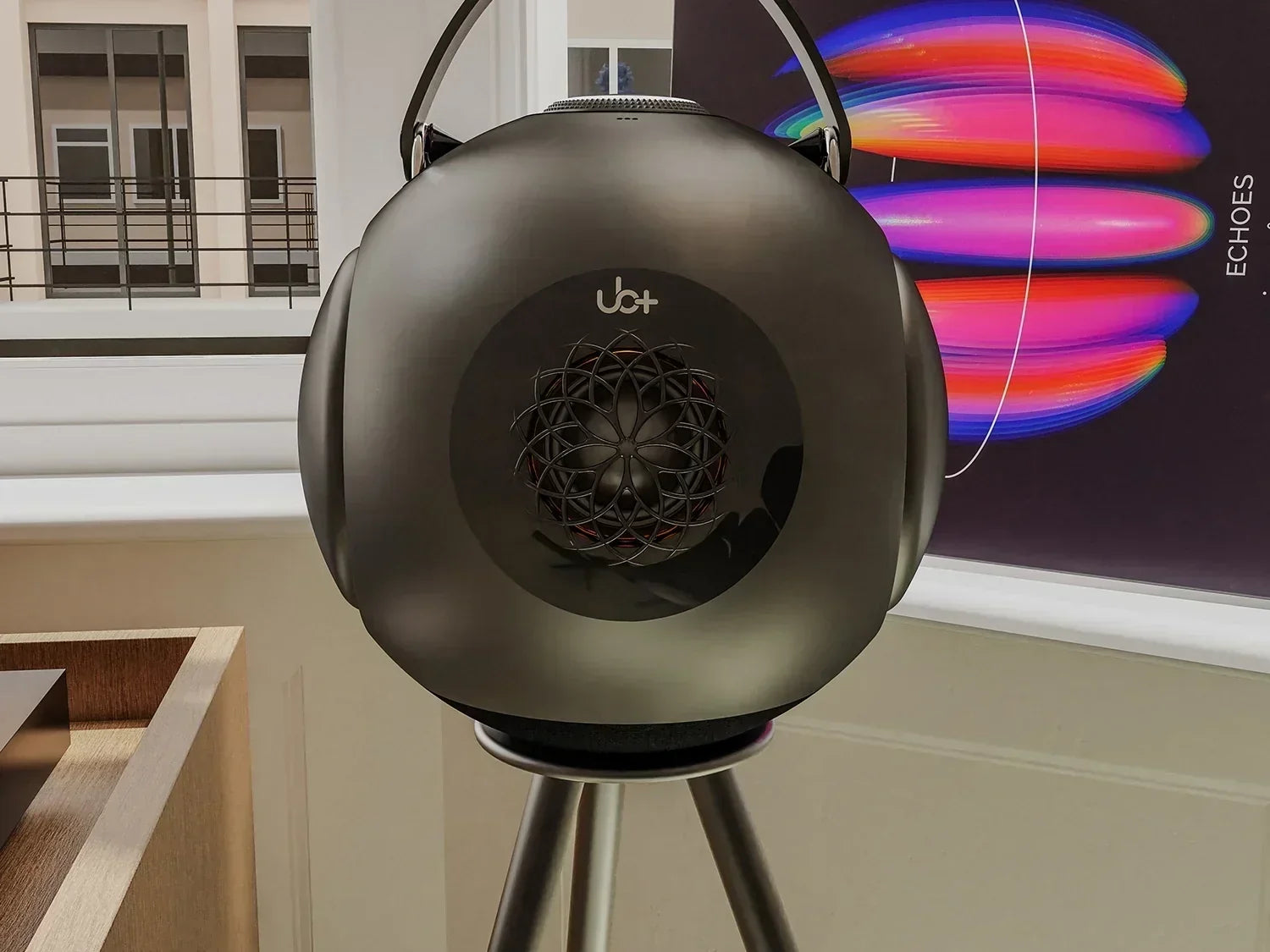
One of the most innovative approaches to solving this problem is found in the UB+ dB1 DoubleBass.
Instead of using a conventional enclosure, it features a patented spherical acoustic chamber inspired by the Helmholtz Resonance principle.
Inspired by the physics of the Helmholtz Resonator, the spherical chamber distributes internal air pressure evenly while significantly reducing standing waves commonly found in box-shaped cabinets.
This engineering helps:
- Reduce cabinet resonance
- Minimize phase distortion
- Improve harmonic reproduction
- Preserve instrument separation
- Enhance tonal accuracy
Rather than acting as a simple housing, the enclosure becomes an active component of the speaker's acoustic system.
Mechanical Engineering Produces More Natural Bass
Deep bass is one of the most difficult challenges for compact Bluetooth speakers.
Many manufacturers compensate through aggressive Digital Signal Processing (DSP).
Although electronically boosted bass may seem impressive initially, it often masks fine musical detail and introduces distortion.
The UB+ dB1 follows a fundamentally different engineering philosophy.
Its 4.5-inch downward-firing long-throw mid-bass driver directs energy into the spherical chamber.
As pressure builds evenly inside the enclosure, it activates dual symmetrical passive radiators positioned on opposite sides.
This patented architecture creates mechanical bass amplification, allowing acoustic physics not software to generate deep, controlled bass.
The combined passive radiator surface area is approximately 3.5× larger than the active woofer, enabling substantially greater air movement than conventional compact speaker designs.
The opposing passive radiators also create a self-cancelling vibration architecture, minimizing cabinet movement while directing more energy into useful bass output.
The onboard DSP continuously monitors system performance and protects the drivers, but it does not artificially generate bass, allowing the speaker's physical engineering to define its sound character.
Premium Components Matter More Than Marketing Claims
Exceptional sound depends on the quality of every internal component.
The UB+ dB1 incorporates premium technologies including:
- 90 mm oversized neodymium magnet
- 35 mm long-stroke voice coil
- 20 mm piston movement
- 18 mm extra-wide surround
- Aluminum shorting ring
Together these components improve driver control, reduce distortion, and maintain accuracy throughout demanding musical passages.
Combined with:
- 40 Hz–20 kHz frequency response
- 93 dB SPL
- Bluetooth 5.3
- Up to 20 hours of battery life
the result is a wireless speaker capable of delivering premium sound both indoors and outdoors without compromising portability.
Marketing Hype vs. Genuine Audiophile Performance
Many advertising campaigns highlight specifications that sound impressive but have limited impact on real listening quality.
Instead of chasing marketing claims, focus on engineering that genuinely improves musical reproduction.
Features That Matter
- Balanced frequency response
- Cabinet engineering
- Low distortion
- Wide soundstage
- Accurate imaging
- Premium driver components
- Natural bass reproduction
- Stable Bluetooth performance
Features That Often Receive Too Much Attention
- Extremely high wattage numbers
- Artificial "Mega Bass" modes
- Flashing LED light shows
- Overly boosted EQ presets
- Marketing terminology without technical explanation
An audiophile-grade speaker is designed to let the music speak for itself rather than relying on exaggerated effects.
Why Long-Term Listening Matters More Than an Impressive First Demo
One of the biggest mistakes people make when shopping for the best audiophile bluetooth speakers is judging sound quality after only a few minutes of listening.
Many speakers are intentionally tuned to create an immediate "wow" effect. Heavy bass, boosted treble, and aggressive loudness can sound exciting during a short in-store demonstration, but those same characteristics often become tiring after an hour or two.
True audiophile performance is different.
A well-engineered speaker remains enjoyable during long listening sessions because it emphasizes balance instead of exaggeration. Whether you're listening to classical music, jazz, acoustic recordings, rock, podcasts, or modern pop, the sound should remain natural and engaging without causing listening fatigue.
The best audiophile speakers are designed to reveal musical detail while maintaining comfort over time.
What to Listen for Before Buying
Specifications are useful, but your ears should always make the final decision.
When evaluating a premium Bluetooth speaker, pay attention to the following characteristics.
Vocal Clarity
Vocals should sound realistic and centered.
A quality speaker allows you to hear subtle breathing, vocal textures, and emotion without sounding harsh or recessed.
Instrument Separation
Every instrument should occupy its own space.
Instead of blending together, guitars, pianos, percussion, and vocals should remain easy to distinguish.
Good separation creates a more immersive and realistic performance.
Soundstage
Premium speakers create the impression that music extends beyond the physical cabinet.
A wide soundstage provides greater openness while helping recordings sound more natural.
Bass Control
Bass should support the music not dominate it.
Listen for:
- Tight bass
- Controlled impact
- Clean low frequencies
- No excessive boominess
Natural bass improves nearly every genre of music.
Treble Smoothness
Treble should provide detail without becoming sharp or fatiguing.
Well-controlled high frequencies allow extended listening sessions without discomfort.
Why Engineering Is More Important Than Marketing
Many Bluetooth speakers depend heavily on aggressive Digital Signal Processing (DSP) to create an exciting first impression.
While DSP plays an important role in protecting drivers and optimizing playback, excessive processing often masks musical detail.
Premium engineering begins long before software becomes involved.
The UB+ dB1 DoubleBass demonstrates this philosophy through its patented Helmholtz Resonance-inspired spherical acoustic chamber.
Inspired by the physics of the Helmholtz Resonator, the spherical enclosure distributes internal air pressure evenly while reducing standing waves, minimizing phase distortion, and improving harmonic reproduction.
Instead of compensating for cabinet limitations electronically, the enclosure itself contributes to cleaner and more accurate sound reproduction.
Mechanical Bass That Preserves Musical Detail
One of the defining characteristics of premium audio is bass that feels powerful without overwhelming the rest of the music.
The UB+ dB1 achieves this through mechanical engineering rather than artificial enhancement.
Its 4.5-inch downward-firing long-throw mid-bass driver works inside the spherical chamber to generate evenly distributed air pressure.
This pressure activates dual symmetrical passive radiators mounted on opposite sides of the enclosure.
The result is mechanical bass amplification, allowing acoustic physics not excessive DSP to create deep, controlled bass.
The combined passive radiator surface area is approximately 3.5× larger than the active woofer, enabling substantially greater air movement than many conventional compact speakers.
At the same time, the opposing passive radiators form a self-cancelling vibration architecture, reducing cabinet movement while directing more energy into useful bass output.
The onboard DSP continuously monitors system performance and protects the speaker, but it does not artificially generate bass, preserving the natural balance of the recording.
Premium Components Deliver Lasting Performance
Exceptional sound quality depends on precision engineering throughout the entire speaker.
The UB+ dB1 incorporates premium technologies including:
- 90 mm oversized neodymium magnet
- 35 mm long-stroke voice coil
- 20 mm piston movement
- 18 mm extra-wide surround
- Aluminum shorting ring
Together these components improve efficiency, maintain accurate cone movement, and reduce distortion even during demanding musical passages.
Combined with:
- 40 Hz–20 kHz frequency response
- 93 dB SPL
- Bluetooth 5.3
- Up to 20 hours of battery life
the speaker delivers reliable performance whether you're listening at home, in the office, or outdoors.
Standard Bluetooth Speaker vs. Audiophile Bluetooth Speaker
|
Feature |
Standard Bluetooth Speaker |
Audiophile Bluetooth Speaker |
|
Sound Tuning |
Bass & Treble Boosted |
Balanced, Accurate |
|
Soundstage |
Limited |
Wide and Natural |
|
Channel Separation |
Average |
Excellent |
|
Cabinet Design |
Rectangular Cabinet |
Patented Helmholtz Resonance-Inspired Spherical Chamber |
|
Internal Resonance |
Higher Standing Waves |
Reduced Standing Waves |
|
Harmonic Reproduction |
Standard |
Enhanced |
|
Phase Distortion |
More Noticeable |
Minimized |
|
Bass Technology |
DSP Bass Boost |
Mechanical Bass Amplification |
|
Driver Layout |
Conventional |
4.5-inch Downward-Firing Mid-Bass Driver |
|
Passive Radiators |
Single or Small |
Dual Symmetrical Passive Radiators |
|
Radiator Surface Area |
Standard |
3.5× Larger Than Active Woofer |
|
Cabinet Vibration |
Noticeable |
Self-Cancelling Vibration Architecture |
|
Bluetooth Version |
Older Standards |
Bluetooth 5.3 |
|
Battery Life |
Average |
Up to 20 Hours |
Audiophile Buyer's Checklist
Before investing in the best audiophile bluetooth speakers, ask yourself:
✔ Does the speaker reproduce music naturally rather than exaggerating bass?
✔ Is the cabinet engineered to reduce standing waves and resonance?
✔ Does it provide a wide soundstage with good instrument separation?
✔ Are premium driver components used?
✔ Does it rely on mechanical bass rather than excessive DSP?
✔ Does it include modern Bluetooth connectivity?
✔ Will it remain enjoyable during long listening sessions?
If the answer is "yes" to most of these questions, you're looking at a speaker designed around genuine audio engineering rather than marketing trends.
Frequently Asked Questions
1. What makes the best audiophile Bluetooth speakers different?
They focus on accurate sound reproduction, premium driver technology, intelligent cabinet engineering, low distortion, and balanced tuning instead of simply producing louder bass or higher volume.
2. Is soundstage important for Bluetooth speakers?
Yes. A wider soundstage creates a more spacious and immersive listening experience, making music feel more natural and lifelike.
3. Why does channel separation matter?
Good channel separation allows individual instruments and vocals to remain distinct, improving clarity and realism.
4. Can portable Bluetooth speakers satisfy audiophiles?
Absolutely. Advances in driver technology, cabinet engineering, and wireless connectivity allow many premium portable speakers to deliver outstanding high-fidelity performance.
5. Is a premium Bluetooth speaker worth the investment?
For listeners who value sound quality, durability, and long-term enjoyment, a thoughtfully engineered premium speaker typically provides much greater value than replacing cheaper models over time.
Conclusion
Choosing the best audiophile bluetooth speakers involves much more than comparing price tags or marketing claims. Genuine audiophile performance comes from balanced tuning, intelligent cabinet engineering, premium driver components, controlled bass, and the ability to reproduce music naturally over years of listening.
Whether you're upgrading your current audio system or purchasing your first premium wireless speaker, prioritize engineering over hype. A well-designed speaker will continue revealing new details in your favorite recordings long after the excitement of the purchase has faded.
Smarter Engineering Creates Better Sound
The UB+ dB1 DoubleBass demonstrates how thoughtful engineering creates authentic audiophile performance. Its patented Helmholtz Resonance-inspired spherical acoustic chamber, based on the principles of the Helmholtz Resonator, distributes internal air pressure evenly to reduce standing waves, minimize phase distortion, and improve harmonic reproduction, preserving the clarity and realism that discerning listeners expect.
A 4.5-inch downward-firing mid-bass driver works with dual symmetrical passive radiators featuring a combined surface area approximately 3.5× larger than the active woofer. This patented design delivers mechanical bass amplification and a self-cancelling vibration architecture, converting energy into deep, controlled bass instead of cabinet vibration. Combined with a 90 mm oversized neodymium magnet, 35 mm long-stroke voice coil, 20 mm piston movement, 18 mm extra-wide surround, aluminum shorting ring, 40 Hz–20 kHz frequency response, 93 dB SPL, Bluetooth 5.3, and up to 20 hours of battery life, the dB1 offers a refined listening experience built on acoustic science rather than artificial DSP-generated effects.
Compare UB+'s flagship speakers to find the model that best matches your listening preferences, room size, and lifestyle.
Explore premium finishes that combine award-winning industrial design with advanced acoustic engineering.
View the latest specifications, pricing, and availability directly from UB+.
Because the best audiophile speaker doesn't just sound impressive for five minutes.
It continues to reveal the music's depth, detail, and emotion every time you listen.



댓글 남기기
이 사이트는 hCaptcha에 의해 보호되며, hCaptcha의 개인 정보 보호 정책 과 서비스 약관 이 적용됩니다.