
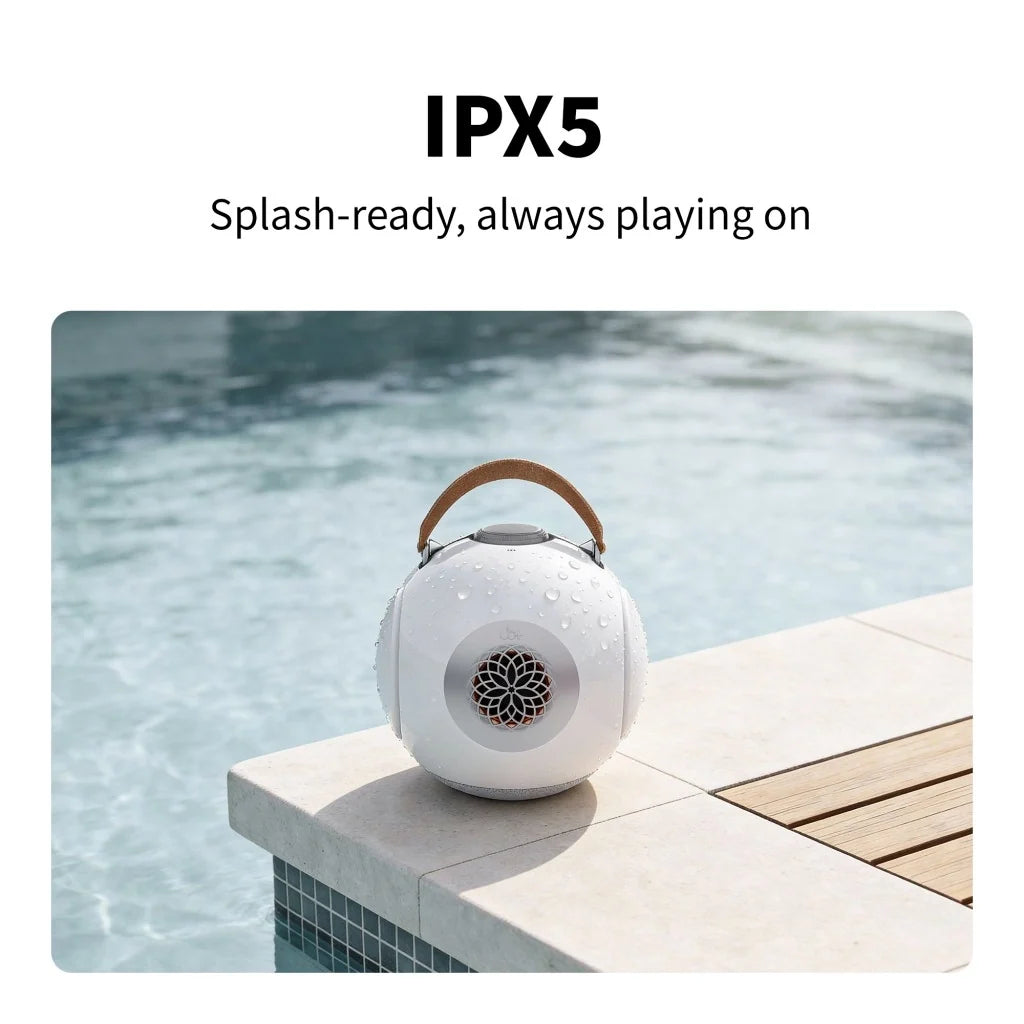
Water resistance is an important consideration when choosing a portable Bluetooth speaker. Whether a speaker is used in a kitchen, home gym, patio, garden, bathroom, or outdoor gathering, accidental exposure to moisture can become a concern. Water droplets, splashes, sweat, and unexpected rain can all create risks for electronic equipment that has not been designed with suitable environmental protection.
However, not every portable speaker offers the same level of protection. Terms such as waterproof, water-resistant, splash-resistant, and weather-resistant are frequently used in product descriptions, but they do not necessarily describe identical capabilities. The most reliable starting point is the product's official Ingress Protection (IP) classification.
When evaluating a splash proof bluetooth speaker, buyers should understand what its water-resistance rating actually covers, which environmental conditions it can withstand, and where its limitations begin. An IPX5 rating, for example, indicates resistance to specified water jets. It does not mean a speaker can be submerged or used underwater.
UB+ offers two portable models worth examining for different listening requirements: the UB+ dB1 DoubleBass and the UB+ dB Mini. The dB1 has a confirmed IPX5 rating, while an equivalent IPX5 classification for the dB Mini has not been established in the product information available for this comparison.
The distinction is important because portable design and water protection are separate product characteristics. A compact speaker may be convenient to carry, but that does not automatically mean its enclosure has been tested against water exposure.
Understanding IP Ratings and IPX5 Water Protection

IP stands for Ingress Protection. The classification system identifies how effectively an electrical enclosure protects against the entry of solid objects and water under defined testing conditions.
An IP rating normally contains two characters after the letters IP. The first character identifies protection against solid particles, while the second identifies protection against water.
For example, IP67 contains two separate protection classifications. The first digit relates to solid-object protection, and the second relates to water protection.
With IPX5, the X indicates that no solid-particle protection rating is specified within that classification. The number 5 identifies resistance to water projected through a nozzle under standardized testing conditions.
In practical terms, IPX5 is designed to demonstrate resistance to qualifying water jets from different directions. This is more meaningful than a general product description that simply says a speaker is splash-resistant.
Breaking Down the IPX5 Classification
|
Rating Element |
Meaning |
What Buyers Should Understand |
|
IP |
Ingress Protection |
Identifies an enclosure protection classification |
|
X |
No solid-particle rating specified |
Does not provide a documented dust-protection level |
|
5 |
Water-jet protection |
Indicates resistance to qualifying water jets under standardized testing |
The classification matters because portable speakers contain several potential points of water entry. These may include enclosure joints, buttons, charging connections, acoustic openings, and other external interfaces.
A properly engineered enclosure must account for these areas as part of the complete product. The rating applies to the tested device under the relevant conditions, not to an assumption that every internal component is independently waterproof.
IPX5 vs. Other Common Water-Resistance Ratings
Different IP classifications describe different forms of water exposure. Understanding their differences helps buyers avoid choosing a speaker based on an incorrect interpretation of its specifications.
|
Rating |
Water Protection |
Practical Interpretation |
|
IPX4 |
Water splashes from any direction |
Protection against qualifying splashing |
|
IPX5 |
Water jets from any direction |
Designed to withstand specified projected water exposure |
|
IPX6 |
Powerful water jets |
Protection against more forceful water jets under testing conditions |
|
IPX7 |
Temporary immersion under specified conditions |
Tested for temporary immersion at a defined depth and duration |
|
IPX8 |
Continuous immersion under specified conditions |
Tested under manufacturer-defined immersion conditions |
These classifications should not be interpreted as a simple ladder where every higher number automatically includes every lower-numbered test. Water-jet resistance and immersion resistance involve different physical conditions.
For example, IPX5 focuses on water projected toward the enclosure, while IPX7 focuses on temporary immersion. A speaker that passes an IPX5 test has not automatically passed an IPX7 immersion test.
For buyers, the important question is not simply which rating has the highest number. It is which classification corresponds to the type of water exposure the speaker is expected to encounter.
UB+ dB1 DoubleBass: IPX5 Protection and Advanced Acoustic Engineering

The UB+ dB1 DoubleBass combines portable wireless playback with a distinctive acoustic architecture. Its confirmed IPX5 classification makes it the relevant UB+ option in this comparison for buyers who want documented protection against qualifying water jets.
This protection can be useful in everyday environments where accidental water exposure is possible. A speaker may be positioned near a kitchen counter, used during an outdoor gathering, or placed in an area where occasional splashing is more likely than in a conventional indoor listening room.
IPX5 provides a defined level of water-jet resistance under standardized testing conditions. It does not mean the speaker can be submerged, left underwater, or exposed indefinitely to uncontrolled weather.
Everyday Environments Where IPX5 Can Be Useful
A portable speaker often moves between different environments throughout the day. Its protection classification can influence where it can be used with greater confidence.
For the dB1, the confirmed IPX5 rating is relevant to several everyday scenarios:
- Kitchen listening: Water exposure can occur around sinks, counters, and food-preparation areas. IPX5 provides a defined level of resistance to qualifying water jets, although keeping the speaker away from direct water contact remains sensible.
- Outdoor gatherings: Accidental splashes are less concerning than they would be with an unrated device, but the speaker should still be moved to shelter during severe weather.
- Home workouts: Moisture can accumulate around exercise equipment. The rating provides a documented protection level, but users should follow the manufacturer's instructions regarding sweat and cleaning.
- Patios and balconies: A portable speaker can be used in more varied environments, provided it is not left exposed to prolonged or uncontrolled weather conditions.
- Everyday portable use: Moving between indoor and outdoor listening areas becomes more convenient when the speaker has a documented water-jet protection classification.
These examples are practical applications, not separate certifications for each environment. The actual limits remain defined by the testing conditions and manufacturer's instructions.
Acoustic Spotlight: The dB1's Spherical Helmholtz-Inspired Bass Architecture

Water protection is only one part of the dB1's engineering. Its acoustic architecture is particularly relevant to buyers who want to understand how a compact portable speaker can produce controlled low-frequency output.
The dB1 uses a patented spherical acoustic chamber inspired by the Helmholtz resonator principle, associated with the work of Hermann von Helmholtz. Instead of relying on a conventional rectangular box with parallel internal walls, the spherical enclosure changes the internal acoustic environment and the way pressure and reflections behave.
Its architecture brings together several important components:
- Spherical acoustic chamber: The geometry avoids the same pattern of parallel internal walls found in conventional box enclosures and can help manage certain internal resonance and reflection behaviors.
- 4.5-inch mid-bass driver: A centrally positioned, downward-firing driver generates the primary acoustic energy inside the chamber.
- 90mm oversized neodymium magnet: The motor structure supports the driver's magnetic system and its ability to control diaphragm movement.
- 35mm long-stroke voice coil: The extended coil design supports greater mechanical excursion.
- Approximately 20mm piston movement: The driver is designed for substantial movement, which is relevant to producing low-frequency output from a compact enclosure.
- Aluminum shorting ring: This motor-system component is intended to help manage certain forms of magnetic nonlinearity and distortion.
- Extra-wide 18mm surround: The surround supports controlled diaphragm movement during larger excursions.
- Two symmetrical passive-radiator plates: Positioned on opposite sides, the radiators respond to internal pressure generated by the active driver.
- Approximately 3.5× combined radiator surface area: The total passive-radiator area is approximately 3.5 times the woofer's area.
The passive radiators move in response to changing internal air pressure. This arrangement helps extend bass output without relying exclusively on additional electrical power. Their symmetrical movement is intended to counterbalance certain mechanical forces and reduce some enclosure vibration.
The spherical chamber also influences internal pressure distribution and acoustic behavior. Its geometry can reduce certain parallel-wall resonance problems, but it should not be described as eliminating every standing wave, reflection, or phase-related issue.
The dB1's approach can be summarized by a simple engineering principle: Most speakers try to push harder. dB1 lets air do the work. Mechanical bass amplification comes from the interaction between the active driver, internal air pressure, and passive-radiator system rather than from simply increasing amplifier power.
DSP also plays a role in the overall system. Digital signal processing supports tonal balance, response shaping, and driver protection. It is not accurate to describe the design as completely DSP-free or to suggest that mechanical bass architecture makes signal processing unnecessary.
Additional dB1 Audio and Connectivity Specifications
The dB1's wider specifications help buyers evaluate the speaker beyond its water-resistance classification.
|
Specification |
UB+ dB1 DoubleBass |
|
Active driver |
4.5-inch mid-bass driver |
|
Frequency response |
Approximately 40Hz–20kHz |
|
Maximum SPL specification |
Approximately 93dB SPL |
|
Wireless connectivity |
Bluetooth 5.3 |
|
Playback options |
Bluetooth, wired, and TF playback |
|
Maximum playback time |
Up to 20 hours |
|
Water resistance |
IPX5 |
|
Stereo capability |
Stereo pairing |
The approximately 93dB SPL figure should be considered alongside its measurement conditions, which are important when comparing maximum acoustic output between products. Similarly, the stated frequency range does not independently describe response flatness, distortion, or performance at maximum volume.
These specifications describe different aspects of the speaker. Frequency response indicates its stated operating range, SPL relates to acoustic output, Bluetooth 5.3 identifies its wireless connection generation, and IPX5 describes its water-jet protection.
For a deeper understanding of the acoustic principles behind these components, it is useful to distinguish between passive-radiator systems and ported speaker designs. Each approach manages enclosure air pressure differently, and implementation determines the final acoustic result.
UB+ dB Mini: Compact Portability and a Separate Water-Protection Check

The UB+ dB Mini is a compact portable speaker designed for users who value convenient everyday listening and a smaller portable format.
Its compact construction makes it practical for moving between rooms or taking music along during daily activities. The model offers up to 20 hours of playback, although actual runtime varies with listening volume, audio content, connectivity, and operating conditions.
For buyers comparing compact Bluetooth speakers, the dB Mini should be evaluated according to its own specifications rather than treated as a smaller version of the dB1. Different models can use different enclosure structures, component arrangements, and environmental-protection approaches.
That is particularly important when discussing water resistance.
An IPX5 rating is confirmed for the dB1, but an equivalent IPX5 classification for the dB Mini has not been established in the product information available for this comparison. It would therefore be inaccurate to describe both models as IPX5-rated or suggest that the dB Mini can withstand the same water exposure.
What Should You Check Before Using the dB Mini Around Water?

Before exposing the dB Mini to moisture, buyers should verify its current manufacturer specifications and care instructions. A product's compact size or portable design is not enough to determine whether its enclosure has been tested against water.
Important details to check include:
- Official IP classification: Look for a published IP rating in the current product specifications or documentation.
- Charging-port protection: Check whether the charging connection has a protective cover or specific moisture precautions.
- Enclosure construction: Seams, buttons, openings, and external interfaces are potential areas where water protection matters.
- Cleaning instructions: Follow the manufacturer's recommended cleaning method rather than rinsing the speaker or applying cleaning products directly.
- Warranty limitations: Review the terms covering liquid damage, since water-related damage may not be covered even when a device has some degree of water resistance.
Until a specific rating is confirmed, the safest approach is to keep the dB Mini away from direct splashes, water jets, and wet surfaces.
This does not make the model unsuitable for portable listening. It simply means its confirmed portability and battery characteristics should be considered separately from water-protection claims that have not been verified.
Why Compact Design Does Not Automatically Mean Water Resistance

Compact Bluetooth speakers are often designed for portability, but a smaller enclosure does not automatically provide better protection against water.
The complete enclosure must be designed to manage potential entry points, including:
- External control interfaces.
- Charging and connection ports.
- Housing joints and structural seams.
- Driver and other acoustic interfaces.
- Areas where different materials or enclosure components meet.
A compact speaker can be engineered with strong environmental protection, but that protection must be established through documented specifications and testing. Without a confirmed rating, buyers should avoid making assumptions based on appearance.
How Water Resistance Works in a Portable Bluetooth Speaker
Water protection is more complicated than adding a protective outer shell. A portable speaker must maintain its acoustic function while limiting the entry of water into sensitive electronic areas.
The enclosure has to accommodate acoustic components, mechanical movement, electrical connections, and external controls. These requirements create a design challenge because openings and interfaces can become potential entry points.
Enclosure Sealing and Structural Interfaces
The enclosure is the first line of defense against water entering the speaker. Manufacturers must consider how different components connect and how those connections behave during normal use.
Several design considerations are especially important:
- Housing joints: Connections between enclosure sections require appropriate sealing.
- Control interfaces: Buttons and external controls must be integrated without compromising the intended protection.
- Charging connections: Ports require careful design because they create access points for electrical connections.
- Acoustic openings: Drivers and other sound-producing components must be integrated into the enclosure while maintaining its intended protective characteristics.
- Material durability: The enclosure must maintain its structure and protective performance during normal handling and use.
The complete product must be considered. A strong outer material alone does not establish water resistance if other interfaces allow moisture to enter.
The Relationship Between Acoustic Design and Environmental Protection

A portable speaker's acoustic architecture also influences how its enclosure is constructed. Internal volume, driver mounting, radiator arrangement, and structural interfaces all contribute to the final design.
For example, a passive-radiator system uses a moving diaphragm to respond to pressure changes inside the enclosure. Its operation is part of the speaker's acoustic behavior, while the surrounding structure must support the intended movement and protection requirements.
Other important technical considerations include:
- Driver excursion: The distance a diaphragm moves during playback. Greater movement can help a driver reproduce low frequencies, but it also creates mechanical and thermal demands.
- Enclosure volume: The internal air space influences the acoustic behavior of the driver and enclosure system.
- Passive-radiator tuning: The relationship between the radiator and enclosure affects low-frequency performance.
- Frequency response: The range of frequencies a speaker reproduces and how evenly it reproduces them.
- DSP: Digital signal processing used to shape frequency response, manage tonal balance, and protect drivers.
- Thermal management: The ability to manage heat generated by the amplifier and other electronic components.
- THD (Total Harmonic Distortion): A measurement of unwanted harmonic components introduced during audio reproduction.
- Dynamic range: The difference between the quietest and loudest signals a system can reproduce within its operating limits.
- Sound dispersion: How sound energy spreads through the listening area.
- Off-axis response: How the frequency balance changes when a listener moves away from the speaker's primary listening direction.
- Phase coherence: The timing relationship between different sound components, which can influence imaging and integration in multi-driver or paired-speaker systems.
These technical concepts help explain speaker performance, but they do not establish an IP classification by themselves. Acoustic engineering and environmental protection must be evaluated as separate parts of the complete product design.
For more background, buyers can explore the key specifications that matter when comparing speakers and how speaker distortion influences sound quality.
What an IPX5 Speaker Can and Cannot Survive

The word waterproof is often used loosely in product marketing, but buyers need practical boundaries. Understanding what an IPX5 rating covers helps prevent misuse and reduces the risk of accidental damage.
For the UB+ dB1, the confirmed rating indicates resistance to qualifying water jets under standardized testing conditions. It does not establish unlimited protection against moisture.
|
Situation |
What IPX5 Indicates |
Practical Recommendation |
|
Accidental splashes |
Protection against specified water exposure |
Use with normal care |
|
Qualifying water jets |
Designed to withstand water jets under standardized conditions |
Follow manufacturer instructions |
|
Light outdoor moisture |
Not a blanket guarantee for every weather condition |
Avoid prolonged exposure |
|
Heavy rain |
Not an unlimited weatherproofing guarantee |
Move the speaker to a protected area |
|
Temporary immersion |
Not covered by the IPX5 rating |
Do not submerge |
|
Swimming pool use |
Does not establish underwater protection |
Keep the speaker out of the water |
|
Saltwater exposure |
Not established by the rating |
Avoid direct contact and follow care instructions |
|
Soap or detergent |
Not established by the rating |
Avoid chemical exposure |
|
High-pressure cleaning |
Not automatically covered by the rating |
Do not use pressure washers or assume stronger jets are safe |
The table is particularly relevant to anyone choosing a splash proof bluetooth speaker for outdoor or moisture-prone environments. IPX5 provides meaningful water-jet protection, but it should not be confused with complete waterproofing.
Water Jets and Immersion Are Different Tests
Water jets and immersion create different physical conditions.
During a water-jet test, water is projected toward the enclosure under specified pressure and flow conditions. During immersion, water surrounds the device and applies pressure across its exposed surfaces. Depth and duration also become important.
A speaker that passes an IPX5 water-jet test has not automatically passed an IPX7 immersion test. That is why the dB1 should not be treated as suitable for underwater listening or placed in a swimming pool.
The same principle applies when comparing products with different IP ratings. Buyers should identify the type of exposure they expect and select a classification that addresses that specific requirement.
Saltwater, Chlorine, and Cleaning Products
IP classifications do not automatically establish resistance to corrosive substances or cleaning chemicals.
Saltwater can leave deposits and contribute to corrosion. Chlorinated pool water and household cleaning products may also affect exterior materials, seals, and exposed surfaces. Even if a speaker has a documented water-resistance rating, that does not mean it is designed for repeated exposure to these substances.
For safer maintenance:
- Avoid placing the speaker where saltwater or pool chemicals can splash onto it.
- Do not use detergents or solvents unless the manufacturer specifically permits them.
- Avoid spraying cleaning products directly onto the enclosure.
- Follow the recommended method for removing dust and surface residue.
- Keep charging connections dry before connecting power.
These precautions are useful because water resistance and chemical resistance are different properties.
Does IPX5 Mean a Speaker Can Be Left Outside?
No. IPX5 should not be interpreted as a permanent outdoor-weather rating.
A speaker left outside may encounter more than water jets. It may experience prolonged rain, humidity, direct sunlight, temperature changes, dust, wind-driven debris, and accidental physical impact.
An IP rating addresses specific ingress conditions, not every environmental factor. For longer-term outdoor use, the manufacturer's guidance should determine whether the product can remain outside and under what conditions.
UB+ dB1 DoubleBass vs. dB Mini: Which Model Should You Choose?
The dB1 and dB Mini address different portable listening priorities. The dB1 is the more straightforward option when a confirmed IPX5 rating is an important purchase requirement. The dB Mini is a compact portable alternative with a confirmed maximum playback time of up to 20 hours, but its water-resistance rating should be checked independently.
|
Feature |
UB+ dB1 DoubleBass |
UB+ dB Mini |
|
Product category |
Portable Bluetooth speaker |
Compact portable Bluetooth speaker |
|
Confirmed water rating |
IPX5 |
No equivalent IP rating confirmed here |
|
Maximum playback time |
Up to 20 hours |
Up to 20 hours |
|
Acoustic design |
Spherical chamber with symmetrical passive-radiator system |
Separate compact design; do not assume dB1 architecture |
|
Primary consideration |
Acoustic engineering and documented water-jet resistance |
Compact portability and everyday listening |
|
Suitable buying priority |
Buyers who need a confirmed IPX5 rating |
Buyers who prioritize compact portable listening and verify protection requirements |
Choose the dB1 DoubleBass If Water Resistance Is a Priority
The dB1 is the more suitable model to examine when documented IPX5 protection is part of the buying decision.
It is worth considering if you want:
- A portable speaker with a confirmed rating for qualifying water-jet exposure.
- More flexibility in environments where accidental water exposure is possible.
- A distinctive spherical acoustic enclosure and passive-radiator bass system.
- A 4.5-inch mid-bass driver and engineered low-frequency architecture.
- Up to 20 hours of maximum playback time.
- Bluetooth 5.3 and multiple playback options.
- A combination of environmental protection and technically developed acoustic design.
The rating still has limits, but it gives buyers a defined protection specification to evaluate. It is particularly useful when comparing a portable speaker with products that make general water-resistant claims without clearly identifying their IP classifications.
Choose the dB Mini If Compact Portability Is the Priority
The dB Mini is worth considering when a smaller portable format and everyday convenience matter more than a confirmed water-resistance classification.
It may be a better fit if you want:
- A compact speaker for moving between rooms.
- Portable music playback for everyday activities.
- Up to 20 hours of maximum playback time.
- A model that can be evaluated independently based on its size, sound, and intended use.
If you specifically need a water-resistant speaker, confirm the dB Mini's current official IP rating before buying or using it in environments where splashes are expected. Do not assume that the dB1's IPX5 specification applies to the smaller model.
Battery Life: Another Important Comparison Factor
Battery runtime becomes particularly important when a speaker is used away from a charging point. A longer maximum playback time can reduce the need for frequent charging during travel, outdoor activities, and everyday listening.
Both models offer up to 20 hours of playback. However, maximum runtime should not be confused with guaranteed performance at every volume level.
Actual battery life can change according to:
- Listening volume and amplifier demand.
- Type of audio being played.
- Wireless connectivity and operating conditions.
- Battery age and charging habits.
- Temperature and other environmental factors.
For a fair comparison, consider maximum runtime as a reference figure rather than an exact estimate of how long the speaker will operate during every listening session.
How to Maintain an IPX5-Rated Bluetooth Speaker
Even a properly rated speaker benefits from sensible maintenance. Water resistance is a design characteristic, not permission to expose electronics to moisture unnecessarily.
Good care habits can help preserve the enclosure, protect electrical connections, and reduce the risk of avoidable damage.
Keep Charging Connections Dry
Charging ports and electrical connections deserve particular attention. Before connecting a charging cable, make sure the relevant port is dry and free from visible moisture.
Avoid charging a speaker while it is wet. If it has been exposed to water, follow the manufacturer's drying instructions before reconnecting it to a power source.
Never assume that the external water-resistance rating makes it safe to charge a wet device. Electrical connections should be treated with particular care.
Avoid Unnecessary Water Exposure
The purpose of IPX5 is to provide a defined level of protection, not to encourage repeated water testing.
For normal use:
- Do not deliberately spray the speaker to test its rating.
- Do not leave it beside a pool where it could fall into the water.
- Avoid placing it directly under heavy rain.
- Keep it away from sinks, bathtubs, and other locations where immersion is possible.
- Store it in a dry place when it is not being used.
- Avoid exposing it to cleaning chemicals or corrosive liquids.
A protective rating is most useful when combined with sensible handling.
Inspect the Enclosure Regularly
Physical damage can affect a device's ability to resist water. Cracks, damaged seams, loose components, or worn protective parts may compromise the original enclosure design.
If the speaker has been dropped or damaged, do not assume that its original water-resistance performance remains unaffected. Visible damage is a reason to stop relying on the original rating until the product has been inspected.
Follow Manufacturer Cleaning Instructions
Do not use solvents, abrasive materials, or aggressive cleaning chemicals unless the manufacturer specifically permits them. A soft, appropriate cleaning method is generally preferable for routine exterior care.
Avoid forcing water into openings or using high-pressure equipment beyond the conditions covered by the rating. The goal is to maintain the device's condition, not to test its protection repeatedly.
Store the Speaker Properly
Storage also influences long-term product care. When the speaker is not in use, keep it in a dry location away from direct heat and unnecessary moisture.
For portable use, a protective carrying case can help prevent scratches and impact damage. However, a carrying case should not be treated as a substitute for the speaker's own environmental protection rating.
What to Look for When Buying a Water-Resistant Portable Speaker
Water protection should be evaluated alongside sound quality, battery performance, portability, and connectivity. A high IP rating may be useful, but it does not automatically make a speaker the best option for every listening environment.
Before purchasing a splash proof bluetooth speaker, consider the following technical and practical factors.
Water-Resistance Classification
Start with the official IP rating. Look for a complete classification and understand what the water-protection number represents.
For the dB1, IPX5 is confirmed. For the dB Mini, verify the current product documentation rather than assuming the same classification.
Also check whether the rating applies to the complete speaker in its normal operating condition or whether the manufacturer specifies particular precautions, such as keeping a port cover closed.
Battery Runtime
Battery capacity and actual playback time influence how useful a portable speaker is away from a power source.
Both the dB1 and dB Mini offer up to 20 hours of playback. This is a maximum figure rather than a guarantee of identical runtime in every situation. Higher volume levels, wireless connectivity, audio content, and operating conditions can reduce actual playback time.
Acoustic Performance
Water resistance does not tell you how a speaker sounds. Buyers should also evaluate:
- Frequency response: How the speaker reproduces low, midrange, and high frequencies.
- Bass extension: How effectively it reproduces lower frequencies.
- Driver excursion: How far the diaphragm moves to produce sound.
- Distortion behavior: How accurately the speaker reproduces audio as playback levels increase.
- Maximum sound pressure level (SPL): How much acoustic output the speaker can produce.
- Dynamic range: Its ability to reproduce differences between quieter and louder passages.
- Sound dispersion: How sound spreads through the listening area.
- Off-axis response: How the sound changes when the listener is not directly in front of the speaker.
- THD: A measurement of unwanted harmonic components introduced during audio reproduction.
These factors help explain how a speaker performs in real listening environments. They should be assessed using model-specific specifications and credible listening or measurement evidence rather than inferred from an IP rating.
Connectivity and Playback Options
Portable speakers are also judged by how conveniently they connect to audio sources. Buyers should check supported wireless standards, wired playback options where applicable, pairing features, and device compatibility.
Bluetooth version alone does not guarantee better sound quality. Audio codec support, connection stability, source-device compatibility, and implementation all influence the experience.
The best option depends on how the speaker will be used. Someone listening primarily from a smartphone may have different connectivity priorities from someone who wants to connect multiple playback sources.
Portability and Intended Environment
Think about where the speaker will be used most often. A speaker intended for a kitchen, office, or bedroom may have different requirements from one used at outdoor gatherings.
Consider:
- Physical size and ease of transport.
- Placement flexibility.
- Charging requirements.
- Expected listening distance.
- Environmental exposure.
- Whether a documented water rating is essential.
A compact speaker may be convenient for everyday movement, while a model with a confirmed protection classification may be more appropriate when moisture exposure is part of the intended environment.
Warranty and Product Care
Review the warranty terms before purchasing. A water-resistance rating does not necessarily mean that every type of liquid damage is covered. The warranty may also exclude damage caused by misuse, unauthorized modifications, or failure to follow care instructions.
This is particularly important for buyers who intend to use a speaker around pools, bathrooms, or outdoor spaces. Understanding the limitations before purchase is better than discovering them after accidental damage.
Is the UB+ dB1 a Good Choice for Water-Resistant Portable Listening?
The UB+ dB1 DoubleBass is the clear option between these two models when a confirmed IPX5 rating is a requirement. Its water-jet resistance provides a defined level of protection for certain moisture-prone environments, while its spherical acoustic chamber, Helmholtz-inspired design, and symmetrical passive-radiator system address sound reproduction through a separate engineering approach.
Its acoustic architecture also gives buyers more to evaluate than a simple water-resistance specification. The driver, motor structure, long-stroke movement, radiator surface area, enclosure geometry, DSP, and connectivity all contribute to the speaker's overall design.
The UB+ dB Mini offers a compact portable alternative with up to 20 hours of maximum playback time. However, buyers should verify its current water-resistance classification before using it in environments where splashes or water exposure are expected.
The important buying principle is simple: choose a speaker based on its documented protection level, not on assumptions created by its portable design or marketing language. IPX5 provides meaningful water-jet protection, but it is not waterproofing and does not authorize immersion.
For buyers who want a portable UB+ speaker with a confirmed IPX5 rating, the UB+ dB1 DoubleBass is the model to examine first. If compact everyday portability is the main priority, compare it with the UB+ dB Mini and confirm the latter's protection specifications before making a decision.
Frequently Asked Questions
Is the UB+ dB1 DoubleBass waterproof?
No. The UB+ dB1 DoubleBass has an IPX5 water-resistance rating. This means it is designed to withstand qualifying water jets under standardized test conditions. It should not be submerged or treated as waterproof.
What does IPX5 mean on a Bluetooth speaker?
IPX5 indicates protection against water projected through a nozzle from different directions under specified testing conditions. It provides a defined level of water-jet resistance, but it does not establish protection against temporary or continuous immersion.
Can I use the UB+ dB1 in the rain?
The IPX5 rating provides protection against specified water exposure, but it should not be interpreted as an unlimited guarantee for heavy rain or prolonged outdoor exposure. Follow the manufacturer's instructions and move the speaker to a protected location when conditions become severe.
Is the UB+ dB Mini IPX5-rated?
An IPX5 rating for the UB+ dB Mini has not been confirmed in the product information used for this comparison. Check the latest official specifications before exposing it to water. The dB1's IPX5 rating should not be transferred to the dB Mini.
Can an IPX5 Bluetooth speaker be used near a swimming pool?
It may be used in an appropriate poolside environment if the manufacturer permits that use, but IPX5 does not mean the speaker can survive falling into the pool. Keep it away from the water's edge and avoid submersion.
Does IPX5 protect against sweat?
IPX5 describes resistance to specified water jets, not a universal guarantee against every type of moisture exposure. Follow the manufacturer's guidance for sweat, cleaning, and drying rather than assuming that the rating covers every workout condition.
What is the difference between IPX5 and IPX7?
IPX5 tests resistance to water jets, while IPX7 tests protection against temporary immersion under specified conditions. They represent different forms of water exposure, so one should not automatically be treated as a substitute for the other.
Does water resistance affect Bluetooth sound quality?
The IP rating itself does not describe sound quality. Acoustic performance depends on factors such as driver design, enclosure behavior, frequency response, DSP, amplifier performance, and sound dispersion. Water resistance is a separate product-protection characteristic.
How long do the UB+ dB1 and dB Mini batteries last?
Both the UB+ dB1 DoubleBass and UB+ dB Mini offer up to 20 hours of playback. Actual battery life depends on volume, audio content, connectivity, and operating conditions.
What should I do if water gets on my Bluetooth speaker?
Follow the manufacturer's care instructions. Keep the speaker disconnected from charging power while wet, dry it using the recommended method, and do not force water into its openings. If you suspect water has entered the enclosure or the speaker behaves abnormally, stop using it and contact the manufacturer or an authorized service provider.


Laat een reactie achter
Deze site wordt beschermd door hCaptcha en het privacybeleid en de servicevoorwaarden van hCaptcha zijn van toepassing.