
When most people shop for a portable bluetooth speaker or a wireless bluetooth speaker, they focus on features that are easy to compare. Battery life, driver size, Bluetooth version, frequency response, and power ratings often dominate product descriptions.
Yet one of the most important factors influencing sound quality is frequently overlooked:
The speaker cabinet itself.
The material surrounding a speaker driver does far more than provide structural support. The cabinet directly affects vibration control, resonance behavior, bass performance, clarity, distortion levels, and the overall listening experience.
In fact, two speakers using identical drivers and amplifiers can sound noticeably different simply because their cabinet materials and construction methods differ.
This is why premium audio manufacturers invest enormous resources into enclosure design. The cabinet is not merely a container for audio components—it is an active part of the acoustic system.
For anyone searching for the best sounding bluetooth speaker, understanding cabinet materials can help separate genuine engineering advantages from marketing claims.
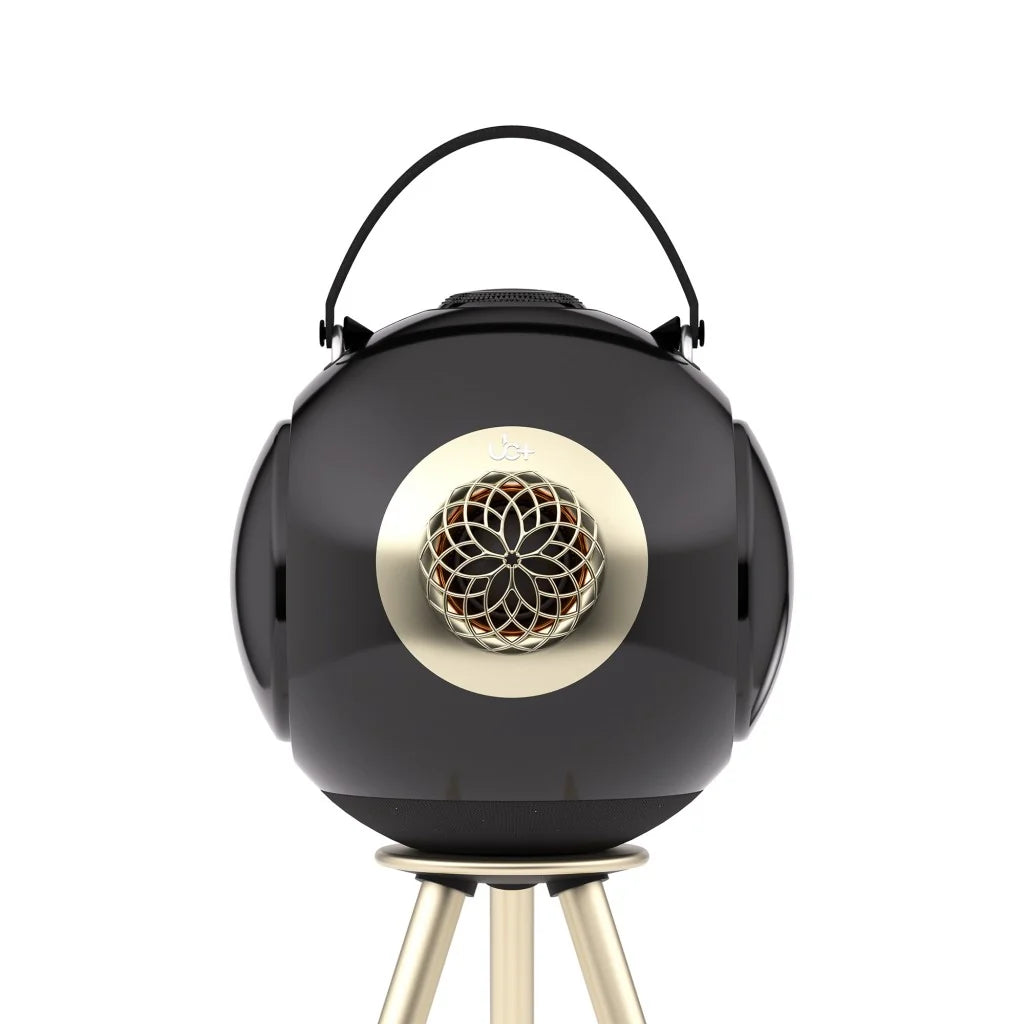
In this guide, we'll explore how speaker cabinet materials influence sound performance, why vibration control matters, how resonance affects audio quality, and why modern designs such as the UB+ dB1 DoubleBass approach enclosure engineering differently from traditional speaker manufacturers.
Why the Speaker Cabinet Matters More Than Most People Realize
A speaker driver creates sound by moving air.
That movement generates energy.
However, not all of that energy becomes music.
Some energy is transferred into:
- Cabinet walls
- Internal air pressure
- Structural vibrations
- Resonant frequencies
If those forces are not controlled properly, the enclosure begins contributing unwanted sound.
Instead of hearing only the music signal, you also hear:
- Cabinet coloration
- Resonance artifacts
- Bass smearing
- Midrange distortion
The result is reduced accuracy.
This is why serious audio engineers often describe the ideal cabinet as one that "disappears."
The enclosure should support sound reproduction without imposing its own sonic character.
Understanding Cabinet Resonance
Every material vibrates.
Wood vibrates.
Plastic vibrates.
Metal vibrates.
Glass vibrates.
The question is not whether a material vibrates, but how it vibrates.
When a speaker operates, its drivers generate mechanical energy.
Some of that energy transfers into the cabinet.
If the cabinet resonates at certain frequencies, those frequencies become exaggerated.
Listeners may perceive:
- Bloated bass
- Boxy mids
- Harsh treble
- Reduced detail
This is one reason why enclosure design plays such an important role in premium audio systems.
What Is Resonance?
Resonance occurs when an object naturally amplifies vibrations at specific frequencies.
Imagine striking a tuning fork.
The fork vibrates at a predictable frequency.
Speaker cabinets behave similarly.
Every enclosure has natural resonant characteristics.
Poorly designed cabinets allow those resonances to become audible.
Well-designed cabinets minimize or control them.
Why Vibration Control Matters
Many consumers evaluate speakers based on volume.
However, controlling vibration is often more important than simply generating louder sound.
Excessive vibration creates several problems:
Energy Loss
Energy that moves the cabinet is energy not being used to move air.
This reduces efficiency.
Bass Inaccuracy
Cabinet movement can blur low frequencies.
The bass may sound larger but less controlled.
Distortion
Vibration introduces unwanted sonic artifacts.
Listening Fatigue
The brain must work harder to interpret distorted information.
Over time, listening becomes less enjoyable.
This is why vibration management is a major focus of modern speaker engineering.
Common Speaker Cabinet Materials
Different manufacturers use different materials depending on performance goals and budget constraints.
Let's examine the most common options.
Plastic Cabinets
Plastic is widely used in affordable Bluetooth speakers.
Advantages include:
- Lightweight construction
- Lower manufacturing cost
- Easy shaping
- Water resistance
However, plastic can also introduce challenges.
Potential drawbacks include:
- Increased resonance
- Flexing under pressure
- Reduced rigidity
A well-engineered plastic cabinet can perform surprisingly well, but material limitations remain.
Wood Cabinets
Wood has long been popular in traditional hi-fi speakers.
Benefits include:
- Natural damping properties
- Attractive appearance
- Strong structural integrity
Challenges include:
- Increased weight
- Environmental sensitivity
- Manufacturing complexity
Many audiophile products still rely heavily on wood-based construction because of its acoustic properties.
Metal Cabinets
Metal enclosures provide excellent rigidity.
Benefits include:
- Structural strength
- Precision manufacturing
- Premium appearance
Potential drawbacks include:
- Ringing effects
- Resonance management challenges
- Higher cost
Without proper engineering, metal cabinets can introduce their own acoustic issues.
Composite Materials
Many premium manufacturers use composites.
These combine multiple materials to balance:
- Rigidity
- Weight
- Damping
- Durability
Composite construction often represents the most sophisticated approach.
Why Shape Matters as Much as Material
Material alone does not determine performance.
Cabinet shape is equally important.
Many traditional speakers use rectangular boxes because they are easy to manufacture.
However, rectangular shapes introduce acoustic challenges.
Flat internal surfaces encourage:
- Standing waves
- Internal reflections
- Uneven pressure distribution
These issues affect sound quality regardless of material choice.
The Problem with Traditional Box Speakers
Most speakers on the market share a common design:
A rectangular enclosure.
This design is practical and economical.
Yet acoustically, it creates limitations.
Inside a box-shaped cabinet:
- Sound waves bounce between parallel surfaces
- Pressure accumulates unevenly
- Resonances become harder to control
Engineers often add damping materials to reduce these effects.
But shape itself remains a factor.
Why Spherical Designs Are Different
A sphere behaves differently from a box.
There are no parallel walls.
Internal pressure distributes more evenly.
Reflections become less problematic.
This creates significant acoustic advantages.
For decades, engineers have recognized the benefits of spherical structures, though manufacturing them has traditionally been more difficult.
The UB+ Approach to Cabinet Design
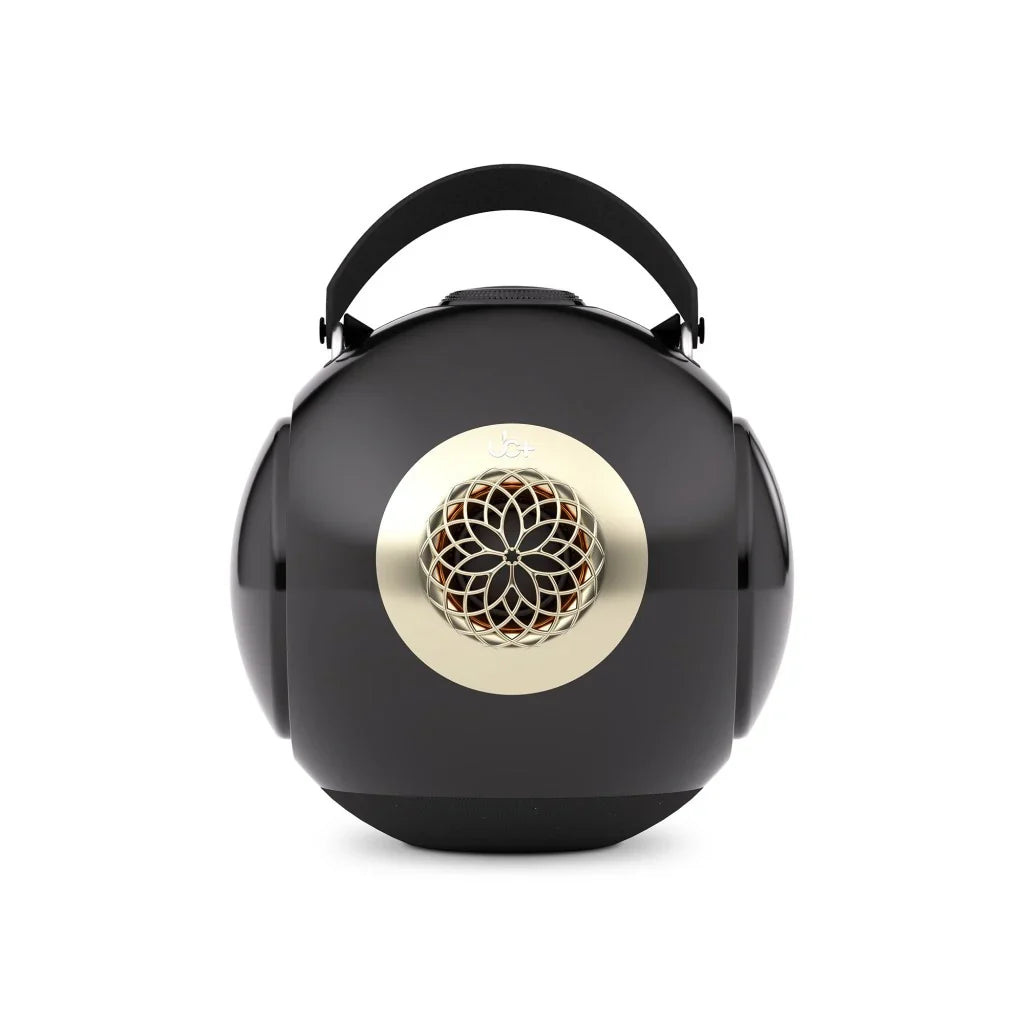
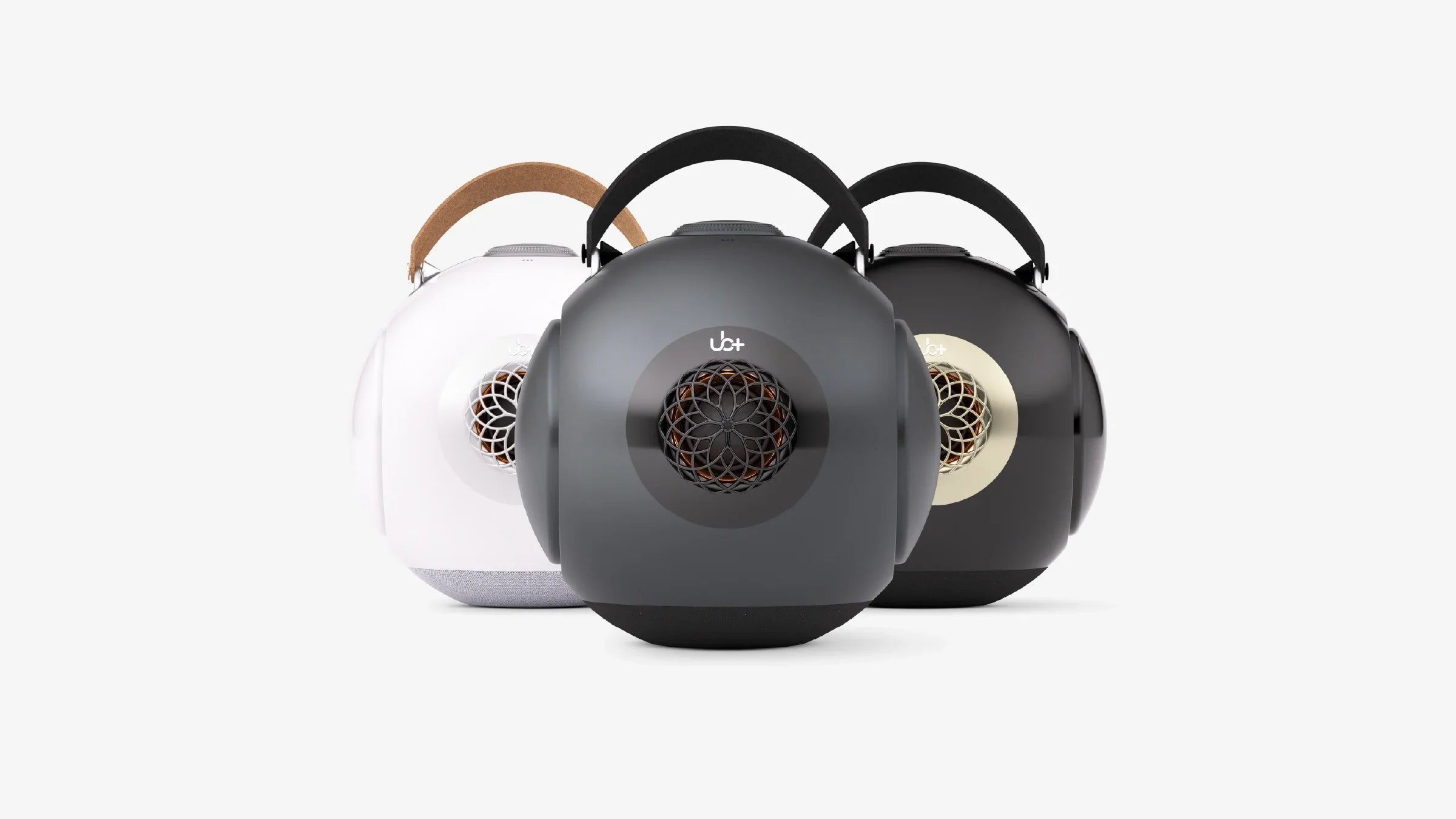
The UB+ dB1 DoubleBass demonstrates how enclosure geometry can become a performance advantage.
Rather than relying on a conventional box design, the dB1 uses a Helmholtz-inspired spherical acoustic chamber.
This approach is based on acoustic principles originally explored by Hermann von Helmholtz.
The goal is not simply visual uniqueness.
The shape serves a functional acoustic purpose.
Understanding the Helmholtz-Inspired Spherical Acoustic Chamber
In the dB1 design:
- Internal air pressure distributes evenly
- Standing waves are minimized
- Resonance behavior is better controlled
- Internal volume is used efficiently
Compared with traditional rectangular enclosures, this architecture helps create cleaner bass performance and improved acoustic balance.
This is one reason many listeners describe the speaker as sounding larger and more natural than its physical dimensions might suggest.
Dual Symmetrical Passive Radiators
Material selection is only one aspect of vibration management.
The dB1 also incorporates:
- Two large passive radiators
- Positioned opposite each other
- Moving in symmetrical oscillation
When music plays:
- Air pressure builds inside the sphere
- Both radiators move simultaneously
- Forces remain balanced
This differs significantly from conventional cabinet designs.
Self-Cancelling Vibration Architecture
One of the most fascinating aspects of the dB1 is its self-balancing behavior.
In many speakers:
- Bass energy causes cabinet movement
- Tables vibrate
- Surfaces resonate
The dB1 reduces this issue through symmetrical force distribution.
Because both passive radiators move together:
- Vibrational forces counterbalance each other
- Cabinet shake is minimized
- More energy becomes usable sound
The result is cleaner, more controlled bass.
Technical Comparison Table: Cabinet Construction
|
Feature |
Budget Plastic Speaker |
Traditional Box Speaker |
UB+ dB1 DoubleBass |
|
Cabinet Shape |
Rectangular |
Rectangular |
Spherical |
|
Internal Reflections |
High |
Moderate |
Reduced |
|
Standing Waves |
Common |
Common |
Minimized |
|
Vibration Control |
Basic |
Moderate |
Self-Cancelling Architecture |
|
Pressure Distribution |
Uneven |
Uneven |
Balanced |
|
Bass Efficiency |
Moderate |
Good |
High |
|
Resonance Control |
Limited |
Moderate |
Advanced |
|
Acoustic Philosophy |
Cost-Driven |
Traditional |
Physics-Driven |
Mechanical Bass Amplification vs Digital Enhancement
Many Bluetooth speakers rely heavily on DSP.
Digital processing artificially boosts bass frequencies.
While this can create impressive initial impact, it may also introduce:
- Distortion
- Compression
- Listening fatigue
The dB1 takes a different approach.
Its spherical chamber works together with:
- Dual passive radiators
- Internal pressure dynamics
- Acoustic physics
to enhance bass mechanically.
This allows the system to achieve substantial low-frequency performance without relying exclusively on software processing.
Why Air Movement Is More Important Than Raw Power
Many consumers assume deeper bass requires more amplifier power.
In reality, air movement often matters more.
The dB1 utilizes:
- A centrally positioned mid-bass driver
- Dual passive radiators
- Efficient pressure distribution
The combined passive radiator surface area is approximately:
3.5 times larger than the woofer surface area itself.
This enables substantial air displacement.
More displaced air often means stronger bass perception.
Importantly, this is achieved without dramatically increasing cabinet size.
High-End Driver Engineering and Cabinet Interaction
Even the best cabinet material cannot compensate for a poor driver.
The dB1 incorporates advanced driver technologies designed to work together with its enclosure architecture.
These include:
Oversized 90mm Neodymium Magnet
Provides stronger driver control and efficiency.
35mm Long-Stroke Voice Coil
Allows greater excursion while maintaining accuracy.
20mm Piston Movement
Supports meaningful low-frequency output.
Aluminum Shorting Ring
Reduces distortion and improves linearity.
Extra-Wide 18mm Surround
Maintains controlled cone movement during demanding bass passages.
Together, these elements help maximize the advantages provided by the enclosure itself.
Bass Engineering Approaches
|
Feature |
Typical Bluetooth Speaker |
Large Party Speaker |
UB+ dB1 DoubleBass |
|
Bass Strategy |
DSP Boost |
Large Drivers |
Mechanical Amplification |
|
Cabinet Shape |
Box |
Box |
Helmholtz-Inspired Sphere |
|
Passive Radiators |
Single or None |
Rare |
Dual Symmetrical |
|
Vibration Management |
Limited |
Moderate |
Self-Cancelling |
|
Air Pressure Efficiency |
Moderate |
Good |
Advanced |
|
Distortion Control |
Basic |
Moderate |
High |
|
Long-Term Listening Comfort |
Moderate |
Moderate |
Excellent |
Why Build Quality Matters
Cabinet materials influence more than sound.
They also affect:
- Durability
- Longevity
- Structural stability
- Consistency over time
A high-quality enclosure maintains performance characteristics longer than a poorly constructed one.
This is particularly important for buyers seeking a long-term investment rather than a disposable audio product.
Why Modern Buyers Should Care About Cabinet Design
Most consumers compare:
- Battery life
- Bluetooth version
- Driver size
Yet enclosure engineering often has a greater impact on listening experience.
A speaker with superior cabinet design can deliver:
- Better bass
- Lower distortion
- Improved clarity
- Greater realism
without requiring larger drivers or higher power ratings.
Final Thoughts
Speaker cabinet materials influence far more than aesthetics.
They affect:
- Resonance
- Vibration
- Efficiency
- Bass performance
- Clarity
- Distortion levels
The best speaker designs treat the enclosure as an active acoustic component rather than a simple container.
This is why premium audio manufacturers devote so much attention to cabinet construction, shape, and material selection.
Modern designs such as the UB+ dB1 DoubleBass illustrate how innovative enclosure engineering can improve sound quality through acoustic physics rather than brute force. By combining a Helmholtz-inspired spherical acoustic chamber, dual symmetrical passive radiators, self-cancelling vibration architecture, and advanced driver technologies, the system demonstrates that cabinet design remains one of the most important—and often overlooked—elements of audio performance.
Frequently Asked Questions
Why do speaker cabinet materials affect sound quality?
Speaker cabinets are constantly exposed to vibrations generated by the drivers. Different materials absorb, reflect, and transfer those vibrations differently, which can influence resonance behavior and overall sound accuracy. A well-engineered cabinet helps minimize unwanted coloration and allows listeners to hear more of the original recording.
Is a heavier speaker always better?
Not necessarily. Weight alone does not determine performance. What matters is how effectively the cabinet controls vibration, manages resonance, and supports the acoustic design goals of the speaker. Some lightweight materials can outperform heavier alternatives when combined with advanced engineering.
Why do spherical speakers often sound different from box speakers?
Spherical speakers reduce many of the acoustic challenges associated with flat internal surfaces. Because a sphere lacks parallel walls, internal reflections and standing waves are reduced, helping create a cleaner and more balanced sound. This is one reason spherical designs have long attracted interest from audio engineers.
What is self-cancelling vibration technology?
Self-cancelling vibration technology uses balanced mechanical forces to reduce cabinet movement. In the UB+ dB1, dual passive radiators move symmetrically, helping counteract unwanted vibration. This allows more energy to be converted into sound rather than cabinet shake.
Does cabinet design matter more than driver size?
Both are important, but cabinet design is often underestimated. Even an excellent driver can perform poorly inside an ineffective enclosure. The best audio products combine high-quality drivers with carefully engineered cabinet structures to maximize performance.
Explore Physics-Driven Audio Design
Looking for a best sounding bluetooth speaker that goes beyond conventional box-speaker thinking?
Discover how the UB+ dB1 DoubleBass combines:
- Helmholtz-inspired spherical acoustic chamber
- Dual symmetrical passive radiators
- Self-cancelling vibration architecture
- Mechanical bass amplification
- 90mm neodymium magnet
- 35mm long-stroke voice coil
- 20mm piston movement
- Aluminum shorting ring
- 18mm wide surround
to create bass that feels natural, controlled, and immersive.


Оставить комментарий
Этот веб-сайт защищается hCaptcha. Применяются Политика конфиденциальности и Условия использования hCaptcha.