

Travel changes how we listen to music. You’re no longer in a controlled living room with fixed acoustics and unlimited power you’re dealing with hotel rooms, outdoor spaces, unpredictable surfaces, and long hours away from charging outlets.
That’s why choosing the right travel speaker isn’t just about portability. It’s about finding a balance between size, durability, battery life, and real bass performance.
Because here’s the truth most buying guides avoid:
Small speakers don’t struggle with bass because they’re small. They struggle because of how they’re designed.
And today, some of the best audiophile bluetooth speakers prove that you don’t need a large system or a subwoofer to get deep, controlled, and satisfying bass on the go.
This guide breaks down what actually matters when choosing wireless speakers with good bass for travel, how modern acoustic design solves traditional limitations, and why some compact speakers outperform much larger competitors.
Why Travel Speakers Usually Sacrifice Bass
Most portable speakers are built with compromises:
- smaller enclosures
- limited internal air volume
- lower power output
- simplified driver systems
To compensate, many brands rely on:
- aggressive DSP (digital bass boost)
- exaggerated tuning
- marketing-heavy “extra bass” claims
The result?
- bass that sounds loud but not deep
- distortion at higher volumes
- listening fatigue over time
This is why many so-called budget audiophile speakers impress at first but disappoint during extended listening.
What “Good Bass” Actually Means in a Portable Speaker
Before choosing a speaker, redefine what you’re looking for.
Good bass is not just:
- loud
- boosted
- overpowering
Real bass should feel:
- deep (extends low without strain)
- controlled (no muddiness or boom)
- textured (you can distinguish instruments)
For travel, this matters even more because you’re often listening in smaller or reflective spaces.
The Portability vs Performance Trade-Off
Traditionally, you had to choose:
- small size → weak bass
- large size → better bass but poor portability
But modern acoustic engineering is changing that.
Instead of relying on:
- bigger drivers
- more power
Advanced designs focus on:
- efficient air movement
- controlled resonance
- enclosure physics
Why Enclosure Design Matters More Than Size
The enclosure is not just a shell it’s part of the sound system.
Traditional Box Speakers:
- flat internal walls
- parallel surfaces
- uneven pressure distribution
This leads to:
- standing waves
- distorted bass
- inefficient energy use
Spherical Design: A Smarter Use of Space
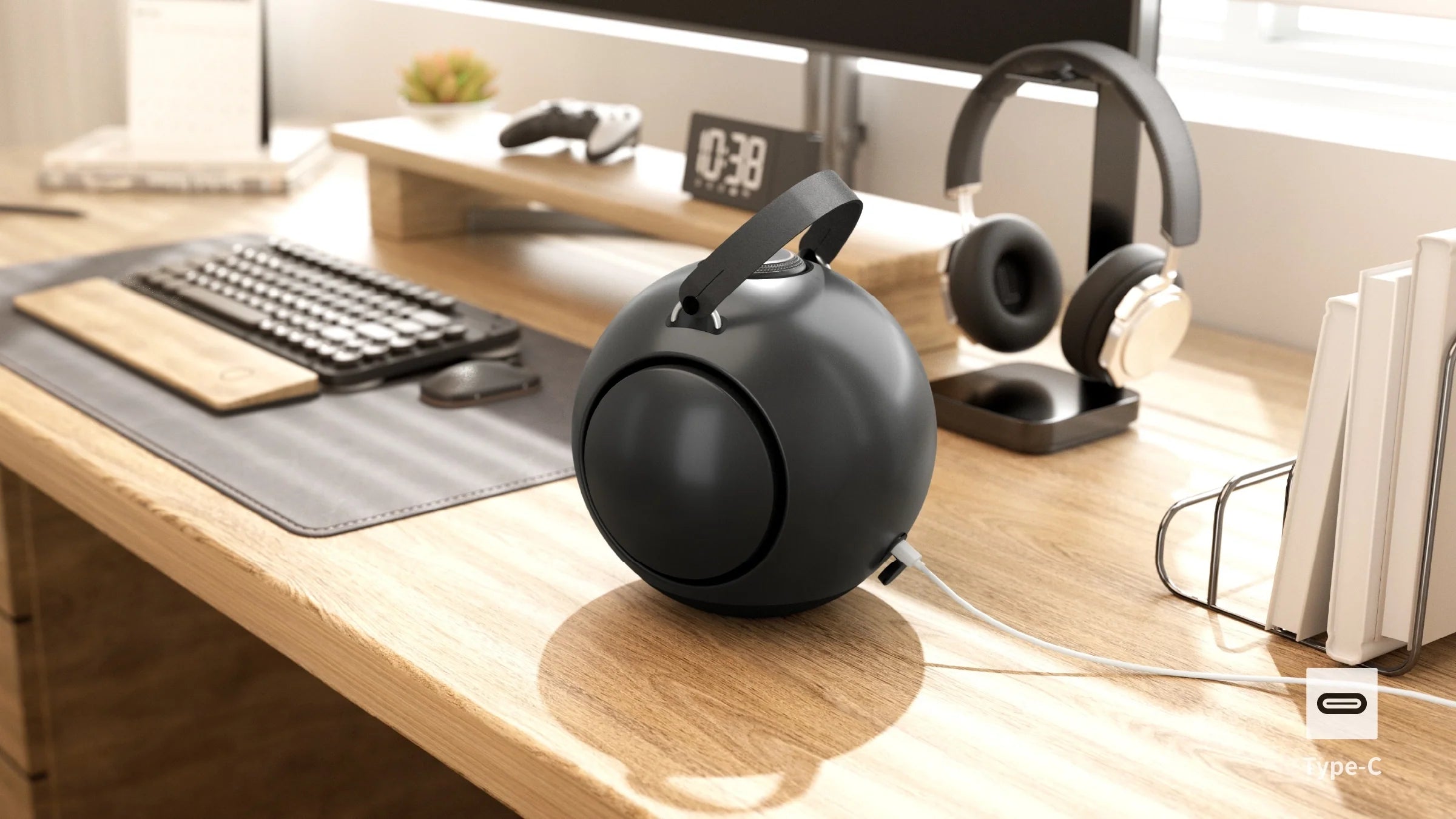
Some of the most advanced portable speakers now use spherical enclosures.
Why?
Because a sphere:
- has no parallel surfaces
- distributes air pressure evenly
- reduces internal distortion
This creates:
- smoother bass
- cleaner mids
- more natural sound
Even in compact form factors, this design can outperform larger box speakers.
Helmholtz-Inspired Chambers: Letting Air Do the Work
At the core of modern bass performance is the Helmholtz resonator principle.
Instead of forcing bass, it:
- traps air in a controlled chamber
- regulates how it moves
- reinforces low frequencies naturally
In a travel speaker, this means:
- deeper bass without increasing size
- less reliance on digital boosting
- more efficient energy use
Dual Passive Radiators: Power Without Bulk
One of the most important features in wireless speakers with good bass is the passive radiator system.
What They Do:
- respond to internal air pressure
- extend bass frequencies
- reduce strain on the main driver
Why Dual Radiators Matter:
Advanced systems use two radiators placed symmetrically.
This allows:
- equal and opposite movement
- self-cancelling vibration
- stable and clean output
3.5× Air Movement: The Hidden Advantage
Some high-end compact speakers dramatically increase bass efficiency by expanding the total moving surface area.
For example:
- passive radiator surface area can be 3.5× larger than the main driver
This results in:
- stronger bass without distortion
- better efficiency
- deeper low-frequency extension
In simple terms:
Most speakers push harder.
Better speakers move smarter.
Downward-Firing Drivers: Filling Space Naturally
Another innovation is the downward-firing driver.
Instead of projecting sound directly:
- it energizes internal air
- pressure builds evenly
- sound disperses naturally
This is especially useful when traveling, where:
- surfaces vary
- placement isn’t always ideal
Travel Speaker Design Differences
|
Feature |
Standard Portable Speaker |
Advanced Acoustic Design |
|
Bass Method |
DSP Boost |
Mechanical (Helmholtz-based) |
|
Enclosure |
Rectangular |
Spherical |
|
Air Movement |
Limited |
3.5× Enhanced |
|
Passive Radiators |
Single / Basic |
Dual Symmetrical |
|
Vibration |
Noticeable |
Self-cancelling |
|
Sound Quality |
Loud but uneven |
Deep and controlled |
Battery Life: What Actually Matters on the Road
Battery specs are often misleading.
Instead of focusing only on hours, consider:
1. Consistency
Does bass weaken as battery drops?
2. Efficiency
Does the speaker waste power on distortion?
3. Real Usage
Can it handle:
- long flights
- day trips
- outdoor sessions
A well-designed speaker maintains:
- stable output
- consistent tonal balance
Durability: Travel-Ready Design
A good travel speaker should handle:
- movement
- temperature changes
- different surfaces
Look for:
- solid construction
- stable base design
- minimal vibration
Speakers with self-cancelling vibration systems are especially useful because they:
- reduce rattling
- maintain sound integrity
- protect internal components
Why Compact Doesn’t Mean Compromised
The idea of the smallest bass speaker used to mean sacrificing sound quality.
But today:
- smarter enclosure design
- better driver engineering
- efficient air movement
allow compact speakers to:
- deliver room-filling sound
- maintain clarity
- avoid distortion
Real Travel Scenarios: What Works Best
Hotel Room
- small to medium space
- reflective surfaces
- controlled volume
Best choice: compact speaker with balanced bass
Outdoor Travel
- open environment
- sound dispersion matters
- higher volume needed
Best choice: efficient speaker with strong air movement
Shared Spaces
- multiple listeners
- varying positions
Best choice: wide dispersion (360° sound)
Travel Needs vs Speaker Features
|
Travel Scenario |
Key Requirement |
Ideal Feature |
|
Hotel Room |
Balanced sound |
Even pressure distribution |
|
Outdoor Use |
Strong output |
High air movement efficiency |
|
Long Trips |
Battery consistency |
Stable power regulation |
|
Shared Listening |
Wide coverage |
360° dispersion |
|
Minimal Packing |
Compact size |
Efficient design |
What Makes a Speaker “Audiophile” on the Go?
The term best audiophile speakers is often overused.
For travel, it means:
- accurate sound reproduction
- balanced tuning
- minimal distortion
Not:
- extreme loudness
- exaggerated bass
The best best audiophile bluetooth speakers focus on:
- clarity
- control
- natural sound
Avoiding Common Buying Mistakes
Mistake 1: Choosing Based on Wattage
→ Doesn’t guarantee better sound
Mistake 2: Falling for “Extra Bass” Marketing
→ Often means distortion
Mistake 3: Ignoring Enclosure Design
→ One of the most important factors
Why Design Matters More Than Specs
Specs tell part of the story.
But real performance comes from:
- how air moves
- how resonance is controlled
- how components work together
This is why some budget audiophile speakers outperform more expensive competitors.
The Shift Toward Physics-Driven Sound
Modern speaker design is moving away from:
- software tricks
- exaggerated tuning
And toward:
- acoustic efficiency
- mechanical resonance control
- smarter geometry
This is where spherical designs and dual radiator systems stand out.
Final Thoughts: Travel Light, Listen Deep
Finding the right travel speaker isn’t about choosing the loudest or biggest option.
It’s about:
- efficiency over brute force
- balance over exaggeration
- design over marketing
The best wireless speakers with good bass today prove that:
- compact size doesn’t mean weak performance
- deep bass doesn’t require a subwoofer
- portability and sound quality can coexist
With innovations like:
- Helmholtz-inspired acoustic chambers
- dual symmetrical passive radiators
- 3.5× air movement systems
- self-cancelling vibration design
- downward-firing drivers
modern portable speakers deliver a listening experience that feels far larger than their size.
Take Better Sound With You
→ Compare dB1 vs dB Mini
→ See color options
→ Check current price
Because great sound shouldn’t stay at home.
And the right speaker doesn’t just travel with you it transforms every place you go into a space worth listening in.



Оставить комментарий
Этот веб-сайт защищается hCaptcha. Применяются Политика конфиденциальности и Условия использования hCaptcha.