
7 Specs That Actually Matter (And Why Most People Get Them Wrong)
Choosing a speaker should be straightforward. Yet the modern audio market is filled with specifications, technical terminology, and performance claims that can make simple comparisons surprisingly difficult. Power numbers get highlighted, bass is described with increasingly dramatic language, and long specification lists can create the impression that more numbers automatically mean better sound.
They do not.
Two speakers can publish similar specifications and still sound completely different. The reason is that speaker performance comes from the interaction between the driver, enclosure, acoustic loading, resonance control, amplification, and the way those elements are engineered as one system.
If you are comparing bass wireless speakers, looking for the best audiophile Bluetooth speakers, or simply trying to understand what actually matters before buying, the seven areas below provide a more useful framework than headline specifications alone.
Frequency Response: The Shape of Sound

Frequency response describes the range of frequencies a speaker is designed to reproduce, usually expressed in hertz (Hz). Lower frequencies represent bass, while higher frequencies represent treble.
But a wider published range does not automatically mean better sound.
A speaker rated for an extremely wide frequency range can still sound unbalanced if certain frequencies are emphasized, recessed, or poorly controlled. What matters is how the speaker behaves across the range and how naturally bass, midrange, and treble connect.
For example, strong low-frequency extension is useful, but bass should not overwhelm vocals or instruments. Similarly, extended treble is valuable only when it remains controlled rather than becoming harsh.
This is where enclosure architecture becomes important.
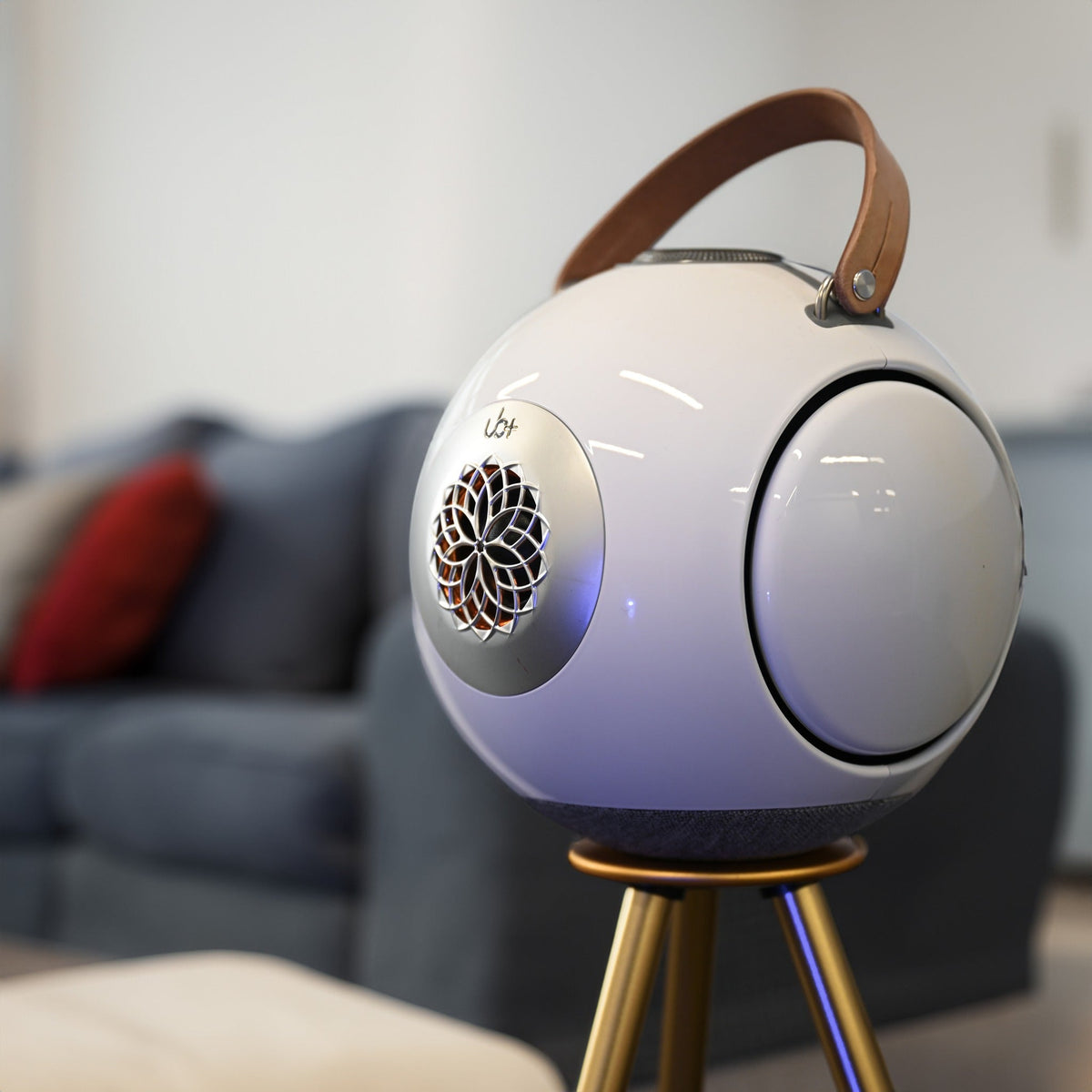
The UB+ dB1 DoubleBass uses a spherical acoustic chamber inspired by Helmholtz resonance principles. Its geometry is designed to manage internal air pressure and reduce problematic internal standing-wave behavior.
The dB1 is specified at approximately 40Hz–20kHz, but the number alone does not explain its sound. The more important question is how the entire acoustic system achieves that response.
For a deeper explanation, read bass extension explained in Hz.
Drivers: The Engine Behind the Sound

The driver is the component that physically moves air to create sound.
In a compact wireless speaker, driver design becomes particularly important because physical space is limited. The size of the driver matters, but it is only one part of the equation.
Driver quality, excursion, motor strength, suspension, enclosure loading, and integration with the rest of the acoustic system can have a greater impact than driver count alone.
A speaker with multiple drivers is not automatically better than one with fewer drivers. What matters is whether the components work together coherently.
The dB1 illustrates this principle with a 4.5-inch long-throw mid-bass driver positioned to fire downward into its spherical acoustic chamber. The driver is supported by a 90mm neodymium magnet, 35mm long-stroke voice coil, approximately 20mm of piston movement, aluminum shorting ring, and wide surround.
These components are part of one mechanical system.
The driver does not simply produce sound directly into the room. It energizes the internal air volume, which then interacts with the spherical chamber and passive radiators.
That relationship between driver and enclosure is far more informative than driver size alone.
For more on how speaker components and industrial design interact, see how Bluetooth speakers are designed.
Passive Radiators: Bass Without the Bulk

Passive radiators are particularly useful in compact speaker designs because they can extend low-frequency output without requiring a large traditional bass-reflex port.
Unlike an active driver, a passive radiator does not receive its own electrical signal. It responds to changes in air pressure created by the active driver inside the enclosure.
The implementation matters.
A poorly controlled passive-radiator system can introduce unwanted movement, noise, or instability. A carefully engineered system can use the radiator as an important part of the low-frequency architecture.
The dB1 uses two passive radiators positioned symmetrically on opposite sides of the spherical enclosure.
Their combined surface area is approximately 3.5× the active woofer area.
The opposing arrangement also helps balance mechanical forces. As the radiators move in response to internal pressure, their symmetrical behavior helps reduce unwanted cabinet movement.
This is an important distinction between simply adding a passive radiator and designing the entire enclosure around one.
For a more detailed explanation, see how passive radiators work in Bluetooth speakers.
SPL: Loudness vs. Control
Sound Pressure Level, or SPL, describes acoustic output and is commonly expressed in decibels.
It is useful, but SPL should not be treated as a standalone measure of sound quality.
A speaker that becomes louder but loses clarity, develops distortion, or compresses its dynamics is not necessarily providing a better listening experience.
The more useful question is:
How well does the speaker maintain control as output increases?
Driver excursion, enclosure stability, thermal behavior, amplification, and resonance management all contribute.
The dB1 is specified at approximately 93dB SPL. That figure provides useful information about its output capability, but it should be considered alongside its driver and enclosure architecture rather than interpreted in isolation.
This is also why raw loudness comparisons can be misleading. A speaker's ability to produce usable output depends on how well the entire system remains controlled.
For more detail, see how loud should a speaker be?.
Bluetooth and Codec Support: Look Beyond the Connection
Wireless connectivity is another specification buyers frequently encounter.
Bluetooth determines how a speaker receives audio from a compatible device, while codecs determine how that audio is encoded and transmitted.
However, wireless transmission is only one part of the signal chain.
A speaker can support sophisticated wireless technology and still sound mediocre if its acoustic system is poorly engineered. Conversely, a well-designed speaker can extract impressive results from a relatively straightforward wireless connection because the driver, enclosure, amplification, and tuning are working together.
The dB1 uses Bluetooth 5.3, providing a current wireless connection standard for compatible devices.
When evaluating Bluetooth speakers, therefore, treat wireless specifications as one part of the system rather than a substitute for acoustic engineering.
For more background on Bluetooth generations, see Bluetooth 4.2 vs. 5.0 vs. 5.3.
Battery Performance: More Than a Playtime Number
Battery life is important for portable speakers, but a single maximum-playtime number does not tell the complete story.
Actual operating time can vary according to listening volume, wireless activity, content, and other conditions.
There is another consideration that is often overlooked: how consistently the speaker performs as battery voltage changes.
A well-engineered portable system needs to manage available power without allowing the sound to become unnecessarily unstable or compressed as the battery level falls.
For listeners who use a speaker for extended sessions, consistency can matter more than simply having the largest advertised number.
The same principle applies to portable audio generally: battery performance should be evaluated as part of the entire product rather than treated as an isolated specification.
For more portable-speaker considerations, see the portable Bluetooth speaker buying guide.
Enclosure Design: The Specification Most People Ignore
If there is one area that deserves more attention, it is enclosure design.
The enclosure is not merely a container for the electronics. It determines how air moves, how pressure develops, how internal reflections behave, and how mechanical energy is transferred into acoustic output.
Traditional rectangular cabinets contain parallel internal surfaces. Those surfaces can contribute to standing-wave behavior and internal reflections, which designers then have to manage through damping, bracing, internal shaping, and digital correction.
The dB1 takes a fundamentally different approach.
Its spherical acoustic chamber removes the conventional parallel-wall geometry and creates a continuous internal cavity.
The design is inspired by Helmholtz resonance principles, with the internal air volume functioning as an active part of the bass system.
That is why the dB1's shape is not simply an aesthetic decision.
The enclosure is part of the acoustic mechanism.
For a broader look at spherical construction, see spherical vs. box speakers: sound comparison.
Why These Seven Specifications Cannot Be Evaluated Separately
The biggest mistake when reading speaker specifications is treating every number as an independent score.
Speaker performance is a system problem.
Frequency response depends partly on the driver and enclosure.
Driver behavior depends on mechanical design and acoustic loading.
Passive radiators depend on the internal air volume and tuning.
SPL depends on how well the driver, amplifier, and enclosure maintain control.
Wireless performance depends on the signal path as well as the acoustic system.
Battery behavior affects how a portable speaker can maintain performance over time.
Enclosure geometry influences nearly everything that happens inside the cabinet.
This is why two speakers with similar specification sheets can produce very different listening experiences.
The most meaningful specifications are the ones that help explain how the speaker works, not simply how impressive the numbers look.
What the dB1 Shows About Speaker Engineering
The dB1 DoubleBass is a useful example because its individual specifications make more sense when considered together.
The approximately 40Hz–20kHz frequency response is supported by a long-throw mid-bass driver and a dedicated low-frequency architecture.
The driver works into a spherical chamber rather than a conventional rectangular enclosure.
Two symmetrical passive radiators respond to internal air pressure and provide substantial radiating area.
The opposing arrangement helps manage mechanical forces.
The spherical architecture supports broad 360° sound dispersion.
DSP can provide control and protection, but the fundamental bass system remains mechanical and acoustic.
The result is an example of why speaker design cannot be reduced to one specification.
How to Read a Speaker Specification Sheet
When comparing speakers, ask what each specification actually tells you.
|
Specification |
What It Tells You |
What It Does Not Tell You |
|
Frequency response |
Approximate frequency range |
Whether the response is balanced |
|
Driver size |
Physical driver dimensions |
Overall sound quality |
|
Driver excursion |
How far the driver can move |
How effectively the system uses that movement |
|
Passive radiators |
Part of the low-frequency system |
Whether they are properly tuned |
|
SPL |
Acoustic output capability |
How cleanly the speaker reaches that level |
|
Bluetooth version |
Wireless connection standard |
Overall sound quality |
|
Codec support |
How audio is transmitted |
Quality of the acoustic system |
|
Battery life |
Potential operating duration |
Performance at every volume level |
|
Enclosure shape |
Physical acoustic architecture |
Whether the design is well engineered |
This approach helps separate useful technical information from marketing shorthand.
What Matters Most for Bass Wireless Speakers?
If bass is your priority, do not start with the phrase “extra bass.”
Look at the complete low-frequency architecture.
Ask:
- How low is the stated frequency response?
- What type of active driver is being used?
- How much excursion does the driver provide?
- Is there a passive-radiator system?
- How large is the radiating area?
- How is internal air pressure managed?
- Is the enclosure mechanically stable?
- Is bass primarily being produced acoustically or heavily boosted through DSP?
This approach provides a much clearer picture of what you are actually buying.
The dB1's answer is a combination of long-stroke driver movement, a spherical acoustic chamber, and two large symmetrical passive radiators.
For another technical perspective, see deep bass without a subwoofer.
What Matters Most for Audiophile-Oriented Listening?
If your priority is clarity and long-term listening rather than maximum impact, look beyond loudness.
A refined speaker should maintain separation between frequencies, control resonance, avoid unnecessary distortion, and reproduce music without making one part of the spectrum dominate everything else.
That means enclosure design, driver integration, frequency balance, and mechanical stability all become important.
The phrase best audiophile Bluetooth speakers should therefore not be interpreted as a ranking based on one specification.
Instead, look for a speaker where the engineering decisions support the listening experience as a whole.
Frequently Asked Questions
What is the most important speaker specification?
There is no single specification that determines overall speaker quality. Frequency response, driver design, passive-radiator architecture, SPL, wireless performance, battery behavior, and enclosure design all contribute.
Does a bigger driver always mean better sound?
No. Driver size is only one part of the acoustic system. Motor strength, excursion, enclosure loading, suspension, tuning, and integration with the rest of the speaker also matter.
Are passive radiators better than ports?
Neither approach is automatically better. Their effectiveness depends on the enclosure, tuning, implementation, and intended performance. Passive radiators can be particularly useful in compact designs where deep bass is required without a large port.
Does higher SPL mean a better speaker?
Not necessarily. SPL indicates acoustic output, but it does not independently describe distortion, tonal balance, clarity, or long-term listening quality.
Why does enclosure shape matter?
Enclosure geometry influences internal pressure, reflections, resonance, and mechanical behavior. The dB1 uses a spherical acoustic chamber to make the enclosure an active part of its acoustic system.
What should I look for if bass is my priority?
Look beyond advertised bass enhancement. Examine frequency extension, driver excursion, passive-radiator design, enclosure geometry, and how the speaker manages mechanical and acoustic energy.
Experience the Engineering Behind the Specifications
The value of a specification becomes clearer when you understand what is happening behind the number.
The UB+ dB1 DoubleBass combines a spherical acoustic chamber, long-throw mid-bass driver, dual symmetrical passive radiators, and 360° sound dispersion into one integrated system.
For a more compact listening approach, the UB+ dB Mini is designed around portability and a smaller physical footprint.
You can also explore related UB+ engineering and buying guides:
→ Understanding the science behind premium audio technology
→ What makes a speaker premium?
→ Speaker driver size vs. sound quality
→ Speaker distortion explained
→ The ultimate Bluetooth speaker buying guide
Explore UB+ Speakers
Specifications are useful when they explain the engineering behind the sound. Frequency response, drivers, passive radiators, SPL, wireless connectivity, battery performance, and enclosure geometry each reveal one part of the system. The real difference comes from how those parts work together.
The best specification is not necessarily the biggest number. It is the one that helps you understand why the speaker sounds the way it does.


Hinterlasse einen Kommentar
เว็บไซต์นี้ได้รับการคุ้มครองโดย hCaptcha และมีการนำนโยบายความเป็นส่วนตัวของ hCaptcha และข้อกำหนดในการใช้บริการมาใช้