
When shopping for a Bluetooth speaker with deep bass, many buyers immediately look at numbers such as wattage, maximum SPL, and frequency response. Specifications like 20Hz–20kHz can appear impressive, but a frequency range by itself does not tell you how a speaker will actually sound in a room.
Two speakers can advertise similar frequency ranges and produce very different results. One may deliver controlled, substantial low-frequency energy, while another may sound boomy, weak, or distorted when pushed.
The reason is simple: bass extension is about more than the lowest number printed on a specification sheet.
It depends on how effectively a speaker can reproduce low frequencies, how much air its acoustic system can move, how well its driver remains controlled, and how the enclosure manages internal pressure and vibration.
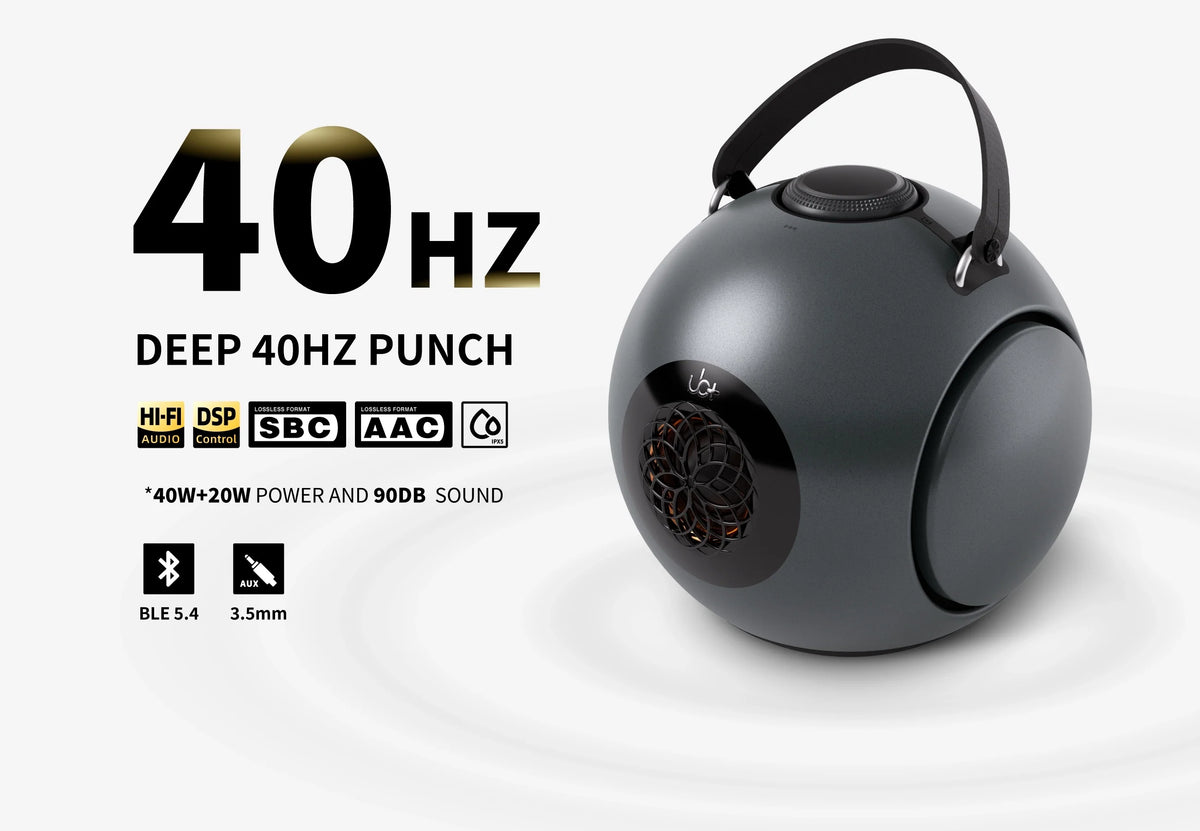
This makes bass extension particularly important when comparing compact wireless speakers. The UB+ dB1 DoubleBass, for example, approaches low-frequency reproduction through a spherical acoustic chamber, dual passive radiators, and a long-throw driver rather than relying only on electronic bass enhancement.
Understanding what those Hz numbers actually mean can help you make a much better speaker-buying decision.
What Does Bass Extension Actually Mean?

Bass extension describes how low in frequency a speaker can reproduce useful audible output.
Frequency is measured in Hertz (Hz). A lower frequency corresponds to a longer sound wave and, generally, requires more physical air movement from the speaker system.
A simplified way to understand the bass region is:
|
Frequency Range |
General Description |
What You Typically Perceive |
|
20–60 Hz |
Sub-bass |
Deep rumble, physical weight |
|
60–120 Hz |
Deep bass |
Kick, bass impact, low-end foundation |
|
120–250 Hz |
Upper bass |
Warmth, body, fullness |
These ranges overlap in real music, and individual instruments contain energy across multiple bands. The important point is that a speaker reaching a lower frequency does not automatically mean it produces better bass.
A frequency-response specification tells you something about the range the system can reproduce. It does not, by itself, tell you how loud that frequency is reproduced, how much distortion occurs, or whether the output remains useful at normal listening levels.
That is why usable bass extension is more meaningful than simply finding the lowest advertised Hz number.
Why Frequency Numbers Alone Can Be Misleading

A manufacturer may list a very wide frequency response, but frequency-response figures need context.
For example, one speaker might technically reach a low frequency at a very reduced output level. Another might have a higher stated lower limit but produce substantially stronger and cleaner low-frequency output within its usable operating range.
For the listener, the second speaker may sound deeper.
This is why you should not evaluate a speaker based only on whether its specification says 20Hz, 30Hz, or 40Hz.
When comparing speakers, also consider:
- how much acoustic output is available at low frequencies
- driver excursion capability
- air displacement
- enclosure design
- passive-radiator or port tuning
- distortion and compression
- performance at realistic listening levels
A speaker's published frequency range is therefore a starting point, not a complete description of its bass performance.
For a broader explanation of the specifications worth examining, see the speaker specs guide covering the factors that actually matter.
Bass Is Fundamentally About Moving Air
Low-frequency sound is not created simply by adding more electrical power.
At a physical level, a speaker produces bass by moving air.
The driver moves forward and backward, creating changes in air pressure that propagate through the room as sound waves. The lower the frequency, the greater the physical demands placed on the acoustic system.
This creates a challenge for compact speakers.
Small speakers have limited:
- driver surface area
- enclosure volume
- excursion
- acoustic efficiency
A designer therefore has to find efficient ways to produce useful low-frequency output without pushing the driver beyond its practical limits.
That is where enclosure architecture becomes important.
A speaker's driver, cabinet, air volume, passive radiator, and electronic control system all need to work together. A powerful amplifier alone cannot overcome every physical limitation.
This is one reason a speaker with seemingly modest specifications can sometimes sound fuller and more controlled than a higher-powered speaker with less effective acoustic engineering.
Why Air Displacement Matters
Air displacement is one of the most useful concepts to understand when evaluating bass.
A simplified relationship is:
Air displacement = radiating area × cone or diaphragm movement
This is why speaker designers pay close attention to both driver size and excursion.
A small driver can move a certain amount of air by moving farther, but there are physical limits to how far it can travel while maintaining control.
Passive radiators provide another way to increase effective low-frequency air movement without requiring the active driver itself to perform all the work.
This is central to the architecture of the UB+ dB1 DoubleBass.
The Helmholtz-Inspired Spherical Acoustic Chamber
The UB+ dB1 DoubleBass takes an unusual approach to enclosure design by using a true spherical acoustic chamber inspired by principles of Helmholtz resonance.
The underlying Helmholtz concept describes how air contained within a cavity can resonate at particular frequencies. In speaker design, acoustic resonance can be incorporated into an enclosure system to influence low-frequency behavior.
UB+ applies this thinking through the dB1's spherical architecture.
Rather than using a conventional rectangular internal cavity with multiple parallel surfaces, the dB1 uses a spherical chamber designed to create more symmetrical internal pressure behavior and reduce problematic internal reflections and standing-wave behavior.
The sphere is therefore not simply a visual choice.
It is part of the acoustic system.
The design is intended to help the driver and passive radiators interact with the enclosed air volume in a controlled way, supporting the speaker's overall low-frequency performance.
You can explore the underlying concept in UB+'s article on spherical Bluetooth speaker design.
The DoubleBass System: Using Air Pressure Efficiently
The dB1's low-frequency architecture goes beyond the shape of its chamber.
Its DoubleBass system uses two large passive radiator plates positioned on opposite sides of the spherical enclosure.
When the active driver moves, it changes the air pressure inside the chamber. That pressure drives the passive radiators, allowing them to contribute to low-frequency air movement.
The system works around several coordinated elements:
- a centrally positioned downward-firing mid-bass driver
- a spherical internal acoustic chamber
- two symmetrical passive radiators
- controlled internal air pressure
- opposing mechanical movement
The symmetrical arrangement is particularly important.
As the two passive radiators move in opposition, their mechanical forces can help cancel unwanted cabinet reaction. That means less of the system's energy is transferred into physical shaking of the enclosure.
Instead, more of the system's movement is directed toward acoustic output.
This is one reason passive-radiator design deserves attention when comparing portable speakers. For a more detailed explanation, see how passive radiators work in Bluetooth speakers.
Why the dB1 Has Approximately 3.5× the Passive-Radiator Surface Area
One of the defining technical characteristics of the dB1 is the size of its passive-radiating surfaces.
The combined passive-radiator surface area is approximately 3.5 times the area of the active woofer.
That gives the system a significantly larger effective radiating area for its low-frequency architecture.
The importance of this is straightforward: bass requires air movement.
Rather than asking the active driver to perform all of the low-frequency work, the dB1 uses the enclosed air pressure to drive its two passive radiators.
The intended result is greater acoustic displacement from a compact enclosure while maintaining controlled driver operation.
This is an important distinction between physical bass architecture and simply adding more electronic bass gain.
The speaker is using the mechanical behavior of its acoustic system to support low-frequency output.
Driver Engineering: The Other Half of Bass Extension
An advanced enclosure cannot compensate for a driver that cannot maintain control.
The dB1 therefore combines its spherical chamber and passive-radiator system with a 4.5-inch long-throw mid-bass driver.
The driver incorporates:
- 90 mm neodymium magnet
- 35 mm long-stroke voice coil
- 20 mm piston movement
- aluminum shorting ring
- 18 mm extra-wide surround
These components work together to support controlled driver movement.
The long-stroke architecture provides substantial excursion capability, while the motor and suspension system are designed to keep the driver operating in a controlled manner.
The aluminum shorting ring is intended to help reduce distortion in the motor system, while the wide surround supports stable movement.
The broader lesson is that bass extension is a system-level characteristic.
It is not created by the driver alone.
For more context on why driver size and engineering should be evaluated together, see speaker driver size versus sound quality.
Usable Bass vs Artificial Bass
Modern DSP is extremely useful in speaker design.
It can help manage:
- driver protection
- tonal balance
- system linearity
- output optimization
- dynamic behavior
The problem occurs when a speaker relies excessively on electronic boosting to create the impression of deep bass beyond what its physical system can comfortably reproduce.
Electronic processing can change the signal, but it cannot eliminate the physical limits of a driver or enclosure.
The dB1 instead places significant emphasis on mechanical and acoustic bass reproduction. The spherical chamber, active driver, and dual passive radiators physically contribute to low-frequency output, while DSP can support the overall system.
This distinction helps explain why two speakers with similar advertised power can produce very different bass.
One may be relying heavily on signal processing.
The other may have a more capable acoustic system.
For a broader discussion of deep bass from compact speakers, see how the UB+ dB1 approaches deep bass without a conventional subwoofer.
Bass Extension vs Loudness
Another common mistake is assuming that a louder speaker automatically has deeper bass.
It does not.
Loudness and bass extension are different characteristics.
A speaker can achieve high overall SPL while producing relatively limited low-frequency extension. Another speaker can sound fuller and deeper at moderate volume because its acoustic system is more effective in the lower frequencies.
When comparing speakers, ask two separate questions:
How loud can it get?
and
How low and how cleanly can it reproduce bass at useful listening levels?
Those questions measure different aspects of performance.
A high maximum SPL does not guarantee deep bass, just as a very low published frequency does not guarantee strong or clean bass.
The dB1, for example, is designed around both broad acoustic output and a dedicated low-frequency architecture rather than treating maximum loudness as the sole objective.
For more on the relationship between speaker output and perceived volume, see how loud a speaker should actually be.
Why Enclosure Geometry Influences Bass
The cabinet is one of the most overlooked parts of a speaker.
The enclosure determines how the driver interacts with the air inside the system. Its volume, shape, internal surfaces, ports or radiators, and structural rigidity all influence acoustic behavior.
Conventional box designs can be highly effective, but parallel internal surfaces can contribute to standing-wave behavior and uneven pressure distribution.
Designers can address these effects through damping, bracing, internal geometry, driver placement, and digital correction.
A spherical enclosure offers a different starting point.
Because the dB1 does not use the same parallel-wall geometry as a rectangular cabinet, its internal acoustic environment can be more symmetrical.
The objective is not to claim that a sphere eliminates every acoustic problem. Rather, its geometry is designed to reduce certain problematic internal interactions at the source.
This is one of the reasons spherical speaker architecture has become an interesting area of audio engineering.
Box Speaker vs Spherical Acoustic Architecture
|
Feature |
Conventional Box Speaker |
UB+ dB1 DoubleBass |
|
Enclosure geometry |
Rectangular or box-based |
True spherical chamber |
|
Internal acoustic approach |
Sealed or ported cabinet |
Helmholtz-inspired spherical architecture |
|
Passive-radiator system |
Varies by design |
Dual symmetrical passive radiators |
|
Air movement |
Depends on driver and enclosure |
Supported by approximately 3.5× radiator surface area |
|
Cabinet reaction |
Depends on cabinet and driver configuration |
Opposing radiator movement helps reduce mechanical reaction |
|
Sound dispersion |
Depends on driver arrangement |
Broad 360-degree spherical dispersion |
|
Bass strategy |
Varies; may use DSP, ports, or radiators |
Mechanical/acoustic architecture supported by DSP |
|
Primary design objective |
Varies by speaker |
Controlled air movement and broad acoustic output |
The important point is not that every box speaker is inferior. Well-designed conventional cabinets can perform extremely well.
The dB1 simply represents a different engineering approach in which the enclosure geometry itself is central to the acoustic system.
What Wattage Actually Tells You
Wattage is another specification that is frequently misunderstood.
A speaker's wattage describes electrical power handling or amplifier output under a particular measurement condition. It does not directly tell you:
- how deep the bass will extend
- how efficiently the system moves air
- how much distortion occurs
- how balanced the frequency response is
- how the speaker interacts with the room
Two speakers with similar amplifier power can therefore sound very different.
Acoustic efficiency matters.
A system that converts electrical energy into controlled air movement effectively can deliver a stronger perceived result than a system that simply consumes more power.
This is why it is better to consider wattage alongside driver design, enclosure architecture, sensitivity/SPL, frequency response, and distortion behavior.
For another useful explanation, see why speaker watts do not tell the whole story.
Why Good Bass Should Sound Controlled, Not Just Loud
Deep bass should add weight to music without covering up everything above it.
Consider a recording with bass guitar, kick drum, vocals, and percussion. If the low end is poorly controlled, increasing bass can mask the midrange and make vocals seem less distinct.
Controlled bass behaves differently.
The low-frequency foundation supports the rest of the recording instead of dominating it.
This is particularly important in smaller rooms, where boundaries can reinforce bass and make excessive low-frequency energy even more obvious.
A well-engineered speaker should therefore balance extension with control.
The goal is not simply to make the room shake.
The goal is to reproduce the low-frequency information in the recording with enough weight, definition, and stability to remain convincing.
How to Evaluate Bass Extension in Real Listening
When you test a speaker, do not begin by asking whether the bass is the loudest you have heard.
Listen for specific characteristics.
Listen for Low-Frequency Definition
Bass instruments should remain identifiable rather than becoming one continuous rumble.
Kick drums should have impact without overwhelming vocals.
Listen at Different Volumes
A speaker that sounds good only at moderate volume may struggle when pushed harder. Conversely, a speaker that maintains balance as volume changes generally has a more capable overall system.
Listen for Distortion
Distortion often becomes more obvious during demanding bass passages. If the bass becomes fuzzy, harsh, or mechanically strained, the system may be approaching its limits.
Pay Attention to the Room
Placement can significantly change perceived bass. A speaker close to a corner or wall may sound much heavier than the same speaker placed in a more open position.
Do Not Ignore the Midrange
Deep bass is only part of the listening experience. If increasing bass causes vocals or instruments to disappear, the system may be producing quantity rather than quality.
For practical placement advice, speaker placement tips for better bass and clarity can help you evaluate a speaker more accurately in your own room.
Bass Extension and the Listening Experience
The real purpose of bass extension is not to win a specification comparison.
It is to make music, movies, and other audio content feel more complete.
Deep low frequencies contribute:
- weight
- scale
- rhythm
- physical impact
- atmosphere
A kick drum feels more convincing when its low-frequency foundation is reproduced properly. A cinematic effect has greater physical presence when the system can reproduce its lower harmonics. Electronic music can feel more immersive when sub-bass information is present without becoming uncontrolled.
But deep bass only improves the experience when it remains integrated with the rest of the frequency range.
That is why controlled bass extension is more useful than chasing the lowest possible Hz number.
FAQ
What does bass extension mean in a speaker?
Bass extension refers to how low a speaker can reproduce useful low-frequency sound. It is generally discussed in Hertz, with lower frequencies representing deeper bass. However, the lowest advertised frequency does not automatically indicate better real-world bass performance.
Is 20Hz better than 40Hz for a Bluetooth speaker?
Not necessarily. A speaker that claims 20Hz may produce that frequency only under specific measurement conditions or at very low output. A speaker with a 40Hz lower specification can potentially produce stronger and more usable bass in normal listening. The measurement method and output level matter.
What is the difference between bass extension and loudness?
Bass extension describes how low a speaker can reproduce frequencies, while loudness describes how much acoustic output it can produce. A speaker can be very loud without having deep bass, and another speaker can have strong bass extension without being the loudest speaker available.
How do passive radiators improve bass?
Passive radiators use changes in internal air pressure to move a separate radiating surface. This allows the enclosure to produce additional low-frequency output without requiring the active driver to perform all of the air movement itself. Their effectiveness depends on the complete acoustic design.
Why does the UB+ dB1 use a spherical chamber?
The dB1 uses a true spherical acoustic chamber inspired by principles of Helmholtz resonance. Its geometry is designed to provide more symmetrical internal pressure behavior and reduce problematic internal reflections and standing-wave behavior while working with the driver and dual passive radiators.
Does more wattage mean deeper bass?
No. Wattage alone does not determine bass extension. Driver excursion, radiating area, enclosure design, acoustic efficiency, tuning, and system control all influence how effectively a speaker reproduces low frequencies.
Look Beyond the Lowest Hz Number
Understanding bass extension changes the way you should read speaker specifications.
A frequency-response number can tell you where a speaker is rated to operate, but it does not tell the entire story of how that speaker will perform in a real room.
The most convincing bass comes from a complete system in which the driver, enclosure, air volume, passive radiators, mechanical structure, and electronic control work together.
The UB+ dB1 DoubleBass illustrates this approach through its Helmholtz-inspired spherical acoustic chamber, dual symmetrical passive radiators, approximately 3.5× passive-radiator surface area, and long-throw driver architecture.
The result is a design focused on physical air movement and controlled low-frequency reproduction rather than relying entirely on an impressive number on a specification sheet.
So when comparing speakers, do not simply ask:
“Which one reaches the lowest Hz?”
Ask:
“Which speaker can reproduce its low frequencies with useful output, control, and clarity?”
That is the more meaningful definition of bass extension.
Explore UB+ Options
→ Explore the UB+ dB1 DoubleBass
→ Compare dB1 vs dB Mini
→ See color options
→ Check current price
Because the best bass is not simply the bass with the lowest number. It is bass that reaches deep enough, moves air effectively, and remains controlled enough to preserve the music around it.




Leave a comment
เว็บไซต์นี้ได้รับการคุ้มครองโดย hCaptcha และมีการนำนโยบายความเป็นส่วนตัวของ hCaptcha และข้อกำหนดในการใช้บริการมาใช้