
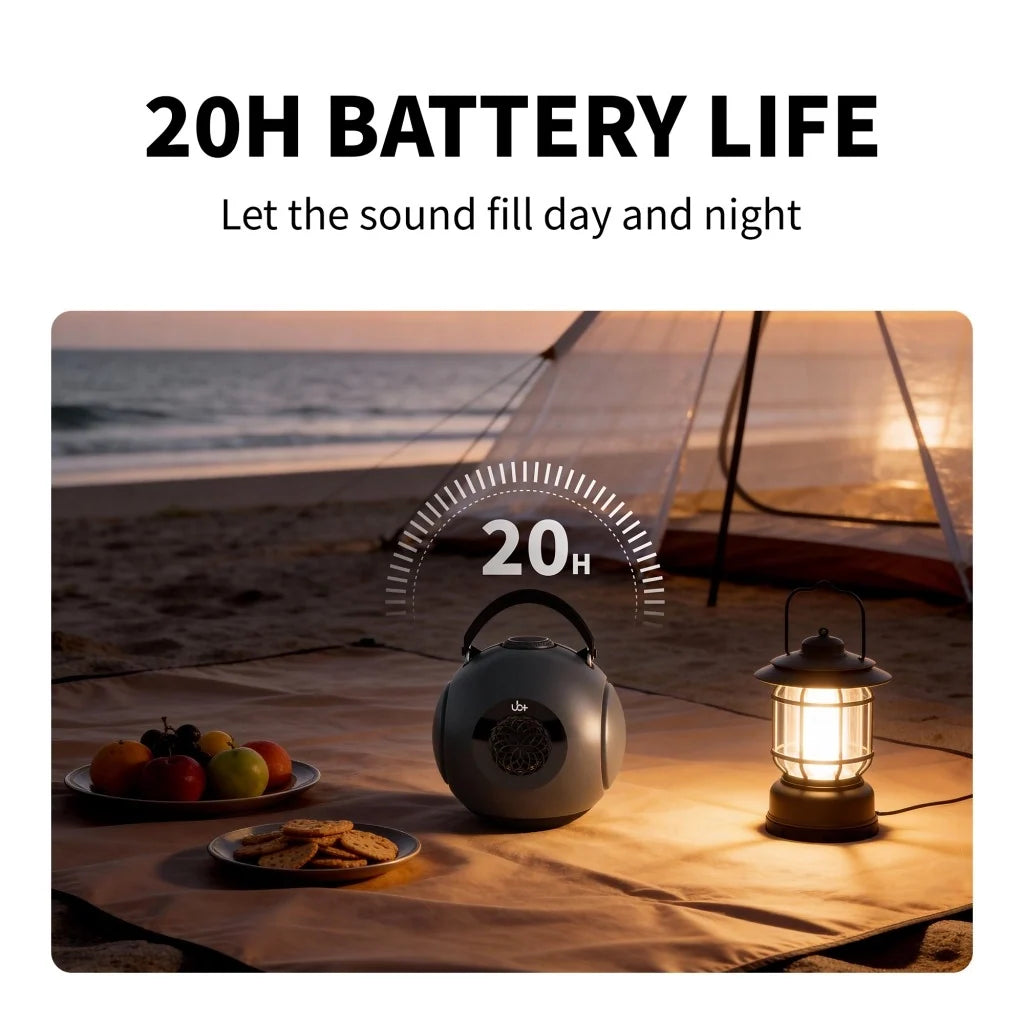
Battery life is one of the most practical considerations when choosing a portable Bluetooth speaker. A speaker may offer impressive sound, strong bass, and modern connectivity, but frequent charging can make it less convenient for everyday use. Whether you listen to music while working, relaxing at home, entertaining guests, or spending time outdoors, a dependable battery helps keep your listening experience uninterrupted.
However, maximum playback time should not be the only factor in a buying decision. Battery efficiency, amplifier performance, driver architecture, enclosure design, sound dispersion, and portability all influence how useful a speaker will be over time. A well-designed portable speaker should balance these elements instead of focusing on a single specification.
For listeners comparing a long battery life bluetooth speaker, UB+ offers several models with different acoustic approaches and playback capabilities. This guide begins with the UB+ dB1 DoubleBass, followed by the dB Mini, before examining the E2 Solace, S1 Circle, and S2 Alphorn. Each model serves a different listening preference, making it easier to compare battery endurance with practical audio performance.
UB+ Speaker Models: Battery Life at a Glance

The following comparison provides an overview of the five UB+ models, their maximum stated playback times, and their main design priorities.
|
UB+ Speaker Model |
Maximum Playback Time |
Main Design Focus |
|
Up to 20 hours |
Spherical acoustic chamber and mechanical bass system |
|
|
Up to 20 hours |
Compact portable audio |
|
|
Up to 30 hours |
Extended listening and long battery performance |
|
|
Up to 16 hours |
Portable spherical speaker design |
|
|
Up to 16 hours |
Distinctive acoustic design and portable listening |
Playback times represent maximum stated battery life. Actual results depend on volume, audio content, wireless connection, and operating conditions.
These figures show that battery endurance varies across the lineup. The dB1 DoubleBass and dB Mini offer matching maximum playback times, while the E2 Solace provides the longest stated runtime. The S1 Circle and S2 Alphorn offer up to 16 hours, which can still support extended everyday listening without requiring constant charging.
UB+ dB1 DoubleBass: Advanced Acoustic Engineering with 20-Hour Playback

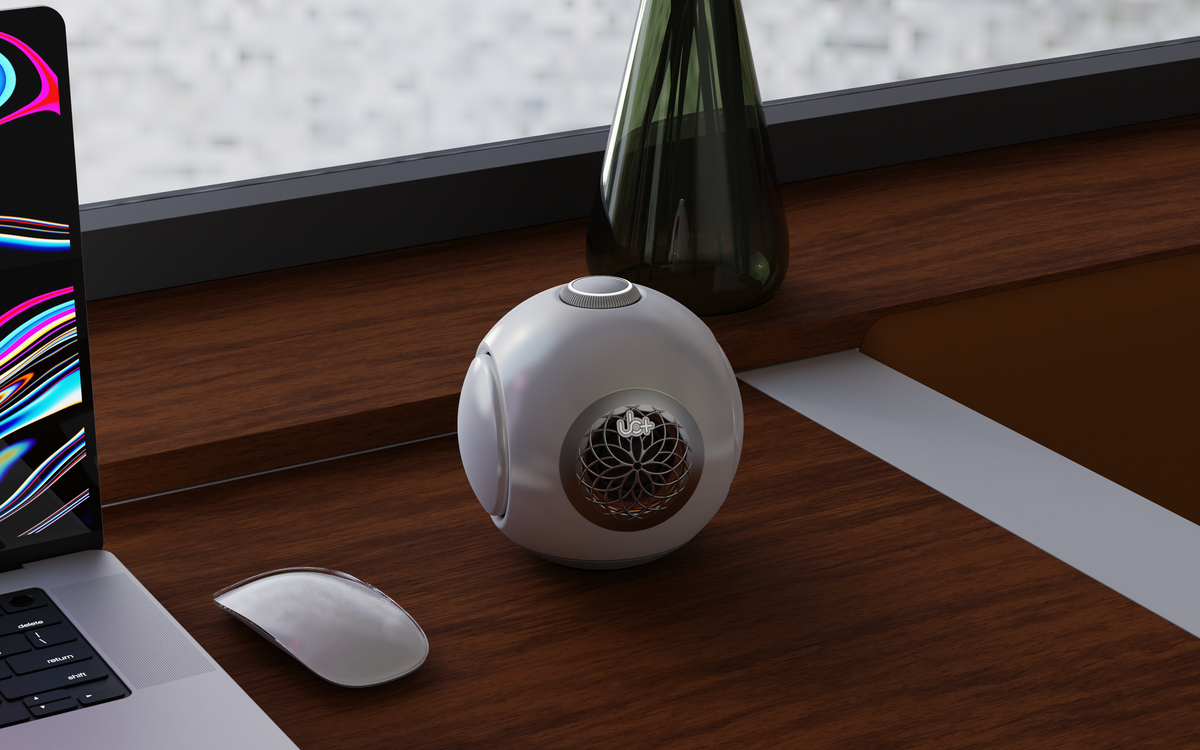
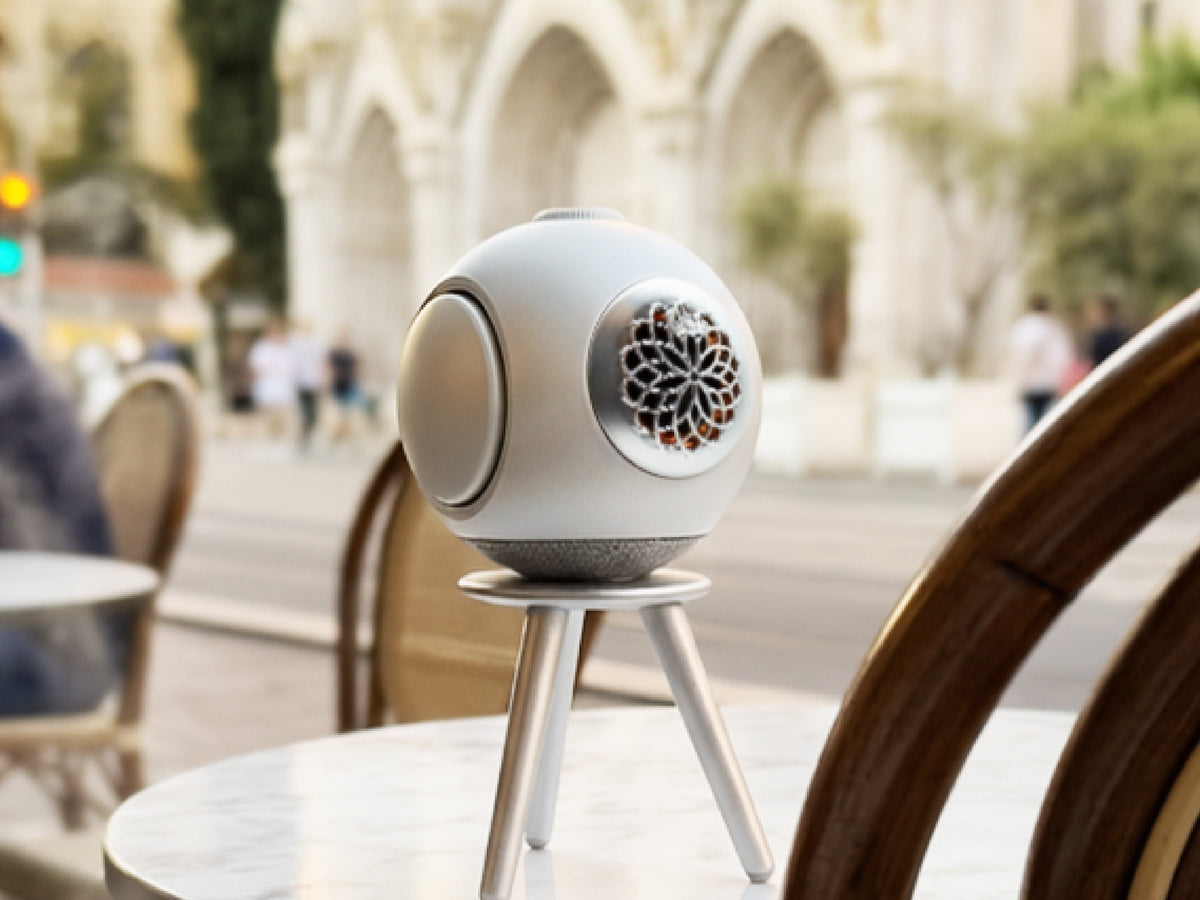
The UB+ dB1 DoubleBass takes the first position because it combines extended portable playback with a distinctive approach to low-frequency reproduction. Its design is built around a spherical acoustic chamber and a coordinated passive-radiator system that uses internal air pressure to support bass output.
The dB1 offers up to 20 hours of playback, making it suitable for long listening sessions at home, in the office, or during outdoor activities where access to a power outlet may be limited. Its design also places particular attention on how the enclosure, driver, and passive radiators work together.
Rather than depending entirely on electronic bass enhancement, the dB1 uses physical acoustic components to contribute to low-frequency performance. This combination of mechanical design and digital signal processing gives the speaker a different engineering approach from many conventional portable box speakers.
The Helmholtz-Inspired Spherical Acoustic Chamber
One of the defining elements of the dB1 is its patented spherical acoustic chamber, inspired by the Helmholtz resonator principle. This approach focuses on the relationship between internal air volume, controlled openings, and resonance.
Inside a speaker enclosure, air behaves as part of the acoustic system. When the driver moves, it creates pressure changes within the enclosure. The chamber's geometry and tuning influence how that pressure interacts with the driver and other acoustic components.
The spherical enclosure also changes the pattern of internal sound-wave reflections compared with a conventional rectangular cabinet. It avoids the same arrangement of parallel interior walls, helping manage certain internal resonance and reflection patterns.
The dB1's acoustic architecture includes:
- A centrally positioned 4.5-inch mid-bass driver.
- A spherical enclosure designed around controlled internal air pressure.
- Two symmetrical passive-radiator plates positioned on opposite sides.
- Combined passive-radiator surface area approximately 3.5 times the woofer area.
- A mechanical approach to bass reinforcement supported by electronic signal processing.
- An enclosure structure designed to integrate the driver and radiators as a coordinated acoustic system.
As the active driver moves, pressure changes inside the chamber drive the passive radiators outward and inward. Their coordinated movement supports low-frequency output without requiring a separate powered driver for each radiator.
The symmetrical arrangement is also designed to counterbalance some mechanical forces produced during operation. This can help reduce certain unwanted enclosure movements and vibrations, although the overall result depends on operating conditions and system integration.
Most speakers try to push harder. dB1 lets air do the work.
Driver Engineering and Audio Specifications
The dB1's driver architecture includes several components intended to support controlled movement and sound reproduction. These details matter because low-frequency performance depends on more than the diameter of a speaker driver.
Its driver system includes:
- 4.5-inch woofer.
- Oversized 90 mm neodymium magnet.
- 35 mm long-stroke voice coil.
- Approximately 20 mm piston movement.
- Aluminum shorting ring.
- Extra-wide 18 mm surround.
- Published frequency response of approximately 40 Hz–20 kHz.
- Published maximum sound pressure level of approximately 93 dB SPL.
The oversized magnet supports the driver's motor system, while the long-stroke design allows greater movement for producing low-frequency output. The aluminum shorting ring is part of the motor design, and the surround helps accommodate the driver's movement.
These components work as part of a complete system. A large magnet or long excursion alone does not guarantee better sound. Driver behavior, enclosure tuning, suspension characteristics, and signal processing must be considered together.
How DSP Supports the Acoustic System
Digital signal processing also plays a role in the dB1. DSP can help manage frequency response, maintain tonal balance, and protect the driver when the speaker operates at higher output levels.
The important distinction is that electronic processing works alongside the physical acoustic architecture. The spherical chamber and passive radiators contribute to the system's bass behavior, while DSP supports the integration and control of the complete speaker.
This combination is relevant when evaluating small speakers because compact enclosures often require careful management of low-frequency response, available driver excursion, and amplifier power.
Connectivity and Everyday Use
Beyond its acoustic design, the dB1 includes practical playback features for different listening situations:
- Bluetooth 5.3 wireless connectivity.
- Wired playback.
- TF-card playback.
- Stereo pairing.
- IPX5 water-jet resistance.
- Up to 20 hours of maximum playback.
Stereo pairing can help create a wider listening presentation when two compatible speakers are used together. Its IPX5 rating provides protection against water jets under specified test conditions, but it should not be interpreted as permission to submerge the speaker.
Who Should Consider the dB1?
The dB1 is worth considering for listeners who prioritize more than battery endurance alone. Its design is particularly relevant for people interested in:
- A spherical acoustic enclosure rather than a conventional rectangular cabinet.
- A dedicated mechanical approach to bass reinforcement.
- A combination of an active driver and dual passive radiators.
- Flexible wired and wireless playback.
- Up to 20 hours of maximum playback.
- Stereo pairing for a broader listening presentation.
For a deeper explanation of its architecture, read UB+ dB1 Audiophile Bluetooth Speaker Design and How Passive Radiators Work in Bluetooth Speakers.
UB+ dB Mini: Compact Portability with 20-Hour Playback

The UB+ dB Mini comes second in this guide. It offers up to 20 hours of playback, matching the dB1's maximum stated battery life while serving a different listening preference.
Where the dB1 emphasizes its spherical acoustic chamber and more elaborate bass architecture, the dB Mini is the compact alternative for people who want portable audio in a smaller format.
Portability is not simply about making a speaker smaller. A compact speaker must balance enclosure volume, driver behavior, amplifier output, battery capacity, and acoustic tuning. Each of these factors affects how the speaker performs in everyday environments.
Why Choose a Compact Speaker?
Smaller speakers can be easier to carry, position, and integrate into daily routines. Their physical format can make them particularly convenient for people who move between rooms, work in smaller spaces, or prefer a portable speaker that does not occupy much desk or shelf space.
The dB Mini is worth considering for:
- Personal listening at home.
- Office environments where available space is limited.
- Travel and everyday portability.
- Background music during work or leisure.
- Listening in bedrooms, smaller living areas, or personal workspaces.
- Users who want up to 20 hours of maximum playback in a compact format.
A compact enclosure does create acoustic constraints. Lower-frequency output depends on driver capability, enclosure design, available excursion, and signal processing. This is why physical size alone cannot determine how a speaker will sound.
The relationship between enclosure volume and bass reproduction is particularly important. Lower frequencies require sufficient air movement, and a smaller speaker must manage that requirement through its complete driver and acoustic system.
Battery Endurance for Everyday Listening
With up to 20 hours of maximum playback, the dB Mini can support multiple listening sessions before requiring another charge, depending on usage conditions.
For someone who listens to music during working hours, this can reduce the need to connect the speaker to a charger throughout the day. It can also be convenient when moving between rooms or using the speaker in locations where charging access is not immediately available.
Actual runtime will depend on volume and operating conditions. Listening at moderate levels generally places different demands on the battery than continuous high-volume playback.
dB1 DoubleBass vs. dB Mini
Both models offer up to 20 hours of playback, but they are designed around different priorities.
|
Comparison Factor |
UB+ dB1 DoubleBass |
UB+ dB Mini |
|
Maximum playback |
20 hours |
20 hours |
|
Design priority |
Advanced spherical acoustic system |
Compact portability |
|
Bass architecture |
Helmholtz-inspired chamber and dual passive radiators |
Compact-speaker acoustic architecture |
|
Portability focus |
Portable listening with a larger acoustic system |
Smaller everyday format |
|
Main consideration |
Acoustic design and bass performance |
Compact convenience |
|
Best suited for |
Listeners prioritizing acoustic engineering |
Listeners prioritizing a smaller portable speaker |
Neither model is automatically the better choice for every listener. The dB1 is the more appropriate starting point when acoustic architecture and bass reproduction are central priorities. The dB Mini makes sense when a smaller portable format is more important.
For a closer model comparison, see UB+ dB1 vs. dB Mini Comparison.
UB+ E2 Solace: Up to 30 Hours for Extended Listening

The UB+ E2 Solace offers the longest maximum playback time in this product lineup: up to 30 hours.
That makes it an important option for people who place battery endurance near the top of their buying criteria. Longer playback can reduce charging interruptions during extended workdays, weekend use, and other situations where the speaker remains active for several hours.
While the dB1 and dB Mini provide up to 20 hours, the E2 Solace adds another 10 hours to the maximum stated runtime. This difference can become useful for people who use their speakers frequently throughout the day or prefer to charge their devices less often.
What Makes 30 Hours Useful?
Battery endurance affects how a speaker fits into a daily routine. A longer maximum runtime can be particularly practical when the speaker is used for several purposes rather than a single short listening session.
Potential applications include:
- Extended listening sessions at home.
- Long workdays and office use.
- Weekend activities and casual gatherings.
- Background music throughout the day.
- Listening in locations where charging access is inconvenient.
- Users who prefer fewer charging interruptions during regular use.
A longer runtime can also provide more flexibility when planning how and where to use a portable speaker. Instead of treating battery charging as a daily requirement, listeners may have more freedom to use the speaker across multiple sessions.
Understanding Maximum Playback Claims
A 30-hour maximum playback figure should be understood as a specified upper runtime rather than a guarantee under every listening condition.
Several factors can influence the actual result:
- Playback volume: Higher output generally increases power consumption.
- Audio content: Different music and sound profiles can create different amplifier demands.
- Wireless operation: Bluetooth connectivity contributes to overall energy use.
- Operating environment: Temperature and other conditions can influence battery behavior.
- Battery condition: Battery age and charging history can affect available capacity over time.
For buyers who frequently use a speaker at moderate volume, a longer maximum runtime can be a meaningful advantage. Those who regularly listen at high output should compare practical usage requirements rather than assuming they will always achieve the maximum figure.
When to Consider the E2 Solace
Choose the E2 Solace as a candidate when your first priority is reducing charging frequency. Its 30-hour maximum runtime is the highest among the five UB+ models covered here.
It is especially relevant for listeners who want a speaker that can remain available across extended periods of everyday use. Battery endurance, however, should still be evaluated alongside physical size, acoustic performance, connectivity, and the speaker's suitability for the intended listening environment.
UB+ S1 Circle: Up to 16 Hours in a Portable Spherical Design

The UB+ S1 Circle provides up to 16 hours of playback. Its spherical design gives it a distinctive appearance while supporting a portable listening format.
The S1 Circle is an option for users who want a speaker that can fit into different spaces without making battery charging a constant part of their routine. Although its maximum runtime is lower than the dB1, dB Mini, and E2 Solace, 16 hours can still cover substantial everyday listening.
The Role of Speaker Shape
Speaker enclosure design influences more than appearance. The shape, internal volume, driver placement, and acoustic tuning all contribute to how a speaker behaves.
Spherical designs are different from conventional rectangular cabinets because their geometry changes the relationship between internal surfaces and sound-wave reflections. However, enclosure shape alone does not determine overall audio quality. Driver characteristics and system tuning remain essential.
The S1 Circle offers an alternative for listeners who prefer a spherical speaker format and want a design that can be positioned in different areas of a home or workspace.
Practical Listening Applications
A 16-hour maximum runtime can support several common uses:
- Listening at home throughout the day.
- Music in a personal workspace.
- Casual listening during social gatherings.
- Portable use around different rooms.
- Background audio during everyday activities.
- Extended listening sessions between charging opportunities.
For many users, this level of endurance may be sufficient for regular listening. The most useful comparison is not simply which speaker has the largest battery figure, but how its runtime aligns with the number of hours the speaker will actually be used.
Who Is the S1 Circle For?
The S1 Circle is worth considering if you prefer a distinctive spherical speaker design and do not need the longest battery runtime in the UB+ lineup.
It offers a different design choice from the dB1 and dB Mini, making it useful to compare based on enclosure preference, placement, and listening habits.
If you are comparing its design and performance with the dB1, see S1 Circle vs. dB1 DoubleBass.
UB+ S2 Alphorn: Up to 16 Hours with a Distinctive Acoustic Identity
The UB+ S2 Alphorn completes this comparison with up to 16 hours of playback.
Its position in the lineup reflects a different design preference. Not every speaker needs to follow the same enclosure shape or acoustic approach. Different physical designs can create different relationships between driver placement, sound projection, enclosure volume, and listening environment.
This makes the S2 Alphorn another option to evaluate according to personal preferences rather than battery runtime alone.
Design and Listening Environment
A speaker's physical design affects how it fits into a room and how listeners interact with it. Placement, nearby surfaces, room dimensions, and listening distance can all influence the perceived sound.
For example, a speaker used on a desk may interact differently with nearby surfaces than one placed on an open shelf or in a larger living area. The listening environment should therefore be part of the buying decision.
The S2 Alphorn provides a distinctive alternative within the UB+ lineup for people who want a different acoustic identity from the dB1, dB Mini, or spherical S1 Circle.
Everyday Use and Playback Flexibility
The S2 Alphorn is an option for people who want a distinctive portable speaker design with up to 16 hours of maximum playback.
When evaluating it, consider:
- How the speaker will be positioned in your listening space.
- Whether its physical design suits your environment.
- How often you expect to use it between charging sessions.
- Whether portability or extended battery endurance is more important.
- How its acoustic presentation compares with other UB+ models.
- Whether its overall design matches your preferred listening setup.
Who Should Consider the S2 Alphorn?
The S2 Alphorn is worth exploring if you are interested in a different speaker design and do not necessarily need the highest maximum playback time in the lineup.
The 16-hour figure can still support extended everyday use, while its distinctive form gives buyers another design direction to consider.
For a direct model comparison, read dB1 DoubleBass vs. S2 Alphorn.
Why Battery Life Is Only One Part of Speaker Performance
A long-lasting battery is valuable, but it does not automatically indicate better sound quality. Battery capacity, amplifier efficiency, driver sensitivity, acoustic design, and playback volume all contribute to the overall experience.
When comparing a long battery life bluetooth speaker, look beyond the maximum runtime and consider the engineering factors that influence both endurance and audio performance.
A speaker that lasts longer but does not suit your listening preferences may not be the most practical purchase. Similarly, a speaker with advanced acoustic engineering may be a better fit for someone who prioritizes bass response, driver integration, or sound presentation over maximum operating time.
Battery Capacity and Power Consumption
A speaker's operating time depends on how efficiently it converts stored electrical energy into acoustic output. Battery capacity is important, but the amount of energy consumed during playback determines how long that stored energy will last.
Important factors include:
- Amplifier efficiency: More efficient amplification can reduce energy consumption for a given output level.
- Driver sensitivity: A more sensitive driver may require less electrical power to reach a particular sound pressure level, depending on the system.
- Playback volume: Higher volume generally increases power demand.
- DSP processing: Digital signal processing can improve system control, but it also requires electrical power.
- Wireless connectivity: Bluetooth operation contributes to overall energy consumption.
- Battery management: Charging and discharge control help manage battery operation and long-term usability.
These factors work together. A larger battery does not automatically guarantee the longest runtime if the speaker's amplifier and acoustic system consume more power during operation.
Acoustic Design and Energy Efficiency
Speaker architecture also affects how effectively a system produces sound.
For example, passive radiators use internal air pressure generated by the active driver to produce additional low-frequency output. They do not require a separate amplifier channel, although their performance depends on enclosure volume, radiator mass, suspension characteristics, and tuning.
The dB1 combines this principle with its spherical chamber and symmetrical radiator arrangement. This is a different engineering approach from relying only on electronic equalization to increase perceived bass.
The relationship between the active driver and passive radiators is particularly important. Their movement must be properly coordinated with the enclosure's internal air volume and the intended tuning frequency. If these elements are not integrated correctly, the expected acoustic benefits may not be achieved.
This is why the complete speaker system matters more than any individual component. Driver size, radiator area, enclosure shape, and DSP should be evaluated as parts of one design.
Sound Quality Requires More Than a Frequency Range
A published frequency response is useful, but it does not describe every aspect of audio performance. Measurement tolerance, listening level, distortion, directivity, and room interaction also matter.
When comparing specifications, consider:
- Frequency response: The range of frequencies a speaker is designed to reproduce.
- Total harmonic distortion: The amount of additional harmonic content produced during reproduction.
- Maximum sound pressure level: How loud the speaker can play under specified measurement conditions.
- Driver and enclosure integration: How effectively the acoustic components work together.
- Dispersion: How sound spreads across different listening positions.
- Bass extension: How effectively the speaker reproduces lower frequencies.
- Tonal balance: How consistently low, mid, and high frequencies are represented.
A frequency response figure without a stated tolerance does not reveal how evenly the speaker reproduces every frequency within that range. Likewise, a maximum SPL figure should be interpreted with its measurement conditions in mind.
Understanding these distinctions helps buyers avoid choosing a speaker based on a single impressive-looking specification.
How to Choose the Right UB+ Model for Your Listening Habits
The most suitable model depends on where you listen, how frequently you use your speaker, and which performance characteristics matter most.
For Acoustic Design and Bass Performance
The dB1 DoubleBass is the starting point for listeners interested in its spherical acoustic chamber, dual passive-radiator arrangement, and mechanical bass architecture.
It is worth comparing when you want to understand how enclosure geometry and controlled air movement can contribute to low-frequency reproduction.
For Compact Everyday Portability
The dB Mini is the option to consider when physical size and convenience are more important than a more elaborate acoustic system. Its 20-hour maximum playback time also makes it competitive with the dB1 in terms of stated battery endurance.
For the Longest Maximum Runtime
The E2 Solace leads the five-model comparison with up to 30 hours of playback. It is the natural starting point for users who want to minimize charging interruptions.
For a Spherical Speaker Format
The S1 Circle provides another option for listeners who prefer a spherical enclosure and want up to 16 hours of maximum playback.
For a Distinctive Alternative Design
The S2 Alphorn offers a different physical and acoustic identity, with up to 16 hours of maximum playback. It is worth evaluating based on its design and how it fits your listening environment.
UB+ Model Comparison: Which One Matches Your Priorities?
|
Your Main Priority |
Model to Consider |
Reason |
|
Spherical acoustic engineering and bass design |
UB+ dB1 DoubleBass |
Helmholtz-inspired chamber and dual passive-radiator system |
|
Compact portable listening |
UB+ dB Mini |
Smaller portable format with up to 20 hours of playback |
|
Maximum stated battery endurance |
UB+ E2 Solace |
Up to 30 hours of playback |
|
Spherical portable design |
UB+ S1 Circle |
Distinctive spherical form and up to 16 hours |
|
Distinctive alternative design |
UB+ S2 Alphorn |
Different acoustic identity and up to 16 hours |
A Practical Buying Checklist
Before selecting a model, consider these questions:
- How long do you need the speaker to operate? Compare maximum playback figures with your typical daily listening time.
- Where will you use it? A speaker for an office desk may have different size requirements from one used in a larger living space.
- What kind of sound do you prefer? Bass architecture, driver integration, and tuning can matter more than a single specification.
- How important is portability? Consider the physical format alongside runtime and placement requirements.
- Do you need additional playback options? Check whether wired, TF-card, Bluetooth, or stereo-pairing functions match your requirements.
- Will you use it outdoors? Check the specific water-resistance rating and remember that water resistance does not mean the speaker is designed for immersion.
- How often will you charge it? Consider whether the maximum runtime is sufficient for your regular listening schedule.
- Will you listen at high volume? Remember that higher output can reduce actual battery endurance.
Taking a few minutes to evaluate these factors can help prevent a common buying mistake: choosing a speaker based only on its battery figure without considering how it will perform in the environment where it will actually be used.
Choose Battery Endurance and Acoustic Performance Together
UB+ offers five different approaches to portable listening, with maximum playback times ranging from 16 to 30 hours. The dB1 DoubleBass and dB Mini both provide up to 20 hours, while the E2 Solace leads the lineup with up to 30 hours. The S1 Circle and S2 Alphorn each offer up to 16 hours.
The right choice depends on how you balance runtime, portability, and sound reproduction. The dB1 is the starting point for listeners interested in its spherical acoustic chamber and mechanical bass architecture. The dB Mini follows as a compact alternative, while the E2 Solace is the strongest option in this group when maximum battery endurance is the main consideration.
The S1 Circle and S2 Alphorn provide additional design choices for people whose priorities include enclosure style, placement, and everyday usability. Their 16-hour maximum playback times may be sufficient for many regular listening routines, especially when the speaker is used for shorter sessions throughout the day.
Ultimately, battery endurance should support the listening experience rather than define it entirely. A well-chosen portable speaker should offer a practical combination of operating time, acoustic performance, physical design, and convenient playback features.
A long battery life bluetooth speaker should do more than remain switched on for hours. It should provide dependable playback, useful design, and sound performance suited to the way you listen.
Explore the UB+ speaker collection to compare the models and find the design that fits your listening needs.
Frequently Asked Questions
1. Which UB+ speaker has the longest battery life?
The UB+ E2 Solace has the longest maximum stated playback time in this comparison, offering up to 30 hours. This makes it the first model to consider when maximum battery endurance is the main buying priority.
2. How long does the UB+ dB1 DoubleBass battery last?
The UB+ dB1 DoubleBass offers up to 20 hours of playback. Actual runtime varies with volume, content, connectivity, and operating conditions. Its acoustic design also includes a spherical chamber and dual passive radiators.
3. Does the UB+ dB Mini have the same battery life as the dB1?
Yes. Both the UB+ dB Mini and dB1 DoubleBass offer up to 20 hours of maximum playback. The main distinction is their design focus: the dB1 emphasizes its acoustic architecture, while the dB Mini is the compact portable option.
4. Which UB+ speaker is best for compact portability?
The UB+ dB Mini is the compact option in this comparison. It provides up to 20 hours of playback in a smaller portable format, making it worth considering for personal listening, desk use, and everyday portability.
5. Do higher battery-life figures mean better sound quality?
No. Battery life measures operating endurance, not sound quality. Audio performance depends on driver design, amplifier behavior, enclosure acoustics, tuning, distortion, and other engineering factors. A speaker with a shorter maximum runtime can still be a better match for a listener's acoustic preferences.
6. Do speaker volume levels affect battery life?
Yes. Higher playback volume generally requires more power, which can reduce operating time. The actual effect depends on the speaker's amplifier, drivers, audio content, and battery system. For more consistent endurance, moderate listening levels generally place less demand on the battery.
7. Are the stated UB+ playback times guaranteed?
The figures represent maximum stated playback times, not guaranteed results under every condition. Actual battery life can vary depending on volume, wireless connectivity, audio content, and usage patterns. Battery condition and operating environment can also influence performance over time.


Leave a comment
เว็บไซต์นี้ได้รับการคุ้มครองโดย hCaptcha และมีการนำนโยบายความเป็นส่วนตัวของ hCaptcha และข้อกำหนดในการใช้บริการมาใช้