
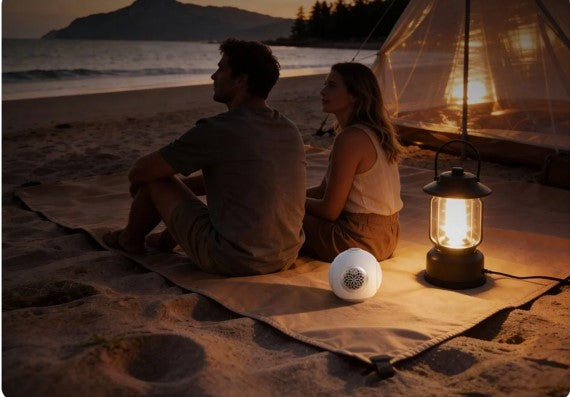
Camping changes the way you listen to music. At home, a speaker can stay plugged into a wall, sit on a stable surface, and operate in a relatively controlled environment. At a campsite, it needs to work around limited power, changing weather, dust, uneven ground, and the practical limitations of carrying equipment into the outdoors. Choosing the best bluetooth speaker for camping therefore means looking beyond sound quality alone. Battery performance, durability, portability, connection reliability, and the ability to produce clear sound in open spaces all influence whether a speaker will be useful after the first evening outdoors.
For a weekend campsite with electrical hookups, battery life may be a secondary consideration. For a remote hiking trip, an overland journey, or several days away from reliable electricity, it becomes one of the most important buying criteria. A speaker that sounds impressive but needs frequent charging may be less useful than a well-balanced model that offers dependable playback, manageable weight, and sufficient protection for outdoor conditions.
The right choice also depends on how you camp. A family campsite, a minimalist backpacking trip, a campervan journey, and an extended off-grid stay create different demands. This guide explains how to evaluate camping speakers by their real-world strengths, which specifications deserve attention, and how to balance sound quality, battery endurance, and physical durability without paying for features you will rarely use.
Why Camping Requires a Different Approach to Speaker Selection

A speaker designed primarily for indoor use may perform well in a bedroom or living room but become less convenient when taken outdoors. Camping removes many of the conveniences that make ordinary portable audio easy: stable power, predictable placement, protection from moisture, and nearby surfaces that help reinforce sound.
Outdoor listening introduces several practical challenges.
- Limited charging opportunities: A campsite may have no electrical outlet, and access to a power bank or vehicle charging connection may be restricted.
- Exposure to the elements: Condensation, splashes, light rain, dust, and damp ground can affect equipment that is not designed for outdoor conditions.
- Open-air acoustics: Low frequencies and reflections behave differently outdoors because there are fewer nearby walls to reinforce sound.
- Transport requirements: Speakers must fit into a backpack, camping box, vehicle storage compartment, or luggage without creating unnecessary weight.
- Unpredictable listening conditions: Music may be played around a picnic table, near a tent, beside a campfire, or across a wider gathering area.
The best purchase is not necessarily the loudest or most expensive speaker. It is the one that matches the trip.
For a useful starting point, compare the intended speaker with the broader recommendations in this outdoor Bluetooth speaker guide. The important question is not simply whether a speaker can be used outdoors, but whether its design suits the particular conditions in which you expect to use it.
Battery Life: The Most Important Specification for Off-Grid Trips

Battery endurance often determines whether a portable speaker remains useful throughout a camping trip. Charging a speaker at home before departure is easy. Recharging it when the nearest outlet is miles away is a different problem.
However, advertised battery life should not be treated as a guaranteed runtime. Manufacturers generally test speakers under particular conditions, and actual playback time can change considerably depending on volume, audio content, wireless connection, temperature, battery age, and other operating factors.
Match battery performance to the length of the trip
Start by estimating how often the speaker will be used instead of selecting a model based on its advertised runtime alone.
For example, a speaker used for an hour or two during dinner has different power requirements from one playing music throughout the day at a busy campsite. A backpacking trip lasting several days also creates a different requirement from a single-night stay at a campsite with vehicle access.
Consider these questions before buying:
- How many hours of music will you play each day?
- Will the speaker play continuously or only during meals and evening gatherings?
- How many nights will pass between charging opportunities?
- Will you carry a power bank, portable power station, or vehicle charging equipment?
- Will the speaker need to share the available power budget with a phone, GPS device, headlamp, or camera?
A long advertised runtime can be valuable, but only when it translates into useful listening time for your routine.
Understand what reduces battery life
Several factors can cause real-world playback to fall below a manufacturer's stated figure.
High volume: Driving the speaker loudly usually demands more power than listening at a moderate level. The difference may be particularly noticeable when music is played across a large campsite.
Bass-heavy music: Strong low-frequency output requires the speaker's acoustic system and amplification to work harder. Depending on the model and its tuning, bass-heavy tracks can affect power consumption.
Cold conditions: Low temperatures can temporarily reduce the usable performance of rechargeable lithium-ion batteries. Keep the speaker within its recommended operating-temperature range, and avoid leaving it exposed to extreme cold overnight.
Battery age: Rechargeable batteries gradually lose capacity through normal use and aging. A speaker that once lasted through several evenings may eventually need charging sooner.
Extra processing and features: Depending on the design, lights, additional connections, and other active features may add to overall power consumption.
For a deeper explanation of runtime expectations, see this guide to Bluetooth speaker battery life.
Plan power before leaving home
When comparing the best bluetooth speaker for camping, think about the speaker and your charging setup as one system. A long-lasting battery is useful, but so is a practical plan for keeping the rest of your electronics charged.
A simple pre-trip checklist can help:
- Fully charge the speaker before departure.
- Check how the speaker charges and whether it uses a cable or adapter you can easily replace.
- Confirm that your power bank has sufficient capacity and compatible output.
- Reserve charging capacity for essential equipment such as phones and navigation devices.
- Avoid assuming that a USB charging connection means the speaker can play and charge simultaneously; check the manufacturer's instructions.
- If the speaker has a battery indicator, understand how it reports remaining power and whether that estimate changes under heavy use.
If you are planning a remote trip, keep your speaker's charging needs separate from your essential safety equipment. Music is useful for recreation, but communication and navigation devices should take priority when power is scarce.
Durability: What a Camping Speaker Should Be Able to Handle

Camping equipment is frequently moved, packed, unpacked, and placed in environments where ordinary household devices would remain protected. A speaker does not need to be indestructible, but its design should suit the conditions you expect to encounter.
Durability involves several different properties. Water resistance is only one of them.
Water resistance and weather exposure
A speaker's IP rating provides a standardized way to understand particular forms of protection against dust or water. The rating matters because terms such as outdoor-ready, rugged, and weather-resistant do not all communicate the same level of protection.
An IPX5 rating, for example, indicates protection against water projected by a nozzle under specified test conditions. The X means that the rating does not specify a dust-protection level. IPX5 is not the same as being waterproof for submersion, and it should not be interpreted as permission to leave a speaker in heavy rain indefinitely.
When comparing products, consider the type of exposure you expect.
- Occasional splashes: Look for a rating appropriate to the possibility of water splashing onto the speaker.
- Rain during an outdoor gathering: Check the manufacturer's stated weather-use guidance as well as its IP rating.
- Dusty trails or sandy campsites: Look for an explicit dust-protection rating rather than relying on the water rating alone.
- Wet grass and condensation: Keep the speaker off the ground and dry it according to the manufacturer's instructions.
- Rivers, lakes, or swimming areas: Do not assume a water-resistant speaker can survive accidental immersion unless its rating and instructions explicitly support that use.
A protective rating helps reduce risk, but it does not remove the need for reasonable care. Water resistance may also be affected by wear, impact damage, aging seals, or improperly closed ports.
For a more detailed look at water-protection considerations, consult this waterproof Bluetooth speaker buying guide.
Impact protection and build quality
A camping speaker may be placed inside a gear box, moved around a vehicle, or carried beside tools and cookware. This makes physical construction worth considering alongside water protection.
Look for practical design details such as:
- A stable base that reduces the chance of the speaker tipping over.
- A housing that feels solid and resists everyday handling.
- Controls that are easy to operate without excessive force.
- Protected or recessed connection ports where appropriate.
- A carrying handle, strap, or compact shape that makes transport easier.
- A grille or driver arrangement that is not easily damaged by ordinary packing.
Rubberized edges and reinforced housings can help protect certain designs from minor knocks, but they do not make every product drop-proof. A speaker's actual resistance to impact depends on its construction and any testing specified by the manufacturer.
For backcountry use, physical protection also includes the way you pack it. Place the speaker where cookware, tools, tent stakes, or other heavy equipment cannot repeatedly strike it.
Heat, moisture, and storage
A camping speaker can encounter challenging conditions even when it never gets directly wet. Leaving it inside a sun-heated vehicle, exposing it to high temperatures beside a fire, or packing it away while damp can create avoidable risks.
Good practice includes:
- Keep the speaker away from open flames, hot cooking equipment, and intense radiant heat.
- Follow the manufacturer's temperature limits for use, charging, and storage.
- Do not charge a wet device unless its instructions explicitly permit it.
- Dry the exterior before returning the speaker to a closed bag or storage box.
- Avoid leaving the speaker in direct sunlight for extended periods.
- Protect the charging port from dirt and moisture when the speaker is not in use.
Durability is not only about surviving an accident. It is also about tolerating repeated trips when the equipment is handled sensibly.
Sound Quality Outdoors: Why Indoor Performance Is Not Enough

A speaker that sounds full in a small bedroom can sound different when carried into an open campsite. Indoors, nearby walls and other room boundaries influence sound by reflecting energy back into the listening area. Outdoors, much of that reinforcement disappears.
This is especially noticeable in the bass. The result can be music that sounds lighter or less powerful than it did in a room, even when the volume setting has not changed.
That does not mean a camping speaker must produce exaggerated bass. It means the acoustic design needs to balance low-frequency presence, vocal clarity, and usable output.
Bass performance without artificial expectations
Bass quality depends on more than the speaker's size or a single frequency-response figure. Relevant factors include:
- Driver capability and excursion.
- Enclosure volume and acoustic architecture.
- Passive-radiator or port design, when used.
- Amplifier capability and digital signal processing.
- Distortion at higher output levels.
- The balance between low frequencies and the rest of the music.
A speaker with strong bass extension can make outdoor music feel more substantial. However, deep bass may consume additional power, and excessive bass tuning can mask voices or reduce clarity at higher listening levels.
The useful goal is balanced sound: enough low-frequency energy to keep music engaging, enough midrange detail to preserve vocals, and enough high-frequency clarity to prevent the sound from becoming dull.
For a more technical explanation of low-frequency performance, read 40Hz bass in Bluetooth speakers explained.
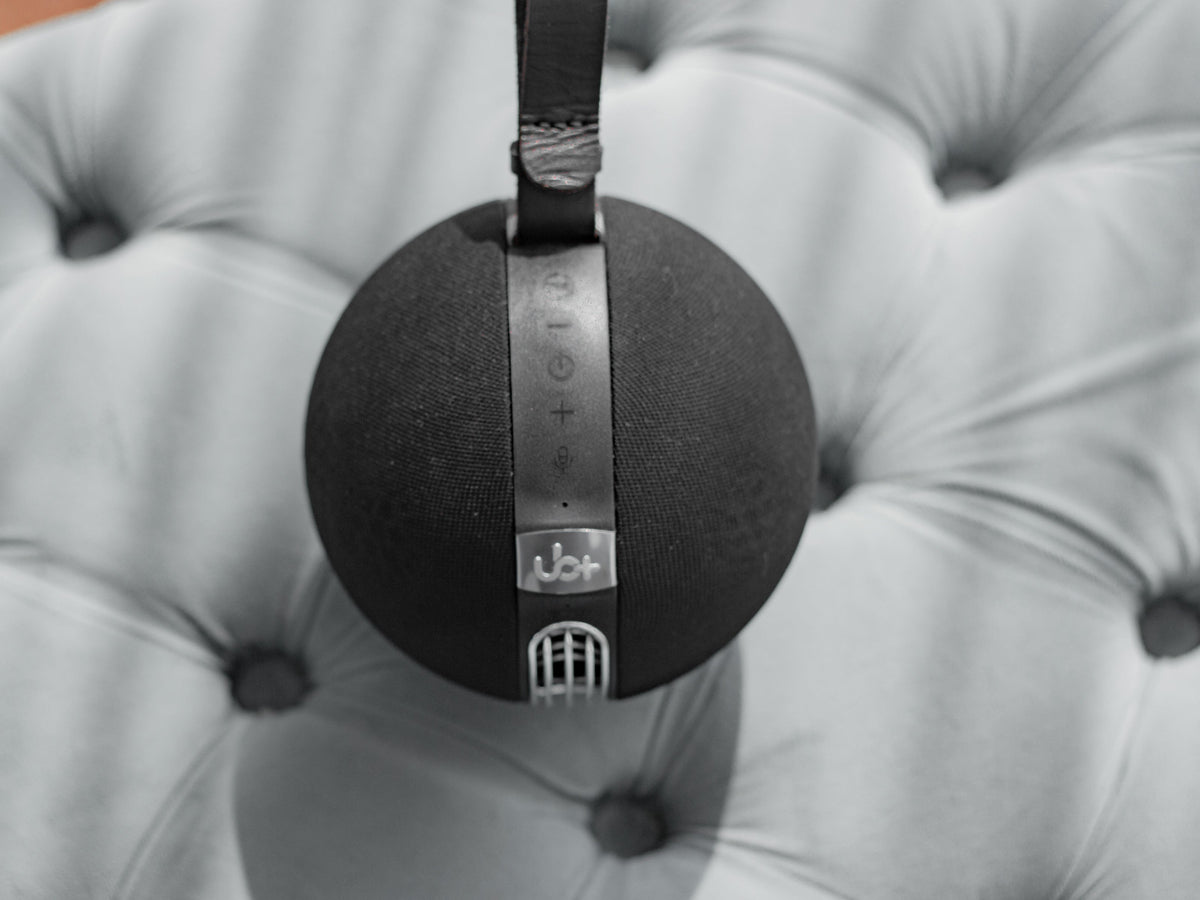
Acoustic Spotlight: The dB1 DoubleBass design

The UB+ dB1 DoubleBass is a useful example of how enclosure architecture and air movement can influence bass reproduction in a portable speaker. Its technical design is relevant to camping because open environments place more emphasis on the speaker's ability to deliver useful low-frequency output without relying on the reinforcing boundaries of a room.
The model's documented acoustic architecture includes several distinctive features.
- Helmholtz-Inspired Chamber: The spherical enclosure draws on the Helmholtz resonator principle. Enclosure geometry affects the internal acoustic behavior of a speaker, although spherical construction should not be interpreted as eliminating every standing wave or source of distortion.
- Central 4.5-inch mid-bass driver: The driver operates within the spherical acoustic structure and is designed to work with the enclosure and passive-radiator system.
- Dual symmetrical passive radiators: Large radiators positioned on opposing sides respond to pressure changes inside the enclosure, helping extend low-frequency output without requiring a conventional open bass port.
- Combined radiator area approximately 3.5 times the woofer area: This design relationship supports substantial air movement through the passive-radiator system.
- Oversized 90 mm neodymium magnet: The motor structure is part of the driver's force-producing system.
- 35 mm long-stroke voice coil, approximately 20 mm piston movement, aluminum shorting ring, and 18 mm extra-wide surround: These construction elements contribute to the driver's mechanical and electromagnetic design.
- DSP-supported tuning: Digital signal processing can help manage tonal balance, linearity, and protection. The acoustic concept is not based on the idea that all digital processing is undesirable.
- Published performance figures: The dB1 specification information supplied for this design lists an approximate 40 Hz–20 kHz frequency range, 93 dB SPL, and Bluetooth 5.3.
- IPX5 water protection: This indicates resistance to water projected by a nozzle under specified testing conditions, not protection against submersion or a guarantee of protection from dust.
The design philosophy is to use the enclosure and passive-radiator system as active parts of the acoustic solution rather than expecting equal results from digital bass emphasis alone. The opposing radiator arrangement may also help counterbalance some mechanical forces, although it should not be treated as eliminating all vibration.
These are dB1-specific technical characteristics. They should not automatically be attributed to other UB+ speaker models, and technical performance alone does not establish how long a speaker will last on a particular camping trip. Battery endurance, sound output, weather exposure, and physical portability still need to be evaluated separately.
Portability: Choose a Speaker You Will Actually Carry

The ideal speaker for a campervan trip may be inconvenient for a long hike. A heavier unit can be perfectly practical when stored in a vehicle, but less appealing when every item must fit inside a backpack.
Think about the entire journey, not just the moment when the music starts.
Match the size to your camping style
Backpacking and hiking: Prioritize manageable weight, a compact footprint, simple controls, and enough battery life for the trip. Every additional item competes with food, water, shelter, and safety equipment.
Car camping: You have greater freedom to choose a larger speaker or bring a charging accessory. A model with fuller sound may be worthwhile when the group spends time around a common campsite.
Campervan and overlanding: Storage dimensions, charging compatibility, and reliable performance during repeated travel may be more important than minimizing every gram.
Family or group camping: Wider sound coverage and adequate volume may matter, but the speaker still needs an appropriate battery and protection level.
Remote multi-day trips: Reliability and energy efficiency deserve extra attention. You may prefer moderate-volume listening sessions rather than playing music throughout the day.
A carrying handle or convenient grip can improve usability, but it does not replace the importance of actual weight and dimensions. Compare those figures with your pack, storage compartment, and other gear before purchasing.
Consider how the speaker will be positioned
Portable speakers do not all project sound in the same way. Some direct most of their output toward the front, while others are designed to distribute sound across a wider area.
For camping, this affects where people can sit and how the speaker should be placed.
- A front-firing design may work well when people are gathered on one side.
- A broad-dispersion or 360-degree design can be useful when listeners are spread around the speaker, provided its actual acoustic design supports that coverage.
- A stable, slightly elevated position can help keep sound clear of obstacles.
- Placing a speaker on soft ground may obstruct parts of its enclosure or reduce stability.
- Avoid positioning it where it can be kicked, stepped on, or exposed to cooking splashes.
Do not assume that a circular or spherical appearance automatically guarantees uniform 360-degree sound. Dispersion depends on the driver layout and acoustic design, not appearance alone.
Bluetooth Connectivity and Offline Listening

For remote trips, Bluetooth provides a straightforward way to play audio from a phone or another compatible device without a local Wi-Fi network. However, wireless reliability and battery planning still matter.
Bluetooth range and connection reliability
The effective connection range depends on the speaker, source device, surrounding obstacles, and radio interference. A manufacturer's stated range is usually measured under particular conditions and should not be treated as a guaranteed distance through vehicles, tents, trees, or uneven terrain.
For dependable operation:
- Keep the phone or audio source reasonably close to the speaker.
- Avoid placing the source behind large obstructions when the connection becomes unstable.
- Check the supported Bluetooth version and any relevant compatibility information.
- Test pairing before leaving home.
- Understand how the speaker handles reconnection after being powered off.
- Bring a backup playback option if music is an important part of a remote group's plans.
A newer Bluetooth version can bring improvements in certain areas, but the version number by itself does not guarantee longer battery life, stronger range, or better sound. Those outcomes depend on the full implementation.
Download music before leaving coverage
Many camping locations have weak or unreliable mobile service. Streaming may stop when the connection disappears, and repeated reconnecting can be frustrating.
Before departure, prepare your listening options:
- Download music or playlists for offline playback when your service allows it.
- Store enough audio on your phone for the trip.
- Test offline playback with mobile data and Wi-Fi disabled.
- Check whether the speaker supports alternative playback methods, such as wired input or removable storage, if these features are useful to you.
- Keep the phone's battery in mind when playing music over Bluetooth for extended periods.
A speaker cannot compensate for an audio source that has no available music. Offline preparation is one of the simplest ways to improve the experience.
Different speaker categories offer different balances of weight, sound, endurance, and protection. There is no single design that suits every campsite.
The following table is a decision-making framework rather than a ranking of specific products. Actual performance depends on individual models and their published specifications.
|
Speaker type |
Main strengths |
Potential drawbacks |
Most suitable use |
|
Ultra-compact portable speaker |
Easy to pack and carry |
May have limited output and low-frequency capability |
Solo hiking and minimalist trips |
|
Rugged outdoor speaker |
Often emphasizes protective construction and outdoor handling |
Protection can add weight or bulk; quality varies by model |
Regular camping and active outdoor use |
|
Larger portable speaker |
Can offer fuller sound and higher output |
Requires more storage space and may be heavier |
Car camping, campervans, and group gatherings |
|
Spherical or broad-dispersion speaker |
Certain designs can distribute sound around a wider listening area |
Appearance alone does not prove 360-degree coverage; model specifications matter |
Shared listening around a campsite |
|
Portable speaker with flexible playback options |
May offer more than one way to play music |
Extra features do not automatically provide better endurance or durability |
Trips where source-device flexibility matters |
When considering the best bluetooth speaker for camping, use this comparison as a starting point, then compare specific models for battery runtime, charging method, protection rating, weight, dimensions, and sound performance.
Two Camping Setups: Weekend Trips and Extended Off-Grid Travel
Your trip duration changes the trade-offs worth making. The table below shows how priorities shift between two common situations.
|
Decision factor |
Weekend campsite |
Extended off-grid trip |
|
Battery priority |
Enough capacity for planned daily listening |
Higher priority because charging may be unavailable |
|
Charging plan |
Wall charger, vehicle, or a small power bank may be sufficient |
More careful energy budgeting and suitable backup power may be necessary |
|
Portability |
Moderate size may be acceptable when driving |
Weight and packing volume become more important when carrying gear |
|
Durability |
Protection for expected splashes, dirt, and handling |
Protection and reliable care practices become more important over repeated days |
|
Sound output |
Group coverage may take priority |
Useful sound at moderate volume may be preferable to maximum loudness |
|
Playback preparation |
Offline playlists remain useful |
Offline music and source-device battery planning are especially important |
|
Backup options |
A phone or another device may cover unexpected needs |
Plan for limited power and avoid relying on a single device for essential functions |
These are not absolute rules. A weekend hike with unpredictable weather may demand more protection than a long campervan trip with secure storage. Use the conditions you are likely to encounter rather than the trip label alone.
What to Check Before Buying a Camping Speaker
A specification sheet becomes more useful when you connect every figure to a real requirement. A long list of features can look impressive while leaving important questions unanswered.
Use this checklist when comparing models.
Battery and charging
- Review the manufacturer's stated battery life and, where available, the testing conditions.
- Check whether expected listening volume will be relatively low, moderate, or high.
- Confirm the charging connector and required power source.
- Check whether a power bank can charge the speaker, if that is part of your plan.
- Determine whether charging and playback can happen simultaneously.
Durability and weather
- Confirm the exact IP rating rather than relying on terms such as “rugged.”
- Look for explicit dust protection when visiting dusty, sandy, or dry outdoor environments.
- Review any restrictions on rain exposure, water exposure, charging, or temperature.
- Consider the housing, grille, controls, and port protection.
- Check the warranty terms and exclusions for outdoor use.
Sound and connectivity
- Listen for clear vocals and balanced sound at the levels you will use outdoors.
- Consider bass performance without assuming a higher bass figure guarantees better music.
- Check the driver's arrangement and sound-dispersion claims.
- Verify Bluetooth compatibility with your source device.
- Download offline audio and test playback before departure.
Portability and support
- Compare the actual weight and dimensions with your available space.
- Check for a grip, handle, strap, or other transport feature that suits your trip.
- Confirm the included charging accessories.
- Review warranty support and the availability of replacement cables or accessories.
- Test the speaker at home before depending on it outdoors.
A speaker that passes these checks is a more informed purchase than one selected only for its appearance, advertised wattage, or headline battery figure.
How to Preserve Battery and Durability During a Trip
Even a well-designed speaker benefits from sensible use. A few simple practices can help keep it working reliably throughout the trip.
Manage volume rather than using maximum output continuously. Moderate playback can reduce energy demand and make conversation around the campsite easier. Keep sound at a considerate level, especially in shared campsites or natural areas where wildlife and other campers may be affected.
Keep it away from moisture when not in use. Place the speaker on a dry surface and store it in a suitable bag or container when conditions deteriorate. Do not assume an outdoor rating makes careless storage harmless.
Avoid extreme temperatures. Keep the speaker out of direct heat and within the operating and storage temperatures recommended by its manufacturer. Do not charge it when it is outside the specified charging-temperature range.
Protect the charging port. Dust, grit, and moisture can complicate charging. Inspect the port before plugging in a cable and follow the manufacturer's cleaning instructions.
Use an appropriate charging routine. Follow the product's guidance for charging and long-term storage. Avoid using damaged cables or incompatible power adapters.
Test everything before leaving. Check pairing, offline playback, battery status, buttons, charging, and any alternative playback options at home. Discovering a problem before departure is better than discovering it at a remote campsite.
Pack it securely. Use a location where it cannot repeatedly strike metal cookware, tools, or other heavy equipment. If the speaker has a carrying case or protective cover, use it when appropriate.
These habits do not guarantee a particular battery life or product lifespan, but they reduce avoidable problems and make outdoor use more predictable.
Prioritize the Trip, Not the Feature List
The most suitable camping speaker is the one that fits your transportation, charging options, surroundings, and listening habits. A compact model may be best for a backpacker who wants music during breaks. A more substantial portable speaker may make sense at a campsite where people gather for meals and conversation. Someone spending several days away from reliable electricity should pay particular attention to measured battery expectations, charging compatibility, and power management.
Before making a decision, rank your priorities in this order:
- First: battery and charging. Estimate how much listening you need and how often the speaker can be recharged.
- Second: protection. Match the IP rating and physical construction to the expected weather, dust, and handling.
- Third: portability. Make sure the size and weight are realistic for the way you travel.
- Fourth: sound quality. Look for clear, balanced audio and adequate output for the space rather than focusing on bass or loudness alone.
- Fifth: connectivity and flexibility. Confirm dependable pairing and prepare offline audio for areas without mobile coverage.
For additional ideas about taking portable audio on the road, explore this guide to portable speakers for travel and adventure. If your trip includes a beach stop or another wet environment, the related Bluetooth speakers for beach use guide can help you think through exposure and portability in a different outdoor setting.
The best choice is not the speaker with the longest advertised runtime, the biggest driver, or the most rugged-looking housing in isolation. It is the model whose documented performance, practical design, and care requirements match the trip you are planning.
Frequently Asked Questions
What is the most important feature in a Bluetooth speaker for camping?
Battery performance is often the first consideration for off-grid camping because charging may not be readily available. However, a suitable water-protection rating, convenient portability, reliable Bluetooth connectivity, and sound quality also matter. The right balance depends on trip length and the conditions you expect.
How much battery life do I need for an off-grid camping trip?
Estimate your likely listening hours per day and multiply that by the number of days between charging opportunities. Then compare the result with the manufacturer's stated runtime while accounting for volume, temperature, music content, and battery age. Leave a margin rather than planning around the advertised maximum.
Is IPX5 enough for a camping speaker?
IPX5 indicates protection against water projected by a nozzle under specified test conditions. It can be relevant for certain outdoor splash exposures, but it does not mean the speaker is suitable for immersion, and it does not establish dust protection. Choose a rating and usage conditions that match the environment, and follow the manufacturer's guidance.
Is a larger speaker always better for camping?
No. A larger speaker may deliver fuller sound or higher output, depending on its design, but it can also take up more space and be heavier to transport. For backpacking, compact size may be more valuable. For car camping or a shared gathering, the added output of a larger model may be worthwhile.
Should I download music before an off-grid trip?
Yes. Mobile coverage can be unreliable or unavailable in remote areas, and streaming depends on a working data connection. Download playlists or other audio for offline playback before leaving, test them without a network connection, and consider the effect of extended playback on your phone's battery.
Explore Portable Audio for Your Next Trip
Before choosing a camping speaker, compare the model's documented battery performance, durability rating, physical size, and acoustic design against the conditions you expect to encounter. The most useful portable speaker is one you can carry comfortably, operate responsibly, and rely on for the listening sessions you have planned.
Explore the UB+ product collection to compare available speaker designs and find an option that suits your approach to portable listening. Review the specifications and product guidance for the individual model before relying on it for an extended off-grid journey.


发表评论
此站点受 hCaptcha 保护,并且 hCaptcha 隐私政策和服务条款适用。