
When comparing portable Bluetooth speakers, specifications such as frequency response, bass extension, SPL, sensitivity, and driver design can quickly become confusing. A number like 40Hz–20kHz tells you something useful about a speaker, but it does not tell the whole story about how that speaker will sound. Likewise, a 93dB specification should be understood in context rather than treated as a simple “louder is better” score.
The important skill is learning how these specifications work together. Frequency response helps describe the range of frequencies a speaker can reproduce. Bass performance depends on much more than the lowest number printed on a specification sheet. Loudness depends on acoustic output, amplifier power, driver efficiency, enclosure design, and distortion limits. This guide explains how to interpret those specifications and what they mean when listening to hip-hop, acoustic music, movies, and other content.
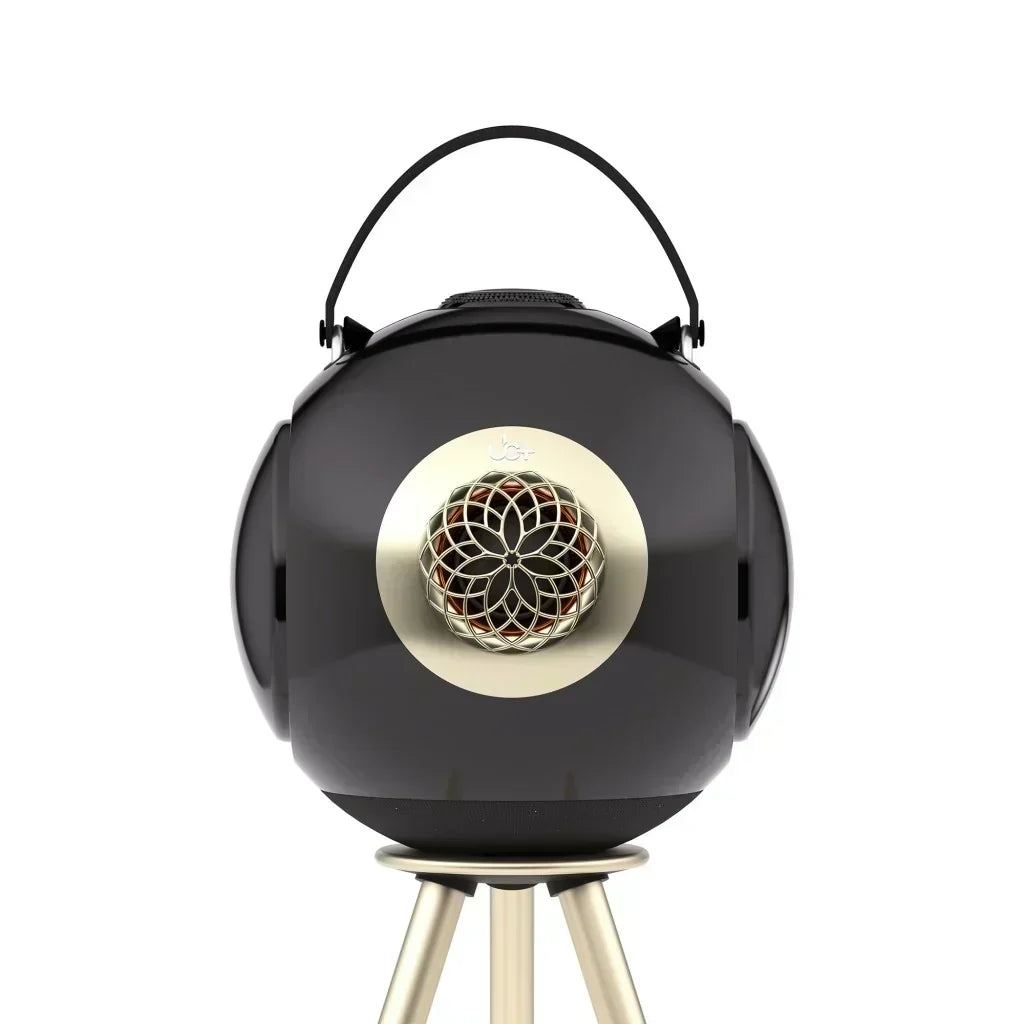
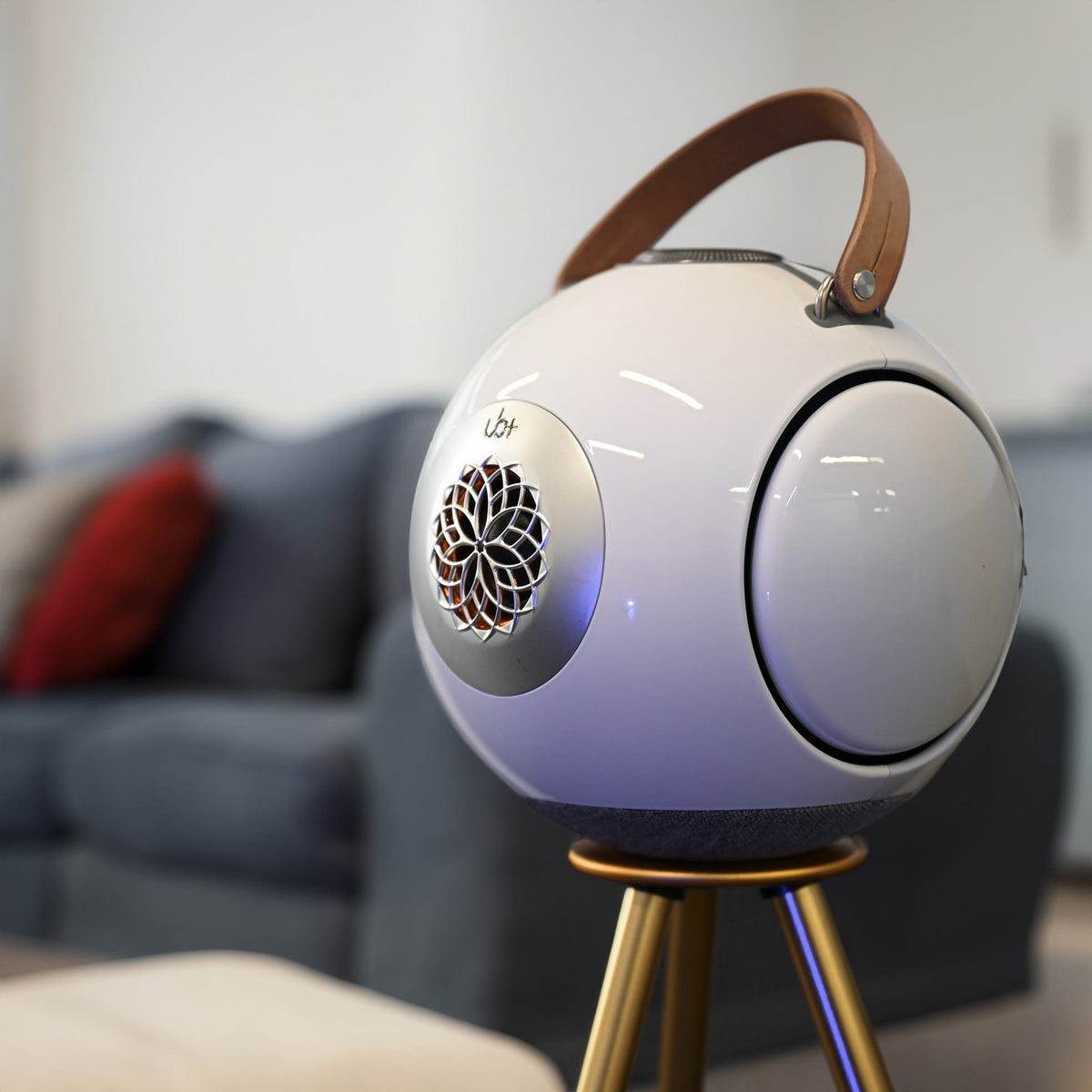
The UB+ dB1 DoubleBass provides a useful example, with a stated 40Hz–20kHz frequency response and approximately 93dB SPL. Its spherical acoustic architecture and dual passive-radiator system also demonstrate why specifications should be considered as part of a complete speaker design.
Frequency Response: What Does 40Hz–20kHz Actually Mean?

Frequency response describes the range of frequencies a speaker is designed to reproduce, measured in Hertz (Hz).
The commonly referenced range of human hearing is approximately 20Hz to 20kHz, although actual hearing varies considerably between individuals and with age.
So, when a speaker is specified at 40Hz–20kHz, the specification indicates a stated range extending from 40 Hz at the low end to 20 kHz at the high end.
But there is an important qualification: a frequency-response range is not a complete description of tonal performance.
The measurement tolerance matters. A specification showing 40Hz–20kHz without explaining the measurement conditions does not tell you how evenly the speaker reproduces every frequency between those endpoints.
For example, two speakers could both claim a 40Hz–20kHz range while producing noticeably different results because their response curves, enclosure designs, drivers, and DSP tuning differ.
What the Frequency Range Tells You
|
Specification |
What It Indicates |
What It Does Not Tell You |
|
40Hz lower limit |
Stated low-frequency extension |
How loud 40Hz is reproduced |
|
20kHz upper limit |
Stated high-frequency extension |
How flat the treble response is |
|
Wide frequency range |
Broad reproduction capability |
Overall sound quality |
|
Published response curve |
More information about tonal balance |
How the speaker behaves in every room |
This is why you should never choose a speaker solely because its frequency-response numbers look wider.
What Is Bass?

Bass refers broadly to the lower-frequency portion of the audible spectrum.
Low frequencies require the speaker to move enough air to create meaningful acoustic pressure. This becomes increasingly difficult as frequency decreases, particularly in compact portable speakers.
Bass reproduction is therefore affected by:
- Driver diameter
- Driver excursion
- Motor strength
- Enclosure volume
- Internal acoustic loading
- Passive-radiator or port design
- Amplifier capability
- DSP
- Mechanical limits
A speaker's quoted lower frequency limit is therefore only one part of the bass story.
A useful way to think about it is:
Frequency response tells you where the system can reproduce sound; acoustic architecture helps determine how effectively it reproduces that sound.
Why 40Hz Matters for Bass-Heavy Music

A speaker reaching approximately 40Hz can reproduce significantly deeper bass content than a compact speaker whose usable response ends substantially higher.
This can matter with music containing strong low-frequency information, including hip-hop, electronic music, cinematic soundtracks, and modern pop productions.
However, 40Hz does not automatically mean “more bass.”
The speaker still needs enough acoustic output and excursion capability at that frequency. If a specification reaches 40Hz but the output at 40Hz is extremely weak, the number alone has limited practical value.
For that reason, when evaluating deep bass Bluetooth speakers, look at the complete bass architecture rather than only the lowest frequency in the specification.
You can learn more about this distinction in the UB+ guide to bass extension and what Hz means for speaker performance.
Hip-Hop: Why Low-Frequency Extension Matters
Hip-hop frequently contains substantial energy in the low-frequency region, including kick drums, basslines, sub-bass effects, and synthesized low-end.
A speaker with stronger low-frequency extension can reproduce more of this information than a system that rolls off earlier.
But bass-heavy music also exposes weaknesses in speaker design.
If the driver approaches its mechanical limits, or if the system relies heavily on aggressive electronic bass enhancement, the result can become compressed or distorted at higher playback levels.
This makes the combination of frequency extension, driver excursion, enclosure design, and headroom more useful than simply looking for the lowest published frequency.
The UB+ dB1 DoubleBass approaches this challenge with a long-throw mid-bass driver working into a spherical acoustic chamber, supported by two opposing passive radiators.
That architecture is designed to use the movement of air within the enclosure to support low-frequency output rather than treating bass as simply an EQ boost.
Acoustic Music: Frequency Response Is Only Part of the Picture
Acoustic music can expose a different set of speaker characteristics.
Vocals, acoustic guitar, piano, strings, percussion, and other instruments contain important information through the midrange and treble. Here, tonal balance and distortion can be more revealing than simply having an impressive bass specification.
A speaker can reproduce 40Hz but still sound unnatural if the midrange is poorly balanced.
For acoustic recordings, pay attention to:
- Vocal intelligibility
- Midrange balance
- Treble smoothness
- Transient detail
- Distortion at normal listening levels
- Overall tonal consistency
The 20kHz upper specification on a speaker such as the dB1 indicates its stated high-frequency extension, but it should not be interpreted as a guarantee of exceptional treble quality by itself.
The quality of reproduction depends on the driver and complete acoustic system.
Movies: Why You Need Both Bass and Clarity
Movie soundtracks place broad demands on a speaker.
A single soundtrack can contain dialogue, music, environmental details, explosions, low-frequency effects, and sudden dynamic changes.
That means a useful movie speaker needs more than deep bass.
It also needs sufficient midrange clarity for dialogue and enough headroom to reproduce changes in level without excessive compression or distortion.
A speaker with broad frequency reproduction can be useful for this reason, but the enclosure and driver system still determine how effectively those frequencies are reproduced.
For TV and movie use, also consider Bluetooth latency. A speaker can sound excellent but still be frustrating for video if audio and video do not remain synchronized.
Loudness: What Does dB Actually Tell You?
Decibels are used to express sound pressure level and many other audio quantities.
This is where speaker specifications can become particularly confusing because dB is not one single measurement.
A speaker may have a published SPL figure, while another product may publish sensitivity. These measurements are related to loudness but are not interchangeable without knowing the measurement conditions.
The UB+ dB1 DoubleBass is specified at approximately 93dB SPL.
That number provides information about the speaker's acoustic output under the manufacturer's stated measurement conditions. It should not automatically be interpreted as a universal sensitivity rating.
This is an important distinction from the original version of this article, which treated 93dB as though it were directly equivalent to sensitivity.
SPL vs. Sensitivity: Don't Treat Them as the Same Specification
SPL and sensitivity can both involve decibels, but they describe different things.
Sensitivity is generally used to describe how much acoustic output a loudspeaker produces for a specified input under defined measurement conditions.
Maximum SPL describes how much acoustic output a system can achieve under specified conditions.
Therefore, a statement such as:
“93dB means the speaker can produce more volume using less power”
cannot be made from the dB number alone unless the specification is explicitly identified as sensitivity and the measurement conditions are known.
For buyers, the practical lesson is simple:
Check what the manufacturer actually measured before comparing dB figures between speakers.
Does a Higher dB Number Mean a Better Speaker?
Not necessarily.
A higher maximum SPL can be useful if you need more acoustic output, particularly outdoors or in larger listening spaces. But maximum loudness is only one part of speaker performance.
A speaker that becomes harsh or heavily distorted at its maximum output may be less useful for everyday listening than a system that maintains cleaner reproduction at its normal operating level.
This is why distortion and headroom belong in the same conversation as loudness.
For more on this topic, see how speaker SPL works and how loud your speaker actually needs to be.
Why Driver Excursion Matters for Bass
Low-frequency reproduction requires substantial air movement.
One way a speaker accomplishes this is by moving the driver farther.
The dB1 DoubleBass uses a 4.5-inch long-throw mid-bass driver with substantial mechanical excursion capability. Its driver system includes a 90mm neodymium magnet, 35mm long-stroke voice coil, and approximately 20mm piston movement.
This type of engineering matters because simply increasing electrical power does not solve the physical challenge of reproducing deep bass from a compact enclosure.
The driver needs to remain controlled while moving enough air.
That is one reason driver design should be considered alongside frequency response.
How Passive Radiators Support Bass
Passive radiators are another important part of compact speaker design.
Instead of using an open port, a passive radiator uses a moving diaphragm that responds to pressure changes inside the enclosure.
The dB1 DoubleBass uses two opposing passive radiators positioned around its spherical acoustic chamber.
The combined passive-radiator surface area is approximately 3.5× the active woofer area.
The arrangement is designed to work with the internal air pressure generated by the active driver. Because the radiators are positioned opposite one another, their movement also contributes to a mechanically balanced enclosure.
This is fundamentally different from simply adding more bass through equalization.
For a more detailed explanation, see how passive radiators work in Bluetooth speakers.
Why the Enclosure Changes the Sound
The enclosure determines how the driver interacts with the air around it.
A conventional box can create internal reflections and standing-wave behavior. A spherical enclosure approaches the internal acoustic environment differently because it does not contain large parallel internal walls in the same way.
The dB1 DoubleBass uses a spherical acoustic chamber inspired by the Helmholtz resonance principle.
The objective is to distribute internal air pressure more evenly and reduce problematic internal resonances and phase-related behavior.
This is an important example of why the physical design of a speaker cannot be separated from its specifications.
A frequency-response number describes the result. The enclosure architecture helps explain how that result is achieved.
Bass Quantity vs. Bass Quality
When people say they want “more bass,” they can mean several different things.
They may want:
- Deeper low-frequency extension
- Greater bass output
- Stronger kick
- More physical impact
- Less distortion
- Better bass definition
- More consistent bass at higher volume
These are not identical goals.
A speaker can have a strong bass boost but poor definition. Another can have deeper extension but a more controlled presentation. Another may produce impressive bass at moderate volume but compress when pushed harder.
For serious comparison, ask:
How deep does the speaker extend, how much output can it produce there, and how well does it maintain control?
That question is much more useful than simply asking which speaker has “the most bass.”
How Loudness and Bass Interact
Bass places significant demands on a portable speaker.
Low frequencies require substantial driver movement, and producing them at higher volume requires additional acoustic and electrical headroom.
This creates a design trade-off.
If the amplifier pushes the driver beyond its practical limits, the system may experience:
- Compression
- Increased distortion
- Reduced bass definition
- Mechanical stress
- Reduced overall clarity
A well-engineered portable speaker therefore needs the driver, amplifier, enclosure, and DSP to work together.
DSP can be useful for maintaining linearity, protecting the driver, and managing tonal balance. But DSP cannot remove the physical requirements of low-frequency reproduction.
How to Read a Speaker Specification Sheet
When you see a specification sheet, read it in this order:
1. Frequency Response
Look at the stated lower and upper limits, but remember that measurement tolerance matters.
2. SPL or Sensitivity
Identify exactly which measurement is being provided before comparing dB numbers.
3. Driver Configuration
Look for driver size, number of drivers, excursion, and other relevant design information.
4. Bass Architecture
Check whether the speaker uses a sealed enclosure, port, passive radiator, or another acoustic approach.
5. Distortion / Headroom
If measurements are provided, examine how the speaker behaves at higher output rather than focusing only on its maximum number.
6. Dispersion
Consider whether the speaker is front-firing, wide-dispersion, or designed for 360-degree listening.
7. Connectivity and Practical Features
Bluetooth version, wired playback, battery, charging, and environmental protection can determine how useful the speaker is in everyday life.
Specification Checklist
|
Specification |
What to Ask |
|
Frequency Response |
How far does the speaker extend at both ends? |
|
Bass |
How is the low end actually produced? |
|
SPL |
What measurement conditions were used? |
|
Sensitivity |
Is this actually a sensitivity specification? |
|
Driver Size |
What type of driver and excursion does it use? |
|
Passive Radiators |
Does the enclosure use them to extend bass? |
|
Enclosure |
How does its geometry affect acoustic behavior? |
|
DSP |
Is it supporting the hardware or heavily compensating for limitations? |
|
Dispersion |
Where will listeners be positioned? |
|
Battery |
How will volume and usage affect practical runtime? |
|
IP Rating |
What environmental conditions can it actually withstand? |
|
Bluetooth |
What wireless standard and connectivity options are supported? |
What the UB+ dB1 DoubleBass Specifications Mean in Context
The dB1 DoubleBass is a useful example because its specifications are connected to a specific acoustic architecture.
|
Specification |
dB1 DoubleBass |
Why It Matters |
|
Frequency response |
Approximately 40Hz–20kHz |
Indicates stated low- and high-frequency extension |
|
SPL |
Approximately 93dB |
Indicates stated acoustic output under specified conditions |
|
Active driver |
4.5-inch long-throw mid-bass |
Provides the primary acoustic excitation |
|
Passive radiators |
Dual opposing |
Supports low-frequency acoustic output |
|
Passive-radiator area |
Approx. 3.5× active woofer area |
Provides substantial radiating surface |
|
Acoustic chamber |
Spherical |
Forms the core enclosure architecture |
|
Acoustic principle |
Helmholtz-inspired |
Relates enclosure behavior to resonant air movement |
|
Dispersion |
360° spherical |
Broadens listening coverage |
|
Wireless |
Bluetooth 5.3 |
Current wireless connectivity platform |
|
Water resistance |
IPX5 |
Designed for resistance to water jets under specified conditions |
The important point is that none of these specifications should be interpreted in isolation.
The 40Hz figure tells you about stated low-frequency extension. The driver and passive-radiator architecture help explain how the speaker produces that low-frequency output. The SPL figure provides an indication of output capability. The spherical enclosure influences how the acoustic system behaves internally and distributes sound.
That is the difference between reading a specification sheet and understanding a speaker.
Which Specifications Matter Most for Different Listening?
|
Listening Priority |
Specifications to Focus On |
|
Hip-hop / EDM |
Bass extension, driver excursion, acoustic loading, output |
|
Acoustic music |
Tonal balance, midrange, treble, distortion |
|
Movies |
Full-range reproduction, dialogue clarity, output, latency |
|
Outdoor listening |
SPL, dispersion, battery, IP rating |
|
Desktop listening |
Tonal balance, compact design, dispersion |
|
General music |
Balanced frequency response, distortion, bass control |
There is no single “best” specification because different listening situations place different demands on a speaker.
Frequently Asked Questions
What does 40Hz–20kHz mean on a Bluetooth speaker?
It describes the speaker's stated frequency-response range, from approximately 40 Hz at the low end to 20 kHz at the high end. It does not by itself tell you how evenly or loudly the speaker reproduces those frequencies.
Is a lower Hz rating always better?
No. A lower published frequency can indicate deeper stated extension, but the measurement tolerance and actual output at that frequency are important. The acoustic design determines how useful that extension is in practice.
Is 93dB the same as 93dB sensitivity?
Not necessarily. You need to know what the manufacturer means by the specification and the measurement conditions. SPL and sensitivity are related but should not automatically be treated as identical.
Does more bass mean better sound?
Not necessarily. Good bass involves extension, control, definition, output, and low distortion. Excessive bass emphasis can also change the tonal balance of the music.
What matters more: frequency response or driver design?
Neither should be considered independently. Frequency response describes a result, while driver and enclosure architecture help determine how that result is achieved. A useful evaluation considers both.
Explore UB+ dB1 DoubleBass
→ Explore the UB+ dB1 DoubleBass
→ Compare the dB1 DoubleBass with the dB Mini
Understanding speaker specifications becomes much easier once you stop treating individual numbers as complete descriptions of performance. Frequency response tells you about range, SPL tells you about acoustic output under defined conditions, and driver/enclosure architecture helps explain how the speaker actually produces that sound. That is the information worth looking at when comparing portable Bluetooth speakers.


留言
此網站已受到 hCaptcha 保護,且適用 hCaptcha 隱私政策以及服務條款。