
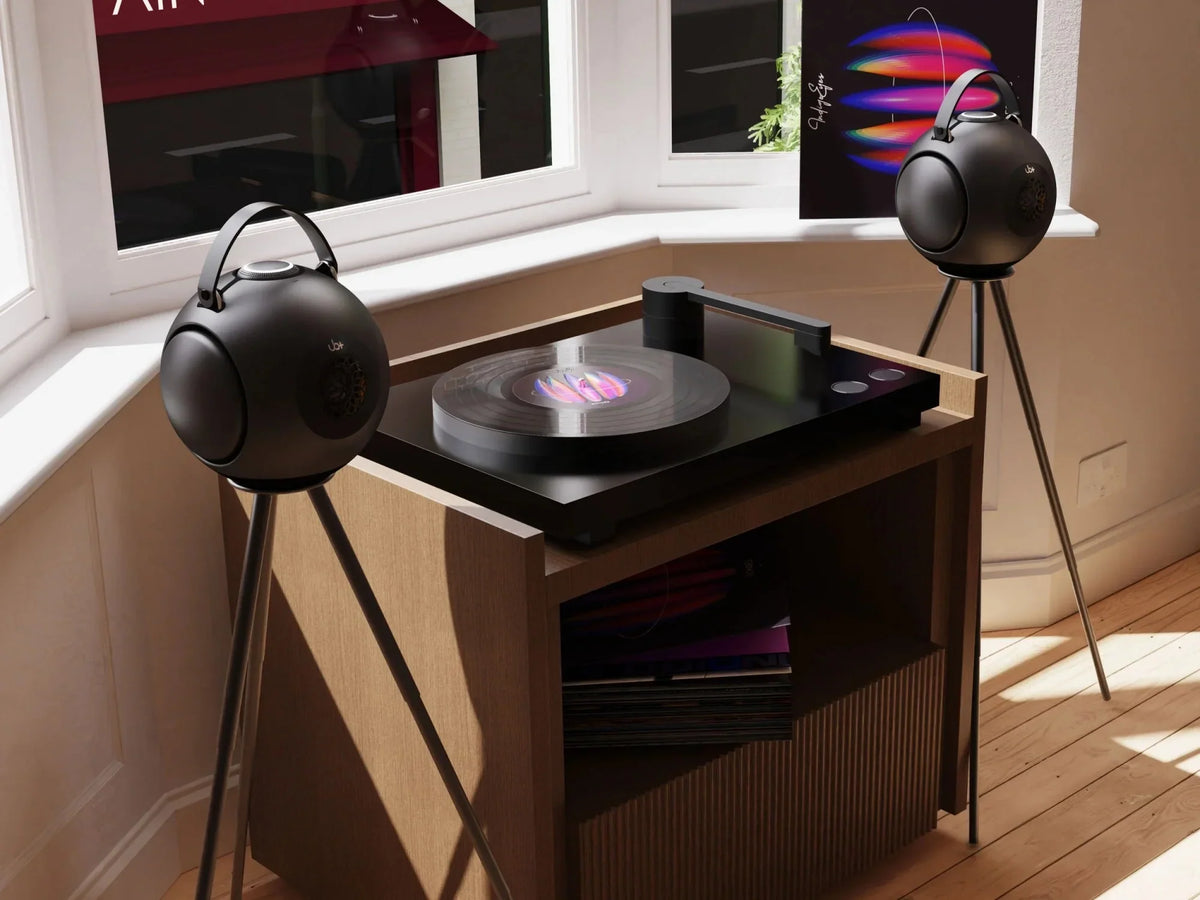
A turntable does not have to be connected to traditional wired speakers to create a serious listening setup. The best bluetooth speaker for vinyl setup can work as the wireless endpoint of an analog-to-digital chain, provided the signal path is configured correctly and the speaker can reproduce the resulting audio without introducing unnecessary coloration. For vinyl listeners, the important considerations are phono preamplification, Bluetooth transmission quality, latency, speaker placement, driver control, bass reproduction, and the acoustic character of the room.
A vinyl system and a wireless speaker solve different parts of the audio chain. The turntable extracts the signal from the record, the cartridge generates a very low-level phono signal, a phono stage applies the required RIAA equalization and gain, and a Bluetooth transmitter can then send the line-level signal wirelessly to a compatible speaker.
That makes wireless audio practical for listening rooms where running speaker cable is undesirable or where the speaker needs to remain visually unobtrusive.
How Vinyl Works With a Bluetooth Speaker

A conventional vinyl setup is fundamentally analog:
Record → Cartridge → Phono Stage → Amplifier → Speaker
A wireless configuration changes the final part of the chain:
Record → Cartridge → Phono Stage → Bluetooth Transmitter → Bluetooth Speaker
The key difference is that the analog signal must be converted into digital data before wireless transmission.
This does not mean the entire vinyl experience becomes meaningless. The character of the cartridge, turntable, phono stage, recording, and speaker still contributes to what you hear. However, the wireless transmission stage becomes another technical variable.
For buyers comparing wireless speakers for vinyl, understanding this signal path is more useful than simply looking for a speaker advertised as "vinyl compatible."
The First Requirement: A Proper Phono Stage
A turntable cannot normally be connected directly to a Bluetooth transmitter unless the turntable already includes an appropriate phono preamp.
A cartridge produces a very low-level signal that requires both amplification and RIAA equalization.
Without the correct phono stage, the signal will be:
- Too weak
- Tonally incorrect
- Unsuitable for a standard line-level input
- Difficult for downstream electronics to process correctly
A typical wireless vinyl setup therefore requires one of three arrangements:
|
Turntable Configuration |
Additional Hardware |
|
Turntable with built-in phono preamp |
Bluetooth transmitter with suitable input |
|
Turntable without phono preamp |
External phono stage + Bluetooth transmitter |
|
Turntable with line-level output |
Compatible Bluetooth transmitter |
The quality of the phono stage matters because it becomes part of the signal chain before the wireless conversion occurs.
Where Bluetooth Enters the Signal Chain
Bluetooth does not connect directly to the grooves on a record.
The physical information stored in the groove is converted by the cartridge into an electrical signal. After amplification and equalization, the signal can be digitized and transmitted wirelessly.
This creates three technical stages worth evaluating:
1. Analog extraction
The cartridge converts groove movement into an electrical signal.
2. Digital conversion and transmission
A Bluetooth transmitter converts the line-level signal into a wireless digital stream.
3. Wireless playback
The receiving speaker decodes the Bluetooth signal and converts it back into an electrical signal for amplification and driver movement.
The quality of the final result therefore depends on the complete chain rather than the Bluetooth speaker alone.
What to Look for in a Vinyl-Friendly Wireless Speaker
For a serious listening room, prioritize the following:
|
Feature |
Why It Matters |
|
Controlled bass |
Prevents low frequencies from becoming bloated |
|
Low distortion |
Preserves detail at moderate and higher levels |
|
Good midrange reproduction |
Important for vocals and acoustic instruments |
|
Stable Bluetooth connection |
Prevents interruptions |
|
Appropriate codec support |
Influences wireless transmission quality |
|
Good driver control |
Helps preserve transient information |
|
Controlled enclosure resonance |
Reduces unwanted coloration |
|
Flexible placement |
Useful in rooms where cable routing is difficult |
|
App-based EQ |
Allows room-specific tonal adjustment |
|
Reliable long-term support |
Important for a permanent listening system |
A high price alone does not guarantee these characteristics.
Does Bluetooth Destroy the Point of Vinyl?
No—but wireless playback changes the signal path.
Vinyl enthusiasts sometimes assume that any digital stage defeats the purpose of using records. That is an oversimplification.
The more useful question is whether the complete system preserves the characteristics you value.
Vinyl playback already depends on numerous components:
record pressing → cartridge → tonearm → phono stage → amplifier → speaker
Adding a Bluetooth transmission stage introduces digital conversion and compression depending on the transmitter and codec.
For some listeners, a fully analog chain remains the preferred reference.
For others, the practical advantages of wireless placement outweigh the additional conversion stage.
A good wireless system can therefore be a sensible listening-room solution when convenience, room aesthetics, and flexible speaker placement matter.
Codec Support Matters More Than the Bluetooth Logo
Bluetooth describes the wireless communication technology, but it does not tell you everything about audio transmission.
Different codecs can use different methods of compressing audio data.
Common codec families include:
- SBC
- AAC
- aptX
- aptX HD
- LDAC
The transmitter and receiver must support the same relevant codec for that codec to be used.
This means buying a speaker that advertises a premium codec is not enough. The Bluetooth transmitter connected to the turntable must also support it.
For a vinyl listening room speaker, codec compatibility should therefore be evaluated as a complete transmitter-to-speaker chain.
Latency Is Usually Less Important for Vinyl Than for Video
Latency describes the delay between the source signal and the reproduced sound.
For music listening, a small delay is generally irrelevant because the listener is not comparing the sound with a visual event.
For television or video, latency becomes much more noticeable because the sound must remain synchronized with the picture.
This makes Bluetooth particularly practical for vinyl.
You can start a record, sit back, and listen without needing the wireless connection to maintain visual lip-sync.
The priority is therefore usually:
stable connection + appropriate codec + consistent playback
rather than extremely low latency.
Acoustic Engineering Still Determines What You Hear
Wireless transmission is only one part of the system.
Once the signal reaches the speaker, the speaker's acoustic architecture determines how electrical energy becomes sound.
This is particularly important with vinyl because bass information can contain substantial low-frequency energy.
An enclosure that produces uncontrolled resonance can add coloration that has nothing to do with the original recording.
This is where the physical design of the speaker becomes relevant.
Acoustic Spotlight: UB+ dB1 DoubleBass
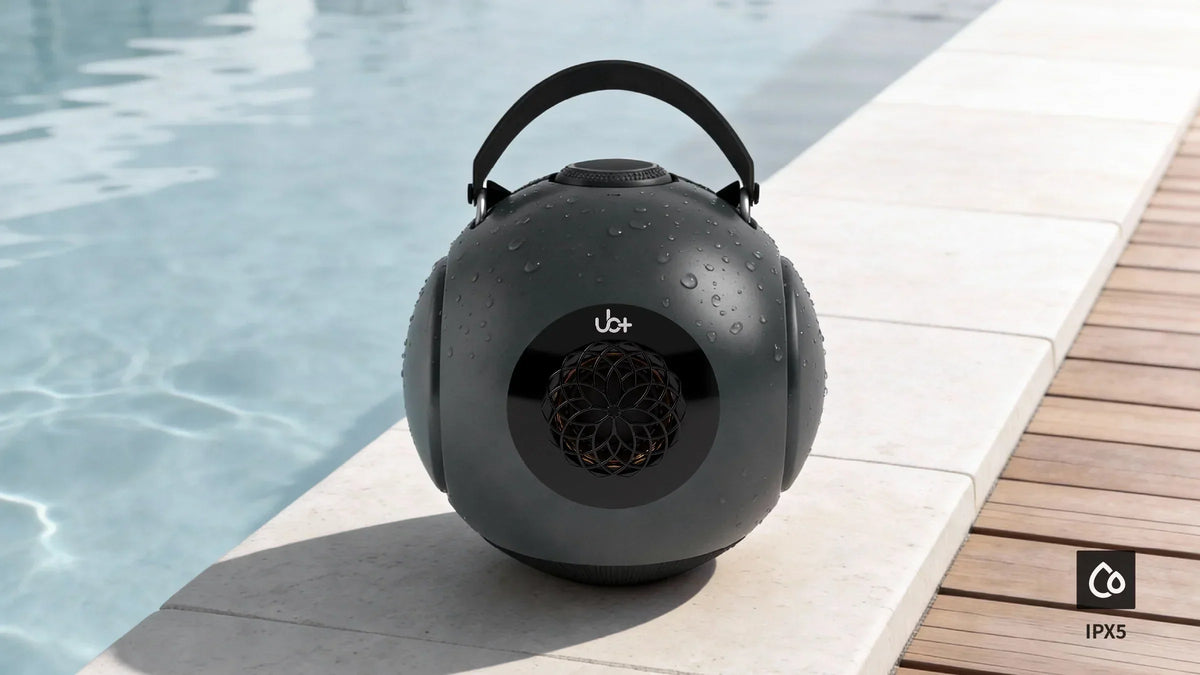
The UB+ dB1 DoubleBass uses a patented spherical acoustic chamber inspired by the Helmholtz Resonance principle. Rather than using conventional parallel internal cabinet surfaces, the spherical geometry distributes internal air pressure throughout the chamber and reduces the standing-wave behavior associated with traditional box enclosures. The design is intended to reduce phase distortion and support more accurate harmonic reproduction.
At the center of the system, a 4.5-inch long-stroke mid-bass driver fires downward into the spherical chamber. Driver movement creates changing internal air pressure, which activates two large passive radiators positioned symmetrically on opposite sides of the enclosure.
The combined passive-radiator surface area is approximately 3.5× larger than the active woofer. This allows the low-frequency system to move substantial quantities of air while maintaining the compact form factor.
Because the passive radiators move in opposing directions, their mechanical forces counteract one another. This creates a self-cancelling vibration architecture that reduces energy transferred into cabinet movement and directs more of the system's mechanical energy toward acoustic output.
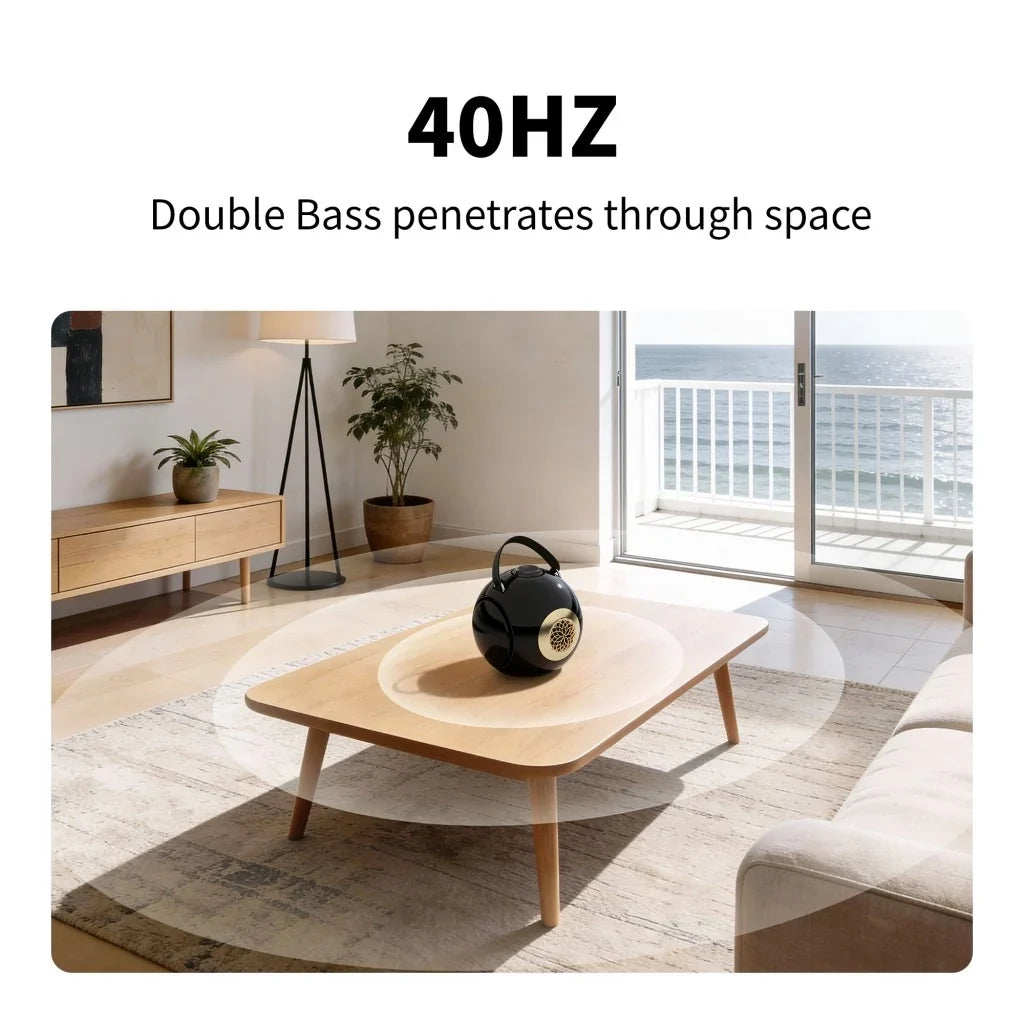
The driver assembly uses a 90 mm oversized neodymium magnet, 35 mm long-stroke voice coil, 20 mm piston movement, 18 mm extra-wide surround, and aluminum shorting ring. The system is specified at approximately 40 Hz–20 kHz with around 93 dB SPL.
The DSP monitors system operation and protects the hardware, while the bass architecture is primarily based on mechanical acoustic design rather than artificially generating low frequencies through aggressive digital enhancement.
For vinyl, this approach is relevant because the speaker is not simply being asked to make a small recording sound louder. It is reproducing the frequency information delivered by the wireless source and turning it into physical air movement.
Why Bass Control Matters With Vinyl
Vinyl records can contain substantial low-frequency information, but turntable systems can also be sensitive to unwanted vibration.
The listening environment matters.
A speaker positioned directly beside a turntable can transmit mechanical energy through the furniture or floor. That energy can potentially reach the turntable and contribute to unwanted feedback.
This is one reason speaker placement should be considered separately from visual aesthetics.
For a wireless vinyl audio system, the ability to place speakers away from the turntable can actually be an advantage.
Wireless transmission removes the need for a physical speaker cable between the turntable area and speaker location, giving you greater freedom to separate the playback system from the record player.
Speaker Placement in a Vinyl Listening Room
A wireless speaker still needs proper acoustic placement.
Avoid automatically placing it beside the turntable simply because that is where the source equipment is located.
Instead, evaluate:
- Distance from the turntable
- Distance from walls
- Corner reinforcement
- Listening position
- Speaker height
- Furniture reflections
- Room symmetry
- Available floor or shelf space
A speaker positioned in a corner may produce stronger bass because of boundary reinforcement.
That does not necessarily mean better bass.
Excessive boundary reinforcement can make low frequencies sound heavy and obscure midrange information.
One Speaker or Two for Vinyl?
This depends on the listening objective.
A single speaker provides simplicity and flexible placement.
Two compatible speakers can provide a proper stereo arrangement with separate left and right channels.
For dedicated listening, stereo separation is generally more important than simply increasing volume.
|
Configuration |
Best Use |
|
One speaker |
Compact rooms and casual listening |
|
Two-speaker stereo pair |
Dedicated music listening |
|
Multiple synchronized speakers |
Large spaces and distributed listening |
|
Traditional wired stereo system |
Maximum control over an all-wired signal path |
If your listening room is primarily used for sitting in one position and critically enjoying records, stereo imaging should receive greater consideration than maximum loudness.
Why Stereo Imaging Matters With Records
Stereo vinyl contains spatial information.
Recordings can place instruments across the stereo field, creating differences between the left and right channels.
A properly positioned stereo pair can reproduce:
- Instrument placement
- Vocal positioning
- Channel separation
- Depth cues
- Width
- Relative ambience
The result depends on both speaker capability and placement.
Two speakers placed directly next to each other provide less meaningful stereo separation than two speakers positioned with appropriate spacing around the listening position.
Wireless Does Not Mean You Can Ignore Room Acoustics
A Bluetooth connection eliminates speaker cable.
It does not eliminate:
- Reflections
- Resonance
- Boundary effects
- Standing waves
- Furniture interaction
- Room modes
A high-quality wireless speaker still benefits from careful placement.
For a listening room, the room itself becomes part of the playback system.
Large hard surfaces can produce strong reflections.
Soft furnishings absorb some frequencies.
Corners reinforce low frequencies.
Open areas behave differently from enclosed spaces.
This is why a speaker that sounds excellent in one room may require different placement or EQ in another.
Using EQ With a Vinyl Setup
An EQ function can be useful when the room introduces tonal problems.
For example, if a speaker positioned close to a wall produces excessive bass reinforcement, a small low-frequency adjustment may produce a more balanced result.
However, EQ should not be used to compensate for fundamentally poor placement.
A sensible sequence is:
Position → Listen → Measure if possible → Adjust EQ → Re-evaluate
This approach is preferable to immediately applying aggressive bass or treble boosts.
If the speaker provides a Bluetooth speaker EQ app, software adjustments can also make it easier to tailor playback without physically moving the speaker every time.
The Difference Between Vinyl Character and Speaker Coloration
These are not the same thing.
Vinyl playback has characteristics associated with the record, cartridge, phono stage, and mastering.
Speaker coloration comes from the playback system.
Examples of unwanted speaker coloration include:
- Excessive cabinet resonance
- Boomy bass
- Harsh upper frequencies
- Distorted midrange
- Poor driver control
- Uneven frequency response
A listener looking for an audiophile wireless speaker should therefore distinguish between enjoying the character of the source and accepting avoidable coloration from the playback hardware.
Wireless Convenience vs Wired Fidelity
There is still a legitimate technical trade-off between wireless and wired systems.
A wired system can maintain an analog signal path from the phono stage through amplification to the speaker.
A Bluetooth system introduces digital conversion and wireless transmission.
|
Consideration |
Wireless Vinyl Setup |
Traditional Wired Setup |
|
Cable management |
Minimal |
More extensive |
|
Speaker placement |
Highly flexible |
Limited by cable routing |
|
Signal path |
Includes wireless conversion |
Can remain analog |
|
Setup complexity |
Potentially simple |
Depends on system |
|
Room aesthetics |
Cleaner |
More visible cabling |
|
Stereo configuration |
Product dependent |
Straightforward |
|
Portability |
High |
Low |
|
Critical analog purity |
Not absolute |
Potentially higher |
For some listeners, the wired route remains preferable.
For others, the ability to position speakers correctly without running cables throughout the room provides greater practical value.
When a Wireless Vinyl Setup Makes the Most Sense
Wireless is particularly useful when:
You rent your home
Running permanent speaker cable may not be practical.
Your listening room has an open layout
Wireless placement can help position speakers where they perform acoustically rather than where cables happen to reach.
You want minimal visual clutter
The turntable can remain the visual centerpiece without a network of speaker wires crossing the room.
You move furniture frequently
Wireless speakers can be repositioned without rewiring the system.
You want vinyl and everyday wireless playback
A Bluetooth speaker can potentially serve as the playback system for records as well as phones, tablets, and computers, depending on the speaker's inputs and supported functions.
When Wired Speakers Still Make More Sense
A wireless setup is not automatically superior.
Choose a traditional wired system if your highest priority is:
- Maintaining an all-analog signal path
- Maximum system customization
- Dedicated stereo amplification
- Separately upgradeable components
- High-end phono-stage experimentation
- Absolute control over the amplification chain
A dedicated listening room built specifically around vinyl may justify the additional equipment and cabling.
A flexible living space may benefit more from wireless architecture.
What to Check Before Buying
Use this checklist before purchasing a speaker for your record setup:
Turntable compatibility
- Does the turntable have a built-in phono preamp?
- If not, do you have an external phono stage?
Wireless transmission
- Does the Bluetooth transmitter support the required codec?
- Does the speaker support the same codec?
- Is the connection stable at your intended distance?
Speaker performance
- Is bass controlled rather than simply boosted?
- Is midrange reproduction clean?
- Is distortion controlled at your normal listening volume?
- Does the enclosure minimize unwanted resonance?
Room integration
- Can the speaker be positioned away from the turntable?
- Is stereo pairing available if you want a two-speaker system?
- Does the system provide useful EQ controls?
Long-term use
- Can the speaker also serve your other listening needs?
- Does the manufacturer provide firmware and software support?
- Are replacement or additional compatible units available?
Common Mistakes With Wireless Vinyl Systems
Connecting the Turntable Directly Without Checking Its Output
A phono-level output is not equivalent to a standard line-level signal.
The correct phono stage is essential.
Buying Based Only on Bluetooth Version
A newer Bluetooth number does not automatically mean better sound.
Codec compatibility, transmitter quality, receiver implementation, and speaker acoustics all matter.
Putting the Speaker Beside the Turntable
This can create unnecessary vibration and acoustic interaction.
Wireless connectivity gives you the opportunity to separate the two.
Increasing Bass to Make Vinyl Sound "Warmer"
Excessive bass enhancement can obscure vocals and instruments.
Room placement should be addressed first.
Using Two Speakers Without Proper Placement
A stereo pair only provides meaningful imaging when the speakers are positioned appropriately relative to the listener.
Best Setup for Different Vinyl Listening Styles
|
Listening Style |
Recommended Configuration |
|
Casual record listening |
One quality wireless speaker |
|
Dedicated stereo listening |
Two compatible speakers |
|
Small apartment |
Compact wireless speaker with flexible placement |
|
Large listening room |
Stereo pair with controlled placement |
|
Minimalist interior |
Wireless speaker positioned away from the turntable |
|
Analog-focused enthusiast |
Phono stage + high-quality wireless transmission or wired amplification |
|
Mixed vinyl and digital listening |
Flexible wireless speaker with app and multiple playback options |
Can a Bluetooth Speaker Actually Be Audiophile-Friendly?
The answer depends on how you define audiophile performance.
If audiophile means an entirely analog signal path with separate amplification and passive speakers, Bluetooth cannot reproduce that exact architecture.
If audiophile means controlled frequency response, low distortion, accurate driver behavior, good imaging, and long-term listening quality, a carefully engineered wireless speaker can satisfy many of those requirements.
The distinction is important.
Wireless should be evaluated as a transmission method—not as a substitute for acoustic engineering.
A poor speaker remains poor regardless of whether the signal arrives through a cable or Bluetooth.
A well-engineered speaker can provide a strong listening experience with either appropriate wireless or wired sources.
Why Speaker Engineering Should Influence Your Decision
For vinyl listeners, the source deserves attention, but the speaker ultimately converts the entire signal into acoustic energy.
That makes driver control, enclosure behavior, bass architecture, and room interaction critical.
A speaker with uncontrolled resonance can add its own signature.
A speaker with poorly controlled bass can overwhelm the lower midrange.
A speaker with inadequate driver excursion can struggle with demanding passages.
A speaker with poor wireless stability can interrupt the listening session.
The right purchase therefore considers the entire chain rather than treating Bluetooth as the only specification that matters.
Final Verdict
The best bluetooth speaker for vinyl setup depends on whether your priority is analog purity, placement flexibility, minimal cabling, or a combination of these requirements.
A wireless vinyl system is technically straightforward when the signal chain is correctly configured:
Turntable → Proper Phono Stage → Bluetooth Transmitter → Wireless Speaker
The critical buying decisions are codec compatibility, wireless stability, speaker acoustics, room placement, and whether you want one speaker or a properly configured stereo pair.
For listeners who want a clean installation without sacrificing attention to physical acoustic engineering, UB+ provides an interesting approach. The dB1 DoubleBass combines wireless playback with an enclosure architecture designed around controlled internal air movement, mechanical bass reproduction, and reduced cabinet vibration.
For a dedicated vinyl room, the strongest setup is not necessarily the one with the most equipment. It is the one that creates a technically appropriate signal path, places the speaker correctly in the room, and reproduces the record without adding avoidable problems.
Explore Your UB+ Options
→ Compare dB1 vs dB Mini
Review the differences in design, acoustic performance, placement, and intended use.
→ Explore UB+ Speakers
See the complete UB+ range at UB+ speakers.
→ Check Current Price
Review current product information, specifications, pricing, and availability.
A vinyl listening room can remain fundamentally analog in its source while using wireless technology at the playback stage. The important decision is understanding exactly where the conversion occurs—and choosing the speaker and signal chain accordingly.


Leave a comment
This site is protected by hCaptcha and the hCaptcha Privacy Policy and Terms of Service apply.