
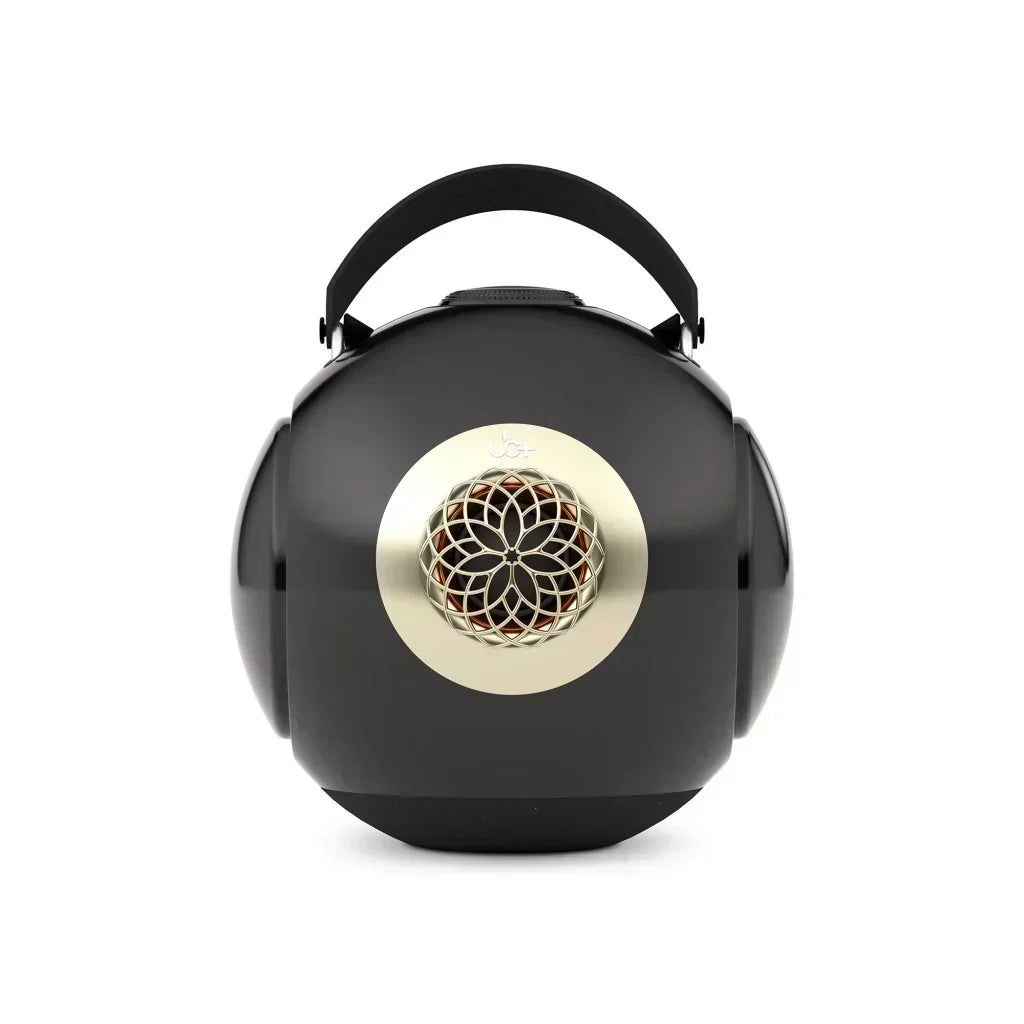
When people shop for a wireless Bluetooth speaker, they usually encounter the finished product: a polished enclosure, a compact footprint, wireless connectivity, and a list of specifications. What is less visible is the design process behind that object—the acoustic decisions that determine how the speaker moves air, manages resonance, controls vibration, and ultimately sounds in a real room.
At UB+, sound is not something added after the industrial design is finished. The acoustic system influences the design from the beginning.
The UB+ dB1 DoubleBass is built around that philosophy. Its spherical enclosure, downward-firing mid-bass driver, internal air volume, and symmetrical passive radiators are interconnected rather than treated as independent features. The result is a speaker designed around how air and mechanical energy behave inside a compact enclosure.
That makes the journey from the first sketch to the final listening test particularly important.
The shape is not simply a visual signature. The chamber is not simply a box for the electronics. The bass system is not simply a digital effect.
The objective is to make the physical architecture contribute to the sound.
Design Starts With an Acoustic Question

The first question in compact speaker design is often framed around size:
How small can the speaker become while still producing convincing sound?
A more useful acoustic question is:
How should the available air volume be used to produce controlled sound?
A compact enclosure has obvious physical limitations. There is less internal volume, limited space for the driver, and less room for conventional acoustic structures. Low frequencies are particularly demanding because they require substantial air movement.
That means enclosure design becomes critical.
The dB1 approaches this challenge through a spherical acoustic chamber inspired by the principles of Helmholtz resonance. Instead of treating the cabinet as a passive container, the geometry and internal air volume form part of the acoustic system.
This philosophy influences the rest of the design.
The driver has to work with the chamber. The chamber has to work with the passive radiators. The passive radiators have to remain mechanically balanced. And the entire system has to remain practical enough for a modern wireless speaker.
Why the Sphere Appears in the First Place

From an industrial-design perspective, a sphere is immediately recognizable.
From an acoustic perspective, its importance goes deeper.
A conventional rectangular cabinet contains flat, parallel internal surfaces. These surfaces can contribute to internal reflections and standing-wave behavior. Designers can use damping, internal structures, and electronic processing to manage those effects, but the geometry itself remains part of the acoustic challenge.
A spherical chamber changes the internal environment.
The curved geometry provides a more uniform acoustic volume and avoids the parallel internal surfaces found in conventional box designs. UB+ uses this architecture as part of its approach to managing internal air pressure and acoustic behavior.
That matters because the speaker is ultimately controlling pressure.
Instead of asking the electronics to correct every acoustic problem after the fact, the physical enclosure is designed to provide a more controlled starting point.
This idea is explored further in the existing UB+ article on spherical Bluetooth speaker design, which examines why the sphere is more than an aesthetic decision.
The Helmholtz Principle as an Acoustic Foundation
The dB1's spherical architecture is inspired by the Helmholtz resonance principle, a classical acoustic concept involving the relationship between air volume, pressure, and resonance.
The important idea is that air can behave as part of an acoustic system.
In the dB1, the internal air volume is energized by the driver. Instead of simply sending the driver's output directly toward the listener, the driver interacts with the chamber first.
That creates an important sequence:
Driver movement → internal air pressure → passive-radiator movement → acoustic output
The enclosure therefore becomes part of the path through which sound is produced.
This is particularly significant in a compact speaker, where physical space is limited and every part of the acoustic volume needs to work efficiently.
The objective is not to create resonance for its own sake. Resonance needs to be controlled, tuned, and integrated with the rest of the system.
From Acoustic Sketch to Driver Placement

Once the enclosure concept is established, driver placement becomes a major design decision.
The dB1 uses a 4.5-inch downward-firing mid-bass driver positioned to fire into the spherical chamber. As the driver moves, it creates pressure within the internal air volume rather than simply projecting its output directly toward the listener.
That pressure then activates the two passive radiators positioned on opposite sides of the enclosure.
This arrangement changes the role of the driver.
It is not working alone.
The driver, chamber, air pressure, and passive radiators form a single mechanical-acoustic system.
Why Fire the Driver Downward?
A conventional portable speaker often places its primary driver toward the front, directly facing the listener.
The dB1 takes another route.
By firing the mid-bass driver downward into the spherical chamber, the design allows the internal air volume to participate before energy is released through the passive radiators.
That helps make the enclosure an active acoustic component rather than simply a protective shell.
The result is a design in which the driver is effectively using the chamber to transform its energy.
This is one of the reasons enclosure architecture deserves as much attention as driver size when comparing portable speakers.
Designing the DoubleBass System

The next major step is the passive-radiator architecture.
Passive radiators are not powered by their own voice coils. Instead, they respond to pressure changes generated by the active driver and the air inside the enclosure.
The dB1 uses two large passive radiators positioned opposite each other.
Their combined surface area is approximately 3.5 times the active woofer area. This provides substantial radiating area for moving air while maintaining a compact overall form.
But the size of the radiators is only part of the story.
Their positioning matters just as much.
Symmetry as a Mechanical Principle
When the two passive radiators move in opposite directions, their mechanical forces counterbalance one another.
That creates a self-balancing architecture.
Instead of allowing reactive forces to push the cabinet strongly in one direction, the opposing radiators help cancel those forces.
This matters because unwanted enclosure movement is wasted mechanical energy.
The goal is for more of the system's energy to become acoustic output rather than cabinet vibration.
That principle is central to the DoubleBass architecture.
It also explains why the name "DoubleBass" refers to more than simply having two passive radiators.
The two radiators are part of a mechanically balanced system.
Resonance Is Not the Enemy
Good speaker design does not attempt to eliminate resonance completely.
Resonance is fundamental to how many acoustic systems work.
The challenge is controlling where resonance occurs, how strongly it develops, and how it interacts with the rest of the speaker.
An uncontrolled resonance can create a noticeable peak, coloration, or unwanted vibration.
A controlled resonance can help a compact speaker produce useful acoustic output efficiently.
The dB1 is designed around that distinction.
Its spherical chamber establishes the air volume. The driver energizes that volume. The passive radiators respond to the pressure. Their symmetrical configuration helps maintain mechanical balance.
The system therefore uses resonance as part of the design rather than treating it as something that must simply be corrected afterward.
From Prototype to Listening Test
A speaker can look perfect in a CAD model and still require extensive tuning before it works properly as a finished product.
Acoustic design has to survive contact with real music.
That means evaluating how the speaker responds to:
- Bass-heavy recordings
- Vocals
- Acoustic instruments
- Dense arrangements
- Dynamic transients
- Higher listening levels
- Quiet background playback
- Different rooms and surfaces
A speaker that sounds impressive for thirty seconds is not necessarily a well-tuned speaker.
Long-term listening reveals different problems.
Bass may become tiring. Vocals may lose clarity. Treble may become aggressive. Cabinet vibration may become noticeable. A speaker may sound balanced at moderate volume but lose control as output increases.
The tuning process therefore has to consider the complete listening experience.
Tuning for Control Instead of Excess
One of the most important distinctions in speaker tuning is the difference between impact and control.
A speaker can create an immediate impression by emphasizing bass or treble. But excessive emphasis can become tiring during longer sessions.
The dB1's physical acoustic system provides the foundation for its tuning.
Because the spherical chamber and passive-radiator architecture are doing substantial acoustic work, DSP can be used as a supporting layer rather than the sole mechanism for creating the desired low-frequency effect. The supplied UB+ engineering material describes DSP as supporting protection, tonal balance, linearity, and driver control while the physical architecture remains the foundation of bass reproduction.
That distinction is important.
DSP is not inherently a problem. Modern speakers depend on digital processing for many useful functions.
The question is what the DSP is being asked to accomplish.
In the dB1, the physical design does much of the heavy lifting.
Building Bass Without Losing the Midrange
Bass exists within a complete musical spectrum.
If low-frequency energy becomes excessive, it can mask vocals, guitars, piano, percussion, and other information in the midrange.
This is why deep bass alone is not enough.
A useful speaker needs to integrate low frequencies with the rest of the presentation.
The dB1's spherical chamber is designed to manage internal acoustic behavior, while its driver and passive-radiator system work together to produce controlled low-frequency output.
The goal is not simply to reach a low number on a frequency-response chart.
It is to make low-frequency energy useful within the complete musical presentation.
For a deeper explanation of what bass extension actually means, the existing UB+ guide on bass extension and speaker frequency response provides additional context.
Mechanical Stability Becomes Part of Sound Quality
When a speaker produces bass, the cabinet experiences mechanical forces.
If those forces are not well managed, some of the energy can become physical movement of the enclosure.
That movement does not contribute directly to the intended acoustic output.
The dB1's opposing passive radiators are designed to counterbalance those forces.
This self-cancelling vibration architecture helps keep the enclosure mechanically stable while the system produces low-frequency output.
The concept is simple:
More controlled mechanical movement means more of the system's energy can be directed toward sound.
This is one of the reasons mechanical design matters just as much as electronic tuning in a compact speaker.
Designing for Real Rooms
A speaker is rarely used in an acoustic laboratory.
It ends up on a desk, shelf, side table, kitchen counter, bedroom furniture, or outdoor surface.
That changes the design requirements.
A speaker used in a living room may have listeners positioned around it. A speaker on a desk may be heard from relatively close range. An outdoor speaker loses the reinforcement that walls and ceilings naturally provide indoors.
The dB1's spherical architecture and broad sound presentation are designed with this flexibility in mind.
Its 360° presentation is particularly relevant in spaces where listeners are not permanently positioned directly in front of the speaker.
For a closer look at how this affects placement, see 360° vs. Front-Firing Speakers.
From Engineering Object to Living-Room Object
Industrial design becomes important once the acoustic architecture is established.
The speaker still needs to belong in a real home.
This is where the spherical form provides another advantage: it does not visually behave like a conventional rectangular electronics box.
The shape is compact, sculptural, and independent of a traditional front-facing orientation.
But the important point is that the visual form follows the acoustic architecture.
The sphere was not simply selected because it looked different.
The shape became part of the acoustic solution first, and its visual identity followed.
That relationship between industrial design and acoustics is what allows the finished speaker to function as both a technical product and an object that fits naturally into modern interiors.
Why the Driver Components Matter Too
Acoustic architecture establishes the foundation, but the driver itself still has to perform.
The dB1 incorporates several driver components designed for controlled movement, including a 90 mm oversized neodymium magnet, 35 mm long-stroke voice coil, 20 mm piston movement, aluminum shorting ring, and 18 mm extra-wide surround. The supplied UB+ material describes these components as contributing to driver control, efficiency, and reduced distortion.
These details matter because the driver ultimately has to respond accurately to the signal.
A sophisticated chamber cannot compensate for an uncontrolled driver.
Likewise, a powerful driver cannot solve every enclosure problem.
The acoustic system works because these elements are designed to operate together.
Tuning for Indoor and Outdoor Listening
Another stage in the process is understanding where the speaker will actually be used.
Indoor rooms naturally interact with sound through walls, ceilings, floors, and furniture.
Outdoor environments are different.
There are fewer nearby boundaries to reinforce low frequencies, and sound energy can disperse more freely.
The dB1's acoustic architecture is designed for both types of environments, with its spherical chamber and mechanical bass system providing the physical foundation for its low-frequency reproduction.
The result is a speaker intended to remain useful beyond one specific room or listening position.
That flexibility is an important part of what makes a wireless speaker genuinely portable.
What the Design Process Is Really Trying to Achieve
The purpose of all this engineering is not to create a complicated specification sheet.
It is to make the speaker disappear behind the music.
When a speaker is working properly, you should not constantly think about its cabinet vibration, internal resonance, driver strain, or placement.
You should hear the recording.
That requires a balance between:
- Acoustic geometry
- Air pressure
- Driver control
- Passive-radiator movement
- Mechanical stability
- Dispersion
- Digital processing
- Real-world tuning
The dB1 brings these elements together around one physical architecture.
Why the Sphere Is the Starting Point, Not the Final Feature
It is easy to look at the dB1 and describe it as a "round speaker."
That misses the important part.
The sphere is the beginning of the acoustic strategy.
Its geometry establishes the chamber. The chamber influences pressure distribution. The driver energizes that air volume. The passive radiators respond to the pressure. Their opposing movement helps balance mechanical forces. The resulting acoustic output is then tuned for the final listening experience.
Each stage follows from the previous one.
That is why the design process is better understood as a chain rather than a collection of specifications.
The Journey From Sketch to Sound
A finished speaker hides most of its engineering.
You see the sphere.
You do not see the pressure moving inside it.
You see the passive-radiator surfaces.
You do not see the mechanical forces they are balancing.
You hear the bass.
You do not necessarily hear the enclosure architecture that helped create it.
That is ultimately what good acoustic engineering is supposed to do.
The technology should support the experience rather than become the experience.
The UB+ dB1 DoubleBass starts with an acoustic idea, develops that idea into a spherical chamber, integrates the downward-firing driver and symmetrical passive radiators, and then uses system tuning to bring the physical architecture together as a complete wireless speaker.
For readers interested in the broader engineering behind the design, the existing UB+ dB1 DoubleBass engineering guide provides another look at the relationship between the spherical chamber, mechanical bass amplification, and driver system.
Frequently Asked Questions
Why does UB+ use a spherical enclosure?
The sphere is part of the acoustic architecture. Its curved internal geometry avoids the parallel surfaces found in conventional rectangular cabinets and provides a controlled chamber for the driver's interaction with internal air pressure.
What does the downward-firing driver do?
The dB1's mid-bass driver fires into the spherical chamber rather than directly toward the listener. This energizes the internal air volume, which then interacts with the passive-radiator system.
Why does the dB1 have two passive radiators?
The two passive radiators provide additional radiating area for low-frequency output while their opposing movement helps counterbalance mechanical forces within the enclosure.
Is the dB1's bass created mainly through DSP?
No. The supplied UB+ engineering information describes the physical acoustic architecture—the spherical chamber, driver, and passive radiators—as the foundation of the bass system. DSP supports functions such as protection, linearity, tonal balance, and driver control.
Does spherical design automatically mean better sound?
No. Shape alone does not determine sound quality. The driver, chamber, air volume, passive-radiator tuning, mechanical structure, DSP, and final tuning all have to work together. The dB1's design is based on that complete system rather than the sphere by itself.
Final Thoughts
From the first acoustic concept to the finished product in a living room, the UB+ dB1 DoubleBass is built around a simple idea: the physical design of a speaker should help create the sound.
The spherical chamber provides the acoustic environment. The downward-firing mid-bass driver energizes that chamber. The dual passive radiators convert internal pressure into additional low-frequency output while their symmetrical movement helps balance mechanical forces.
The result is a wireless Bluetooth speaker whose acoustic architecture is inseparable from its industrial design.
That is the difference between designing a speaker around a collection of components and designing the components around an acoustic system.
The finished sphere may look simple.
The engineering inside it is anything but.
Experience the dB1 DoubleBass


Leave a comment
This site is protected by hCaptcha and the hCaptcha Privacy Policy and Terms of Service apply.