

Large rooms create a different challenge for portable audio. A speaker that sounds powerful beside a sofa or on a desk may struggle when listeners are spread across a large living room, kitchen, dining area, or connected open-plan space. The sound has to travel farther, cover more listening positions, and maintain enough low-frequency presence without becoming harsh or distorted.
Choosing the best bluetooth speaker for large room listening therefore requires more than comparing wattage, driver diameter, or advertised loudness. Maximum clean sound pressure level (SPL), acoustic efficiency, bass control, dispersion, and placement all influence how successfully a speaker performs in a spacious environment.
For buyers comparing premium portable audio, the UB+ dB1 DoubleBass is the lead model to examine. Its Helmholtz-inspired spherical acoustic chamber, centrally positioned mid-bass driver, and dual symmetrical passive radiators give it a distinctive approach to low-frequency reproduction. The UB+ S2 Alphorn provides another model to consider when comparing the UB+ range and deciding which design best suits your listening environment.
This guide examines the technical factors that matter in large rooms, explains how to evaluate real-world loudness, and shows where each model fits into a practical buying decision.
Why Large Rooms Are More Difficult for Bluetooth Speakers

A large room does not simply require a louder speaker. It requires a system capable of maintaining a useful listening level across a greater distance and a wider area.
In a compact bedroom, the listener may sit only a short distance from the speaker. In an open-plan living area, someone preparing food in the kitchen may be considerably farther away than someone sitting near the speaker. The sound must remain understandable and balanced across both positions.
Several factors make this challenging.
Longer listening distances
Sound pressure decreases as distance from the source increases. In an ideal free field, doubling the distance from a point source produces approximately a 6 dB reduction in direct sound pressure level. Real rooms behave differently because reflections and absorption affect the result, but the basic principle remains important.
A speaker that sounds sufficiently loud from two meters away may not provide the same experience at five or six meters.
Greater listening-area coverage
Open-plan spaces often have several listening zones rather than one defined seating position. Sound needs to reach different areas without depending entirely on a narrow listening angle.
Low-frequency demands
Bass energy can behave differently across a large room. Room dimensions, openings, furniture, and boundary positions influence how low frequencies build up or cancel at different locations.
Background noise
Cooking appliances, conversations, ventilation, and movement can raise the ambient noise level. A speaker needs enough clean output to remain audible without requiring excessive volume.
These considerations explain why buyers searching for a bluetooth speaker for open plan living should evaluate the complete acoustic system rather than relying on a single headline specification.
What Actually Makes a Speaker Suitable for a Large Room?

A capable large-room speaker combines sufficient output with controlled sound reproduction. Increasing volume is useful only when the speaker can maintain clarity as the level rises.
The most important evaluation factors are SPL, distortion, frequency response, dispersion, and acoustic efficiency.
Sound Pressure Level: Look Beyond the Loudness Claim
Sound pressure level measures the acoustic pressure produced by a speaker and is commonly expressed in decibels (dB SPL).
It provides a more useful way to discuss output than vague descriptions such as powerful, booming, or room-filling. However, SPL figures must be interpreted carefully.
When comparing specifications, check:
- Whether the manufacturer provides a maximum SPL measurement.
- The measurement distance, such as one meter.
- Whether the figure represents peak or continuous output.
- The frequency range and test conditions.
- Whether distortion remains controlled at the stated level.
A maximum peak figure does not necessarily describe how cleanly a speaker performs during extended playback. A product may reach a high instantaneous level while producing less convincing results when asked to maintain that output.
For a deeper explanation, read how loud a speaker should be: the SPL guide.
Power Is Not the Same as Acoustic Performance
Wattage describes electrical power, not the complete acoustic output of a speaker.
Two speakers with similar amplifier ratings can perform differently because of variations in:
- Driver sensitivity.
- Motor strength.
- Voice-coil design.
- Cone excursion.
- Enclosure volume and tuning.
- Passive-radiator configuration.
- DSP and power management.
A well-engineered compact speaker can use its available power more effectively than a poorly designed system with a larger headline wattage.
This is why buyers should compare output specifications and acoustic architecture together. The article on speaker driver size versus sound quality explains why driver diameter alone cannot predict performance.
Frequency Response and Bass Extension

A large room can make weak bass reproduction more noticeable. Low frequencies contribute to musical weight, rhythm, and the physical character of a recording.
However, a claimed frequency range does not tell the whole story. A specification such as 40Hz–20kHz does not automatically mean that the speaker produces equal output at every frequency or maintains that response at maximum volume.
Look for a combination of:
- Useful low-frequency extension.
- Controlled bass response.
- Clear vocal reproduction.
- Stable midrange performance.
- Manageable distortion as volume increases.
The bass extension and Hz speaker guide provides additional context on what frequency specifications mean in practical listening.
UB+ dB1 DoubleBass: A Different Approach to Room-Filling Bass

The UB+ dB1 DoubleBass is the lead model in this comparison because its acoustic architecture addresses an important challenge in compact speakers: producing substantial low-frequency output without depending entirely on digital bass enhancement.
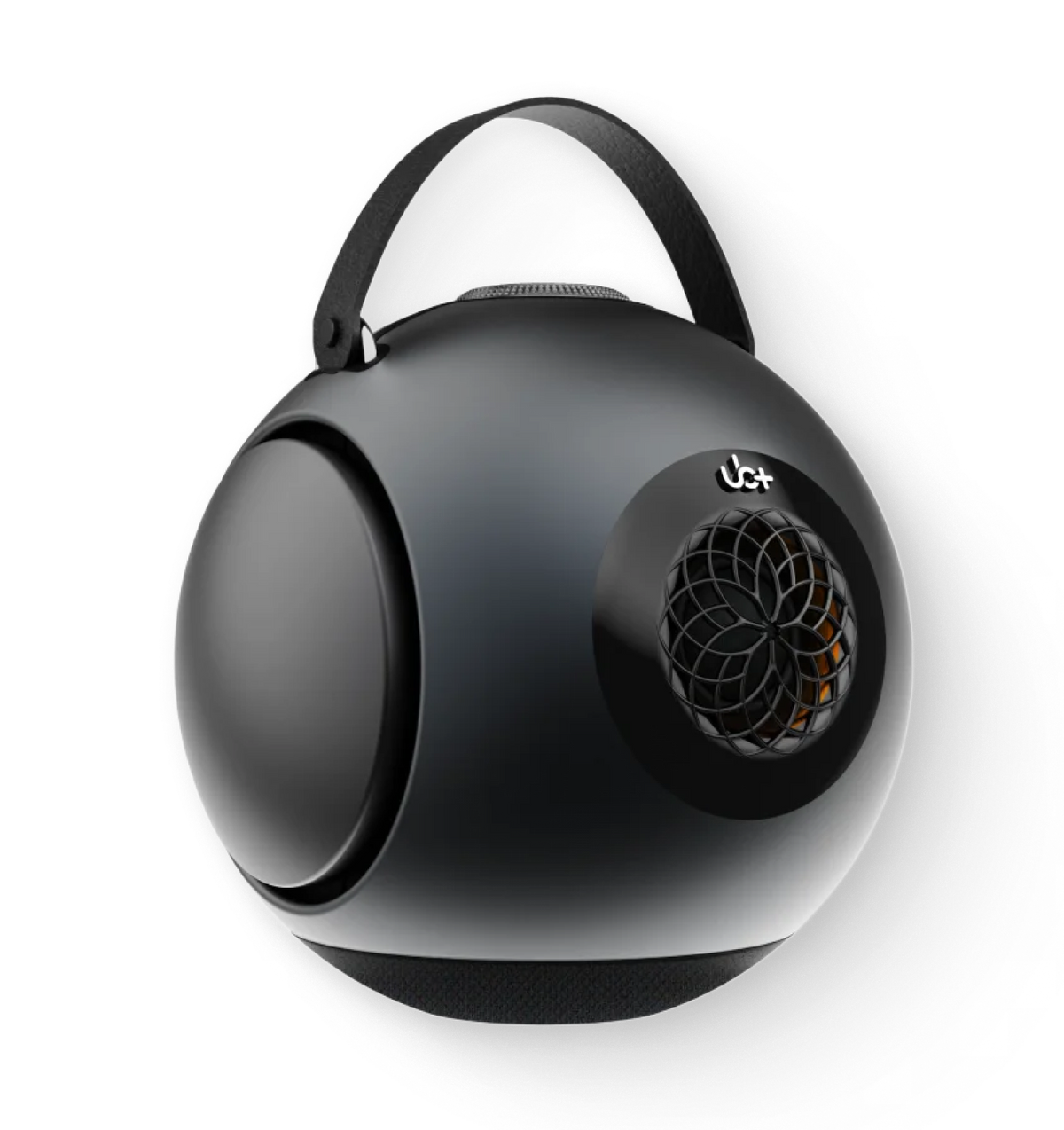
Its design combines a spherical acoustic chamber inspired by the Helmholtz resonator principle with a central downward-firing mid-bass driver and two large passive radiator plates mounted on opposite sides.
The objective is to manage internal air pressure and low-frequency movement through the physical design of the enclosure.
Helmholtz-Inspired Spherical Acoustic Chamber

The dB1 uses a true spherical enclosure rather than a conventional rectangular box. Its internal acoustic chamber is inspired by the Helmholtz resonator principle, which describes how an enclosed volume of air and a controlled opening can produce a resonant response.
The spherical geometry avoids the conventional parallel-wall arrangement found in rectangular enclosures. This can help reduce certain internal standing-wave behaviors, although it does not eliminate every resonance or reflection.
The chamber contributes to the speaker's acoustic behavior by managing internal air pressure around the driver and passive-radiator system.
For large-room listening, this matters because bass quality is not simply about producing more low-frequency energy. It is also about maintaining control so that bass notes do not overwhelm vocals, percussion, and other musical details.
Dual Symmetrical Passive Radiators
The dB1 uses two large passive radiator plates positioned on opposite sides of the enclosure.
Unlike an active driver, a passive radiator does not have its own powered voice coil. It responds to pressure variations generated inside the enclosure by the active driver.
The dB1's arrangement is designed to:
- Increase the available radiating surface area.
- Support low-frequency air movement.
- Work with the internal chamber's acoustic loading.
- Balance some mechanical forces through symmetrical movement.
- Support bass reproduction without relying on a conventional open bass-reflex port.
The combined passive-radiator surface area is approximately 3.5 times the woofer's surface area. That is a substantial radiating area for a compact speaker, although surface area alone does not guarantee a particular bass level or frequency response. Tuning, excursion, enclosure volume, and driver characteristics remain essential.
This is the physical principle behind the phrase: Most speakers try to push harder. dB1 lets air do the work.
For a technical explanation of the underlying mechanism, see how passive radiators work in Bluetooth speakers.
Driver Engineering and Acoustic Control

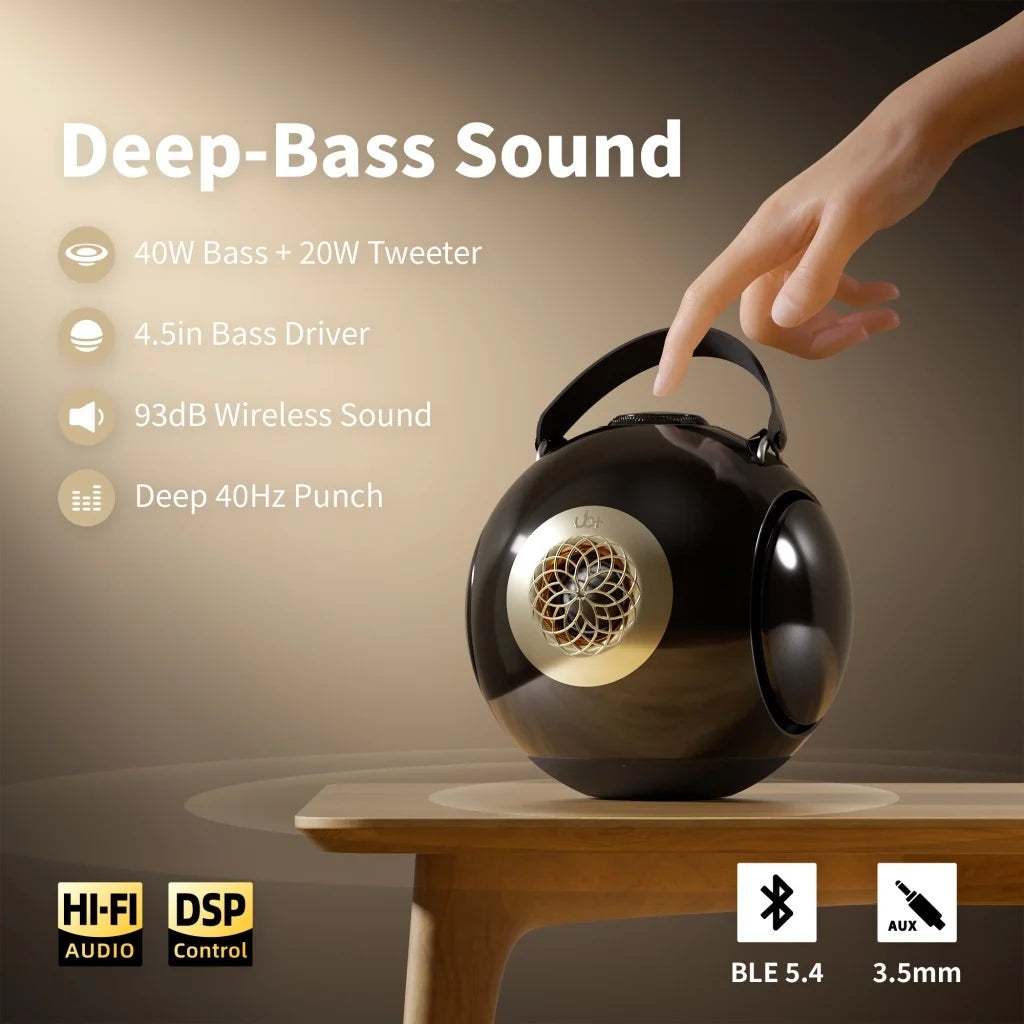
The dB1's active driver system includes:
- 4.5-inch mid-bass driver.
- Oversized 90mm neodymium magnet.
- 35mm long-stroke voice coil.
- Central downward-firing driver arrangement.
These components work within the complete acoustic system rather than operating as isolated specification highlights.
DSP also has a role. It supports linearity, protection, and tonal balance. The design should not be interpreted as eliminating digital processing; its distinction is the use of mechanical and acoustic architecture as part of the bass-reproduction strategy.
dB1 Technical Specifications
|
Specification |
UB+ dB1 DoubleBass |
|
Driver |
4.5-inch mid-bass driver |
|
Magnet |
90mm neodymium |
|
Voice coil |
35mm long-stroke |
|
Frequency response |
40Hz–20kHz |
|
Maximum SPL specification |
93dB SPL |
|
Acoustic chamber |
Helmholtz-inspired spherical design |
|
Passive radiators |
Two symmetrical plates |
|
Radiator surface area |
Approximately 3.5× woofer surface area |
|
Bluetooth |
Bluetooth 5.3, low latency |
|
Playback options |
Bluetooth, wired, and TF playback |
|
Battery life |
Up to 20 hours |
|
Water resistance |
IPX5 |
|
Additional capability |
Stereo pairing |
The 93dB SPL specification is useful when comparing published output figures, but buyers should check measurement conditions before treating it as a direct prediction of continuous listening performance across an entire open-plan room.
The UB+ dB1 acoustic design explanation provides a closer look at the engineering behind this model.
UB+ S2 Alphorn: Another Model to Consider

The UB+ S2 Alphorn is the supporting model in this buying guide.
It is worth considering when comparing the UB+ lineup rather than assuming that one speaker design is automatically the right choice for every large room. The ideal purchase depends on the room's dimensions, listening distance, desired volume, placement options, and the kind of music being played.
When comparing the S2 Alphorn with the dB1 DoubleBass, pay attention to the individual product specifications and intended listening experience. In particular, compare:
- Published output and SPL information.
- Frequency response and bass characteristics.
- Physical dimensions and placement requirements.
- Connectivity and playback options.
- Battery performance and portability.
- Whether the speaker suits one primary listening area or several locations.
The important distinction is that the dB1's spherical chamber and dual passive-radiator architecture are specific to its design. Those technical features should not be assumed to apply to the S2 Alphorn.
For a direct model comparison, see UB+ dB1 DoubleBass vs. S2 Alphorn.
How to Choose a Speaker for Different Large-Room Layouts
Not every large room has the same acoustic requirements. A long rectangular living room, a high-ceiling lounge, and an open-plan kitchen-living area can produce very different listening experiences.
|
Room layout |
Main acoustic challenge |
What to prioritize |
|
Large rectangular living room |
Longer listening distance |
Clean output and suitable dispersion |
|
Open-plan kitchen and lounge |
Multiple listening zones |
Broad usable coverage and balanced sound |
|
High-ceiling living room |
Greater vertical volume and reflections |
Adequate output and controlled tonal balance |
|
Combined dining and living area |
Uneven listener positions |
Flexible placement and consistent listening |
|
Large furnished room |
Absorption and reflections |
Balanced response and practical positioning |
Large Living Rooms
In a large living room, begin by identifying the primary listening position. A speaker that performs well from the sofa may sound different from the same position near the far end of the room.
Consider:
- How far the speaker is from the main seating area.
- Whether the room has an open connection to another space.
- Whether the speaker can be positioned centrally.
- Whether several people need to listen from different seats.
The dB1 is worth evaluating when a compact design with substantial bass engineering is a priority. Test it at the actual listening distance rather than judging it only from nearby playback.
Open-Plan Living and Dining Areas
An open-plan space is more complicated because it may not have clear acoustic boundaries. The kitchen, dining area, and lounge can function as connected listening zones.
A bluetooth speaker for open plan living should be assessed for practical coverage rather than just how loud it sounds directly beside the unit.
Useful considerations include:
- Placing the speaker where sound has a relatively unobstructed path.
- Avoiding positions hidden behind large furniture.
- Testing music from the kitchen and dining areas.
- Checking vocal clarity at the farthest regular listening position.
- Listening at normal household volume before increasing the level.
A single portable speaker can be convenient for everyday music, but a very large or unusually shaped space may require a multi-speaker arrangement for more consistent coverage.
High-Ceiling Rooms
High ceilings can contribute to longer reverberation and more noticeable reflections, particularly when the room also contains hard floors, large windows, and bare walls.
A speaker with high output is not automatically the solution. If the room has excessive reflections, increasing volume can make the listening experience more tiring without improving clarity.
Consider adding curtains, rugs, upholstered furniture, or other suitable furnishings to manage reflections. Then test speaker placement and listening level again.
Loudness, SPL, and Listening Distance: What Should You Target?
Buyers searching for a loud bluetooth speaker for big room often focus on the highest available SPL figure. That is understandable, but a more useful approach is to estimate the level needed at the listening position.
For example, consider the difference between a speaker measured at one meter and a listener sitting five meters away. In an ideal free-field approximation, the direct sound level would fall by roughly 14dB over that distance. Reflections and room boundaries change the actual result, but distance remains a major consideration.
The following table is an illustrative listening guide, not a universal room-size standard or a guarantee of suitable coverage.
|
Listening situation |
Practical priority |
|
Background music |
Comfortable, balanced output |
|
Everyday living-room listening |
Clear vocals and sufficient volume margin |
|
Music across an open-plan area |
Clean output at the farthest listening position |
|
Social gatherings |
Higher output capability with controlled distortion |
|
Extended listening |
Tonal balance and listening comfort |
Do not treat any single SPL target as mandatory for a particular room. Ambient noise, listener preference, music dynamics, and speaker placement all influence the required level.
Also remember that prolonged exposure to high sound levels can damage hearing. More output is not always better. A speaker should provide sufficient clarity without encouraging unnecessarily loud playback.
Speaker Placement: How to Get More Coverage Without Simply Turning Up the Volume
Placement can make a substantial difference to the sound you hear. Even a capable speaker may perform poorly if its output is obstructed or its position creates uneven bass response.
Keep the Acoustic Output Unobstructed
Avoid placing the speaker behind furniture, inside a tightly enclosed shelf, or directly beside objects that block its intended sound path.
For the dB1, allow appropriate space around the enclosure and passive-radiator areas. Do not cover or obstruct components that need to move freely.
Test More Than One Position
Try several practical positions and listen from different parts of the room.
A useful test includes:
- Place the speaker on a stable surface.
- Start with some space between it and nearby walls.
- Play a familiar track containing vocals and bass.
- Listen from the primary seating position.
- Move to the farthest regular listening area.
- Adjust placement and compare the tonal balance.
The strongest bass position is not necessarily the best overall position. A placement that produces slightly less bass but clearer vocals and more even sound may be preferable.
Read the Bluetooth speaker placement guide for bass and clarity for additional practical advice.
Understand Room Acoustics
Large rooms can contain a mixture of reflective and absorptive surfaces. Hard floors, glass, bare walls, and high ceilings may contribute to reflections, while curtains, carpets, and upholstered furniture absorb some sound energy.
Room dimensions also influence low-frequency behavior. Certain bass frequencies may become stronger in one location and weaker in another.
This is why a speaker's performance cannot be evaluated entirely from its specifications. The room becomes part of the listening system.
For more detail, explore room acoustics basics: why speakers sound different in different spaces.
One Speaker or Multiple Speakers for an Open-Plan Home?
A single speaker is convenient. It requires less equipment, fewer connections, and less setup. For everyday background music and casual listening, a capable portable speaker may be sufficient.
However, a single speaker has physical limitations. If the room is exceptionally wide or listeners are spread across several connected spaces, one source may not provide the same listening level everywhere.
Consider a multi-speaker setup when:
- The listening area extends across several rooms.
- People regularly listen from opposite ends of the space.
- More consistent coverage is important than portability.
- The system needs to support gatherings at higher listening levels.
- A single speaker cannot maintain suitable clarity at the farthest position.
Stereo pairing can also be useful when supported by the product, but stereo separation and room coverage are different objectives. Two speakers positioned appropriately may create a wider stereo image, while a poorly arranged pair can produce uneven sound across the room.
The article on pairing two speakers versus using one Bluetooth speaker explains the differences.
What Matters Most in a Large-Room Bluetooth Speaker?
The following comparison focuses on the characteristics that influence a large-room buying decision.
|
Evaluation factor |
Why it matters |
What to look for |
|
Maximum clean SPL |
Determines usable output |
Measurement conditions and distortion behavior |
|
Frequency response |
Influences tonal balance |
Useful bass extension and clear midrange |
|
Acoustic efficiency |
Affects output from available power |
Driver, motor, and enclosure engineering |
|
Bass architecture |
Influences low-frequency reproduction |
Properly tuned enclosure and radiator system |
|
Dispersion |
Affects listening across different positions |
Suitable driver arrangement and coverage |
|
Connectivity |
Supports everyday usability |
Bluetooth, wired, or alternative playback |
|
Portability |
Determines placement flexibility |
Weight, dimensions, and battery life |
|
Room interaction |
Changes the sound at different positions |
Placement flexibility and acoustic balance |
The dB1 stands out in the acoustic-design discussion because of its spherical chamber and symmetrical passive-radiator system. The S2 Alphorn remains a separate option to compare using its own specifications and intended use.
Common Mistakes When Buying a Loud Speaker for a Big Room
A spacious room can make buyers focus too heavily on loudness. Several mistakes can lead to an expensive purchase that still does not solve the actual problem.
Choosing by wattage alone
Amplifier power does not establish maximum clean SPL. Compare sensitivity, output specifications, and distortion behavior where available.
Assuming deep bass means better room coverage
Bass extension and sound coverage are separate performance considerations. A speaker may reproduce low frequencies effectively without providing sufficient output across a very wide area.
Ignoring listening distance
A speaker that sounds loud nearby may not provide the same experience several meters away. Always assess performance from the positions where people will actually listen.
Overlooking room acoustics
Hard surfaces and unfavorable room dimensions can affect clarity and bass response. More volume may amplify the problem rather than solve it.
Expecting one portable speaker to replace every type of audio system
Portable speakers offer convenience, but exceptionally large spaces or high-output entertainment requirements may justify a dedicated multi-speaker system.
Frequently Asked Questions
What is the most important specification when choosing a Bluetooth speaker for a large room?
Maximum clean SPL is one of the most useful specifications, particularly when the manufacturer explains the measurement conditions. However, frequency response, distortion, dispersion, and listening distance should also be considered. No single specification determines how well a speaker will perform in every large room.
Can one portable Bluetooth speaker fill an open-plan living room?
It can provide satisfying music in many open-plan homes, particularly for background listening and moderate-volume playback. The result depends on the room's layout, the distance between the speaker and listeners, ambient noise, and the speaker's output capability. Very wide spaces may benefit from multiple speakers.
Is a spherical speaker better for large rooms?
Not automatically. Enclosure shape alone does not determine sound coverage. Driver orientation, acoustic architecture, frequency-dependent directivity, and the room all influence the result. The UB+ dB1 combines a spherical chamber with a specific driver and passive-radiator arrangement, so its performance should be evaluated as a complete system.
Does a 93dB SPL rating mean a speaker can fill any large room?
No. The measurement distance, test conditions, peak-versus-continuous rating, frequency, and distortion level all matter. A published 93dB SPL specification should be interpreted in its measurement context rather than treated as a guarantee of uniform coverage throughout a large room.
Is bass more difficult to reproduce in an open-plan room?
It can be. Open-plan spaces have fewer consistent acoustic boundaries than enclosed rooms, and their connected areas can create complicated low-frequency behavior. Bass may sound different between the kitchen, dining area, and lounge. Speaker placement and room dimensions influence the result.
Is the UB+ dB1 suitable for everyday large-room listening?
The dB1 is worth considering if you want a portable speaker with a distinctive spherical acoustic chamber, dual symmetrical passive radiators, and a published 40Hz–20kHz frequency range. Whether it provides enough output for your particular space depends on room dimensions, listening distance, background noise, and preferred volume. Test it under realistic conditions before deciding.
Should I choose the dB1 DoubleBass or S2 Alphorn?
Compare the models based on their individual specifications, intended listening experience, portability, and placement requirements. The dB1 is particularly relevant if you value its Helmholtz-inspired chamber and dual passive-radiator architecture. Review the S2 Alphorn's product information separately rather than assuming it uses the same acoustic system.
Explore UB+ Speaker Options for Large Rooms and Open-Plan Living
The right speaker should deliver an enjoyable listening experience at the distance and volume your space requires. Compare the UB+ models and evaluate their individual designs before making your decision.
- Explore UB+ dB1 DoubleBass: Examine its Helmholtz-inspired spherical acoustic chamber, 4.5-inch mid-bass driver, dual symmetrical passive radiators, and mechanical approach to bass reproduction.
- Discover UB+ S2 Alphorn: Compare another UB+ model using its own specifications, design, and intended listening characteristics.
- Browse All UB+ Speakers: Review the wider lineup and compare available speaker options.
Before choosing, measure the approximate listening distance, consider how many areas need sound coverage, and think about whether you mainly want background music or higher-output listening. If the space is unusually large, test the speaker from the farthest regular listening position rather than judging its performance from nearby.
A good large-room audio setup is not simply the loudest one. It is the system that combines appropriate output, controlled bass, clear midrange, and practical coverage for the way people actually use the space.


Hinterlasse einen Kommentar
Diese Website ist durch hCaptcha geschützt und es gelten die allgemeinen Geschäftsbedingungen und Datenschutzbestimmungen von hCaptcha.