
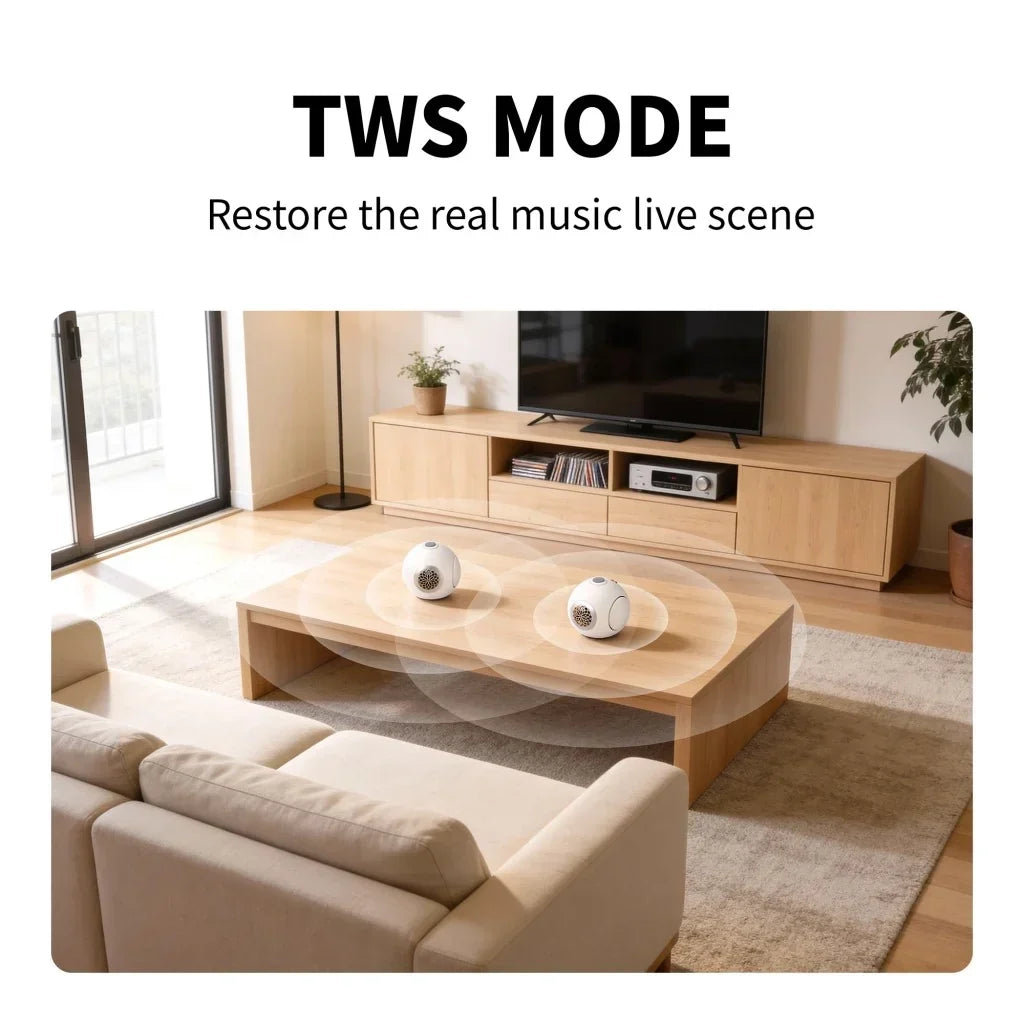
Movie night does not always require a soundbar, multiple speakers, or a complicated surround-sound installation. In a smaller living room, apartment, bedroom, or flexible entertainment space, a carefully designed wireless bluetooth speaker can provide a surprisingly engaging movie experience when the speaker is positioned correctly and its acoustic architecture is suited to the job.
The challenge is that movies place different demands on a speaker than casual music listening. Dialogue needs to remain clear. Background scores need enough separation to avoid masking voices. Low-frequency effects need weight without turning into uncontrolled boom. And sound should remain consistent when several people are watching from different positions.
That makes speaker design more important than simply looking for the biggest advertised power number.
The UB+ dB1 DoubleBass approaches this challenge through a spherical acoustic chamber, mechanical bass reinforcement, dual symmetrical passive radiators, and 360° sound dispersion. The goal is not to reproduce a complete multi-channel theater from one enclosure, but to create a broad, balanced, room-filling presentation from a compact wireless design.
If you're looking for the best portable bluetooth speaker for movie nights, the important question is not simply how loud it gets. It is how effectively the speaker manages dialogue, bass, dispersion, resonance, and placement.
Why Movie Audio Needs More Than Loudness

Movie soundtracks are extremely dynamic.
One moment may contain quiet dialogue, followed by music, environmental effects, or a low-frequency action sequence. A speaker that relies heavily on exaggerated bass or aggressive processing can sound impressive during short demonstrations but become less comfortable during an entire film.
For movie listening, several characteristics matter together:
- Clear vocal reproduction
- Controlled bass
- Consistent midrange
- Wide sound distribution
- Low cabinet vibration
- Stable wireless connectivity
- Enough output for the room
Dialogue is particularly important. If bass becomes too dominant, voices can become harder to distinguish. If the upper frequencies are excessively emphasized, speech may become sharp or tiring.
The acoustic system therefore has to maintain a useful balance across the frequency range.
This is one reason enclosure architecture matters. The speaker cabinet is not simply a container for electronics. Its geometry influences how internal air pressure, resonance, and vibration behave before sound reaches the room.
For a deeper explanation of how spherical architecture changes the acoustic behavior of a speaker, see UB+'s article on spherical Bluetooth speaker design and DoubleBass engineering.
Can One Speaker Really Create a Mini Home Cinema?

A single speaker cannot reproduce the discrete left, right, center, rear, and height channels of a properly configured multi-channel home theater. That distinction is important.
However, a single speaker can still create a more immersive listening environment than the narrow presentation of many conventional compact speakers.
The difference comes largely from dispersion.
A conventional front-firing speaker directs much of its energy toward a preferred listening position. That can work well when one person sits directly in front of it, but it becomes less convenient when several people are sitting around a room.
The dB1 uses a spherical architecture designed for 360° sound dispersion. Instead of treating one direction as the primary listening axis, the system distributes sound around the speaker.
That can be useful during movie nights where:
- Multiple people are watching together
- Seating positions are not perfectly aligned
- The room is relatively small
- The speaker needs to remain visually unobtrusive
- The listening position changes during the evening
For a broader explanation of this difference, UB+'s guide to 360° vs. front-firing speakers explores how dispersion changes the listening experience.
The result should not be described as true surround sound. Instead, it is a broad, room-filling presentation from a single acoustic source.
The Role of Bass in Movie Sound

Bass is one of the most noticeable differences between television speakers and a dedicated audio system.
Explosions, engines, cinematic scores, environmental effects, and other soundtrack elements often contain substantial low-frequency information. When a speaker cannot reproduce those frequencies effectively, the movie can feel smaller and less physical.
But simply increasing bass is not the answer.
Excessive low-frequency output can mask dialogue and make the soundtrack sound congested. The useful goal is controlled low-frequency extension.
The dB1 approaches this mechanically.
A centrally positioned mid-bass driver energizes the air inside the spherical chamber. The internal pressure then interacts with two large passive radiator plates positioned symmetrically on opposite sides of the enclosure.
The combined passive-radiator surface area is approximately 3.5 times the area of the active woofer. This gives the acoustic system a large moving surface through which to transfer low-frequency energy.
Because the radiators move symmetrically, their mechanical forces counterbalance each other. This reduces unwanted cabinet movement and allows more of the system's energy to become acoustic output.
This architecture is explored in more detail in UB+'s article on passive radiators vs. ported boxes and spherical speaker bass.
Why a Spherical Chamber Matters
The dB1's round exterior is not simply an aesthetic decision.
The enclosure is built around a spherical acoustic chamber inspired by the Helmholtz resonator principle. Unlike a conventional rectangular cabinet, the sphere does not have parallel internal walls running across the enclosure.
That difference can influence how internal pressure and reflections behave.
A conventional box can develop internal standing-wave patterns because sound reflects between opposing surfaces. Designers can manage these effects through damping, internal construction, driver placement, and digital processing, but the geometry remains part of the acoustic problem.
A spherical chamber approaches the problem differently.
The geometry is intended to:
- Distribute internal pressure more evenly
- Reduce problematic standing-wave behavior
- Minimize internal acoustic irregularities
- Support cleaner harmonic reproduction
- Integrate the enclosure into the acoustic system itself
This does not mean that a sphere automatically makes every speaker better. Driver selection, tuning, materials, amplification, and implementation still matter.
What makes the dB1 distinctive is that the spherical enclosure is central to the complete acoustic architecture rather than being added simply as a visual design feature.
The DoubleBass Architecture: More Than a Passive Radiator
Passive radiators are commonly used to extend bass response in compact speakers. The dB1 takes the concept further by using two large radiators in a symmetrical arrangement.
The basic acoustic sequence is straightforward:
Driver movement → internal air pressure → passive radiator movement → acoustic output
The driver does not simply fire directly at the listener. Instead, the downward-firing mid-bass driver energizes the internal air volume.
That pressure acts on the two passive radiators.
Because the radiators are positioned opposite each other and move in symmetrical directions, mechanical forces are balanced.
This matters because cabinet movement represents energy that is not being converted into useful acoustic output. Reducing unnecessary movement helps the system remain mechanically stable.
The result is an approach to bass that relies substantially on air movement and mechanical architecture, rather than treating DSP as the primary source of perceived low-frequency impact.
The DSP still has a role in system management, protection, linearity, and tonal balance. The important distinction is that the physical acoustic design does much of the work.
Dialogue Clarity Is Just as Important as Bass
A movie speaker should never be evaluated only by how impressive its bass sounds.
Dialogue occupies the midrange, and this part of the spectrum contains some of the most important information in a film.
If low frequencies are poorly controlled, they can mask vocal detail. If the cabinet introduces unwanted resonances, certain frequencies may become exaggerated. If the speaker has a narrow dispersion pattern, dialogue can become less consistent as listeners move away from the central axis.
The dB1's spherical architecture is designed to address several of these issues at the system level.
Its enclosure geometry works with the driver and passive radiators as one acoustic system. The objective is to maintain a controlled tonal presentation instead of creating a speaker that sounds exciting only because certain frequencies have been heavily emphasized.
For anyone building a compact entertainment setup, this balance is more useful than chasing maximum bass output.
Where You Place the Speaker Can Change the Experience
Even a well-engineered speaker can sound different depending on its position.
For a movie setup, start by placing the speaker relatively close to the television or display. The goal is to make the sound appear connected to the picture rather than coming from a completely different location in the room.
A few practical guidelines can help.
Keep the Acoustic Path Open
Avoid placing the speaker inside a closed cabinet or behind objects that obstruct its acoustic output.
The dB1 is designed around broad dispersion, so it benefits from having open space around the enclosure.
Use a Stable Surface
A solid, stable surface helps keep the speaker properly positioned.
Although the DoubleBass architecture is designed to counterbalance mechanical forces through symmetrical radiator movement, placement still affects how the sound interacts with the room.
Experiment With Distance From Walls
Walls can reinforce low frequencies.
Moving the speaker closer to a boundary can increase perceived bass, while moving it farther into the room can produce a different tonal balance.
There is no universal position for every room. A practical approach is to start near the television and make small adjustments while listening to familiar movie scenes.
Consider the Main Listening Area
If one person watches alone, positioning can be relatively precise.
For a group, 360° dispersion becomes more useful because listeners may sit at different angles relative to the speaker.
That is where a spherical design can become particularly practical.
A Single Speaker vs. a Traditional Multi-Speaker Setup
A single wireless speaker and a full home theater serve different purposes.
|
Feature |
Single UB+ dB1 Setup |
Traditional Multi-Speaker Cinema |
|
Physical setup |
Simple |
More complex |
|
Wiring |
Minimal |
Can require multiple connections |
|
Speaker count |
One |
Multiple |
|
Dispersion |
360° spherical presentation |
Position-dependent |
|
Dialogue source |
Single acoustic source |
Dedicated center channel possible |
|
Bass architecture |
Mechanical DoubleBass system |
Depends on system/subwoofer |
|
Room coverage |
Broad |
Can be precisely distributed |
|
Stereo separation |
Limited compared with separate left/right speakers |
Greater |
|
Placement flexibility |
High |
Requires planned speaker positions |
|
Best suited to |
Compact movie setups and flexible spaces |
Dedicated home theater rooms |
The table highlights an important distinction: a single speaker is not a replacement for a properly configured multi-channel theater in every respect.
Its advantage is simplicity.
You can create a more engaging movie setup without filling the room with speakers, cables, stands, and separate components.
Why Driver Design Matters During Action Scenes
Movie soundtracks can place significant demands on a compact driver.
A quiet dialogue scene may require only modest excursion. An action sequence can suddenly demand much more movement.
The dB1 uses a 4.5-inch mid-bass driver, supported by a 90 mm neodymium magnet and a long-stroke motor system. Its driver architecture is designed to maintain controlled movement during demanding passages.
The system also incorporates an aluminum shorting ring and wide surround construction to support controlled driver behavior.
The purpose of these components is not simply to increase volume.
Driver control matters because uncontrolled excursion can introduce distortion and reduce clarity. A movie soundtrack with complex effects needs the speaker to remain composed when several frequency ranges are active at the same time.
That is especially relevant when watching films at moderate-to-high listening levels.
A Rechargeable Speaker Adds More Flexibility
A mini home cinema does not necessarily have to stay in one room.
A rechargeable bluetooth speaker can move between a living room, bedroom, balcony, or another part of the home without requiring a permanent installation.
The dB1 combines wireless connectivity with a rechargeable design, making it possible to change the setup without rebuilding the entire audio system.
Its IPX5 water resistance also provides additional flexibility for suitable outdoor or splash-prone environments.
That does not turn it into an outdoor theater system, but it does make the same speaker useful beyond movie night.
Don't Choose a Movie Speaker by Wattage Alone
Power specifications can be useful, but they do not tell the complete story.
Two speakers with similar power ratings can behave very differently because their:
- Drivers differ
- Enclosures differ
- Passive-radiator systems differ
- DSP tuning differs
- Dispersion patterns differ
- Resonance characteristics differ
This is why acoustic architecture deserves attention alongside conventional specifications.
For buyers comparing different portable models, UB+'s speaker specifications guide provides a broader framework for understanding the numbers that actually matter.
The key is to look at specifications as part of a system rather than treating any individual number as a complete measure of performance.
Bluetooth Connectivity and Movie Playback
Wireless performance also matters during movie night.
The dB1 uses Bluetooth 5.3, providing a modern wireless connection between compatible devices.
For movie playback, however, Bluetooth version alone does not guarantee perfect audio-video synchronization.
Actual latency can depend on the source device, operating system, Bluetooth implementation, codec, application, and speaker processing.
If you are watching video, the most useful test is simple: connect the speaker to your actual television, phone, tablet, or streaming device and check dialogue synchronization.
A technically modern Bluetooth connection is valuable, but the complete playback chain determines the final experience.
What Makes a Mini Home Cinema Feel Immersive?
Immersion is not created by bass alone.
It comes from the combination of:
Scale + clarity + dispersion + dynamics + room interaction
A speaker that produces deep bass but masks dialogue will not necessarily create a better movie experience.
Likewise, a speaker with exceptionally clear dialogue but very limited low-frequency output may make action scenes feel flat.
The goal is balance.
The dB1's architecture attempts to create that balance through its spherical chamber, mechanical bass reinforcement, symmetrical passive radiators, and broad dispersion.
This is also why the physical design can matter as much as the electronics.
The speaker is effectively using the enclosure itself as part of the acoustic system.
Common Mistakes When Building a One-Speaker Movie Setup
Putting the Speaker Inside a Cabinet
Enclosing the speaker can restrict its acoustic output and change how the sound interacts with the room.
Keep the speaker exposed.
Increasing Bass Too Aggressively
If your television or source device has EQ controls, avoid immediately pushing the bass to maximum.
Too much low-frequency energy can make dialogue harder to follow.
Turning the Volume Up Too Far
Higher volume is not automatically more immersive.
If the speaker begins sounding strained, reducing the volume slightly can actually make dialogue and effects easier to distinguish.
Ignoring Room Size
A compact bedroom and a large open-plan living room require different expectations.
A single speaker can be highly effective in a smaller space, while a larger room may benefit from multiple speakers or a dedicated home theater system.
Expecting True Surround Sound From One Speaker
A spherical speaker can create broad, room-filling sound, but it does not create independent rear or height channels.
Understanding that distinction helps set realistic expectations.
When a Single Speaker Makes Sense
A one-speaker movie setup can be particularly practical for people who value:
- Minimal equipment
- Easy installation
- Flexible placement
- Portable listening
- Shared-room listening
- Reduced visual clutter
- Strong low-frequency presence from a compact design
It can also make sense in spaces where a permanent soundbar or multi-speaker installation is impractical.
A student apartment, bedroom, studio, small living room, or temporary rental does not always justify a complex cinema installation.
In those environments, the simplicity of a well-engineered single speaker can be part of the appeal.
The Broader Design Philosophy Behind dB1
The dB1 is built around a different question than simply asking how to make a portable speaker louder.
The more fundamental question is:
How can the enclosure, driver, air volume, and passive radiators work together to create controlled sound?
That philosophy is visible throughout the design.
The spherical chamber provides the acoustic environment.
The downward-firing mid-bass driver energizes that environment.
The dual passive radiators convert internal pressure into external acoustic movement.
Their symmetrical configuration helps counteract unwanted mechanical forces.
And the DSP supports system protection and tonal consistency rather than being the sole source of perceived bass.
This is a systems approach rather than a specification-first approach.
A Practical Movie-Night Setup
For a simple setup, start with the television or streaming device as the source and place the dB1 near the screen.
Keep the speaker unobstructed.
Use moderate volume initially and choose a movie with dialogue-heavy scenes, music, and action sequences. This lets you evaluate the complete tonal balance rather than judging the speaker from a single dramatic scene.
Then make small placement adjustments.
Move the speaker slightly forward or backward. Try different distances from the wall. Listen from different seats.
Because the dB1 is designed for 360° dispersion, the experience should not depend on sitting directly in front of one narrow acoustic axis.
The result is a simple system that can be changed without adding substantial equipment.
A Better Movie Night Starts With Better Acoustic Design
Turning a single speaker into a mini home cinema is not about pretending one device can reproduce every element of a dedicated theater system.
It is about making the most of one carefully engineered acoustic source.
For movie listening, the important qualities are clear dialogue, controlled bass, broad dispersion, stable mechanical behavior, and reliable wireless connectivity.
The UB+ dB1 DoubleBass brings those elements together through a spherical Helmholtz-inspired chamber, downward-firing mid-bass driver, dual symmetrical passive radiators, and 360° sound dispersion.
Its combined passive-radiator surface area is approximately 3.5× the active woofer area, while the symmetrical architecture is designed to reduce unwanted enclosure movement.
That makes the dB1 a particularly interesting option for listeners who want substantial cinematic sound without building a room around a traditional speaker system.
For more context on how the dB1 compares with compact alternatives, you can also explore UB+'s dB1 vs. dB Mini comparison.
The objective is simple: make the movie more engaging without making the setup more complicated.
Ready to Upgrade Your Movie Nights?
→ Compare dB1 vs dB Mini
→ See color options
→ Check current price
A great movie setup does not have to fill the room with equipment. Sometimes, thoughtful acoustic engineering and the right placement are enough to make a single speaker feel much bigger than its physical footprint.
Frequently Asked Questions
Can one Bluetooth speaker really work for a movie night?
Yes. A single speaker cannot reproduce the discrete channels of a full surround-sound system, but a well-designed speaker can provide broad, room-filling audio for a compact movie setup. The UB+ dB1 uses spherical 360° dispersion, allowing sound to reach listeners from different positions rather than concentrating the output in one narrow direction.
Is the UB+ dB1 good for movie dialogue?
The dB1 is designed to maintain a balanced presentation rather than relying on excessive bass enhancement. Its spherical acoustic architecture, controlled driver movement, and resonance management are intended to help preserve midrange clarity, which is important for dialogue, vocals, and other detail in movie soundtracks.
Does the dB1 provide surround sound?
The dB1 provides 360° sound dispersion, but it does not create true multi-channel surround sound with separate front, rear, center, and height channels. Its advantage is a broad and consistent presentation from a single speaker, which can work well for smaller rooms and simple entertainment setups.
How does the dB1 create deeper bass for movies?
The dB1 uses a spherical acoustic chamber inspired by Helmholtz resonance principles, combined with a downward-firing mid-bass driver and two symmetrical passive radiators. The internal air pressure drives the passive radiators, helping produce low-frequency output without relying entirely on aggressive digital bass boosting.
Where should I place the dB1 for movie watching?
Start by placing it near the television or display, preferably on a stable and unobstructed surface. Avoid putting it inside a closed cabinet. You can then experiment with its distance from walls and other boundaries to find the balance of bass and room coverage that works best in your space.
Is the dB1 suitable for a small apartment or bedroom movie setup?
Yes. Its compact wireless design, rechargeable operation, and broad dispersion make it suitable for spaces where a conventional multi-speaker home theater may be impractical. It can provide a more substantial movie experience without requiring multiple speakers, extensive wiring, or a permanent installation.



Hinterlasse einen Kommentar
Diese Website ist durch hCaptcha geschützt und es gelten die allgemeinen Geschäftsbedingungen und Datenschutzbestimmungen von hCaptcha.