
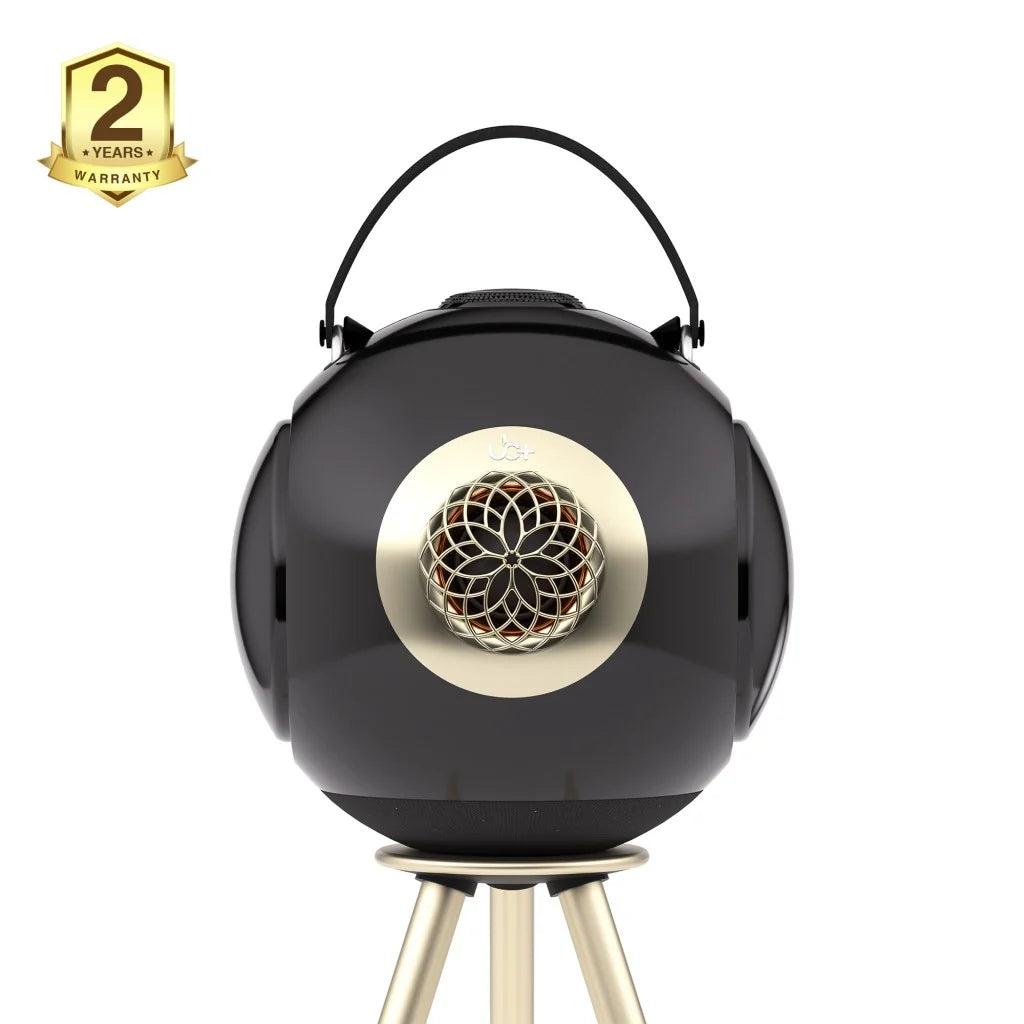
When you’re searching for the best portable bluetooth speaker or comparing the best sounding bluetooth speaker for your home, one question quietly shapes everything you’ll hear:
How does the speaker actually project sound into your space?
Because beyond specs, beyond brand names, and even beyond raw power sound dispersion determines whether your music feels immersive or limited, natural or directional, effortless or fatiguing.
That’s where the debate between 360° speakers and front-firing speakers becomes important.
At first glance, the difference seems simple:
- Front-firing speakers project sound forward
- 360° speakers disperse sound in all directions
But in real rooms with walls, furniture, reflections, and movement the difference is far more meaningful.
This guide breaks down how each design performs in real-world environments, how placement affects sound, and why modern acoustic engineering especially spherical, Helmholtz-inspired designs has pushed 360° speakers into a new category of performance.
Understanding Sound Dispersion: The Foundation of the Experience
Sound doesn’t travel in a straight line it interacts with everything around it.
When a speaker plays:
- sound waves reflect off walls
- frequencies build and cancel
- the room shapes what you hear
The way a speaker emits sound its dispersion pattern determines how evenly that sound fills the space.
What Is a Front-Firing Speaker?
Front-firing speakers are the traditional design used in most audio systems.
They:
- project sound in one primary direction
- rely on listener positioning
- create a focused “sweet spot”
How They Perform in Real Rooms
In a controlled setup:
- placed at ear level
- aimed directly at the listener
front-firing speakers can deliver:
- precise imaging
- strong stereo separation
- detailed soundstage
This is why they’re commonly used in:
- studio monitors
- home theater systems
- stereo setups
Limitations of Front-Firing Speakers
In everyday environments, however, things change.
1. Narrow Listening Zone
Move slightly off-axis and sound quality drops.
2. Placement Sensitivity
They must be positioned carefully to sound their best.
3. Uneven Room Coverage
Sound weakens in other parts of the room.
This can be frustrating if you:
- move around frequently
- share listening with others
- use the speaker casually
What Is a 360° Speaker?
A 360° speaker is designed to:
- distribute sound evenly in all directions
- reduce dependence on placement
- create a more immersive environment
Instead of aiming sound at you, it fills the room.
How 360° Speakers Work
True 360° performance depends on more than driver placement.
Advanced designs use:
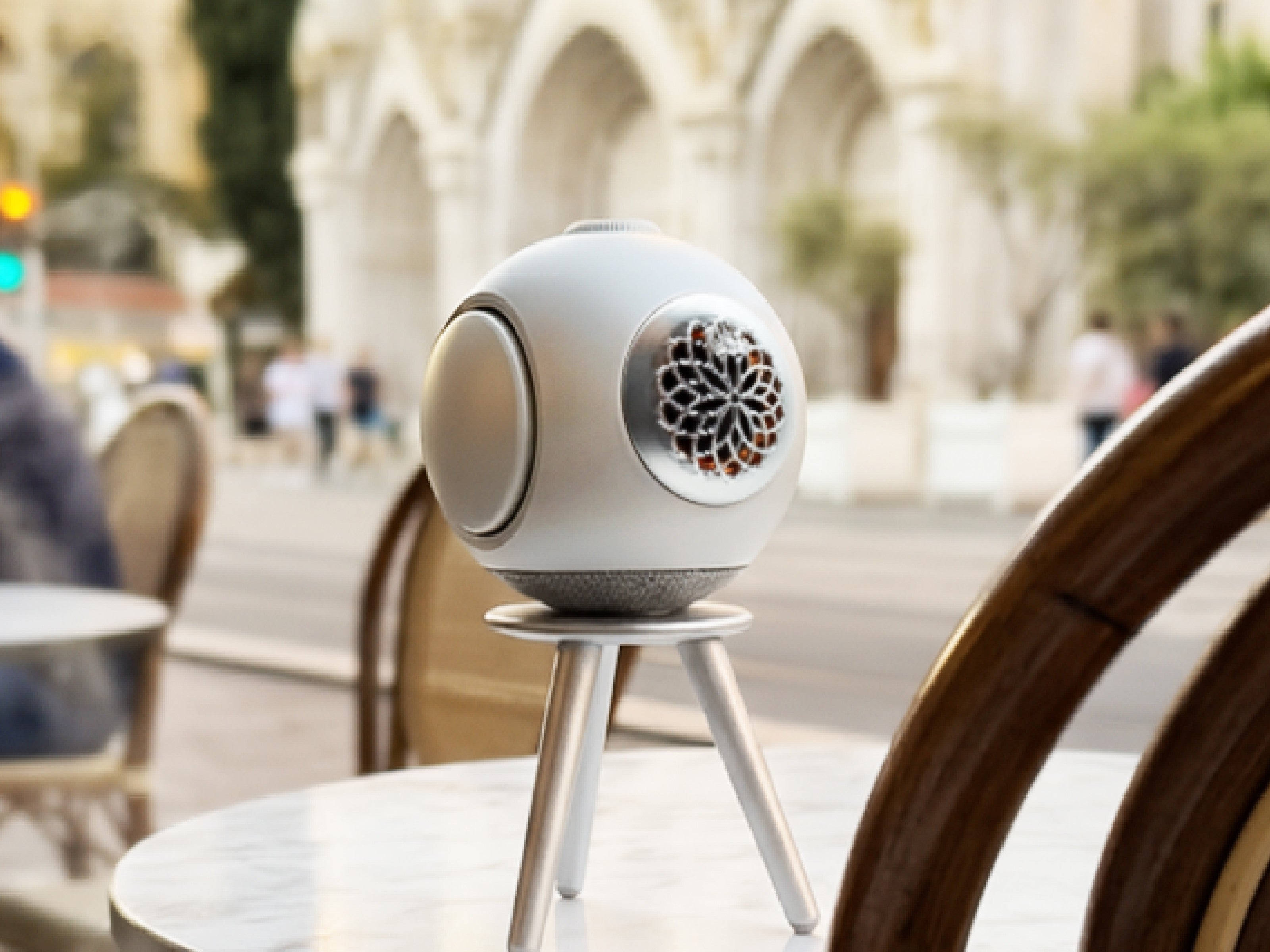
- spherical enclosures
- downward-firing drivers
- symmetrical acoustic systems
to create:
- even pressure distribution
- consistent sound output
- wide dispersion
Why Shape Matters for 360° Sound
Many speakers claim 360° sound, but few achieve it effectively.
The reason is simple:
Geometry controls how sound behaves.
Box Enclosures and Directionality
Traditional box speakers:
- have flat surfaces
- reflect sound unevenly
- encourage directional output
Even if multiple drivers are used, the shape still limits dispersion.
Spherical Enclosures and True Dispersion
A spherical enclosure:
- has no parallel surfaces
- distributes air pressure evenly
- minimizes internal distortion
This allows sound to:
- expand naturally
- disperse uniformly
- maintain consistency throughout the room
Helmholtz-Inspired Acoustic Chambers
At the core of advanced 360° speakers is the Helmholtz resonator principle.
Instead of forcing sound outward, it:
- uses controlled air pressure
- reinforces low frequencies
- stabilizes internal resonance
When combined with spherical geometry:
- bass becomes deeper and more controlled
- mids remain clear
- highs disperse evenly
Dual Passive Radiators: Balanced Energy for Room-Filling Sound
To achieve strong bass in a compact form, many 360° speakers use passive radiators.
But the most refined systems use:
Dual Symmetrical Passive Radiators
- positioned on opposite sides
- move in equal and opposite directions
- cancel vibration
This creates:
- stable output
- efficient energy conversion
- deeper bass without distortion
3.5× Air Movement: Why It Changes Everything
In advanced designs:
- passive radiator surface area can reach 3.5× that of the main driver
This dramatically increases:
- air displacement
- bass authority
- overall efficiency
Without requiring:
- more power
- larger size
Downward-Firing Drivers: The Key to Natural Dispersion
Unlike front-firing speakers, many 360° designs use downward-firing drivers.
Instead of projecting sound forward:
- the driver energizes internal air
- pressure builds inside the enclosure
- sound radiates outward evenly
This results in:
- smoother room coverage
- less harshness
- more immersive listening
360° vs Front-Firing Speakers
|
Feature |
Front-Firing Speaker |
360° Speaker |
|
Sound Direction |
Forward |
All directions |
|
Listening Zone |
Narrow sweet spot |
Wide coverage |
|
Placement Sensitivity |
High |
Low |
|
Room Filling Ability |
Limited |
Excellent |
|
Movement Flexibility |
Low |
High |
|
Sound Consistency |
Varies by position |
Even throughout room |
Real-World Scenarios: Which Works Better?
Scenario 1: Small Apartment
Front-firing speakers:
- can sound great in one position
- lose impact elsewhere
360° speakers:
- fill the entire space
- maintain balance
Winner: 360° speaker
Scenario 2: Desk or Focused Listening
Front-firing speakers:
- provide precise direction
- work well for near-field listening
360° speakers:
- feel more ambient
Winner: Depends on preference
Scenario 3: Social Gatherings
Front-firing speakers:
- require repositioning
- uneven sound for groups
360° speakers:
- deliver consistent audio for everyone
Winner: 360° speaker
Scenario 4: Outdoor Use
Front-firing speakers:
- project sound in one direction
360° speakers:
- spread sound evenly
- better for open environments
Winner: 360° speaker
Practical Use Cases
|
Scenario |
Best Choice |
Reason |
|
Personal listening |
Front-firing |
Focused sound |
|
Shared rooms |
360° |
Even coverage |
|
Travel |
360° |
Flexible placement |
|
Work desk |
Front-firing |
Directional clarity |
|
Living room |
360° |
Room-filling sound |
Placement Flexibility: A Major Advantage
One of the biggest advantages of 360° speakers is flexibility.
You can place them:
- in the center of a room
- on a side table
- near walls
And still get:
- balanced sound
- consistent performance
Front-firing speakers, on the other hand, require:
- precise positioning
- correct angles
- careful setup
Why 360° Speakers Feel More Natural
The human ear is used to hearing sound from multiple directions.
In real life:
- reflections come from all around
- sound is not strictly directional
360° speakers replicate this:
- creating a more natural experience
- reducing listening fatigue
- enhancing immersion
Loudness vs Coverage
Front-firing speakers often focus on:
- loudness
- direct impact
360° speakers focus on:
- coverage
- consistency
This means:
- less need to increase volume
- more comfortable listening
Portable and Rechargeable Use
For portable bluetooth speakers, 360° design offers clear advantages:
- no need to aim the speaker
- works in any position
- ideal for travel and shared use
This is why many best small bluetooth speakers now adopt this approach.
The Role of Efficiency in Modern Design
Advanced 360° speakers combine:
- spherical enclosures
- Helmholtz resonance
- dual passive radiators
- downward-firing drivers
to achieve:
- strong bass
- even dispersion
- compact size
Why Many “Budget Speakers” Fall Short
Many best budget bluetooth speakers claim:
- 360° sound
- powerful bass
But often rely on:
- DSP boosting
- basic driver setups
- inefficient enclosures
This leads to:
- distortion
- uneven sound
- limited real-world performance
Choosing the Right Speaker for You
Choose a Front-Firing Speaker if:
- you sit in one position
- you want directional clarity
- you prefer studio-style listening
Choose a 360° Speaker if:
- you move around while listening
- you share your space
- you want consistent sound everywhere
Final Thoughts: Which Sounds Better?
There’s no universal winner only what fits your lifestyle.
But in most real-world environments:
- rooms are not perfectly set up
- listeners move around
- sound needs to adapt
And this is where 360° speakers excel.
With innovations like:
- Helmholtz-inspired acoustic chambers
- spherical enclosures
- dual symmetrical passive radiators
- 3.5× air movement systems
- self-cancelling vibration design
they offer a listening experience that feels:
- natural
- balanced
- immersive
without requiring perfect placement.
Experience Room-Filling Sound
→ Compare dB1 vs dB Mini
→ See color options
→ Check current price
Because great sound isn’t just about how loud it is.
It’s about how evenly it reaches you wherever you are in the room.



Leave a comment
This site is protected by hCaptcha and the hCaptcha Privacy Policy and Terms of Service apply.