

When shopping for a Bluetooth speaker with deep bass, many buyers immediately look at specifications such as wattage, maximum SPL, driver size, and frequency response. Numbers like 20Hz–20kHz or 40Hz–20kHz can appear impressive, but a frequency range by itself does not tell you how a speaker will actually sound in a room.
Two speakers can advertise similar frequency ranges and produce very different results. One may deliver controlled, substantial low-frequency energy, while another may sound boomy, weak, or distorted when pushed. The difference often comes down to the relationship between the driver, enclosure, air displacement, acoustic tuning, and electronic control.
The reason is simple: bass extension is about more than the lowest number printed on a specification sheet.
It depends on how effectively a speaker can reproduce low frequencies, how much air its acoustic system can move, how well its driver remains controlled, and how the enclosure manages internal pressure and vibration. A speaker must also maintain useful output at realistic listening levels. Reaching a frequency under a particular test condition does not necessarily mean that the speaker can reproduce it strongly or cleanly during everyday listening.
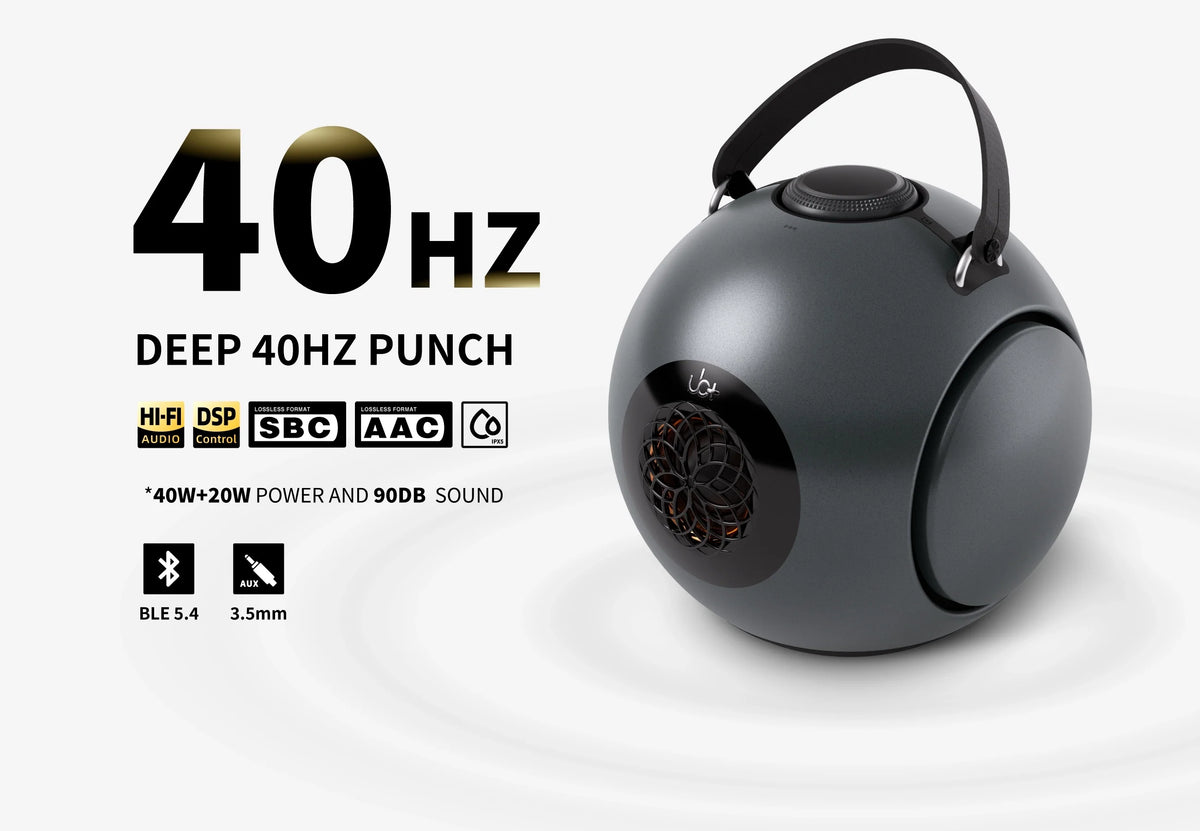
This makes bass extension particularly important when comparing compact wireless speakers. The UB+ dB1 DoubleBass, for example, approaches low-frequency reproduction through a spherical acoustic chamber inspired by Helmholtz resonance, dual symmetrical passive radiators, and a long-throw driver rather than relying only on electronic bass enhancement.
Understanding what those Hz numbers actually mean can help you make a much better speaker-buying decision. Instead of choosing a speaker simply because it advertises the lowest frequency, you can evaluate the engineering that determines whether its bass is deep, controlled, and useful.
What Does Bass Extension Actually Mean?

Bass extension describes how low in frequency a speaker can reproduce useful audible output. Frequency is measured in Hertz (Hz), where one hertz represents one cycle per second. A lower frequency corresponds to a longer sound wave and generally requires more physical air movement from the speaker system.
A simplified way to understand the bass region is:
|
Frequency Range |
General Description |
What You Typically Perceive |
|
20–60 Hz |
Sub-bass |
Deep rumble, physical weight, low-frequency atmosphere |
|
60–120 Hz |
Deep bass |
Kick drum impact, bass foundation, low-end power |
|
120–250 Hz |
Upper bass |
Warmth, body, fullness, and weight in instruments |
These ranges overlap in real music, and individual instruments contain energy across multiple frequency bands. A kick drum, for example, can contain both a low-frequency component and a higher-frequency attack that helps define its impact. The same applies to bass guitar, electronic music, and cinematic sound effects.
The important point is that a speaker reaching a lower frequency does not automatically mean it produces better bass.
A frequency-response specification tells you something about the range the system can reproduce. It does not, by itself, tell you how loudly that frequency is reproduced, how much distortion occurs, or whether the output remains useful at normal listening levels.
For example, a speaker may have a published lower frequency limit but produce very little acoustic output at that point. Another speaker may have a higher stated lower limit yet deliver stronger and more controlled bass across the frequencies listeners use most often.
That is why usable bass extension is more meaningful than simply finding the lowest advertised Hz number.
Why Frequency Numbers Alone Can Be Misleading

A manufacturer may list a very wide frequency response, but frequency-response figures need context. The measurement conditions, tolerance, output level, and test method all affect how useful the specification is when comparing products.
For example, one speaker might technically reach a low frequency at a very reduced output level. Another might have a higher stated lower limit but produce substantially stronger and cleaner low-frequency output within its usable operating range.
For the listener, the second speaker may sound deeper and more convincing.
This is why you should not evaluate a speaker based only on whether its specification says 20Hz, 30Hz, or 40Hz. You should also consider:
- Low-frequency output: How much acoustic energy does the speaker produce in its bass range?
- Driver excursion: How far can the active driver move while maintaining controlled operation?
- Air displacement: How effectively can the system move air at low frequencies?
- Enclosure design: How does the cabinet's volume and geometry influence the driver's behavior?
- Passive-radiator or port tuning: How does the acoustic system support low-frequency output?
- Distortion and compression: Does the bass remain clean as the volume increases?
- Realistic listening performance: Can the speaker reproduce useful bass at the volume levels you actually use?
A speaker's published frequency range is therefore a starting point, not a complete description of its bass performance.
When comparing specifications, it is also worth distinguishing between a rated frequency range and a measured response curve. A range gives you two endpoints, while a response curve can show how output changes across the frequencies between them. If a manufacturer does not provide measurement tolerance or test conditions, avoid treating the lowest number as a precise prediction of what you will hear.
Bass Is Fundamentally About Moving Air

Low-frequency sound is not created simply by adding more electrical power. At a physical level, a speaker produces bass by moving air.
The active driver moves forward and backward, creating changes in air pressure that propagate through the room as sound waves. The lower the frequency, the greater the physical demands placed on the acoustic system, particularly when the speaker must maintain meaningful output.
This creates a challenge for compact speakers.
Small speakers have limited:
- Driver surface area.
- Enclosure volume.
- Driver excursion.
- Acoustic efficiency.
- Available space for the acoustic components that support low-frequency reproduction.
A designer therefore has to find efficient ways to produce useful low-frequency output without pushing the driver beyond its practical limits.
That is where enclosure architecture becomes important.
A speaker's driver, cabinet, air volume, passive radiator, and electronic control system all need to work together. A powerful amplifier alone cannot overcome every physical limitation. Increasing the electrical signal may increase driver movement, but excessive movement can also create distortion, compression, and mechanical stress.
This is one reason a speaker with seemingly modest specifications can sometimes sound fuller and more controlled than a higher-powered speaker with less effective acoustic engineering.
Why Air Displacement Matters
Air displacement is one of the most useful concepts to understand when evaluating bass.
A simplified relationship is:
Air displacement = radiating area × diaphragm movement
This relationship explains why speaker designers pay close attention to both driver size and excursion. A larger radiating surface can move more air with a given amount of movement, while a driver with greater excursion can displace more air by traveling farther.
A small driver can move a certain amount of air by moving farther, but there are physical limits to how far it can travel while maintaining control. If the driver is pushed beyond its intended operating range, distortion and mechanical stress can increase.
Passive radiators provide another way to increase effective low-frequency air movement without requiring the active driver itself to perform all the work. They use pressure changes inside the enclosure to move an additional diaphragm, contributing to the system's acoustic output.
This is central to the architecture of the UB+ dB1 DoubleBass. Its active driver, spherical chamber, and two passive radiator plates are designed to work together rather than treating the woofer as the only source of low-frequency movement.
The result is a system-level approach to bass reproduction: the active driver generates pressure, the enclosure manages that pressure, and the passive radiators contribute additional air movement.
The Helmholtz-Inspired Spherical Acoustic Chamber
The UB+ dB1 DoubleBass takes an unusual approach to enclosure design by using a true spherical acoustic chamber inspired by principles of Helmholtz resonance.
The underlying Helmholtz concept describes how air contained within a cavity can resonate at particular frequencies. A traditional Helmholtz resonator uses a cavity and an opening through which air moves. In speaker design, related acoustic-resonance principles can be incorporated into an enclosure system to influence low-frequency behavior.
UB+ applies this thinking through the dB1's spherical architecture.
Rather than using a conventional rectangular internal cavity with multiple parallel surfaces, the dB1 uses a spherical chamber designed to create more symmetrical internal pressure behavior and reduce problematic internal reflections and standing-wave behavior.
The sphere is therefore not simply a visual choice.
It is part of the acoustic system.
Its geometry provides a different internal environment from a conventional box-shaped cabinet. The design is intended to help the driver and passive radiators interact with the enclosed air volume in a controlled way, supporting the speaker's overall low-frequency performance.
This does not mean that a spherical enclosure eliminates every resonance or acoustic problem. All speaker enclosures require careful engineering, and the complete result depends on driver placement, internal volume, damping, tuning, and structural behavior. The sphere provides a different starting point for managing the internal acoustic environment.
You can explore the underlying concept in UB+'s article on spherical versus box speaker design and sound.
The DoubleBass System: Using Air Pressure Efficiently
The dB1's low-frequency architecture goes beyond the shape of its chamber.
Its DoubleBass system uses two large passive radiator plates positioned on opposite sides of the spherical enclosure. When the active driver moves, it changes the air pressure inside the chamber. That pressure drives the passive radiators, allowing them to contribute to low-frequency air movement.
The system works around several coordinated elements:
- A centrally positioned, downward-firing mid-bass driver.
- A spherical internal acoustic chamber.
- Two symmetrical passive radiators.
- Controlled internal air pressure.
- Opposing mechanical movement that helps balance enclosure reaction.
The symmetrical arrangement is particularly important.
As the two passive radiators move outward together, their opposing positions help balance the mechanical forces acting on the enclosure. This arrangement is intended to reduce unwanted cabinet reaction and the transfer of vibration to a supporting surface.
The objective is to direct more of the system's movement toward acoustic output rather than unnecessary physical shaking. The exact result still depends on the complete design, operating frequency, output level, and supporting surface.
This is one reason passive-radiator design deserves attention when comparing portable speakers. Passive radiators are not simply decorative additions. Their mass, suspension, surface area, and tuning influence how they interact with the active driver and enclosure.
For another explanation of how the UB+ dB1 uses its acoustic architecture, read the dB1 DoubleBass design and engineering overview.
Why the dB1 Has Approximately 3.5× the Passive-Radiator Surface Area
One of the defining technical characteristics of the dB1 is the size of its passive-radiating surfaces.
The combined passive-radiator surface area is approximately 3.5 times the area of the active woofer. That gives the system a significantly larger effective radiating area for its low-frequency architecture.
The importance of this is straightforward: bass requires air movement.
Rather than asking the active driver to perform all of the low-frequency work, the dB1 uses the enclosed air pressure to drive its two passive radiators. Their combined surface area allows them to contribute substantial diaphragm movement within a compact enclosure.
The intended result is greater acoustic displacement from the system while maintaining controlled active-driver operation.
This is an important distinction between physical bass architecture and simply adding more electronic bass gain. Electronic processing can alter the signal sent to the driver, but it cannot create unlimited diaphragm area or eliminate the mechanical limits of the speaker.
The dB1 uses its active driver, spherical chamber, and dual passive radiators as a coordinated acoustic system. The design focuses on using internal air pressure to support low-frequency output rather than depending entirely on stronger electronic bass boosting.
Driver Engineering: The Other Half of Bass Extension
An advanced enclosure cannot compensate for a driver that cannot maintain control. The dB1 therefore combines its spherical chamber and passive-radiator system with a 4.5-inch long-throw mid-bass driver.
Its supplied driver-engineering details include:
- 90mm neodymium magnet: Part of the driver's magnetic motor system.
- 35mm long-stroke voice coil: Designed to support substantial driver movement.
- 20mm piston movement: The specified movement capability associated with the driver's excursion architecture.
- Aluminum shorting ring: Intended to help manage motor-related distortion.
- 18mm extra-wide surround: Supports the driver's moving diaphragm and excursion.
These components work together to support controlled driver movement.
The long-stroke architecture provides substantial excursion capability, while the motor and suspension system are designed to keep the driver operating in a controlled manner. The aluminum shorting ring is intended to help reduce distortion in the motor system, while the wide surround supports stable movement.
The driver does not work independently of the enclosure. Its performance depends on how its moving mass, motor strength, suspension, and excursion interact with the chamber and passive radiators.
The broader lesson is that bass extension is a system-level characteristic. It is not created by the driver alone.
When comparing other portable speakers, the UB+ dB Mini is another compact option to explore. It has a different product format from the dB1, so its specifications and acoustic design should be evaluated on their own rather than assuming that it uses the same spherical chamber and dual-radiator architecture.
Usable Bass vs Artificial Bass
Modern DSP is extremely useful in speaker design. Digital signal processing can help manage:
- Driver protection.
- Tonal balance.
- System linearity.
- Output optimization.
- Dynamic behavior.
- Frequency-response adjustments.
The problem occurs when a speaker relies excessively on electronic boosting to create the impression of deep bass beyond what its physical system can comfortably reproduce.
Electronic processing can change the signal, but it cannot eliminate the physical limits of a driver or enclosure. Boosting a frequency that a small speaker cannot reproduce efficiently may require more excursion and amplifier power, potentially increasing distortion or compression.
The dB1 instead places significant emphasis on mechanical and acoustic bass reproduction. The spherical chamber, active driver, and dual passive radiators physically contribute to low-frequency output, while DSP can support the overall system through tuning, linearity, and protection.
This distinction helps explain why two speakers with similar advertised power can produce very different bass.
One may be relying heavily on signal processing to emphasize low frequencies. The other may have a more capable acoustic system that uses enclosure volume, driver movement, and passive radiators to support the output.
Neither DSP nor mechanical design should be treated as a substitute for the other. Good speaker engineering often requires both. The important question is how effectively the complete system reproduces bass without sacrificing control.
For a broader discussion of deep bass from compact speakers, see how the UB+ dB1 approaches deep bass without a conventional subwoofer.
Bass Extension vs Loudness
Another common mistake is assuming that a louder speaker automatically has deeper bass.
It does not.
Loudness and bass extension are different characteristics. A speaker can achieve high overall SPL while producing relatively limited low-frequency extension. Another speaker can sound fuller and deeper at moderate volume because its acoustic system is more effective in the lower frequencies.
When comparing speakers, ask two separate questions:
- How loud can it get?
- How low and how cleanly can it reproduce bass at useful listening levels?
Those questions measure different aspects of performance.
A high maximum SPL does not guarantee deep bass, just as a very low published frequency does not guarantee strong or clean bass. A speaker may also behave differently as the volume increases. Some systems maintain their tonal balance reasonably well, while others use limiting or compression to protect the driver.
The dB1, for example, is designed around both broad acoustic output and a dedicated low-frequency architecture rather than treating maximum loudness as the sole objective. Its published specifications include a frequency range of 40Hz–20kHz and a maximum SPL rating of 93dB.
These figures provide useful reference points, but they should not be interpreted in isolation. Frequency-response measurement conditions, SPL measurement distance, and distortion behavior all influence how specifications translate into real listening performance.
Why Enclosure Geometry Influences Bass
The cabinet is one of the most overlooked parts of a speaker.
The enclosure determines how the driver interacts with the air inside the system. Its volume, shape, internal surfaces, ports or radiators, and structural rigidity all influence acoustic behavior.
Conventional box designs can be highly effective, but parallel internal surfaces can contribute to standing-wave behavior and uneven pressure distribution. Designers can address these effects through damping, bracing, internal geometry, driver placement, and digital correction.
A spherical enclosure offers a different starting point.
Because the dB1 does not use the same parallel-wall geometry as a rectangular cabinet, its internal acoustic environment can be more symmetrical. This geometry is intended to reduce certain problematic internal interactions and support more controlled pressure behavior.
The objective is not to claim that a sphere eliminates every acoustic problem. Rather, its geometry is designed to reduce certain problematic internal interactions at the source while working with the driver and passive radiators.
This is one of the reasons spherical speaker architecture is an interesting area of audio engineering. It changes the way the enclosure participates in the acoustic system instead of treating the cabinet as a simple container for the driver.
Box Speaker vs Spherical Acoustic Architecture
|
Feature |
Conventional Box Speaker |
UB+ dB1 DoubleBass |
|
Enclosure geometry |
Rectangular or box-based |
True spherical chamber |
|
Internal acoustic approach |
Sealed or ported cabinet |
Helmholtz-inspired spherical architecture |
|
Passive-radiator system |
Varies by design |
Dual symmetrical passive radiators |
|
Air movement |
Depends on driver and enclosure |
Supported by approximately 3.5× radiator surface area |
|
Cabinet reaction |
Depends on cabinet and driver configuration |
Opposing radiator movement helps reduce mechanical reaction |
|
Sound dispersion |
Depends on driver arrangement |
Broad 360-degree spherical dispersion |
|
Bass strategy |
Varies; may use DSP, ports, or radiators |
Mechanical/acoustic architecture supported by DSP |
|
Primary design objective |
Varies by speaker |
Controlled air movement and broad acoustic output |
The important point is not that every box speaker is inferior. Well-designed conventional cabinets can perform extremely well. A properly engineered ported or sealed enclosure can deliver excellent bass.
The dB1 simply represents a different engineering approach in which the enclosure geometry itself is central to the acoustic system.
What Wattage Actually Tells You
Wattage is another specification that is frequently misunderstood.
A speaker's wattage describes electrical power handling or amplifier output under a particular measurement condition. It does not directly tell you:
- How deep the bass will extend.
- How efficiently the system moves air.
- How much distortion occurs.
- How balanced the frequency response is.
- How the speaker interacts with the room.
- How well the speaker maintains output as volume increases.
Two speakers with similar amplifier power can therefore sound very different.
Acoustic efficiency matters. A system that converts electrical energy into controlled air movement effectively can deliver a stronger perceived result than a system that simply consumes more power.
This is why it is better to consider wattage alongside driver design, enclosure architecture, sensitivity or SPL, frequency response, excursion, and distortion behavior.
A speaker with more amplifier power may have greater potential output, but that does not automatically make it the better choice for someone who values controlled bass at normal listening levels.
Why Good Bass Should Sound Controlled, Not Just Loud
Deep bass should add weight to music without covering up everything above it.
Consider a recording with bass guitar, kick drum, vocals, and percussion. If the low end is poorly controlled, increasing bass can mask the midrange and make vocals seem less distinct. The kick drum may lose definition, while bass notes can blend into a continuous rumble.
Controlled bass behaves differently.
The low-frequency foundation supports the rest of the recording instead of dominating it. Individual notes remain easier to distinguish, and the midrange continues to carry vocals and instrument detail.
This is particularly important in smaller rooms, where boundaries can reinforce bass and make excessive low-frequency energy even more obvious. A speaker placed close to a wall or corner may sound significantly heavier than it does in a more open position.
A well-engineered speaker should therefore balance extension with control.
The goal is not simply to make the room shake. The goal is to reproduce the low-frequency information in the recording with enough weight, definition, and stability to remain convincing.
How to Evaluate Bass Extension in Real Listening
When you test a speaker, do not begin by asking whether the bass is the loudest you have heard. Listen for specific characteristics that reveal how the system behaves across different recordings and volume levels.
Listen for Low-Frequency Definition
Bass instruments should remain identifiable rather than becoming one continuous rumble. Kick drums should have impact without overwhelming vocals. Listen for whether individual bass notes sound distinct or whether they blur together.
Listen at Different Volumes
A speaker that sounds good only at moderate volume may struggle when pushed harder. Conversely, a speaker that maintains balance as volume changes generally has a more capable overall system.
Test both quiet and louder passages. Notice whether the bass becomes compressed, distorted, or disproportionately prominent as the volume increases.
Listen for Distortion
Distortion often becomes more obvious during demanding bass passages. If the bass becomes fuzzy, harsh, or mechanically strained, the system may be approaching its limits.
Listen for unwanted rattling or buzzing as well. These sounds can sometimes come from the speaker itself, but they can also come from furniture or objects vibrating nearby.
Pay Attention to the Room
Placement can significantly change perceived bass. A speaker close to a corner or wall may sound much heavier than the same speaker placed in a more open position.
Try listening from your normal seat and moving the speaker slightly if the bass seems excessive or uneven. For practical guidance, UB+'s article on speaker placement tips for better bass and clarity can help you evaluate a speaker more accurately in your own room.
Do Not Ignore the Midrange
Deep bass is only part of the listening experience. If increasing bass causes vocals or instruments to disappear, the system may be producing quantity rather than quality.
A good test recording should contain bass, vocals, and instruments together. This helps you judge whether the speaker maintains balance rather than making the low end sound impressive in isolation.
Bass Extension and the Listening Experience
The real purpose of bass extension is not to win a specification comparison.
It is to make music, movies, and other audio content feel more complete.
Deep low frequencies contribute:
- Weight: The low-frequency foundation that makes instruments and sound effects feel substantial.
- Scale: A greater sense of size and depth in music and cinematic audio.
- Rhythm: The low-end definition that supports kick drums, bass lines, and electronic beats.
- Physical impact: The sense of energy associated with powerful low-frequency passages.
- Atmosphere: The rumble and depth that help create an immersive listening experience.
A kick drum feels more convincing when its low-frequency foundation is reproduced properly. A cinematic effect has greater physical presence when the system can reproduce its lower harmonics. Electronic music can feel more immersive when sub-bass information is present without becoming uncontrolled.
But deep bass only improves the experience when it remains integrated with the rest of the frequency range.
That is why controlled bass extension is more useful than chasing the lowest possible Hz number.
Choosing a UB+ Speaker for Different Listening Needs
Understanding bass extension can help you compare portable speakers more carefully. It is also important to match the speaker's design to the way you intend to use it.
The UB+ dB1 DoubleBass is the model to examine if you are particularly interested in spherical acoustic architecture and its dual symmetrical passive-radiator system. Its 4.5-inch long-throw driver, Helmholtz-inspired chamber, and approximately 3.5× combined passive-radiator surface area form a coordinated approach to low-frequency reproduction. Its stated frequency range is 40Hz–20kHz, with a 93dB SPL rating and up to 20 hours of playback.
The UB+ dB Mini is another portable option for listeners who want a compact speaker for everyday use. It offers up to 20 hours of playback, but its product specifications and acoustic design should be evaluated separately from the dB1 rather than assuming the same driver and enclosure architecture.
You can also compare the UB+ S2 Alphorn if you are exploring other portable speaker formats. Its intended use and design differ from the dB1, so consider the full product specifications and your listening priorities when choosing.
The right choice depends on more than bass extension. Consider where you listen, how much portability matters, which connections you need, and whether you prioritize low-frequency performance, everyday convenience, or a combination of both.
Frequently Asked Questions
What does bass extension mean in a speaker?
Bass extension refers to how low a speaker can reproduce useful low-frequency sound. It is generally discussed in Hertz, with lower frequencies representing deeper bass. However, the lowest advertised frequency does not automatically indicate better real-world bass performance. Output level, distortion, and measurement conditions also matter.
Is 20Hz better than 40Hz for a Bluetooth speaker?
Not necessarily. A speaker that claims 20Hz may produce that frequency only under specific measurement conditions or at very low output. A speaker with a 40Hz lower specification can potentially produce stronger and more usable bass in normal listening. The measurement method, response tolerance, and output level matter.
What is the difference between bass extension and loudness?
Bass extension describes how low a speaker can reproduce frequencies, while loudness describes how much acoustic output it can produce. A speaker can be very loud without having deep bass, and another speaker can have strong bass extension without being the loudest speaker available.
How do passive radiators improve bass?
Passive radiators use changes in internal air pressure to move a separate radiating surface. This allows the enclosure to produce additional low-frequency output without requiring the active driver to perform all of the air movement itself. Their effectiveness depends on the complete acoustic design, including radiator mass, suspension, enclosure volume, and tuning.
Why does the UB+ dB1 use a spherical chamber?
The dB1 uses a true spherical acoustic chamber inspired by principles of Helmholtz resonance. Its geometry is designed to provide more symmetrical internal pressure behavior and reduce problematic internal reflections and standing-wave behavior while working with the driver and dual passive radiators.
Look Beyond the Lowest Hz Number
Understanding bass extension changes the way you should read speaker specifications.
A frequency-response number can tell you where a speaker is rated to operate, but it does not tell the entire story of how that speaker will perform in a real room. The lowest advertised frequency does not reveal how much air the system can move, how cleanly it reproduces bass, or whether it maintains useful output as the volume increases.
The most convincing bass comes from a complete system in which the driver, enclosure, air volume, passive radiators, mechanical structure, and electronic control work together.
The UB+ dB1 DoubleBass illustrates this approach through its Helmholtz-inspired spherical acoustic chamber, dual symmetrical passive radiators, approximately 3.5× combined passive-radiator surface area, and long-throw driver architecture. Its design emphasizes physical air movement and controlled low-frequency reproduction rather than relying entirely on an impressive number on a specification sheet.
If you are comparing different compact speaker formats, explore the UB+ dB Mini as another portable option, or review the UB+ S2 Alphorn to compare a different design within the UB+ range.
So when comparing speakers, do not simply ask:
"Which one reaches the lowest Hz?"
Ask:
"Which speaker can reproduce its low frequencies with useful output, control, and clarity?"
That is the more meaningful definition of bass extension. Explore the UB+ dB1 DoubleBass, compare it with the UB+ dB Mini, and review the UB+ S2 Alphorn to find the speaker design that best matches your listening needs.
Because the best bass is not simply the bass with the lowest number. It is bass that reaches deep enough, moves air effectively, and remains controlled enough to preserve the music around it.



Leave a comment
This site is protected by hCaptcha and the hCaptcha Privacy Policy and Terms of Service apply.