

When people search for the best portable bluetooth speaker or compare the best sounding bluetooth speakers, they usually look at specs wattage, battery life, frequency range, and brand reputation.
But there’s a more fundamental question most buyers never ask:
Does the shape of a speaker affect how it sounds?
The short answer is yes significantly.
Speaker shape is not just a design choice. It directly influences how sound waves behave, how bass is produced, and how audio fills a room. The long-standing dominance of rectangular box speakers has more to do with manufacturing convenience than acoustic perfection.
Today, with advancements in acoustic engineering, spherical speakers are challenging that norm offering a different approach to both sound and design.
This guide breaks down the real differences between spherical and traditional box speakers, focusing on:
- internal sound wave behavior
- resonance and distortion
- bass performance
- room dispersion
- real-world listening experience
If you’re deciding between a wireless bluetooth speaker with a conventional design and a newer spherical alternative, this comparison will give you a clearer, more technical perspective.
Why Most Speakers Are Boxes (And Why That’s a Compromise)
Rectangular speakers dominate the market for practical reasons:
- easy to manufacture
- efficient to ship
- simple to stack and store
- compatible with standard components
But acoustically, the box shape introduces inherent problems.
Parallel Internal Surfaces
Inside a rectangular enclosure:
- walls face each other directly
- sound waves bounce back and forth
- reflections repeat in predictable patterns
This creates standing waves, where certain frequencies are amplified while others cancel out.
The result:
- uneven bass
- muddy mids
- inconsistent tonal balance
Internal Reflections and Phase Issues
Flat surfaces reflect sound in straight lines.
These reflections:
- collide with direct sound waves
- create phase interference
- blur detail and clarity
Even high-end best audiophile bluetooth speakers using box designs must compensate for this.
Reactive Engineering
To reduce these issues, manufacturers add:
- damping materials
- internal bracing
- digital signal processing (DSP)
But these are corrective measures.
They don’t eliminate the root problem the geometry itself.
Spherical Speakers: A Different Starting Point
Spherical speakers approach the problem differently.
Instead of fixing issues after they occur, they prevent them from forming.
No Parallel Walls
A sphere has:
- no flat opposing surfaces
- no predictable reflection paths
This means:
- standing waves are minimized
- internal resonance is smoother
Even Pressure Distribution
Inside a spherical enclosure:
- air pressure builds uniformly
- energy spreads evenly
This results in:
- more consistent bass
- cleaner midrange
- natural tonal balance
Reduced Phase Distortion
Because reflections are dispersed:
- sound waves remain more coherent
- timing accuracy improves
This leads to:
- clearer vocals
- better instrument separation
The Helmholtz Principle: Turning Shape into Function
Many advanced spherical speakers use a Helmholtz-inspired acoustic chamber.
This concept:
- traps air inside a volume
- controls how it moves
- reinforces specific low frequencies
When applied to a spherical enclosure:
- resonance becomes controlled
- bass is amplified mechanically
- efficiency increases
This is fundamentally different from DSP-driven bass in typical budget bluetooth speakers.
Internal Sound Behavior: Box vs Sphere
Let’s simplify the physics.
In a Box Speaker
- sound waves bounce between flat surfaces
- reflections overlap
- energy builds unevenly
In a Spherical Speaker
- waves disperse in all directions
- reflections are diffused
- energy remains balanced
This difference shapes everything you hear.
Internal Acoustic Differences
|
Feature |
Box Speaker |
Spherical Speaker |
|
Internal Surfaces |
Parallel |
Non-parallel |
|
Standing Waves |
Strong |
Minimal |
|
Pressure Distribution |
Uneven |
Even |
|
Reflections |
Direct and repetitive |
Dispersed |
|
Phase Accuracy |
Lower |
Higher |
|
Sound Character |
Colored |
Natural |
Bass Performance: Where Shape Matters Most
Bass is the most demanding frequency range.
It requires:
- large air movement
- stable pressure
- controlled resonance
Box Speakers and Bass
Box speakers often:
- rely on bass ports or DSP
- struggle with internal resonance
- produce uneven low frequencies
This can lead to:
- boomy bass
- distortion at higher volume
- listening fatigue
Spherical Speakers and Bass
Spherical speakers:
- distribute pressure evenly
- reduce internal interference
- support smoother resonance
When combined with advanced systems, they can deliver:
- deeper bass
- tighter control
- more natural response
Mechanical Bass vs Digital Boost
Most portable bluetooth speakers rely on DSP to enhance bass.
This involves:
- boosting low frequencies artificially
- simulating depth
The downside:
- distortion increases at higher volume
- sound becomes less natural
Mechanical Bass Systems
Advanced designs use:
- physical air movement
- resonance control
- passive components
This creates bass that feels:
- real
- controlled
- fatigue-free
Dual Passive Radiators: Balanced Energy Conversion
One of the most important innovations in modern speaker design is the use of dual symmetrical passive radiators.
How They Work:
- internal air pressure activates both radiators
- they move in opposite directions
- mechanical forces cancel out
Benefits:
- reduced vibration
- efficient energy transfer
- deeper bass
3.5× Air Movement: Why It Changes Performance
In advanced spherical designs:
- passive radiator surface area can be significantly larger than the driver
For example:
- up to 3.5× more air-moving surface
This allows:
- stronger bass output
- less strain on the driver
- higher efficiency
Downward-Firing Drivers: A Different Sound Path
Traditional speakers project sound forward.
Spherical systems often use downward-firing drivers.
Instead of direct output:
- the driver energizes internal air
- pressure builds inside the enclosure
- sound is released evenly
This creates:
- smoother dispersion
- less harshness
- better room integration
Sound Dispersion: Direction vs Immersion
Box Speakers
- directional output
- limited listening area
- dependent on positioning
Spherical Speakers
- 360° dispersion
- wide listening field
- consistent sound throughout the room
This is especially valuable in:
- shared spaces
- bedrooms
- small apartments
Real-World Listening Experience
|
Feature |
Box Speaker |
Spherical Speaker |
|
Sound Direction |
Forward |
360° |
|
Room Coverage |
Uneven |
Even |
|
Sweet Spot |
Required |
Not required |
|
Bass Behavior |
Variable |
Controlled |
|
Distortion |
Higher at volume |
Lower |
|
Listening Fatigue |
More likely |
Reduced |
|
Placement Sensitivity |
High |
Low |
Portability vs Performance
Many assume spherical speakers sacrifice portability.
But modern designs challenge this.
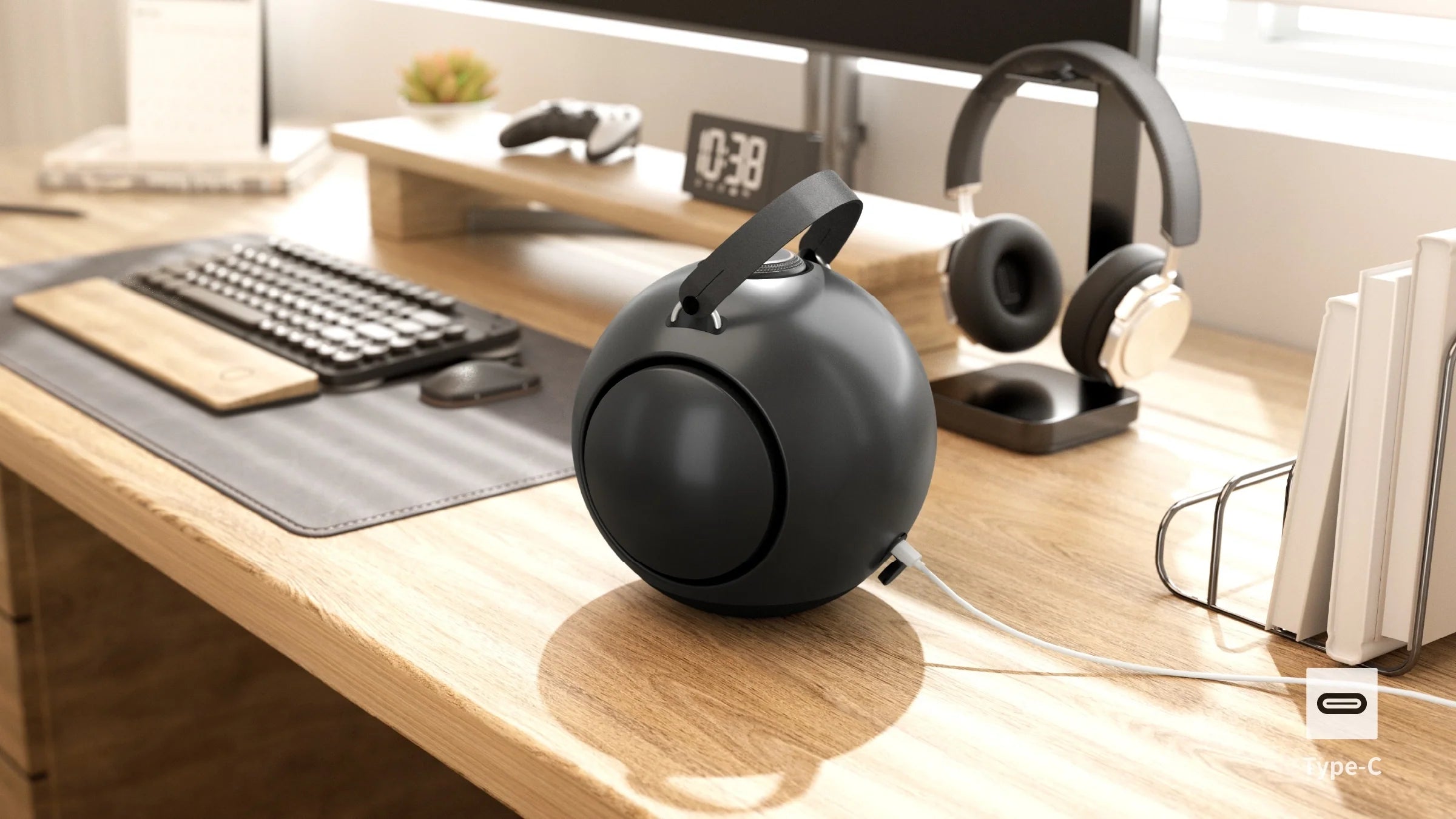
A well-engineered rechargeable bluetooth speaker can:
- remain compact
- deliver strong bass
- maintain efficiency
This creates a hybrid category:
portable speakers with near home-level performance
Space and Aesthetic Considerations
Beyond sound, shape affects how a speaker fits into your environment.
Box Speakers:
- dominate visually
- require alignment
- feel technical
Spherical Speakers:
- blend into spaces
- feel sculptural
- reduce visual clutter
This is why they are increasingly popular in modern interiors.
When Should You Choose a Box Speaker?
Box speakers still make sense when:
- you want traditional stereo setups
- you need directional sound
- you have a fixed listening position
When Should You Choose a Spherical Speaker?
Spherical speakers are ideal when you:
- want even room coverage
- move around while listening
- prefer minimal design
- value natural sound
The Myth of “Best Budget Speaker”
Many best budget bluetooth speakers focus on:
- loudness
- exaggerated bass
- marketing specs
But often compromise on:
- acoustic design
- long-term listening comfort
True value comes from:
- efficiency
- engineering
- balance
Why Shape Is the Future of Speaker Design
As technology evolves, we’re seeing a shift from:
- spec-driven design
to - physics-driven design
Spherical speakers represent:
- a return to acoustic fundamentals
- better integration between form and function
- more natural listening experiences
Final Thoughts: Does Shape Really Affect Sound?
Yes and more than most people realize.
Speaker shape influences:
- how sound waves behave
- how bass is produced
- how audio fills a space
Spherical designs offer advantages that go beyond aesthetics:
- Helmholtz-inspired acoustic chambers
- dual symmetrical passive radiators
- 3.5× air movement efficiency
- self-cancelling vibration
- 360° sound dispersion
They demonstrate that better sound doesn’t come from more power it comes from better design.
Explore a Different Approach to Sound
→ Compare dB1 vs dB Mini
→ See color options
→ Check current price
Because the next evolution of audio isn’t just about what you hear.
It’s about how sound moves and the shape that allows it to move naturally.



Leave a comment
This site is protected by hCaptcha and the hCaptcha Privacy Policy and Terms of Service apply.