
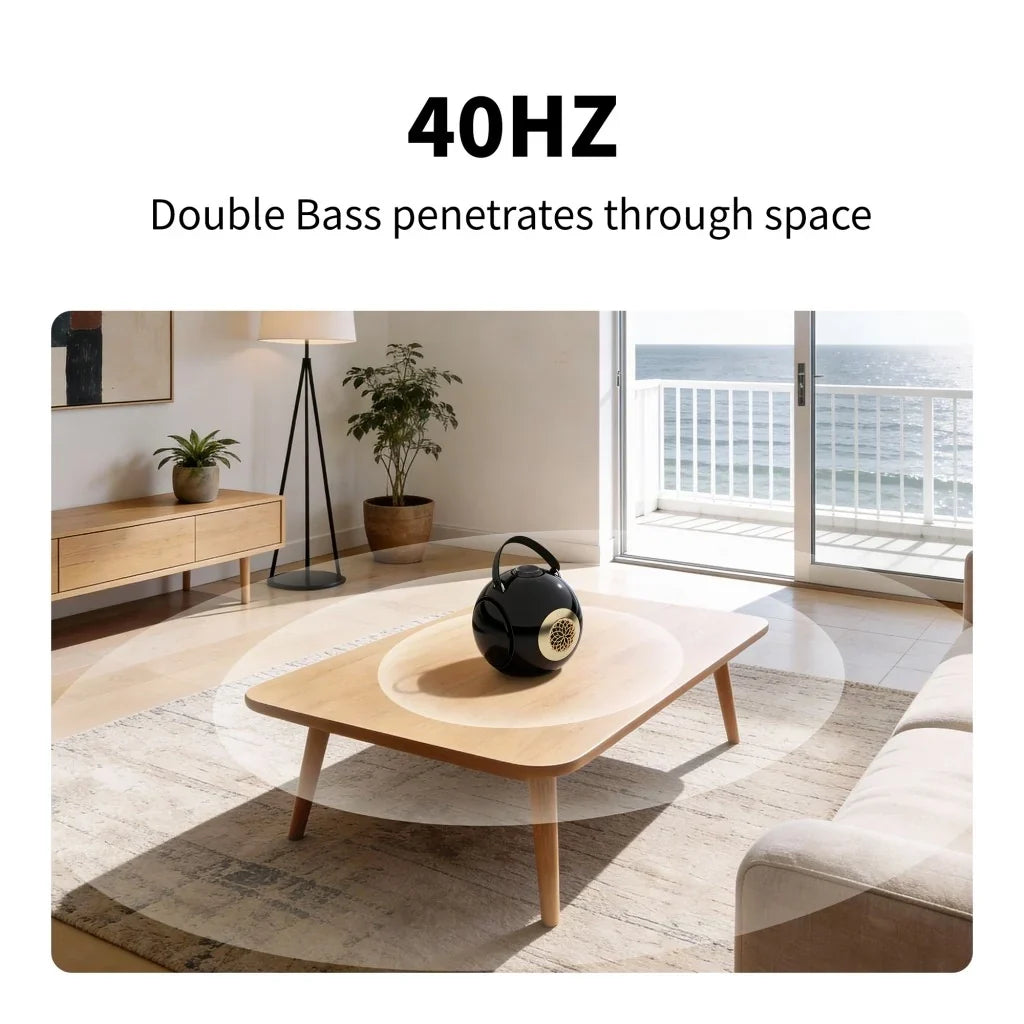
A 40Hz bass Bluetooth speaker can reproduce frequencies deep enough to add weight to kick drums, bass guitar, electronic music, and cinematic effects. However, a 40Hz specification does not automatically mean a speaker will deliver powerful, physical bass. Real bass performance depends on driver excursion, enclosure design, acoustic efficiency, amplifier power, passive-radiator tuning, and distortion control.
Two speakers may both claim a 40Hz frequency response but sound completely different. One may barely reproduce 40Hz at a low output level, while another may produce deeper, stronger, and more controlled bass at practical listening volumes.
For buyers comparing deep bass Bluetooth speakers, the important question is not simply how low a speaker can reach. It is whether the speaker can reproduce those frequencies with enough output, accuracy, and control to make the music genuinely thump.
What Does 40Hz Mean?

Frequency describes how many sound-wave cycles occur every second. A 40Hz tone completes 40 cycles per second and sits within the deep-bass region.
Human hearing is often described as extending from approximately 20Hz to 20kHz, although actual hearing varies by age, listening level, and hearing health. Frequencies around 40Hz are low enough to create a sense of weight and physical pressure, but they are still above the deepest sub-bass frequencies used in some electronic music and movie soundtracks.
A speaker capable of reaching 40Hz may reproduce:
- Low synthesizer notes
- Deep kick-drum fundamentals
- Bass guitar fundamentals
- Organ and orchestral low frequencies
- Cinematic rumble
- Electronic music sub-bass
- Greater low-end atmosphere in recordings
However, the number “40Hz” describes frequency extension—not necessarily loudness, impact, or accuracy.
Why 40Hz Bass Is Difficult for Compact Speakers

Low-frequency sound requires substantial air movement. At higher frequencies, a driver can create sound through relatively small movements repeated many times per second. At 40Hz, producing strong acoustic pressure generally requires greater diaphragm displacement or a more efficient acoustic system.
This creates several challenges for portable speakers:
- Small drivers have limited surface area.
- Compact enclosures restrict internal acoustic volume.
- Deep bass requires amplifier power.
- Driver excursion increases at lower frequencies.
- Passive radiators must be correctly tuned.
- Battery limitations can affect sustained output.
- DSP must prevent mechanical and thermal overload.
A portable speaker with powerful bass therefore needs more than a strong amplifier or a bass-heavy EQ setting. Its driver, enclosure, acoustic chamber, and control system must work together.
Bass Extension Is Not the Same as Bass Impact

Bass extension describes how low a speaker can reproduce sound. Bass impact describes how forcefully and convincingly that sound is delivered.
These are different characteristics.
A speaker may extend to 40Hz but produce very little output at that frequency. Another speaker may reach only 50Hz but generate stronger and more satisfying energy between 60Hz and 100Hz, where much of the punch of a kick drum is perceived.
|
Characteristic |
Meaning |
Listening Result |
|
Bass extension |
The lowest frequency a speaker can reproduce |
Determines how deep the speaker can reach |
|
Bass output |
How loudly the speaker produces low frequencies |
Determines whether deep bass is clearly audible |
|
Bass impact |
The physical and musical force of the low end |
Determines how strongly drums and bass lines feel |
|
Bass control |
How accurately the system manages movement and resonance |
Prevents muddy or loose bass |
|
Bass distortion |
Unwanted sound created by system limitations |
Makes low frequencies harsh, blurred, or mechanical |
The best bass Bluetooth speaker must balance all five factors. A low frequency-response number is useful, but it is not enough on its own.
Which Frequencies Make a Speaker “Thump”?
The sensation of thumping usually comes from a combination of deep bass, mid-bass, and transient energy.
|
Frequency Range |
Main Contribution |
|
20–35Hz |
Sub-bass pressure and cinematic rumble |
|
35–50Hz |
Deep bass weight and low synthesizer fundamentals |
|
50–80Hz |
Kick-drum punch and physical bass impact |
|
80–120Hz |
Warmth, fullness, and rhythmic energy |
|
120–250Hz |
Upper-bass body and tonal balance |
A speaker that reaches 40Hz may reproduce the deepest part of a kick drum, but the actual punch may depend heavily on its output between 60Hz and 100Hz.
If a speaker boosts only the upper bass, it may sound boomy rather than deep. If it reaches 40Hz but cannot produce enough output in the punch region, it may sound technically impressive but emotionally weak.
A well-designed Bluetooth speaker with good bass should provide a balanced transition between deep bass, mid-bass, and the midrange.
How to Read a 40Hz Frequency-Response Specification
A frequency-response claim should always be interpreted carefully.
For example, a speaker may be advertised as having a response of 40Hz–20kHz. That does not explain:
- Whether 40Hz is reproduced at full output
- Whether the response drops sharply at 40Hz
- Whether the measurement was taken indoors or outdoors
- Whether the result was measured at a specific volume
- Whether the response tolerance was ±3dB, ±6dB, or another value
- Whether distortion was present at the lowest frequency
A frequency range without a tolerance figure provides limited information.
Consider this comparison:
|
Speaker |
Published Response |
What the Number May Not Reveal |
|
Speaker A |
40Hz–20kHz |
40Hz may be present only at a very low level |
|
Speaker B |
40Hz–20kHz |
May provide stronger output and better control at 40Hz |
|
Speaker C |
50Hz–20kHz |
May produce more usable bass in the 60–100Hz region |
|
Speaker D |
40Hz with passive-radiator reinforcement |
May improve low-frequency efficiency through acoustic design |
This is why buyers should examine driver design, maximum output, distortion, and enclosure architecture alongside the published frequency range.
For a deeper explanation of frequency response and bass extension, see this guide to bass extension and speaker frequency response.
Driver Excursion: The Physical Foundation of Deep Bass
Driver excursion refers to the distance a speaker diaphragm moves forward and backward from its resting position.
At low frequencies, the driver often needs to move farther to create sufficient acoustic pressure. If the driver reaches its mechanical limits, the sound may become compressed or distorted.
A long-throw driver is designed to accommodate greater movement while maintaining control. However, long excursion must be supported by a properly designed motor and suspension system.
Important driver characteristics include:
- Diaphragm surface area
- Voice-coil travel
- Magnet strength
- Suspension compliance
- Motor linearity
- Thermal handling
- Diaphragm rigidity
- Excursion control
A driver with a strong magnetic motor and long-throw capability can provide greater low-frequency output, but only when the enclosure and amplifier are designed to support it.
When a driver moves beyond its linear operating range, bass may become blurred, compressed, or distorted. The speaker may also activate protection systems that reduce low-frequency output.
Why Enclosure Design Determines Bass Quality
The enclosure is an active part of a speaker’s acoustic system. It controls internal air pressure and influences how the driver interacts with the surrounding environment.
Poor enclosure design can create:
- Internal standing waves
- Unwanted resonances
- Uneven frequency response
- Excessive cabinet vibration
- Phase irregularities
- Reduced bass clarity
Traditional speaker designs commonly use sealed enclosures, ported boxes, or passive-radiator systems.
Sealed Enclosures
A sealed enclosure traps air behind the driver. This enclosed air acts as a spring and helps control diaphragm movement.
Sealed designs can provide predictable behavior and good transient control, but they may require more driver excursion and amplifier power to reproduce very low frequencies at high volume.
Ported Enclosures
A ported enclosure uses an opening or duct to reinforce a selected low-frequency range. The air inside the port interacts with the enclosure volume to create a resonant system.
Ported designs can improve efficiency around their tuning frequency, but they may also introduce airflow noise, turbulence, and reduced control below the tuning point.
Passive-Radiator Enclosures
A passive radiator is an unpowered diaphragm that responds to pressure changes inside the enclosure. It helps produce low-frequency output without requiring a long air port.
Passive-radiator systems are useful in compact speakers because they can provide bass reinforcement while avoiding some of the physical limitations of conventional ports.
Their performance depends on:
- Radiator surface area
- Radiator mass
- Suspension design
- Enclosure volume
- Tuning frequency
- Maximum excursion
- Internal pressure behavior
For a more detailed explanation, read about how passive radiators work in Bluetooth speakers.
Acoustic Spotlight: UB+ dB1 DoubleBass Engineering
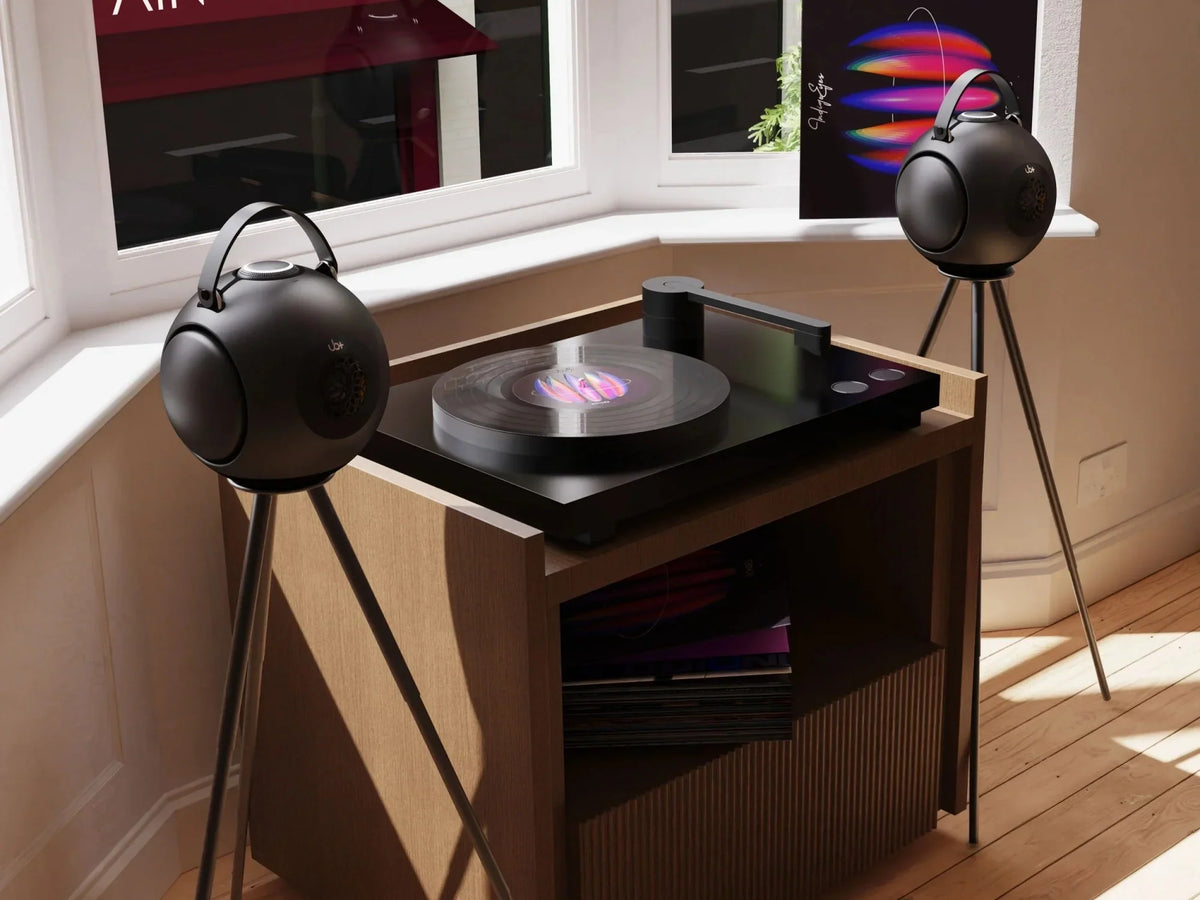
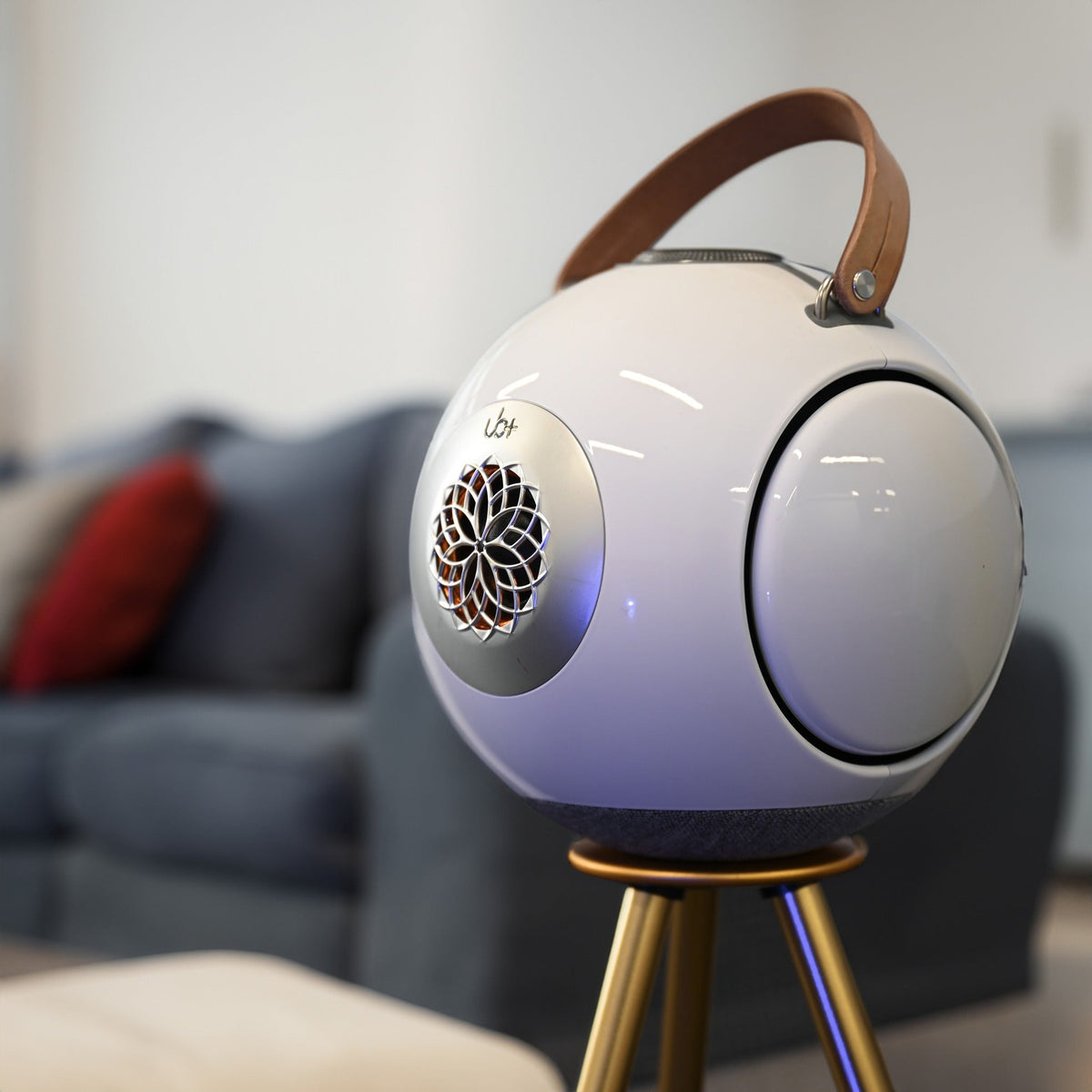
The UB+ dB1 DoubleBass approaches low-frequency reproduction through a spherical acoustic architecture rather than a conventional rectangular box.
Its acoustic chamber is inspired by the Helmholtz resonance principle. The spherical structure distributes internal air pressure more evenly and helps reduce problematic standing-wave behavior and phase irregularities within the enclosure.
A central mid-bass driver fires into the spherical chamber. Two large passive-radiator plates are positioned on opposite sides of the structure. When the driver creates pressure inside the sphere, both radiators respond symmetrically.
The combined passive-radiator surface area is approximately 3.5 times larger than the active woofer’s surface area. This provides a larger area through which the system can move air, supporting more efficient low-frequency reproduction.
The opposing radiators also contribute to a self-balancing mechanical structure. Their movement can partially cancel unwanted mechanical forces, reducing cabinet shake and helping more of the system’s energy become acoustic output.
This is different from simply applying aggressive digital bass boost. The dB1’s bass performance is based substantially on mechanical and acoustic efficiency. DSP remains important for protection, tonal balance, linearity, and driver management, but it is not expected to create deep bass that the physical system cannot produce.
You can explore the design in the UB+ dB1 DoubleBass deep-bass engineering guide.
Why Passive-Radiator Surface Area Matters
A passive radiator moves air through the movement of its diaphragm. Increasing the effective radiating area can allow the system to produce greater low-frequency output without requiring each radiator to move excessively.
This can provide several advantages:
- More efficient air displacement
- Lower excursion demands per radiator
- Greater low-frequency output potential
- Reduced mechanical stress
- Improved compact-speaker performance
- Greater flexibility in acoustic tuning
The dB1’s approximately 3.5× combined passive-radiator area is therefore an important part of its acoustic design. However, surface area alone does not guarantee performance. Radiator mass, suspension, chamber volume, and tuning must all be correctly matched.
The Role of DSP in Deep-Bass Reproduction
Digital signal processing can improve the performance of a wireless speaker, but it cannot remove the physical requirements of low-frequency reproduction.
DSP may be used to:
- Shape the frequency response
- Control driver excursion
- Prevent amplifier clipping
- Protect the voice coil
- Compensate for battery-voltage changes
- Maintain tonal balance
- Limit output during extreme conditions
- Reduce the risk of mechanical damage
However, excessive bass boosting can force a small driver to move beyond its useful range. This can increase distortion, consume amplifier headroom, reduce battery life, and activate protective limiting.
A mechanically efficient deep bass portable speaker uses DSP to refine and protect the acoustic system—not to compensate indefinitely for insufficient driver displacement or enclosure volume.
Why Bass Can Become Weaker at High Volume
A compact speaker may sound full at moderate volume but lose some bass when played loudly. This usually happens because low frequencies require significant electrical and mechanical resources.
At high volume, the system may approach:
- Amplifier voltage limits
- Amplifier current limits
- Voice-coil temperature limits
- Driver excursion limits
- Passive-radiator excursion limits
- Battery power-delivery limits
- DSP protection thresholds
When one of these limits is reached, the speaker may reduce bass output to protect itself. This behavior is called dynamic compression.
When comparing a portable speaker with deep bass, listen at the volume level where you will actually use it. A speaker that sounds impressive quietly may not maintain the same tonal balance at party volume.
Indoor and Outdoor Bass Performance
Room acoustics have a major influence on low-frequency performance.
Indoor Listening
Walls, floors, corners, and furniture can reinforce certain bass frequencies. A speaker placed near a wall or corner may sound fuller than the same speaker placed in the middle of a room.
However, rooms can also create cancellations. One listening position may have strong 40Hz output, while another position may have noticeably weaker bass.
Outdoor Listening
Outside, there are fewer surfaces to reinforce low frequencies. A speaker must generate more acoustic output without relying on room gain.
This means outdoor bass performance depends heavily on:
- Maximum SPL
- Driver efficiency
- Passive-radiator design
- Amplifier headroom
- Battery capability
- Dispersion
- Enclosure stability
A speaker that sounds deep in a small room may sound less powerful in an open garden, patio, or beach setting.
Does a Larger Speaker Always Have Better Bass?
Larger speakers often have more space for bigger drivers, larger enclosures, stronger amplifiers, and larger passive radiators. These advantages can make deep bass easier to produce.
But physical size does not guarantee quality.
A poorly designed large speaker may produce loose or uneven bass. A compact speaker with a carefully engineered acoustic chamber may offer better control and more consistent low-frequency performance.
The most important factors are:
- Driver displacement
- Enclosure volume
- Motor strength
- Radiator surface area
- Acoustic tuning
- Amplifier headroom
- DSP behavior
- Mechanical vibration control
Good engineering can make a compact enclosure more efficient without relying entirely on exaggerated EQ.
How to Evaluate a 40Hz Bass Bluetooth Speaker
Before buying, consider the following factors.
Frequency-Response Tolerance
Look for information about how accurately the speaker maintains its stated frequency range. A tolerance figure is more useful than a bare lower-frequency number.
Driver Design
Look for details about driver size, excursion, magnet strength, and voice-coil construction. These specifications provide clues about the speaker’s ability to move air.
Enclosure Architecture
Determine whether the speaker uses a sealed chamber, port, passive radiators, or another acoustic system. The enclosure directly affects bass efficiency and control.
Maximum Output
Deep bass at low volume is not the same as deep bass at high volume. Maximum SPL and compression behavior are important for practical use.
Distortion
Listen for buzzing, rattling, harshness, or a loss of bass definition. These symptoms may indicate that the system is reaching its limits.
Bass Balance
A good speaker should reproduce deep bass without overwhelming the midrange. Bass should have texture and definition rather than sounding like one continuous rumble.
Indoor and Outdoor Performance
If you plan to use the speaker outdoors, test it in an open environment. Room reinforcement can make indoor bass seem deeper than it actually is.
Battery Behavior
Some wireless speakers reduce bass as the battery level falls. This may protect the amplifier and driver, but it affects real-world performance.
40Hz Bass Versus Artificial Bass Boost
Bass boost can be useful when applied carefully. It may correct a slightly thin recording or compensate for a listening environment that absorbs certain frequencies.
The problem occurs when extreme EQ is used to create the illusion of deep bass.
Excessive bass boost can:
- Increase driver excursion
- Consume amplifier headroom
- Increase distortion
- Reduce battery life
- Trigger protective limiting
- Reduce maximum volume
- Produce an unnatural tonal balance
A better approach is to begin with an acoustically efficient design. DSP can then refine the sound while protecting the hardware.
The UB+ dB1 DoubleBass follows this principle by combining a spherical acoustic chamber, central driver, and opposing passive radiators to improve the physical movement of air.
Is 40Hz Enough for Audiophile Listening?
For many listeners, a well-designed 40Hz speaker can reproduce most of the important low-frequency content in popular music, jazz, rock, acoustic recordings, and orchestral music.
It may not deliver the deepest sub-bass with the same authority as a dedicated subwoofer or large floorstanding speaker. Nevertheless, frequency extension is only one part of audiophile-quality bass.
High-quality bass should be:
- Controlled
- Tonally accurate
- Free from obvious resonance
- Properly integrated with the midrange
- Consistent across listening levels
- Detailed enough to distinguish instruments
- Deep enough for the chosen music
A speaker with slightly less extension but better control may sound more realistic than one that produces exaggerated low-end energy.
40Hz Bass Evaluation Checklist
|
Factor |
What to Examine |
Why It Matters |
|
Lower frequency limit |
Around 40Hz or lower |
Indicates potential bass extension |
|
Response tolerance |
Published ±dB range |
Shows how consistently the speaker reaches the stated frequency |
|
Driver excursion |
Long-throw or high-displacement design |
Supports stronger low-frequency output |
|
Passive-radiator area |
Large and correctly tuned radiators |
Improves air movement efficiency |
|
Enclosure design |
Controlled internal pressure and resonance |
Reduces coloration and uneven response |
|
Maximum SPL |
Output without severe compression |
Helps maintain bass at high volume |
|
DSP behavior |
Protection and tonal correction |
Prevents excessive excursion and distortion |
|
Distortion |
Low audible distortion |
Keeps bass clean and defined |
|
Outdoor performance |
Strong output without room reinforcement |
Helps preserve bass in open spaces |
|
Mechanical stability |
Reduced cabinet vibration |
Directs more energy into sound |
Final Considerations
A 40Hz bass Bluetooth speaker can offer meaningful low-frequency depth, but its performance cannot be judged by the frequency-response number alone. Driver excursion, acoustic-chamber design, passive-radiator area, amplifier headroom, DSP behavior, and mechanical stability all influence whether the bass feels deep and convincing.
The best low-frequency systems turn frequency extension into usable acoustic output. They reproduce bass loudly enough to be heard, cleanly enough to remain defined, and accurately enough to preserve the character of the recording.
For buyers comparing deep bass Bluetooth speakers, the real question is not simply whether a speaker reaches 40Hz. It is whether the speaker has been engineered to move air efficiently and maintain control when the music demands it.
Explore UB+ Options
→ Explore the UB+ dB1 DoubleBass
→ Compare the dB1 DoubleBass with the dB Mini
→ Explore UB+ Speakers
→ Check Current Price
Because deep bass is not created by a number alone. It comes from a speaker designed to move sound naturally, efficiently, and under control.


Laisser un commentaire
Ce site est protégé par hCaptcha, et la Politique de confidentialité et les Conditions de service de hCaptcha s’appliquent.