
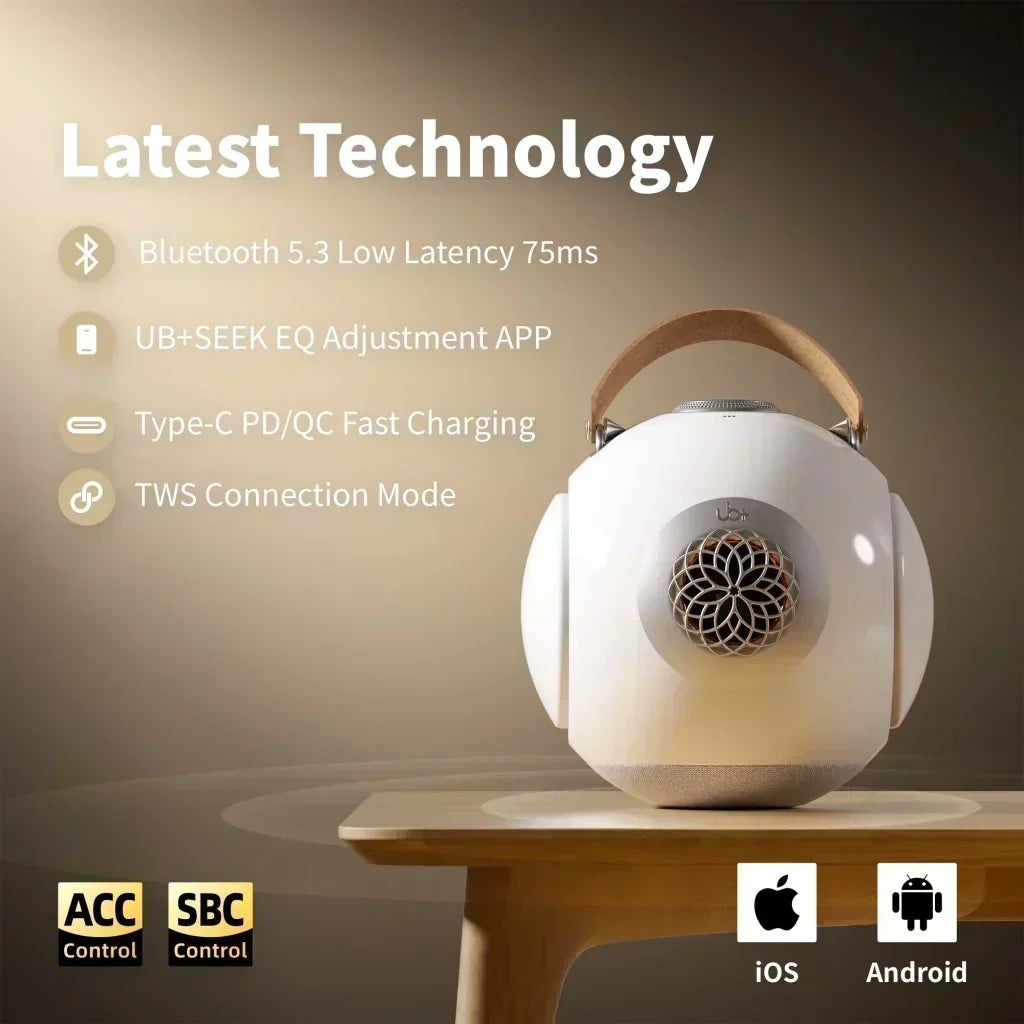
When shopping for a portable bluetooth speaker, it is easy to compare the obvious numbers: price, battery life, wattage, driver size, and advertised bass. Design often gets treated as something separate from performance—a visual upgrade rather than an engineering decision.
But a speaker can be designed to look distinctive because its shape serves an acoustic purpose.
That distinction matters when considering a designer speaker. The real question is not whether a speaker looks more sophisticated. It is whether the design improves the way the speaker moves air, controls resonance, manages vibration, distributes sound, and maintains performance over time.
The UB+ dB1 DoubleBass provides an interesting example because its spherical appearance is directly connected to its acoustic architecture. The enclosure, downward-firing mid-bass driver, dual symmetrical passive radiators, and internal air volume are designed as one system rather than as separate components.
For someone comparing a wireless bluetooth speaker, the difference between decorative design and functional design is therefore worth understanding.
What Actually Makes a Speaker a Designer Speaker?

The phrase designer speaker can mean different things.
Sometimes it simply refers to a product with a distinctive visual identity. In other cases, it describes a speaker where industrial design and acoustic engineering were developed together.
That second approach is more relevant when evaluating the dB1.
A conventional compact speaker may begin with a rectangular enclosure because it is efficient to manufacture, easy to package, and convenient to place on a shelf. The electronics and drivers are then fitted into that structure.
A design-led acoustic system can begin with a different question:
What enclosure geometry allows the acoustic system to work efficiently?
That changes the development process.
Instead of treating the cabinet as a box around the electronics, the enclosure becomes part of the acoustic system itself.
The dB1 takes this approach through a spherical chamber inspired by Helmholtz resonance principles, combined with a mechanically balanced DoubleBass system.
This is why the shape should not be evaluated separately from the sound.
For a broader look at the relationship between industrial design and audio performance, UB+'s guide to industrial design and speaker sound quality explores how physical design decisions can influence the listening experience.
Design Should Serve the Sound

A speaker can be visually impressive and still sound ordinary.
The reverse is also true: a technically capable speaker does not necessarily need a complicated appearance.
The more useful question is whether the visual form reflects a functional acoustic decision.
The dB1's spherical enclosure is an example.
A rectangular cabinet contains parallel internal surfaces. These surfaces can create reflections and standing-wave behavior inside the enclosure. Designers can manage those effects through damping, driver placement, internal construction, and electronic processing.
A spherical enclosure changes the geometry of the internal volume.
Instead of relying on parallel walls, the curved chamber provides a continuous acoustic surface. The objective is more even internal pressure distribution and more predictable resonance behavior.
That matters particularly for low frequencies because bass depends heavily on air movement and enclosure volume.
The speaker is therefore not simply round because round looks different.
The geometry is part of the acoustic strategy.
Why the Spherical Enclosure Matters

The dB1's Helmholtz-inspired spherical chamber is one of the central ideas behind its design.
Helmholtz resonance describes the behavior of air moving within a resonant cavity. Speaker designers have long used related acoustic principles to help manage low-frequency response.
The dB1 applies that thinking through its spherical internal volume.
The intended benefits include:
- More even internal pressure distribution
- Reduced problematic internal reflections
- Controlled resonance
- Better integration between the driver and enclosure
- A physical acoustic structure that contributes to low-frequency reproduction
The important point is that the enclosure is doing acoustic work.
This differs from treating the cabinet as a passive container and relying primarily on electronic processing to create the desired tonal effect.
For readers interested specifically in how spherical geometry changes speaker behavior, UB+'s existing article on spherical vs. box speakers and sound comparison provides additional context.
The DoubleBass System: Why Symmetry Matters
The most distinctive part of the dB1 is not the sphere alone.
It is the way the spherical chamber works with the DoubleBass system.
Inside the dB1, a centrally positioned mid-bass driver fires downward into the spherical acoustic chamber. Rather than directing all of its energy immediately toward the listener, the driver energizes the internal air volume.
That pressure then drives two large passive radiator plates positioned symmetrically on opposite sides of the enclosure.
The sequence is essentially:
Driver movement → internal air pressure → passive radiator movement → acoustic output
The two radiators move in symmetrical opposition.
That symmetry matters mechanically.
When a passive radiator moves, it creates a reaction force. With two radiators operating symmetrically, those forces can counterbalance one another. This helps reduce unwanted cabinet movement and allows more of the system's energy to be converted into acoustic output.
This is one reason the DoubleBass concept is about more than simply adding passive radiators.
It is about how those components interact mechanically.
UB+'s existing article on how passive radiators work in Bluetooth speakers covers the underlying principle in more detail.
Why Passive Radiator Surface Area Matters
The dB1's combined passive-radiator surface area is approximately 3.5 times the area of the active woofer.
That larger moving surface gives the system a way to displace substantial amounts of air without requiring the active driver to perform all of the low-frequency work by itself.
This is particularly relevant in a compact speaker.
Small enclosures have physical limitations. You cannot simply shrink a large conventional speaker and expect identical bass behavior.
Engineers therefore use different methods to extend low-frequency response, including:
- Ports
- Passive radiators
- Acoustic chambers
- DSP
- Larger driver excursion
- Specialized enclosure geometry
The dB1 combines several of these principles but places substantial emphasis on mechanical acoustic design.
The result is intended to produce bass that feels full and controlled rather than simply boosted.
That distinction is important for long listening sessions.
Sound Quality Is About More Than Wattage
Wattage is one of the easiest specifications to compare because it is expressed as a single number.
But it does not tell you how a speaker actually sounds.
Two speakers with similar power specifications can behave differently because their:
- Drivers are different
- Enclosures are different
- Resonance characteristics are different
- Passive-radiator systems are different
- Dispersion patterns are different
- Digital processing is different
- Mechanical stability is different
This is why a designer speaker should not be evaluated solely by comparing numbers on a product page.
The interaction between components is more important.
The dB1's acoustic system combines a 4.5-inch mid-bass driver, a 90 mm neodymium magnet, long-stroke motor construction, and a spherical chamber. These components are intended to work together rather than function as isolated specifications.
For a more general framework, UB+'s speaker specifications guide explains why individual specifications need to be interpreted as part of the overall speaker system.
The Driver Is Still the Engine
Enclosure design is important, but it cannot compensate for an unsuitable driver.
The dB1 uses a high-excursion mid-bass driver designed to work with the internal acoustic chamber.
Its construction includes:
- A 90 mm neodymium magnet
- A 35 mm long-stroke voice coil
- Extended piston movement
- An aluminum shorting ring
- A wide surround supporting controlled movement
These features are intended to help the driver maintain controlled excursion while producing substantial low-frequency energy.
That matters because a compact speaker can easily become strained when asked to reproduce bass at higher output levels.
If the driver loses control, distortion increases and the resulting sound can become muddy or harsh.
The objective of the dB1 architecture is therefore not simply to make the driver move more.
It is to make the entire acoustic system share the workload.
Mechanical Design Can Affect Listening Comfort
Listening fatigue is often discussed as a tonal issue, but mechanical behavior also matters.
A speaker that relies heavily on aggressive bass enhancement can sound exciting for short demonstrations. Over longer sessions, however, excessive low-frequency emphasis or harsh upper-frequency energy can become tiring.
Controlled bass is different.
When low frequencies remain integrated with the midrange, vocals and instruments can retain their separation instead of becoming buried under excessive energy.
The dB1's spherical chamber and DoubleBass system are designed around that principle.
The aim is not to create bass simply because bass attracts attention.
The aim is to create a low-frequency foundation that supports the rest of the music.
That approach becomes particularly relevant for people who listen for several hours at a time.
Designer Speaker vs. Conventional Portable Speaker
The differences become clearer when the two approaches are viewed side by side.
|
Feature |
Conventional Portable Speaker |
UB+ dB1 DoubleBass |
|
Enclosure |
Typically rectangular |
Spherical acoustic chamber |
|
Internal geometry |
Parallel surfaces are common |
Curved spherical volume |
|
Bass approach |
May combine ports, passive radiators, and DSP |
Helmholtz-inspired chamber with DoubleBass passive radiators |
|
Driver position |
Often forward-facing |
Downward-firing into internal chamber |
|
Passive radiators |
May use one or more |
Dual symmetrical radiators |
|
Radiator surface area |
Varies |
Approximately 3.5× active woofer area combined |
|
Mechanical behavior |
Depends on cabinet and driver design |
Symmetrical radiator movement helps counterbalance forces |
|
Dispersion |
Often directional |
360° spherical dispersion |
|
Design philosophy |
Compactness and manufacturing efficiency often prioritized |
Acoustic architecture and industrial design developed together |
|
Portability |
Common |
Rechargeable wireless design |
|
Water resistance |
Varies by model |
IPX5 |
The table is not meant to suggest that every conventional portable speaker uses the same architecture. Portable speakers vary considerably.
The useful distinction is that the dB1 makes its acoustic geometry part of its identity.
Does a Designer Speaker Last Longer?
This is where the word longevity needs some care.
A premium or designer appearance does not automatically mean a product will last longer.
Actual longevity depends on factors such as:
- Component quality
- Battery chemistry and management
- Driver construction
- Mechanical stress
- Enclosure materials
- Environmental exposure
- Usage patterns
- Repairability and support
What thoughtful acoustic engineering can do is reduce unnecessary mechanical stress during operation.
The dB1's symmetrical passive-radiator arrangement is designed to reduce unwanted enclosure vibration. Its spherical structure also provides a rigid geometric form, while the driver is designed for controlled excursion.
These are engineering decisions that support consistent operation.
But no speaker is immune to battery aging, physical damage, moisture beyond its rated protection, or normal component wear.
A realistic discussion of longevity should acknowledge those factors rather than treating "designer" as a guarantee of years of performance.
Battery Performance Is Part of the Ownership Experience
For a wireless speaker, the battery is just as relevant to long-term usability as the acoustic system.
A speaker may sound excellent when fully charged but become less satisfying if output changes substantially as the battery level drops.
Consistent power management therefore matters.
The dB1 is designed as a rechargeable wireless speaker for flexible listening rather than as a permanently installed system.
That allows it to move between:
- Living rooms
- Bedrooms
- Home offices
- Outdoor spaces
- Travel environments
- Shared entertainment areas
The value of that flexibility is easy to overlook when comparing speakers only by sound quality.
A speaker that can move with you can serve multiple roles instead of becoming tied to one location.
A Designer Speaker Has to Work in the Room
One of the strongest arguments for thoughtful physical design is that speakers exist in real spaces.
The same speaker can behave differently in:
- A small bedroom
- A large living room
- A home office
- An open-plan apartment
- A covered outdoor area
Room boundaries affect bass. Furniture affects reflections. Listener position affects perceived balance.
A spherical speaker can provide an advantage when listeners are not sitting in one precise location because the system is designed around broad dispersion rather than a single forward-facing axis.
That does not eliminate room acoustics.
It simply gives the speaker a different relationship with the room.
For more practical information, UB+'s guide to room acoustics and why speakers sound different in different spaces explains why placement and room geometry remain important even with a well-designed speaker.
Designer Speakers and Minimalist Interiors
There is another reason people choose designer audio products: the speaker has to coexist with the space around it.
Traditional audio equipment can be visually dominant.
That is not necessarily a problem, especially in a dedicated listening room. But many modern homes use audio equipment in shared spaces where furniture, lighting, technology, and décor need to work together.
The dB1's spherical form takes a different visual approach.
Rather than resembling a conventional rectangular electronics box, it becomes an object within the room.
That can be useful for:
- Minimalist interiors
- Modern living rooms
- Home offices
- Bedrooms
- Creative studios
- Design-conscious spaces
The important point is that the visual design does not exist independently from the acoustics.
The same spherical geometry that gives the dB1 its distinctive appearance is also central to its acoustic architecture.
Portability Changes What a Designer Speaker Can Do
A traditional premium speaker may be designed for one permanent listening position.
A portable designer speaker has a different advantage: it can move.
The dB1 combines its acoustic architecture with rechargeable wireless operation, allowing the same speaker to become part of different listening environments.
Use it at a desk during the day.
Move it to the living room for music.
Take it outside for an appropriate gathering.
Use it for a movie night.
That flexibility changes the value calculation.
You are not paying only for a visual object. You are considering how many different listening situations one acoustic system can serve.
Designer Does Not Automatically Mean Better
This is an important distinction.
Not every designer speaker is acoustically superior to every conventional speaker.
A distinctive shape does not guarantee good sound.
A high price does not guarantee good engineering.
A premium material does not automatically produce better bass.
When evaluating a designer speaker, look for evidence of functional design:
Does the enclosure geometry serve an acoustic purpose?
Is the driver appropriate for the enclosure?
How is bass generated?
How is vibration controlled?
How widely does the speaker disperse sound?
What happens at higher listening levels?
How does the speaker behave across different rooms?
These questions are much more useful than simply asking whether the speaker looks expensive.
Where the dB1 Fits
The dB1 is designed around the idea that industrial design and acoustic engineering should not be separated.
Its defining elements work together:
Spherical chamber: provides the acoustic volume and geometry.
Downward-firing mid-bass driver: energizes the internal chamber.
Dual symmetrical passive radiators: convert internal pressure into low-frequency acoustic output while balancing mechanical forces.
3.5× combined radiator surface area: provides substantial moving surface for bass reproduction.
360° dispersion: allows the speaker to distribute sound broadly around the enclosure.
Rechargeable wireless operation: allows the system to move between environments.
That combination makes the dB1 different from a speaker where the visual design is simply applied to a conventional internal architecture.
When Is a Designer Speaker Worth Considering?
A designer speaker becomes more relevant when you care about several things at the same time.
You Want Sound and Appearance to Work Together
If the speaker will remain visible in your living space, design becomes part of the ownership experience.
You Listen for Long Periods
Controlled tonal balance and mechanical stability can matter more than short-term loudness.
You Want Stronger Bass Without a Separate Subwoofer
A properly designed passive-radiator and acoustic-chamber system can provide substantial low-frequency support from a compact enclosure.
You Move the Speaker Between Spaces
A rechargeable wireless design provides flexibility that fixed speakers cannot.
You Care About Acoustic Architecture
If you enjoy understanding why a speaker sounds the way it does, a physics-driven design offers more to evaluate than a simple feature list.
Frequently Asked Questions
Are designer speakers actually better sounding?
Not automatically. "Designer" describes an approach to product design, not a guarantee of sound quality. What matters is whether the enclosure, driver, acoustic system, amplification, and tuning work effectively together. The dB1's designer form is closely connected to its spherical acoustic chamber and DoubleBass architecture.
What makes the UB+ dB1 different from a regular portable Bluetooth speaker?
The dB1 combines a spherical acoustic chamber, downward-firing mid-bass driver, and dual symmetrical passive radiators. Its combined passive-radiator surface area is approximately 3.5 times the active woofer area. The enclosure and mechanical system are designed to work together rather than relying only on electronic bass enhancement.
Does the spherical shape improve speaker sound?
Shape alone does not guarantee better sound. In the dB1, however, the spherical geometry is part of the acoustic design. The curved internal volume avoids the parallel internal walls found in conventional rectangular cabinets and is intended to support more even pressure distribution and controlled resonance.
Is a designer speaker worth the higher price?
That depends on what you value. If your priorities are simply basic wireless playback at the lowest possible cost, a conventional portable speaker may meet your needs. If you value acoustic engineering, distinctive industrial design, portability, controlled bass, and a speaker that can function as part of the room's design, a designer model may offer additional value.
Can the dB1 replace a home stereo system?
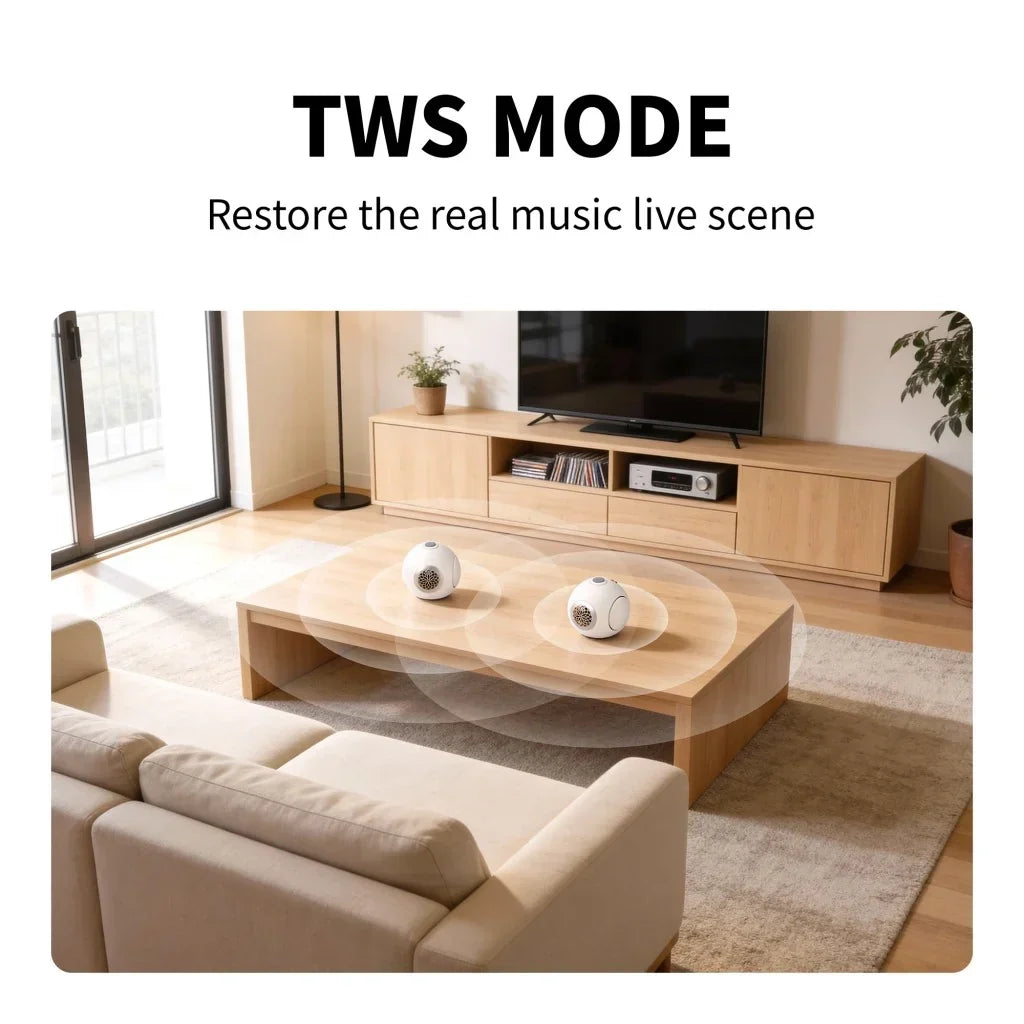
The dB1 can serve as a compact wireless listening system, but it does not provide the same stereo separation as two dedicated left-and-right speakers or the discrete channels of a multi-speaker home theater. Its 360° dispersion and compact design instead focus on broad, flexible listening from a single enclosure.
Is a designer speaker suitable for outdoor use?
The dB1 is designed for flexible indoor and outdoor use and has an IPX5 rating for water resistance. Outdoor use still requires sensible placement and protection from conditions beyond the product's rating. Its rechargeable design also makes it practical to move between indoor spaces and suitable outdoor environments.
Final Thoughts: Is a Designer Speaker Worth It?
A designer speaker is worth evaluating for more than its appearance.
The meaningful difference comes when design, acoustics, materials, mechanical behavior, and usability are developed as one system.
The UB+ dB1 DoubleBass demonstrates that approach through its spherical Helmholtz-inspired acoustic chamber, downward-firing mid-bass driver, dual symmetrical passive radiators, and broad 360° dispersion.
The result is a speaker designed around a simple principle: the physical structure should contribute to the sound rather than simply contain the electronics.
That does not mean every listener needs a designer speaker. Different listeners have different priorities, spaces, budgets, and listening habits.
But if you want a speaker that combines acoustic engineering, distinctive industrial design, portability, and long-session listening, the dB1 presents a clear example of what that category can mean when the design is functional rather than purely decorative.
Ready to Explore the dB1 DoubleBass?
→ Compare dB1 vs dB Mini
→ See color options
→ Check current price
A well-designed speaker should not force you to choose between how your audio sounds and how the product belongs in your space. The strongest designs make those two things part of the same idea.



Laisser un commentaire
Ce site est protégé par hCaptcha, et la Politique de confidentialité et les Conditions de service de hCaptcha s’appliquent.