
Choosing a speaker should be straightforward. Yet comparing modern audio products can quickly become confusing when manufacturers emphasize wattage, driver size, frequency range, bass enhancement, and wireless technology without explaining what those specifications actually mean. A longer specification sheet does not necessarily indicate a better speaker, and the biggest numbers rarely tell the whole story.
So, what makes a good speaker? The answer depends on how effectively its components work together. Frequency response, driver construction, acoustic loading, passive radiators, sound pressure level, wireless connectivity, battery performance, and enclosure geometry all influence the final listening experience. A weakness in one area can limit the benefits of another, even when the individual specifications look impressive.
Two Bluetooth speakers can advertise similar frequency ranges and power ratings but produce noticeably different sound. One may deliver controlled bass, clear vocals, and consistent output, while the other sounds boomy, compressed, or harsh at higher volume. The difference often comes from the engineering behind the numbers: driver motor strength, diaphragm excursion, enclosure resonance, acoustic impedance, damping, amplifier behavior, and the integration of every component.
This guide examines seven important speaker specifications, explains what they reveal, and shows why evaluating the complete acoustic system is more useful than comparing isolated figures. It also looks at how different UB+ speaker designs address portability, bass reproduction, sound distribution, and extended listening.
Frequency Response: Understanding the Full Sound Range

Frequency response describes the range of frequencies a speaker can reproduce, usually measured in hertz (Hz). Low frequencies represent bass, the middle frequencies contain much of the information in vocals and instruments, and high frequencies contribute detail, brightness, and treble.
A specification such as 40Hz–20kHz indicates the stated operating range, but it does not tell you whether the speaker reproduces every frequency at the same level.
That distinction matters.
A speaker might reach a low bass frequency but produce very little usable output there. Another might have a narrower published range but deliver a more balanced and consistent response across its operating bandwidth. Without measurement conditions and a frequency-response tolerance, the endpoints alone cannot establish which speaker sounds better.
When comparing frequency response, consider:
- Low-frequency extension: How effectively the speaker reproduces bass rather than simply listing a low frequency.
- Midrange balance: Whether vocals, guitars, piano, and other instruments sound natural.
- Treble control: Whether high frequencies remain detailed without becoming sharp or fatiguing.
- Response consistency: Whether the transition between bass, midrange, and treble sounds coherent.
- Listening level: Whether tonal balance changes significantly as volume increases.
- Off-axis response: Whether the sound remains reasonably consistent when listeners move away from the speaker's primary listening position.
Frequency response is also affected by the listening environment. Room modes, boundary reinforcement, speaker placement, and reflective surfaces can change the perceived bass and tonal balance. A specification measured under controlled conditions cannot fully predict how a speaker will sound in every room.
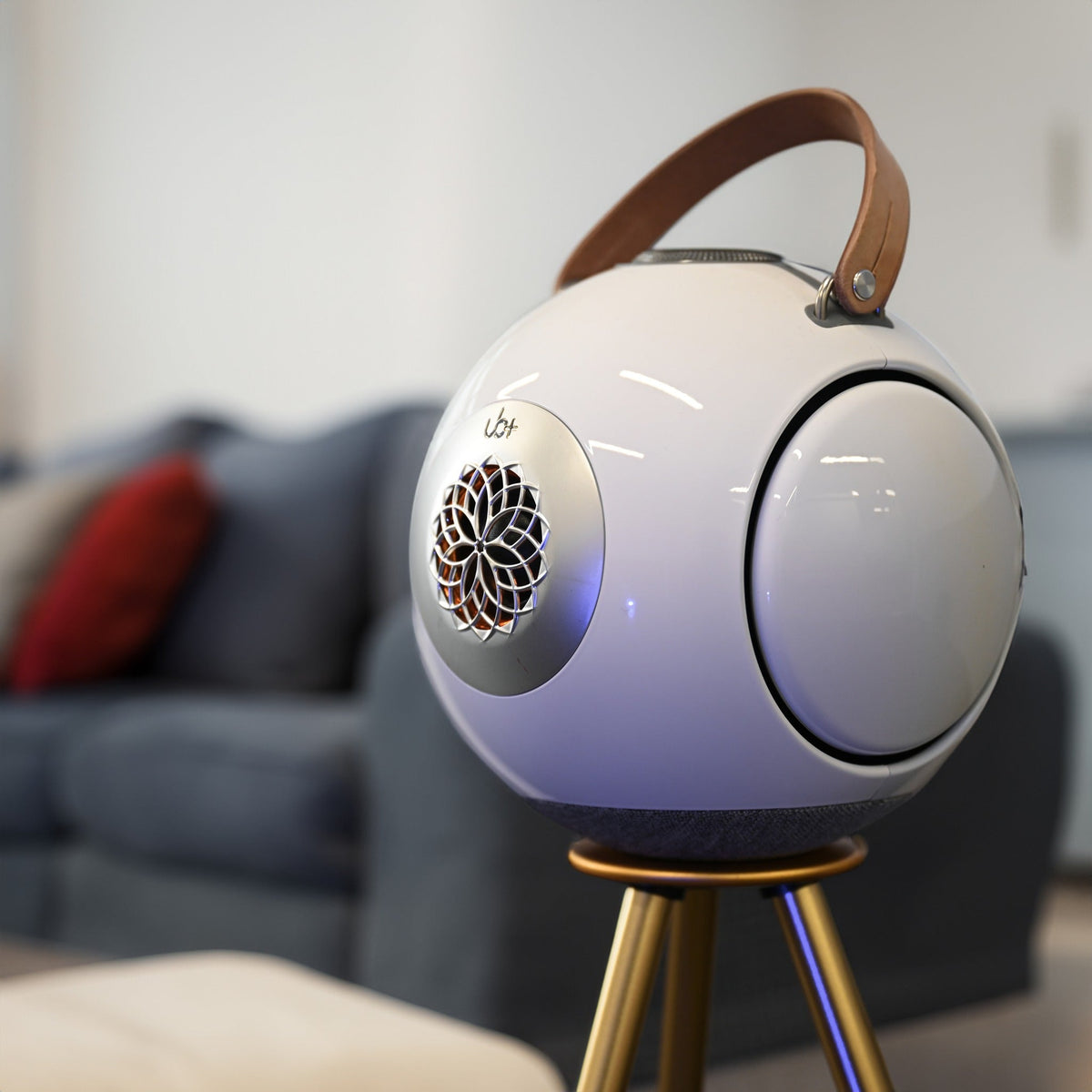
The UB+ dB1 DoubleBass is specified at approximately 40Hz–20kHz. That range is supported by a dedicated acoustic system rather than a frequency-range number alone. Its spherical chamber, active driver, and passive radiators work together to manage low-frequency output.
The important point is that frequency response should be evaluated alongside the design responsible for producing it.
For a more detailed explanation, read Bass Extension Explained: Understanding Hz in Speaker Performance.
Driver Design: More Than Diameter and Driver Count

A speaker driver converts an electrical audio signal into physical movement, displacing air to produce sound. Its construction has a direct influence on frequency response, output capability, distortion, and overall performance.
Driver diameter is one useful specification, but it is not a complete measure of quality. A larger driver does not automatically produce better sound, and adding more drivers does not guarantee greater clarity or stronger bass.
Several mechanical and electrical characteristics deserve attention:
- Motor strength: The magnetic motor controls the force applied to the voice coil and diaphragm.
- Voice coil design: Coil dimensions, thermal capacity, and construction influence how the driver handles power.
- Excursion: The distance the diaphragm can move affects its ability to displace air, particularly at low frequencies.
- Suspension: The surround and other suspension components help control movement and maintain stability.
- Thermal behavior: Heat management affects how consistently the driver performs during extended listening.
- Acoustic loading: The enclosure changes how the driver behaves, particularly at lower frequencies.
- Electrical impedance: The driver's impedance affects the load presented to the amplifier and should be considered when evaluating system compatibility.
A useful concept here is volume displacement. A driver moves air through the combination of its effective diaphragm area and excursion. This helps explain why a compact speaker may need substantial mechanical movement, carefully designed acoustic loading, or additional radiating surfaces to produce meaningful low-frequency output.
The dB1 illustrates why these elements should be considered together. It uses a 4.5-inch long-throw mid-bass driver with a 90mm neodymium magnet, a 35mm long-stroke voice coil, approximately 20mm of piston movement, an aluminum shorting ring, and a wide surround.
These components serve different mechanical purposes. The motor provides magnetic force, the voice coil converts electrical energy into movement, and the suspension helps control the diaphragm throughout its operating range. The aluminum shorting ring is part of the motor design and can help manage certain forms of electromagnetic distortion.
The driver also works into the speaker's internal spherical acoustic chamber. Rather than treating the driver as an isolated component, the design uses the internal air volume as part of the overall bass-producing system.
This relationship between driver mechanics and enclosure architecture is more informative than comparing driver diameter alone.
For additional background, see What Makes a Speaker Premium? The Materials Behind the Sound.
Passive Radiators: Producing Low Frequencies in a Compact Enclosure

Passive radiators are commonly used in compact speaker systems to support low-frequency output without requiring a conventional bass-reflex port.
An active driver receives an electrical signal and moves in response. A passive radiator does not have its own powered voice coil. Instead, it responds to pressure changes inside the enclosure, moving as the active driver compresses and releases the internal air.
This movement contributes acoustic output around the system's tuning region. The result depends on the radiator's mass, suspension, surface area, enclosure volume, and interaction with the active driver.
The principle is related to the mass-air resonance of the enclosure. The internal air behaves partly like a spring, while the passive radiator contributes moving mass. Together, these elements form a resonant system that can support output around a selected low-frequency region.
A passive radiator is not automatically an upgrade over a port. Both approaches have advantages and limitations, and the quality of implementation determines their effectiveness.
A well-designed passive-radiator system can be particularly useful when a compact enclosure needs meaningful bass extension but cannot accommodate a sufficiently large port. It also avoids some port-related airflow noise, although the radiator itself must still be controlled to prevent unwanted mechanical noise or excessive movement.
The dB1 uses two passive-radiator plates positioned symmetrically on opposite sides of its spherical enclosure. Their combined surface area is approximately 3.5 times the active woofer's area.
This large radiating area allows the internal pressure generated by the active driver to engage both radiators. Their opposing arrangement is also intended to balance certain mechanical forces, helping reduce unwanted enclosure movement.
The architecture matters because the radiators are not simply added to an existing cabinet. They are integrated into a system built around the relationship between the driver, internal air volume, and enclosure geometry.
The result is a mechanical approach to bass reproduction. The active driver energizes the chamber, and the passive radiators respond to the resulting pressure changes. DSP still has a role in response shaping, tonal balance, and driver protection, but it does not replace the physical work performed by the acoustic system.
For a deeper technical explanation, read How Passive Radiators Work in Bluetooth Speakers.
Sound Pressure Level (SPL): Loudness Is Not the Same as Quality
Sound Pressure Level, or SPL, measures acoustic pressure and is expressed in decibels (dB). It provides information about how much sound a speaker can produce under specified measurement conditions.
SPL is useful when comparing output capability, but it should never be treated as a standalone sound-quality score.
A speaker might produce a high sound-pressure level while introducing distortion, compressing musical dynamics, or losing tonal balance. Another may deliver a lower maximum output but maintain cleaner reproduction across its practical listening range.
The more useful question is not simply how loud a speaker can become. It is how well it maintains control as output increases.
Several factors influence this:
- Driver excursion and mechanical limits.
- Amplifier power and thermal management.
- Enclosure rigidity and resonance behavior.
- Distortion and compression at higher output.
- Frequency-dependent output capability.
- Measurement distance, environment, and test conditions.
- Directivity and how sound is distributed around the listening area.
Two common terms are worth understanding. Total harmonic distortion (THD) describes unwanted harmonic content added to the original signal. Dynamic compression describes a reduction in output changes as the system approaches its operating limits. Both can affect how a speaker sounds when pushed harder.
The dB1 is specified at approximately 93dB SPL. This figure provides an indication of its output capability, but it should be interpreted with the measurement conditions in mind. A maximum SPL figure without a stated distance, weighting, test signal, and distortion threshold is not a complete performance comparison.
It is also important to distinguish between maximum output and sustained listening performance. A speaker that briefly reaches a particular level may not maintain that output cleanly over an extended period.
For more information, read How Loud Should a Speaker Be? Understanding the SPL Guide.
Bluetooth and Codec Support: Evaluate the Entire Signal Chain
Bluetooth specifications tell you how a speaker connects wirelessly to a compatible device. Bluetooth versions introduce changes to the underlying wireless technology, while supported audio codecs determine how digital audio is encoded for transmission.
However, the wireless connection is only one part of the audio signal chain.
A speaker with a newer Bluetooth version does not automatically sound better than one with an older version. The source recording, codec support, device compatibility, digital processing, amplification, drivers, and acoustic design all contribute to the result.
When evaluating wireless specifications, look at:
- Bluetooth version: Indicates the generation of the wireless connection technology, but does not independently determine audio fidelity.
- Codec compatibility: Determines which supported encoding formats can be used between the source and speaker.
- Connection stability: A reliable connection helps avoid interruptions and dropouts.
- Latency: Relevant when watching video, gaming, or using applications where audio and visual timing need to remain synchronized.
- Playback options: Wired inputs and memory-card playback can provide alternatives to wireless streaming.
- Device compatibility: The source device and speaker need to support a compatible transmission format for the intended connection.
Codec support deserves particular attention. A codec is responsible for encoding and decoding audio during wireless transmission. Different codecs have different approaches to compression, bitrate, latency, and compatibility. However, codec names should not be treated as direct rankings of speaker quality.
The UB+ dB1 uses Bluetooth 5.3. It also supports wired and TF-card playback, giving listeners more than one way to access audio content.
For buyers, the practical lesson is to treat wireless connectivity as a compatibility and convenience specification. It matters, but it cannot compensate for an inefficient driver, poorly controlled enclosure, or badly integrated acoustic system.
For a closer look at wireless generations, see Bluetooth 4.2 vs. 5.0 vs. 5.3: What Actually Changes?.
Battery Performance: Understanding Real-World Playback
Battery life is an important consideration when choosing a portable Bluetooth speaker. However, maximum advertised playback time does not necessarily represent the operating time every listener will experience.
Volume level, audio content, wireless activity, battery condition, and operating environment can all affect runtime. Bass-heavy music played at high volume generally places different demands on a portable audio system than low-volume background playback.
There is also a difference between battery capacity and power management.
A well-engineered portable speaker needs to manage available energy while maintaining stable operation. Amplification, driver efficiency, signal processing, and thermal behavior all influence how the available battery power is used.
A battery management system also plays a role in monitoring battery conditions and protecting the cells. Power regulation helps the electronics operate within their intended voltage range, while amplifier efficiency influences how much battery energy is converted into usable audio output.
When comparing battery performance, consider:
- Maximum playback time: A useful starting point, provided the manufacturer explains the test conditions.
- Listening volume: Higher output generally increases power consumption.
- Charging requirements: Consider how long the speaker takes to recharge and whether its charging connection suits your routine.
- Usage pattern: Occasional background listening and extended high-volume playback create different demands.
- Portability: Battery life matters most when the speaker will regularly operate away from a power source.
- Power efficiency: Amplifier and driver efficiency affect how effectively stored energy is used.
The UB+ dB1 DoubleBass offers up to 20 hours of playback. Its actual runtime depends on listening volume, content, connectivity, and operating conditions.
Other UB+ models provide different playback targets depending on their intended use:
- UB+ E2 Solace: Up to 30 hours of playback.
- UB+ dB Mini: Up to 20 hours of playback.
- UB+ S1 Circle: Up to 16 hours of playback.
- UB+ S2 Alphorn: Up to 16 hours of playback.
These figures provide useful reference points, but they should not be interpreted as guaranteed runtimes under every listening condition. The right model depends on how often you travel, where you listen, and how much portability matters in your daily routine.
Battery performance is therefore best evaluated alongside portability, acoustic output, and the way you intend to use the speaker.
Enclosure Design: The Acoustic Specification Buyers Often Overlook
The enclosure is one of the most important parts of a loudspeaker, yet it receives less attention than driver size, wattage, or battery capacity.
A speaker cabinet does much more than protect the electronics. Its internal volume, shape, rigidity, and acoustic loading influence air pressure, resonance, internal reflections, and the mechanical behavior of the driver.
Traditional rectangular enclosures contain parallel internal surfaces. These surfaces can contribute to standing-wave patterns and internal reflections. Designers manage these effects through internal damping, bracing, cabinet shaping, and other acoustic techniques.
The shape of an enclosure does not determine sound quality by itself, but it influences the engineering challenges a designer must solve.
The UB+ dB1 takes a different approach with a spherical acoustic chamber inspired by the Helmholtz resonator principle associated with physicist Hermann von Helmholtz.
A Helmholtz resonator uses an enclosed air volume and an opening to create a frequency-dependent resonance. In the dB1, the spherical chamber forms part of the acoustic architecture, with internal air pressure interacting with the active driver and passive radiators.
The spherical geometry also avoids the conventional parallel-wall arrangement found in rectangular cabinets. This changes the pattern of internal reflections and standing-wave behavior that the design must manage. It does not eliminate every internal resonance, but it provides a different acoustic environment from a typical box enclosure.
Several related acoustic concepts help explain why this matters:
- Internal resonance: Air inside an enclosure can resonate at particular frequencies, influencing the speaker's response.
- Standing waves: Reflected sound waves can interact and create areas of reinforcement or cancellation.
- Acoustic damping: Materials and structural design can reduce unwanted resonant behavior.
- Cabinet vibration: Mechanical energy can cause enclosure panels or surfaces to move, potentially adding unwanted sound.
- Acoustic impedance: The enclosure and its openings influence how the driver transfers energy into the surrounding air.
The chamber is therefore not just an exterior styling choice. It participates in the speaker's low-frequency operation.
This distinction is important when comparing compact speakers. Two products may use similar driver diameters but behave differently because their enclosures create different acoustic loading conditions.
For a broader look at this design approach, read Spherical Bluetooth Speaker Design: The DoubleBass Approach.
Why These Seven Specifications Must Be Evaluated Together
The most common mistake when comparing speaker specification sheets is treating each number as an independent performance score.
In reality, loudspeaker performance is a connected system. A specification becomes meaningful when you understand how it relates to the other components.
Consider the relationships:
- Frequency response depends on driver capability, enclosure loading, acoustic tuning, and signal processing.
- Driver performance depends on motor strength, excursion, suspension, thermal behavior, and the acoustic environment.
- Passive radiators depend on enclosure volume, radiator mass, surface area, and system tuning.
- SPL depends on the driver, amplifier, enclosure, thermal limits, and distortion behavior.
- Bluetooth performance depends on the source device, wireless connection, supported codecs, and signal processing.
- Battery runtime depends on power consumption, listening level, battery capacity, and operating conditions.
- Enclosure geometry influences internal pressure, reflections, resonance, and mechanical behavior.
Consider a compact speaker with a small active driver. Its ability to reproduce low frequencies may depend heavily on excursion and acoustic loading. If the enclosure is poorly matched to the driver, adding amplifier power may increase distortion or compression rather than produce useful bass.
The same principle applies to high-frequency reproduction. A tweeter or full-range driver needs to work within its mechanical limits, and its integration with other drivers affects crossover behavior, phase response, and off-axis performance.
This explains why two products with similar headline specifications can produce very different listening experiences.
A speaker with a large driver may still struggle to reproduce controlled bass if its enclosure is poorly matched. A speaker with a wide frequency-response claim may not sound balanced if its midrange and treble are uneven. A high SPL rating may be less useful if distortion rises significantly near maximum output.
The better approach is to ask what each specification reveals about the design, how it was measured, and whether the supporting components are engineered to work together.
What the UB+ dB1 DoubleBass Demonstrates About Speaker Engineering
The UB+ dB1 DoubleBass provides a practical example of how individual specifications become more meaningful when considered as one acoustic system.
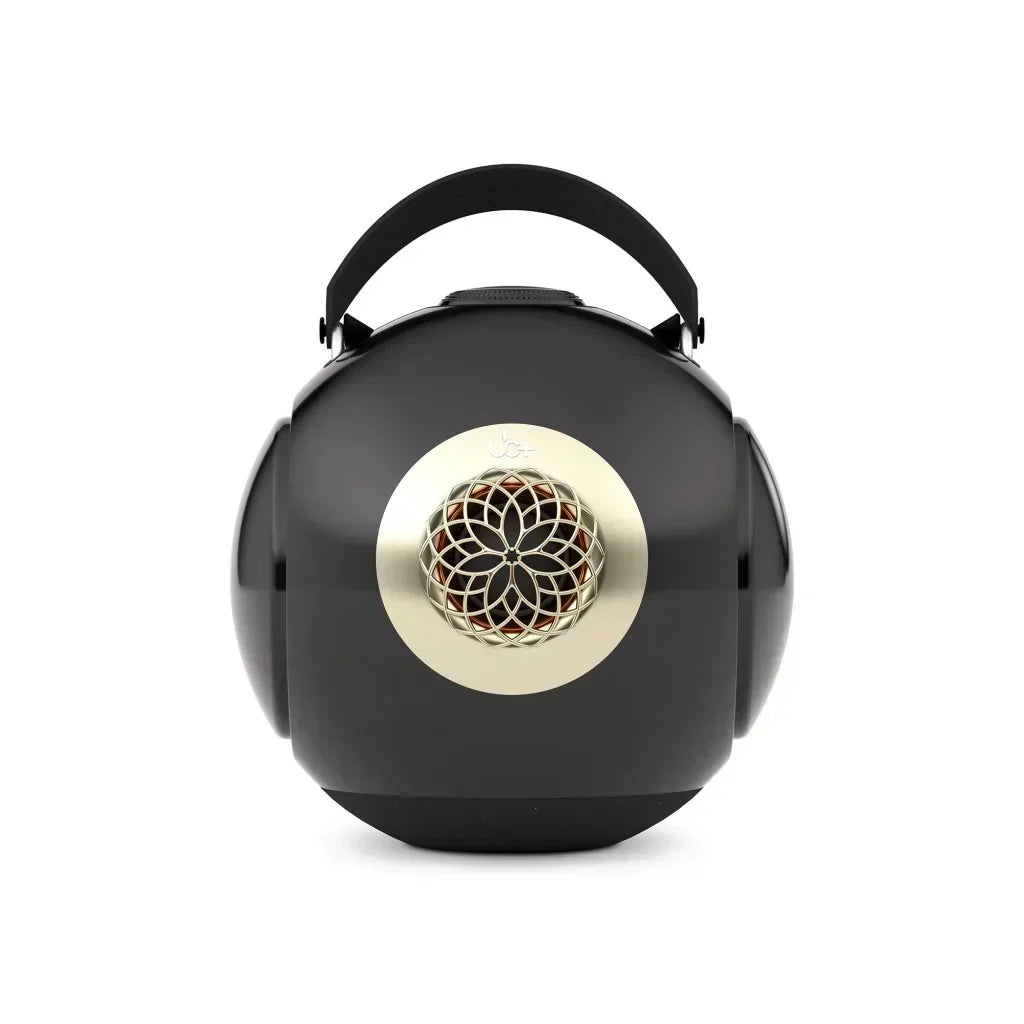
Its design combines a long-throw mid-bass driver, a spherical acoustic chamber, and two symmetrical passive radiators. Each component has a specific role, but the intended performance comes from their interaction.
The main engineering elements include:
- Spherical acoustic chamber: Uses a geometry inspired by Helmholtz resonance principles to manage internal air pressure and change internal reflection behavior.
- Long-throw mid-bass driver: Provides controlled diaphragm movement to support low-frequency reproduction.
- Dual passive radiators: Respond to internal pressure and contribute to the low-frequency output.
- Large radiating surface area: The combined passive-radiator area is approximately 3.5 times the active woofer area.
- Symmetrical radiator arrangement: Helps counterbalance certain mechanical forces and reduce some unwanted enclosure movement.
- 360° spherical dispersion: Supports sound distribution around the speaker rather than relying on a single forward-facing orientation.
- DSP integration: Supports response shaping, tonal balance, and driver protection rather than serving as a substitute for the physical bass system.
The dB1 is specified at approximately 40Hz–20kHz and 93dB SPL. It also supports Bluetooth 5.3, wired and TF-card playback, stereo pairing, and up to 20 hours of playback.
Its IPX5 rating indicates resistance to qualifying water jets under standardized test conditions. It should not be interpreted as protection against immersion or as a guarantee of unlimited outdoor weather resistance.
The speaker's mechanical architecture is particularly relevant when discussing bass. The active driver moves air inside the chamber, the internal pressure engages the passive radiators, and the symmetrical arrangement helps manage certain mechanical forces. This is the basis of its mechanical bass approach.
The broader lesson is that no single feature explains the speaker's performance. The driver, chamber, radiators, processing, and enclosure all contribute to the final result.
How to Read a Speaker Specification Sheet
A specification sheet is most useful when you understand both what a figure tells you and what it leaves unanswered.
|
Specification |
What It Tells You |
What It Does Not Tell You |
|
Frequency response |
Stated frequency range |
Whether the response is balanced or how it was measured |
|
Driver size |
Physical driver diameter |
Overall sound quality or bass extension |
|
Driver excursion |
Potential diaphragm movement |
How effectively the complete system uses that movement |
|
Magnet and motor design |
Part of the driver's force-producing system |
Complete driver performance |
|
Passive radiators |
Part of the low-frequency architecture |
Whether the system is properly tuned |
|
SPL |
Acoustic output under specified conditions |
How cleanly the speaker reaches that level |
|
Bluetooth version |
Wireless technology generation |
Overall audio fidelity |
|
Codec support |
Compatible audio transmission formats |
Quality of the speaker's acoustic system |
|
Battery life |
Potential operating duration |
Runtime at every volume level |
|
Enclosure geometry |
Physical acoustic architecture |
Whether the design is correctly engineered |
|
THD |
Harmonic distortion under stated conditions |
Complete perceived sound quality |
|
Impedance |
Electrical load presented to the amplifier |
Whether the speaker is acoustically well designed |
A useful comparison should also include measurement conditions. For example, frequency response without a tolerance range is incomplete, and SPL without distance or distortion information can be difficult to compare.
Instead of choosing the product with the longest list of specifications, look for evidence that the numbers describe a coherent and properly integrated design.
What Matters Most When Choosing Bass-Focused Bluetooth Speakers?
If bass is your priority, start with the low-frequency architecture rather than marketing phrases such as extra bass or enhanced bass.
Strong bass reproduction involves more than boosting low frequencies through digital signal processing. The active driver needs sufficient excursion, the enclosure needs appropriate acoustic loading, and any passive-radiator or port system needs to be correctly integrated.
Before buying, ask:
- How low does the published frequency response extend?
- Is a measurement tolerance provided?
- What type of active driver does the speaker use?
- Does the driver have sufficient excursion for its intended output?
- Does the design use a port, passive radiator, or another acoustic approach?
- How much radiating area is available?
- How does the enclosure manage internal pressure and resonance?
- Does the speaker maintain control as volume increases?
- Is DSP being used for tonal balance and protection, or is aggressive bass boosting central to the design?
The dB1 combines long-throw driver movement, a spherical acoustic chamber, and two large symmetrical passive radiators. Its approach uses mechanical and acoustic design as a central part of bass reproduction, while DSP supports system control.
For listeners comparing different portable designs, the UB+ dB1 DoubleBass is the model to examine when the spherical chamber and dual-radiator architecture are central considerations. The UB+ dB Mini offers a more compact alternative with up to 20 hours of playback.
This is a more useful way to evaluate bass performance than relying on a single advertised bass figure.
What Matters Most for Audiophile-Oriented Listening?
Audiophile-oriented listening is not simply about maximum loudness, exaggerated bass, or the widest advertised frequency range. It is about how accurately and coherently a speaker reproduces music.
A speaker intended for detailed listening should be evaluated across several areas:
- Tonal balance: Bass, midrange, and treble should work together without one region dominating.
- Distortion: Unwanted changes to the original signal should remain controlled across practical listening levels.
- Resonance management: Driver and enclosure behavior should not introduce excessive coloration.
- Driver integration: Components should operate coherently across their intended frequency ranges.
- Dynamic control: The speaker should reproduce changes in musical intensity without unnecessary compression.
- Stereo imaging: When using a compatible stereo pair, channel integration and placement can influence the perceived soundstage.
- Low-level detail: Subtle musical information should remain audible without requiring excessive volume.
- Listening fatigue: Harsh treble, excessive mid-bass, and resonance peaks can make extended listening less comfortable.
The phrase best audiophile Bluetooth speakers should not be treated as a ranking based on one specification. A high-end listening experience depends on the complete system, the recording, the room, and the listener's priorities.
A speaker designed for a bedroom or office may prioritize a different balance of portability, output, and sound distribution than one intended for a larger living space. The UB+ S1 Circle, UB+ S2 Alphorn, and UB+ E2 Solace provide additional UB+ options to explore when comparing different product formats and playback requirements.
For more context, explore Best Audiophile Bluetooth Speakers: What to Look for in Premium Portable Audio.
Frequently Asked Questions
What is the most important specification when buying a speaker?
There is no single specification that determines overall speaker quality. Frequency response, driver construction, excursion, acoustic loading, SPL, enclosure design, and system integration all matter. The most useful specification is one that helps explain how the complete speaker performs.
Does a bigger speaker driver always produce better sound?
No. Driver diameter is only one part of the design. Motor strength, excursion, suspension, voice coil construction, enclosure volume, and acoustic tuning also influence performance. A smaller, well-integrated driver system can outperform a larger driver in a poorly designed enclosure.
Are passive radiators better than bass-reflex ports?
Neither approach is universally better. Passive radiators can be useful in compact enclosures where a large port is impractical, while bass-reflex ports can provide effective low-frequency output when correctly designed. The best choice depends on enclosure volume, tuning, available space, and intended performance.
Does higher SPL mean a better Bluetooth speaker?
No. SPL describes acoustic output, not complete sound quality. A speaker may reach a high level but introduce distortion or compression. Measurement conditions and the speaker's ability to maintain clarity at higher output are important.
Why does speaker enclosure shape matter?
Enclosure geometry affects internal air pressure, reflections, resonance, and mechanical behavior. Different shapes create different acoustic conditions that designers must manage. The UB+ dB1 uses a spherical chamber inspired by Helmholtz resonance principles as part of its acoustic system.
Does Bluetooth 5.3 guarantee better sound than older Bluetooth versions?
No. Bluetooth 5.3 identifies the wireless technology generation, but audio quality also depends on codec compatibility, the source device, digital processing, amplification, drivers, and enclosure design. A newer connection standard does not automatically make a speaker acoustically superior.
What should I check if deep bass is my main priority?
Look at frequency extension, driver excursion, passive-radiator or port design, enclosure volume, acoustic tuning, and distortion behavior. Also consider whether the speaker maintains bass control at higher listening levels rather than relying entirely on boosted low frequencies.
How important is battery life in a portable speaker?
Battery life is important when you regularly listen away from a power source. However, advertised maximum runtime is not guaranteed under every condition. Volume, content, connectivity, and battery condition can all affect actual playback time.
What is the difference between a passive radiator and an active driver?
An active driver receives an electrical signal and uses a voice coil and magnetic motor to move its diaphragm. A passive radiator has no powered voice coil. It moves in response to internal air-pressure changes and contributes acoustic output around the enclosure's tuning region.
Does a spherical speaker automatically sound better than a box speaker?
No. Enclosure shape alone does not guarantee superior sound. A spherical design changes internal geometry and reflection behavior, but driver quality, acoustic tuning, damping, material selection, and system integration remain essential. The design needs to be engineered as a complete acoustic system.
Explore UB+ Speakers Built Around Different Listening Priorities
Understanding specifications is the first step. Choosing a speaker becomes easier when you can connect those figures to the engineering decisions behind them.
The UB+ dB1 DoubleBass brings together a spherical acoustic chamber, long-throw mid-bass driver, dual symmetrical passive radiators, and 360° sound dispersion. It is designed for listeners who want to understand how enclosure architecture and mechanical bass reproduction contribute to portable-speaker performance.
For a smaller portable option, the UB+ dB Mini offers a more compact listening approach with up to 20 hours of playback.
Other models provide additional choices depending on your listening environment and portability requirements:
- UB+ E2 Solace — up to 30 hours of playback for listeners prioritizing extended portable use.
- UB+ S1 Circle — a compact spherical design with up to 16 hours of playback.
- UB+ S2 Alphorn — another UB+ listening option with up to 16 hours of playback.
Compare the models based on their intended use, physical format, and confirmed specifications rather than assuming that every speaker shares the same acoustic architecture.
- Compare UB+ dB1 DoubleBass and dB Mini
- Explore the UB+ dB1 DoubleBass
- Explore the UB+ dB Mini
- Explore UB+ E2 Solace
- Explore UB+ S1 Circle
- Explore UB+ S2 Alphorn
- Browse all UB+ speakers
A specification sheet can tell you what a speaker is designed to do. The engineering behind those specifications explains how it attempts to do it. That is the distinction worth understanding before making a purchase.


Commenta
Questo sito è protetto da hCaptcha e applica le Norme sulla privacy e i Termini di servizio di hCaptcha.