

The difference between a speaker that sounds flat and one that sounds alive isn't marketing it's the materials inside it. Two speakers can look nearly identical and still be worlds apart in clarity, bass depth, and how long they hold up, simply because of what their drivers, cabinets, and wiring are made from. Knowing what to look for means you can tell a genuinely premium speaker from one that's just priced like it.
This guide breaks down exactly what “premium” means at the material level, from the cabinet down to the binding posts, so you know what you're actually paying for.
A Delicate Balance
If you love listening to music, you probably have favorite speakers or headphones you've spent real money on. The secret to their sound is in the materials they're built from. Multiple components have to work in harmony to deliver accurate reproduction that means clarity across every frequency with minimal distortion and coloration, so you hear the music as intended. The materials behind each of those components decide how well they deliver.
What Makes a Premium Speaker
The Enclosure
Speakers rely on several components working together, but from the outside, the only visible parts are the cabinet, the speaker cone with its dust cap, and the surround that encloses the cone. The cabinet isn't just a box holding everything in place its material and construction directly shape the quality of the sound coming out of it.
Common Enclosure Materials
Wood. Most enclosures are made from medium-density fiberboard (MDF), the standard in affordable speakers because it's dense, stiff, and stable. MDF resists vibration well, which keeps sound clearer with less distortion, and it's flexible enough to be shaped for better sound dispersion. Solid wood is the higher-end option birch and walnut are favored for their acoustic properties, with birch prized for being strong yet lighter than standard plywood. Particleboard is the cheap alternative used in mass-produced speakers; it's easy to work with but doesn't deliver good sound quality. True premium builds use solid oak or maple for both sound and aesthetics, and the most expensive models step up to specialty woods like Japanese white oak, valued for being more dimensionally stable than other solid woods.
Fiberglass. An increasingly popular cabinet material, fiberglass is rigid and lightweight, which gives manufacturers more freedom to shape it around specific acoustic goals. Its excellent insulation properties isolate the speaker from outside interference, and its rigidity minimizes resonance and unwanted vibration for a cleaner output.
Material choice only solves part of the problem, though. Even a cabinet built from the best wood or fiberglass available still has to deal with its own shape and shape is where most compact speakers quietly lose sound quality.
Understanding the Helmholtz Resonator
Before getting into how UB+ engineers its cabinets, it's worth understanding the actual physics involved, because it explains why shape matters as much as material.
A Helmholtz resonator is a simple concept with an outsized effect: it's any enclosed pocket of air with a small opening that, when disturbed, vibrates at one specific, predictable frequency the same principle at work when you blow across the top of an empty bottle and get a single clear tone. The size of the cavity and the size of the opening determine exactly what that frequency is. German physicist Hermann von Helmholtz first described this behavior in the 1860s while studying how air resonates inside differently shaped cavities, and the principle has been used in acoustic engineering ever since, from concert hall wall panels to car exhaust systems designed to cancel unwanted engine drone.
Inside a conventional rectangular speaker cabinet, the flat, parallel internal walls behave badly by comparison. Sound waves bounce directly between opposite walls and reinforce each other at certain frequencies, creating standing waves buildups of resonance at specific points in the cabinet that color the sound, muddy the bass, and work against the very drivers trying to reproduce it accurately. A rectangular box has no natural way to relieve that pressure evenly; the reflections just keep bouncing.
A Helmholtz-inspired spherical chamber approaches the problem completely differently. Instead of flat walls that trap and reflect sound in straight lines, a spherical enclosure has no parallel surfaces for reflections to bounce directly between. Air pressure generated by the driver moves outward in every direction at once and distributes itself evenly around the curved interior, which is what actually reduces standing waves rather than just dampening them after they've already formed. That's the core reason a spherical chamber, engineered around Helmholtz Resonance principles, changes the acoustic outcome not just the industrial design.
|
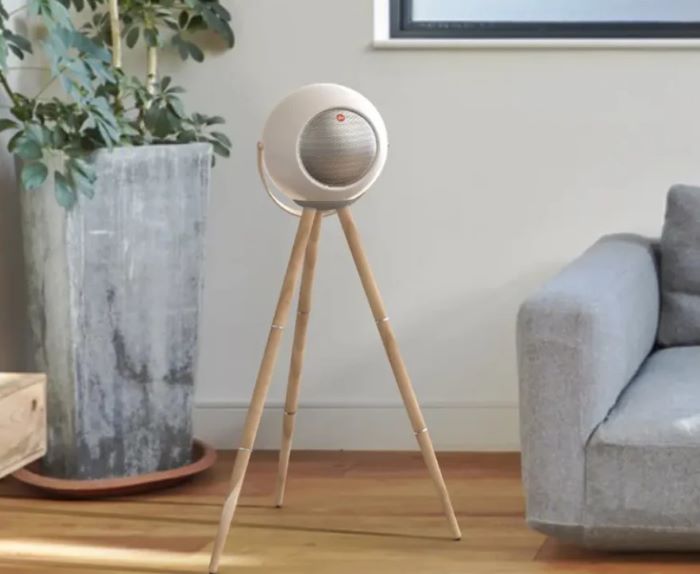
Technical Blueprint: How the dB1 DoubleBass Engineers the Enclosure The UB+ dB1 DoubleBass applies this exact principle. Its patented spherical acoustic chamber, inspired by the Helmholtz Resonance principle described above, distributes internal air pressure evenly, which significantly reduces standing waves, minimizes phase distortion, and improves harmonic reproduction the cabinet itself becomes an active part of the acoustic system rather than just a protective shell. Mechanical bass, not DSP: a 4.5-inch downward-firing long-throw mid-bass driver sits inside that spherical chamber, where evenly distributed air pressure activates dual symmetrical passive radiators mounted on opposite sides. This patented configuration produces mechanical bass amplification acoustic physics, not software, generating deep, controlled bass with combined passive radiator surface area roughly 3.5× larger than the active woofer. Because the radiators move in opposing directions, they create a self-cancelling vibration architecture that reduces cabinet movement while directing more energy into bass output. Onboard DSP monitors performance and protects the drivers, but it doesn't artificially generate bass. Component-level engineering: a 90mm oversized neodymium magnet, 35mm long-stroke voice coil, 20mm piston movement, 18mm extra-wide surround, and aluminum shorting ring work together across a 40Hz–20kHz frequency response at 93dB SPL, over Bluetooth 5.3, with up to 20 hours of battery life. → See the dB1 DoubleBass — full specs, finishes, and current pricing. → Compare dB1 vs. dBMini — find which UB+ speaker fits your room and listening habits. → Browse the full UB+ collection — see how the dB1 stacks up against the rest of the lineup. |

The Drivers
The drivers are the heart of the speaker where electrical signals become sound so the materials used in each one directly shape what you hear.
Bass or Woofers. Premium woofers are typically fiberglass or carbon fiber: fiberglass for its strength-to-weight ratio and cleaner bass reproduction, carbon fiber for being lighter, stiffer, and lower-distortion. Mid-range speakers use aluminum (durable, fast transient response, but can sound metallic if poorly tuned) or Kevlar/Aramid fiber (stiff, strong, accurate). Budget speakers use paper (warm, but moisture-prone) or polypropylene (durable and moisture-resistant, but not stiff enough for the best sound quality).
Tweeters. High frequencies are handled here, and premium models use rigid titanium for accurate reproduction. Mid-range speakers use aluminum or silk; budget models use mylar (polyester).
Midrange Drivers. This is where vocals and instruments live. Premium builds use ceramic or Kevlar for accuracy with minimal distortion; more affordable speakers use paper, composites, or polypropylene.
Driver material only tells half the story, though placement and count decide whether that quality reaches every corner of a room or just the direction the speaker happens to be facing. A titanium tweeter aimed at one wall is still only serving whoever is standing in front of it.
|
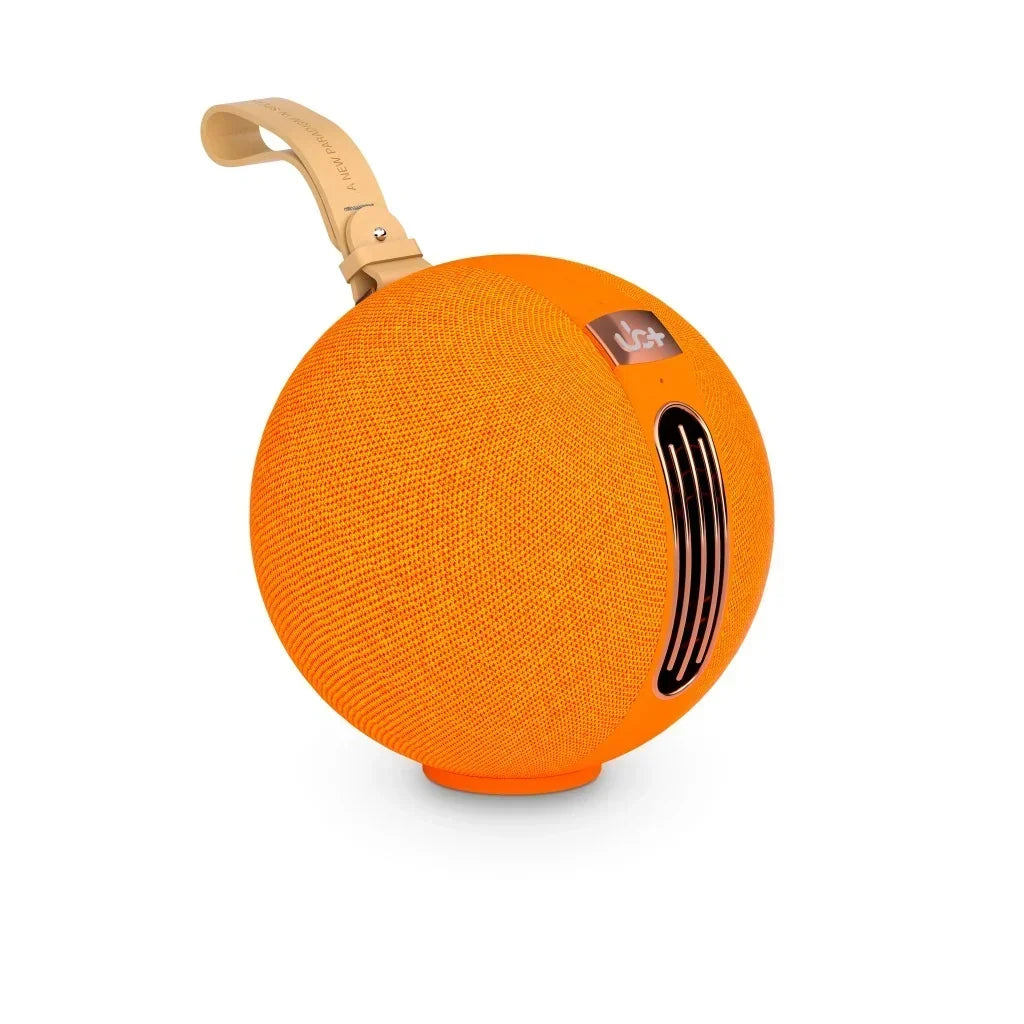
Technical Blueprint: How the S1 Circle Engineers Driver Placement The UB+ S1 Circle shows why driver arrangement matters as much as driver material. Six precisely arranged drivers dual woofers, dual tweeters, dual passive radiators sit inside a spherical enclosure that projects sound outward in every direction rather than toward a single wall, so the accuracy built into each individual driver doesn't disappear the moment you're not standing directly in front of the speaker. The same Helmholtz-inspired spherical geometry that manages standing waves in the dB1 does the same work here, letting six drivers share one chamber without fighting each other acoustically. Wireless and everyday-use engineering: Bluetooth 5.3 handles pairing speed, connection stability, and interference resistance, and a built-in microphone adds hands-free calling both add-ons that only matter because the underlying driver array is already balanced enough to make use of them. Component-level engineering: output totals 40W (20W per channel) across a 45Hz–17kHz frequency response, 93dB SPL, with IPX5 water resistance and a 16-hour battery. → See the S1 Circle — full specs and current pricing. → Compare S1 Circle colorways — six finishes, including Mars Rustic Orange and Pluto Obsidian. → Browse the full UB+ collection — compare every driver configuration side by side. |

The Crossover Networks
Often called the brain of the speaker, the crossover routes different frequency ranges to their correct drivers. In premium builds, the inductors and capacitors are made from copper and polypropylene to minimize distortion and signal loss.
The Connectors and Wiring
Internal wiring and connectors affect sound quality just as much as the bigger components. Premium speakers use oxygen-free wiring and high-grade connectors to preserve the clearest possible signal transfer.
The Binding Posts
This is where speaker wires and connectors attach. Premium models typically use gold-plated binding posts, which are highly conductive and corrosion-resistant, keeping the signal path clean over years of use.
Internal Bracing and Damping
These elements reduce the unwanted vibration that muddies sound. Premium speakers reinforce the enclosure with internal bracing to cut down on cabinet vibration for a cleaner, more stable output, and use rubber or specialized damping compounds inside the cabinet to absorb vibration further both are directly responsible for the accuracy and clarity you actually hear.
Bracing and damping matter most in smaller enclosures, where there's less mass to naturally resist vibration in the first place which is exactly the challenge a compact spherical chamber has to solve.
|
Technical Blueprint: How the dBMini Engineers Around Its Size The UB+ dBMini proves compact bracing and chamber design can still deliver full-range sound. Its 4-driver system a 3-inch woofer, 1.5-inch tweeter, and dual passive radiators sits inside a 128mm sphere weighing just 0.65kg, using the same Helmholtz-inspired spherical, symmetrical-chamber design as the dB1 and S1 Circle to reduce the standing waves that typically cause coloration in small rectangular speakers. Mechanical engineering at a smaller scale: the same principle that gives the dB1 its bass dual passive radiators working with a downward-firing driver instead of relying on DSP boost carries over here, letting the dBMini reach down to 45Hz, a range most speakers this size can't touch. Component-level engineering: 40W total output (25W woofer, 15W tweeter) across a 45Hz–20kHz frequency response, Bluetooth 5.4, IPX5 water resistance, TWS stereo pairing, and up to 20 hours of battery life. → See the dBMini — full specs and current pricing. → Compare dBMini vs. dB1 DoubleBass — weigh portability against maximum bass output. → Browse the full UB+ collection — find the size and driver setup that fits how you listen. |

Special Features
Premium speakers often add features beyond core materials to improve the listening experience. Waveguides disperse sound for a wider, more even soundstage, while bi-wiring and bi-amping separate wires by frequency to reduce interference and improve clarity.
Final Thoughts
There's a lot happening inside a premium speaker before a single note reaches your ears. Combining high-quality materials with precision engineering down to the physics of the cabinet itself is what lets premium speakers deliver sound that actually justifies the price tag. Now you know exactly what to check for before you buy one, and why a sphere isn't just a design choice.
Frequently Asked Questions
What makes a speaker sound “premium”?
It comes down to the materials in its drivers, cabinet, and wiring fiberglass or carbon fiber woofers, titanium tweeters, oxygen-free wiring, and a well-braced enclosure all work together to reduce distortion and deliver more accurate sound reproduction.
What is a Helmholtz resonator, and why does it matter for speaker design?
A Helmholtz resonator is any enclosed pocket of air with a small opening that vibrates at one predictable frequency when disturbed the same effect as blowing across a bottle. In speaker design, applying that principle to a spherical cabinet shape helps distribute air pressure evenly and reduce the standing waves that build up inside conventional rectangular enclosures.
What's the difference between a paper woofer and a fiberglass or carbon fiber woofer?
Paper woofers offer natural warmth but are prone to moisture damage and wear faster, while fiberglass and carbon fiber woofers are stiffer and more durable, giving cleaner, lower-distortion bass reproduction over the long term.
Why do gold-plated binding posts and oxygen-free wiring matter for sound quality?
Both reduce resistance and signal loss along the path from amplifier to driver gold-plated posts resist corrosion for a consistently clean connection, and oxygen-free wiring carries the signal with less interference, so less of the original sound is lost before it reaches the speaker.


Leave a comment
This site is protected by hCaptcha and the hCaptcha Privacy Policy and Terms of Service apply.