

When people search for a portable Bluetooth speaker, specifications are usually the first thing they encounter. Battery life, driver size, frequency response, Bluetooth connectivity, and maximum sound pressure level can help narrow down a purchase. However, those figures rarely explain how a speaker actually performs in everyday listening.
That is where detailed reviews and real-world listening impressions become valuable. A useful speaker review should examine more than maximum volume or advertised bass. It should consider tonal balance, low-frequency extension, transient response, distortion, sound dispersion, enclosure resonance, build quality, and how comfortably the product fits into everyday environments.
The UB+ dB1 DoubleBass and UB+ dB Mini are particularly interesting because their designs move away from the conventional rectangular-speaker formula. Both bring a spherical visual identity to portable audio, while the dB1 takes a more elaborate approach to acoustic engineering through its spherical chamber, long-throw driver, and dual passive radiators.
For reviewers and buyers, the important question is not simply whether these speakers look different. It is how their engineering choices influence the listening experience, what each model is designed to offer, and which product makes more sense for a particular environment.
Why Reviewer Opinions Matter More Than Specification Lists

Specifications provide measurable information, but they cannot independently describe the complete listening experience.
Two speakers can advertise similar frequency ranges and still sound noticeably different. Their performance may vary because of driver motor strength, diaphragm excursion, enclosure volume, acoustic loading, passive-radiator tuning, digital signal processing, and sound dispersion.
A useful review should therefore investigate how these components work together.
When evaluating a speaker, reviewers should pay attention to:
- Bass extension: How effectively the speaker reproduces lower frequencies.
- Bass control: Whether low-frequency output remains defined rather than becoming boomy or muddy.
- Midrange clarity: Whether vocals and instruments remain distinguishable.
- Treble response: Whether high frequencies sound detailed without excessive harshness.
- Dynamic performance: How well the speaker handles changes in musical intensity.
- Distortion: Whether unwanted harmonic content becomes noticeable as volume increases.
- Sound dispersion: How consistently the sound is distributed around the listening area.
- Build quality: Whether the enclosure, materials, and physical controls feel properly engineered.
- Placement flexibility: How the speaker performs on desks, shelves, tables, and other everyday surfaces.
For someone comparing a portable Bluetooth speaker, these observations can be more useful than choosing a product based on wattage or driver diameter alone.
A review should also distinguish between measurable specifications and subjective impressions. Terms such as warm, bright, spacious, detailed, and powerful describe listening experiences, but they should ideally be supported by explanations of the acoustic behavior responsible for them.
UB+ explores the engineering behind these characteristics in its guide to the science behind premium audio technology.
The Design Philosophy Behind UB+ Speakers

The first thing that separates UB+ from many conventional portable-speaker designs is its approach to enclosure geometry.
Most traditional portable speakers use rectangular or cylindrical housings. These formats are practical for manufacturing, packaging, and placement, but their internal geometry creates particular acoustic conditions that designers need to manage.
The UB+ dB1 DoubleBass uses a spherical acoustic chamber instead of a conventional rectangular cabinet. Its design is inspired by the principles of Helmholtz resonance, where an enclosed air volume and an opening create a frequency-dependent resonant system.
The sphere is therefore more than an aesthetic decision.
Its geometry forms part of the speaker's acoustic architecture, influencing internal air pressure and the behavior of internal reflections. The dB1 combines this chamber with a long-throw mid-bass driver and two opposing passive radiators to create its low-frequency system.
This distinction matters when evaluating reviewer impressions. A speaker can look unusual simply to create visual differentiation, but the dB1's shape is directly connected to the way its acoustic system is designed.
The relationship between exterior design and acoustic function is also explored in UB+’s guide to spherical speakers and bass performance.
What Makes the dB1 DoubleBass Different?

The dB1's most distinctive engineering feature is the relationship between its spherical chamber, active driver, and passive radiators.
At the center of its acoustic system is a 4.5-inch long-throw mid-bass driver positioned to fire downward into the spherical chamber. Two large passive-radiator plates are mounted symmetrically on opposite sides of the enclosure.
When the active driver moves, it creates changes in internal air pressure. That pressure drives the passive radiators, allowing them to contribute low-frequency acoustic output without requiring the active driver to produce all the air movement by itself.
The combined surface area of the two passive radiators is approximately 3.5 times the area of the active woofer.
This is important because low-frequency reproduction depends heavily on air displacement. The available displacement is influenced by the effective radiating area and the distance each radiating surface can move.
A larger combined passive-radiator area gives the system substantial radiating surface, but its effectiveness still depends on the radiator mass, suspension, enclosure volume, tuning, and integration with the active driver.
The opposing radiator arrangement also helps manage mechanical reaction forces. As the radiators move in response to internal pressure, their symmetrical behavior is intended to reduce certain unwanted mechanical movements of the enclosure.
This is the foundation behind the dB1's DoubleBass concept.
For buyers who want to examine the complete architecture, visit the UB+ dB1 DoubleBass product page.
Understanding the dB1's Helmholtz-Inspired Acoustic Chamber
A Helmholtz resonator is an acoustic system that uses an enclosed volume of air and an opening to produce resonance at a particular frequency. The principle is familiar in acoustic engineering and has applications in resonators, instrument design, and enclosure tuning.
The dB1 uses a spherical acoustic chamber inspired by this principle. The internal air volume participates in the speaker's bass architecture rather than functioning only as empty space around the electronics.
Several technical concepts help explain why this matters:
- Enclosure volume: The amount of air inside the chamber influences its acoustic behavior.
- Acoustic compliance: The enclosed air behaves partly like a spring when compressed and released by the active driver.
- Resonant frequency: The interaction between air volume and the acoustic system contributes to frequency-dependent behavior.
- Internal reflections: Sound waves interact with enclosure surfaces, influencing internal acoustic behavior.
- Standing-wave modes: Internal dimensions and geometry affect the frequencies at which standing-wave patterns can develop.
- Acoustic damping: Material selection and structural design help manage unwanted resonant behavior.
A conventional rectangular enclosure has parallel internal surfaces that can contribute to particular standing-wave patterns. A spherical chamber removes that conventional parallel-wall geometry and creates a continuous curved internal environment.
This does not eliminate every resonance or reflection. Instead, it changes the internal acoustic conditions that the designer needs to manage.
The sphere also provides the physical environment in which the active driver and passive radiators interact. That makes enclosure geometry part of the acoustic mechanism, not simply a visual styling feature.
To explore the broader engineering behind enclosure design, read Passive Radiators vs. Ported Boxes: Understanding Spherical Speaker Bass.
Why the dB1's Passive-Radiator System Matters

Passive radiators are especially useful in compact speaker designs where a conventional bass-reflex port may be difficult to accommodate.
Unlike an active driver, a passive radiator does not receive an independent electrical audio signal. It responds to pressure changes created inside the enclosure by the active driver.
The system behaves like a mass-and-spring arrangement:
- The enclosed air volume contributes acoustic compliance.
- The passive radiator contributes moving mass.
- The suspension controls the radiator's movement.
- The enclosure and radiator interact around the system's tuning frequency.
This arrangement can support low-frequency output while avoiding the need for a large port. It also avoids some airflow-noise problems associated with poorly designed ports, although passive radiators have their own mechanical limits and must be correctly tuned.
The dB1's two opposing radiators are designed to work together with the spherical chamber and active driver. Their combined surface area provides a substantial radiating area, while their symmetrical arrangement helps manage certain reaction forces.
For reviewers, this is a more useful detail than simply saying the speaker has passive radiators. The important questions are how much radiating area is available, how the system is tuned, and whether the radiators remain controlled at different listening levels.
Explore the technical explanation in How Passive Radiators Work in Bluetooth Speakers.
Driver Engineering: The Mechanical System Behind the Bass

The acoustic chamber is only part of the equation. The active driver also needs to handle the mechanical demands of low-frequency reproduction.
The dB1 uses a 4.5-inch long-throw mid-bass driver supported by several specific components:
- 90mm oversized neodymium magnet: Part of the magnetic motor system that supplies force to the voice coil.
- 35mm long-stroke voice coil: Designed to support substantial driver movement.
- Approximately 20mm piston movement: Provides information about the driver's mechanical travel.
- Aluminum shorting ring: Part of the motor architecture that can help control certain electromagnetic distortion mechanisms.
- Extra-wide surround: Supports diaphragm suspension and controlled movement.
These components should not be evaluated as separate marketing features. Their purpose becomes clearer when considered as a complete electromechanical system.
The magnetic motor interacts with the voice coil to generate force. The suspension helps control diaphragm movement, while the voice coil and motor construction influence how consistently the driver operates as excursion increases.
Several additional concepts are useful when reviewing driver performance:
- Linear excursion: Describes the range of diaphragm movement over which the driver can operate with acceptable linearity.
- Motor force factor (BL): Describes the relationship between magnetic flux density and the length of voice coil conductor within the magnetic field.
- Moving mass (Mms): Represents the effective moving mass of the driver, including the diaphragm and associated moving components.
- Compliance (Cms): Describes the mechanical flexibility of the driver's suspension.
- Distortion: Can increase when the driver operates beyond the range where its motor, suspension, and diaphragm behavior remain sufficiently linear.
The dB1's driver works into its spherical chamber, which then interacts with the two passive radiators. This is why driver size alone cannot explain its low-frequency architecture.
For more background on the relationship between driver construction and performance, read Speaker Specs Guide: Seven Key Factors That Matter.
Deep Bass Versus Boosted Bass: What Reviewers Should Listen For

Bass is one of the easiest aspects of a compact speaker to exaggerate. Increasing low-frequency energy can make a short demonstration sound immediately impressive, but excessive bass emphasis can eventually make music less balanced.
When bass is too prominent, it can mask parts of the midrange. Vocals may lose definition, instruments may sound congested, and the overall presentation may become tiring during extended listening.
This is why reviewers should distinguish between deep bass and boosted bass.
Deep bass refers to the ability to reproduce lower frequencies with meaningful acoustic output.
Boosted bass refers to emphasizing a portion of the low-frequency response, whether through equalization or other processing.
The two are not interchangeable.
A well-integrated bass system needs to manage excursion, resonance, distortion, and acoustic output. It should also maintain a sensible transition between the bass and midrange regions.
The dB1 approaches low-frequency reproduction through the physical interaction of its long-throw driver, spherical chamber, and dual passive radiators. Digital signal processing also has a role in response shaping, tonal balance, and driver protection.
DSP should not be treated as the opposite of mechanical acoustic design. In a properly integrated speaker, signal processing and physical components can serve complementary functions.
For reviewers, useful listening checks include:
- Whether kick drums have definition rather than sounding like a single low-frequency thump.
- Whether bass guitar notes remain distinguishable.
- Whether vocals retain clarity when bass-heavy tracks are played.
- Whether the speaker develops audible distortion as volume increases.
- Whether low-frequency output remains controlled across different music genres.
For a broader discussion of distortion and its effect on listening, see Speaker Distortion Explained.
The dB Mini: A Compact Alternative for Everyday Listening

The UB+ dB Mini takes the broader UB+ design direction into a smaller portable format.
Its compact dimensions make it easier to integrate into desks, bedrooms, shelves, and smaller listening spaces. The spherical design also gives it a distinctive appearance compared with conventional rectangular portable speakers.
However, it is important to understand the difference between a compact speaker and a larger acoustic system.
Physical size affects the amount of air a speaker can displace, the available enclosure volume, and the space available for drivers and radiating surfaces. A smaller speaker should not automatically be expected to reproduce the same low-frequency scale or maximum acoustic output as a larger design.
The dB Mini is therefore best considered on its own terms: a compact portable option for listeners who value a smaller footprint and flexible placement.
For buyers comparing the two models, the most useful differences to consider are:
|
Consideration |
UB+ dB1 DoubleBass |
UB+ dB Mini |
|
Product format |
Larger portable speaker |
Compact portable speaker |
|
Design direction |
Spherical acoustic chamber |
Compact spherical design |
|
Primary distinction |
Dedicated long-throw driver and dual passive-radiator architecture |
Smaller physical footprint |
|
Playback time |
Up to 20 hours |
Up to 20 hours |
|
Best comparison point |
Acoustic architecture and bass-system design |
Portability and everyday placement |
The dB Mini should not be assumed to share the dB1's driver dimensions, passive-radiator arrangement, Helmholtz-inspired chamber, or other model-specific technical features.
For a more detailed comparison, read UB+ dB1 vs. dB Mini: Which Portable Speaker Should You Choose?.
You can also explore the dB Mini product page for its design and current product details.
Design Is Part of the Listening Experience
Modern speakers increasingly occupy visible spaces. A speaker may sit on a living-room table, desk, bedroom shelf, or studio workspace for years.
That makes industrial design more important than it was when audio equipment was commonly hidden inside cabinets or dedicated media furniture.
The spherical form of UB+ speakers gives them a different relationship with their surroundings. Instead of looking like conventional electronics, the rounded enclosure can function as part of an interior.
However, visual design and acoustic engineering should not be confused. A distinctive exterior does not guarantee better sound. The materials, internal volume, structural rigidity, driver integration, and acoustic tuning still determine how effectively the enclosure performs.
This is where the dB1's design becomes interesting: its spherical shape is connected to the internal acoustic chamber, not simply the product's exterior appearance.
The same broader consideration applies when evaluating designer audio products. Reviewers should consider whether the physical design supports the intended acoustic architecture while also fitting naturally into the user's environment.
Explore the relationship between aesthetics and audio performance in UB+’s guide to designer speakers and sound quality.
360° Sound Dispersion: How Placement Changes the Experience
Sound dispersion describes how acoustic energy spreads through the listening environment.
A conventional front-firing speaker generally has a preferred listening direction. Depending on its driver arrangement and directivity, the perceived frequency balance can change as listeners move away from the main listening axis.
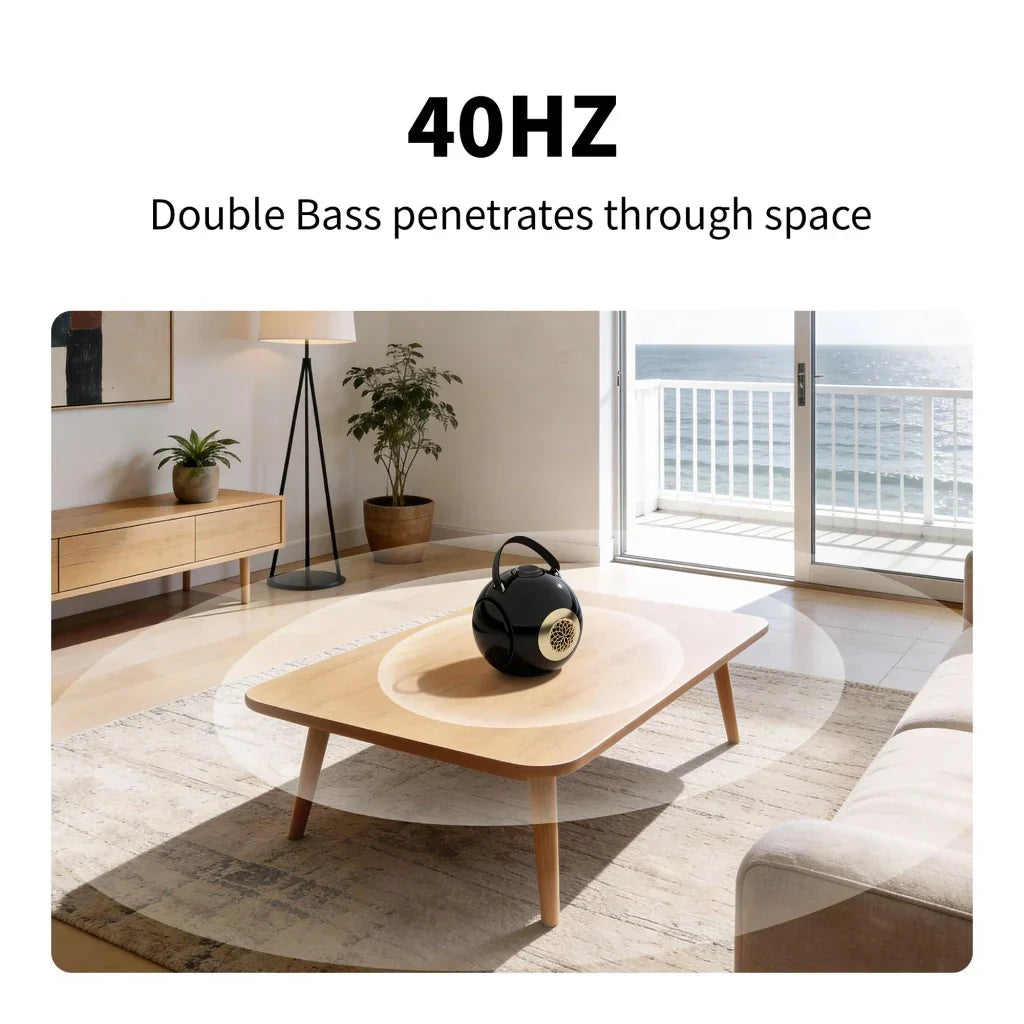
The dB1's spherical architecture is designed around broad 360° sound dispersion. This makes it relevant to environments where listeners are not always sitting directly in front of the speaker.
Potential applications include:
- Living rooms where people listen from different seating positions.
- Open spaces where listeners move around.
- Offices and shared work areas.
- Social settings where the speaker is placed centrally.
- Rooms where a single forward-facing listening position is impractical.
However, 360° dispersion does not mean that every frequency is distributed identically in every direction. Driver placement, wavelength, frequency response, room reflections, and nearby surfaces still influence what listeners hear.
Placement also remains important. Walls, corners, furniture, and floors can change perceived bass through boundary reinforcement and room interaction.
For reviewers, useful tests include listening from several positions, comparing near-field and farther listening, and checking whether the tonal balance changes noticeably as the listener moves around the speaker.
For a deeper explanation, read What Is Soundstage in a Speaker System?.
What Reviewers Should Evaluate Beyond Maximum Volume
A useful speaker review should explain how a product behaves under realistic listening conditions. Maximum volume is only one part of that evaluation.
For the UB+ dB1, several technical areas deserve attention.
- Frequency response: The dB1 is specified at approximately 40Hz–20kHz. Reviewers should consider the balance and consistency of the response, not only the stated endpoints.
- Sound pressure level: The approximately 93dB SPL specification provides an indication of output capability. Measurement distance, weighting, distortion threshold, and test conditions are important when comparing this figure with other products.
- Driver excursion: The long-throw driver is designed to support substantial movement. Reviewers should listen for control and distortion as low-frequency demand increases.
- Passive-radiator behavior: The two radiators should be considered as part of the enclosure's tuning and air-displacement system.
- Resonance management: The spherical chamber changes the internal geometry compared with conventional rectangular enclosures. Its performance should be evaluated as part of the complete acoustic system.
- Dynamic compression: Reviewers should assess whether the speaker maintains musical contrast and clarity as volume increases.
- Stereo pairing: The dB1 supports stereo pairing. When evaluating a pair, reviewers can consider channel separation, imaging, phase coherence, and the effect of speaker placement.
- Connectivity: Bluetooth 5.3, wired playback, and TF-card playback provide different ways to access audio. Compatibility and connection stability should be assessed separately from acoustic performance.
The dB1 also has an IPX5 rating. This indicates resistance to qualifying water jets under standardized test conditions. It does not mean the speaker is waterproof or safe for immersion.
These details help create a more meaningful review than simply describing the speaker as loud, powerful, or premium.
UB+ dB1 Compared With Conventional Portable Speaker Design
It is tempting to reduce the speaker market to a simple question of which brand is better. That is usually too simplistic.
Different manufacturers prioritize different things. Some focus heavily on ruggedness and outdoor portability. Others prioritize maximum output, compact dimensions, battery performance, or mainstream accessibility.
UB+ takes a distinctive position around acoustic architecture and industrial design.
|
Feature |
Conventional Portable Speaker Designs |
UB+ dB1 DoubleBass |
|
Enclosure geometry |
Often rectangular or cylindrical |
Spherical acoustic chamber |
|
Bass architecture |
Varies by driver, port, or radiator |
Long-throw driver with dual passive radiators |
|
Acoustic principle |
Depends on enclosure design |
Helmholtz-inspired chamber |
|
Passive-radiator area |
Varies by model |
Approximately 3.5× active woofer area |
|
Mechanical arrangement |
Depends on system design |
Opposing radiator arrangement |
|
Sound dispersion |
Depends on driver and enclosure layout |
Designed for broad 360° dispersion |
|
Active driver |
Varies by model |
4.5-inch long-throw mid-bass driver |
|
Wireless connection |
Varies by model |
Bluetooth 5.3 |
|
Playback options |
Varies by model |
Bluetooth, wired, and TF-card playback |
|
Design priority |
Portability, output, durability, or other goals |
Acoustic engineering and industrial design |
This comparison does not suggest that every conventional portable speaker performs the same way. They do not. It highlights the different design philosophy behind the dB1.
For buyers interested in the relationship between acoustic architecture and bass performance, the dB1 DoubleBass product page provides a useful starting point.
Other UB+ Speakers: Matching the Product to the Listening Environment
The dB1 and dB Mini are central to this comparison, but they are not the only products worth exploring when considering the UB+ range.
Different listening environments create different requirements. A bedroom speaker may prioritize a manageable footprint, while a larger living space may call for a different product format. Someone who regularly listens away from a power outlet may prioritize longer playback time.
Here are additional UB+ models to consider:
UB+ E2 Solace
The UB+ E2 Solace offers up to 30 hours of playback. Its longer stated runtime makes it an option worth considering when extended portable listening is a priority.
UB+ S1 Circle
The UB+ S1 Circle is a compact spherical model with up to 16 hours of playback. It provides another option for buyers comparing everyday listening formats.
UB+ S2 Alphorn
The UB+ S2 Alphorn offers up to 16 hours of playback. Buyers can explore its product details when comparing the wider UB+ range.
These models should be evaluated using their own published specifications. The dB1's Helmholtz-inspired chamber, dual passive radiators, driver dimensions, and other technical features should not be assumed to apply to the other products.
You can compare the wider range through the UB+ speaker collection.
How to Evaluate Speaker Reviews Before Buying
Not all reviews provide the same level of useful information. Some focus mainly on appearance and first impressions, while others examine the engineering, measurements, and listening behavior in greater detail.
When researching a speaker, look for reviews that explain their testing conditions and distinguish between objective measurements and subjective impressions.
A useful evaluation checklist includes:
- Listening environment: Was the speaker tested in a room, open space, or controlled environment?
- Placement: Was it tested near walls, in corners, or in a more open position?
- Volume matching: Were competing speakers compared at similar perceived loudness?
- Music selection: Did the reviewer use different genres and recordings?
- Bass assessment: Did the review distinguish extension from excessive bass emphasis?
- Distortion testing: Was performance examined at different output levels?
- Dispersion testing: Did the reviewer listen from different angles?
- Connectivity testing: Were wireless stability and playback alternatives checked?
- Battery testing: Were actual playback conditions explained?
- Long-session listening: Was the speaker evaluated beyond a brief demonstration?
One particularly important consideration is loudness matching. When two speakers are compared at different volumes, the louder one may initially seem more detailed or impressive. Matching playback levels makes the comparison more meaningful.
Room acoustics also matter. Reflections, absorption, room modes, and boundary reinforcement can influence perceived sound. A review should avoid presenting one listening environment as proof of how a speaker will perform everywhere.
UB+ provides additional guidance in its portable Bluetooth speaker buying guide.
Frequently Asked Questions
What do reviewers notice first about the UB+ dB1?
The spherical enclosure is usually the most immediately distinctive feature. Its importance goes beyond appearance because the sphere forms the basis of the dB1's acoustic chamber and contributes to its internal pressure management.
Is the dB1's bass mainly created through DSP?
No. The dB1's low-frequency architecture is primarily mechanical and acoustic. The spherical chamber, long-throw driver, and dual passive radiators perform the fundamental bass work, while DSP supports response shaping, tonal balance, and driver protection.
What makes the dB1 different from a conventional box speaker?
Its spherical acoustic chamber and dual opposing passive radiators create a different approach to internal air pressure and low-frequency reproduction. The enclosure is part of the acoustic system rather than simply a rectangular housing for the electronics.
Is the dB Mini as powerful as the dB1?
The dB Mini is a smaller speaker and should not automatically be expected to match the dB1's physical bass capability or output scale. Its advantage is its compact size and flexibility while retaining the UB+ spherical design direction.
Do passive radiators automatically improve bass?
No. Passive radiators can support low-frequency output in compact enclosures, but their effectiveness depends on radiator mass, suspension, surface area, enclosure volume, tuning, and driver integration. Poor implementation can create unwanted movement or distortion.
Does a spherical enclosure eliminate standing waves?
No. A spherical enclosure changes the internal geometry and avoids conventional parallel-wall arrangements, but it does not eliminate every resonance or reflection. The complete design still needs appropriate acoustic control and tuning.
What does 360° sound dispersion mean?
It describes a design intended to distribute sound around the speaker rather than relying primarily on a single forward-facing listening direction. Actual dispersion varies with frequency, driver placement, room reflections, and the surrounding environment.
How long does the dB1 battery last?
The UB+ dB1 offers up to 20 hours of playback. Actual runtime varies with volume, audio content, connectivity, battery condition, and operating conditions.
Is the dB1 waterproof?
The dB1 has an IPX5 rating, which indicates resistance to qualifying water jets under standardized test conditions. It is not rated for immersion, so it should not be treated as waterproof.
Should I rely only on reviews when choosing a speaker?
No. Reviews are most useful when combined with published specifications, listening preferences, room size, placement requirements, portability needs, and budget. A speaker that performs well for one reviewer may not be the best choice for every environment.
Explore the UB+ dB1 and dB Mini: Two Different Portable Listening Approaches
What makes the UB+ dB1 DoubleBass and dB Mini interesting is not simply that they look different. Their spherical design direction gives them a distinctive place in the portable audio market, while the dB1 demonstrates how enclosure geometry can become part of the acoustic system.
The UB+ dB1 DoubleBass is the model to explore when you are interested in its spherical acoustic chamber, long-throw mid-bass driver, dual symmetrical passive radiators, and 360° sound dispersion. Its mechanical bass architecture makes it particularly relevant to buyers who want to understand the engineering behind compact low-frequency reproduction.
The UB+ dB Mini offers a smaller format for listeners who prioritize a compact footprint and everyday placement flexibility. It retains the spherical design direction without requiring buyers to choose the larger dB1 format.
You can explore the individual products and compare the wider range here:
- Explore UB+ dB1 DoubleBass — Examine its acoustic chamber, driver architecture, passive radiators, and product specifications.
- Explore UB+ dB Mini — Compare the compact model's design, portability, and playback details.
- Compare dB1 DoubleBass vs. dB Mini — Understand the differences between the two models.
- Explore UB+ E2 Solace — Consider the model with up to 30 hours of playback.
- Explore UB+ S1 Circle — Discover another compact spherical speaker option.
- Explore UB+ S2 Alphorn — Review another model in the UB+ lineup.
- Browse all UB+ speakers — Compare the available product range.
For more technical reading, explore these related UB+ articles:
- Understanding the Science Behind Premium Audio Technology
- What Makes a Speaker Premium?
- Speaker Specs Guide: Seven Key Factors
- How Passive Radiators Work in Bluetooth Speakers
- Speaker Distortion Explained
- What Is Soundstage in a Speaker System?
A useful speaker review should do more than say that a product sounds good. It should explain how the driver, enclosure, acoustic loading, resonance control, and signal processing contribute to the listening experience. That is where the UB+ approach becomes distinctive: the relationship between air, enclosure geometry, mechanical movement, and sound is central to the dB1's design, while the dB Mini provides a more compact option within the same broader design direction.



Commenta
Questo sito è protetto da hCaptcha e applica le Norme sulla privacy e i Termini di servizio di hCaptcha.