

Choosing between wired and wireless audio is no longer simply a question of convenience. For anyone researching wired vs bluetooth speaker for home audio, the real comparison involves signal transmission, latency, power delivery, placement, acoustic performance, connectivity, and how the system will actually be used. A wireless home audio speaker can eliminate cable runs and provide flexible placement, while a traditional wired system can offer direct signal transmission and a more conventional upgrade path.
For a dedicated listening room, those differences become more important because the environment is designed around sound quality rather than casual background listening. The right choice depends on whether you prioritize installation flexibility, source compatibility, low latency, maximum control, or a cleaner room layout.
Wired vs Wireless: The Fundamental Difference

The most obvious distinction is how the audio signal reaches the speaker.
A wired system uses a physical connection between the source and amplification or between amplification and the speaker. Depending on the architecture, this could involve analog or digital interconnects and dedicated speaker cables.
A Bluetooth system receives audio wirelessly from a compatible source.
That difference creates several practical consequences.
|
Factor |
Wired Speaker System |
Bluetooth Speaker System |
|
Physical connection |
Required |
Wireless |
|
Installation |
More involved |
Faster |
|
Placement flexibility |
Cable dependent |
High |
|
Latency |
Typically very low |
Depends on Bluetooth implementation |
|
Compression |
Depends on connection/source |
Codec dependent |
|
Multi-room flexibility |
System dependent |
Platform dependent |
|
Battery operation |
Usually unavailable |
Available on portable designs |
|
Cable management |
Required |
Minimal |
|
Source flexibility |
Often extensive |
Device dependent |
|
Everyday convenience |
Moderate |
High |
Neither approach is universally superior.
The important question is whether the limitations of one architecture actually matter in your listening room.
What Wired Speakers Still Do Best
A wired system remains attractive when the listening room is built around fixed audio equipment.
Physical connections provide a direct signal path without the wireless transmission stage. This can be particularly useful for listeners who use dedicated sources, external amplification, DACs, turntables, CD players, network streamers, or other components.
A wired setup can also provide predictable connectivity.
Once the system is installed correctly, there is no Bluetooth pairing process to repeat and no concern about a phone disconnecting because it moved outside the effective wireless range.
For critical listening, that predictability can be valuable.
Lower Latency
Latency is one of the clearest technical advantages of wired audio.
A physical connection does not require the same wireless encoding, transmission, buffering, and decoding process associated with Bluetooth.
This matters for:
- Video playback
- Musical instrument monitoring
- Gaming
- Recording
- Real-time source monitoring
For ordinary music listening, small amounts of Bluetooth latency are usually irrelevant because the listener is not comparing the speaker output against a live visual or acoustic reference.
For synchronized applications, however, latency can become noticeable.
What Bluetooth Changes

Bluetooth removes the physical connection between the source device and the speaker.
That sounds simple, but the effect on a home listening environment is substantial.
You can place the speaker where it produces the best practical result without planning a cable route from the listening position to the source.
A phone, tablet, laptop, or compatible audio device can become the source.
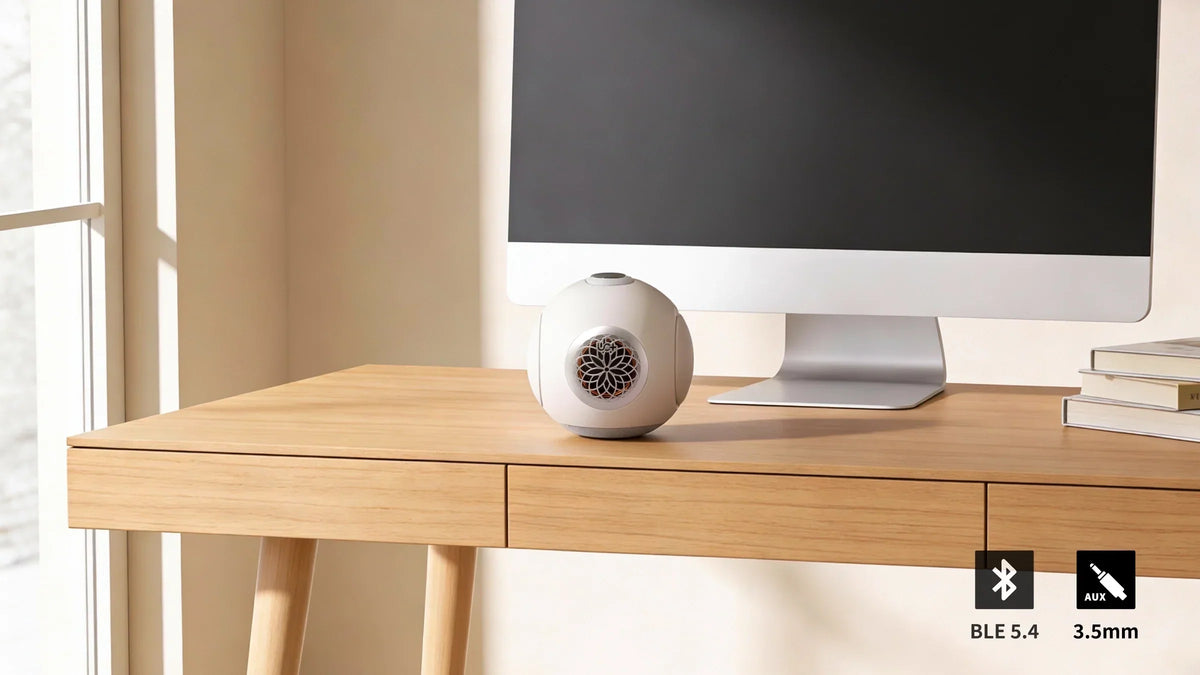
This makes a Bluetooth speaker for home listening particularly convenient for households where music comes from multiple personal devices rather than a fixed hi-fi rack.
It also makes temporary listening positions much easier.
Move the speaker to another room, connect a different device, and continue listening without rearranging the room around cables.
Bluetooth Compression: What Actually Happens?
Bluetooth audio normally requires the source to encode audio before transmission.
The receiving speaker then decodes that signal.
The codec determines how the audio data is compressed and transmitted.
Common Bluetooth codecs include:
- SBC
- AAC
- aptX
- aptX HD
- LDAC
The exact codec support varies between the transmitting device and receiving speaker.
Codec quality matters because lossy compression removes some information from the original audio signal. However, codec selection should not be treated as the only measurement of sound quality.
The speaker itself remains critical.
A high-quality codec connected to a poorly engineered speaker cannot produce excellent acoustic performance.
Conversely, a well-designed speaker can provide a highly enjoyable listening experience even when the wireless transmission does not reproduce every bit of the original recording.
Codec Support vs Real-World Sound Quality
Buyers often spend too much time comparing codec names while ignoring the complete audio chain.
A useful evaluation should consider:
|
Component |
Why It Matters |
|
Bluetooth codec |
Determines how audio is encoded for transmission |
|
Wireless implementation |
Affects stability and reliability |
|
DAC |
Converts digital information into an analog signal |
|
Amplifier |
Drives the speaker system |
|
Driver |
Converts electrical energy into acoustic movement |
|
Enclosure |
Controls internal acoustic behavior |
|
Acoustic tuning |
Determines tonal balance and response |
The codec is one part of the chain.
It does not independently determine whether a speaker sounds good.
This is particularly important when comparing a high-end wireless speaker with a traditional component-based system.
The Listening Room Changes the Equation
A listening room provides a controlled environment that can expose differences between speaker architectures.
Room size, wall construction, furniture, floor surfaces, ceiling height, and speaker placement all influence what reaches your ears.
A speaker with strong direct output but poor resonance control can sound less accurate than its specifications suggest.
Likewise, a wireless speaker with excellent acoustic engineering can outperform expectations despite its compact enclosure.
This is why the physical speaker should be evaluated separately from the connection method.
Wireless transmission does not determine cabinet resonance.
A cable does not automatically guarantee superior bass.
Acoustic Spotlight: How the dB1 Approaches Bass Reproduction
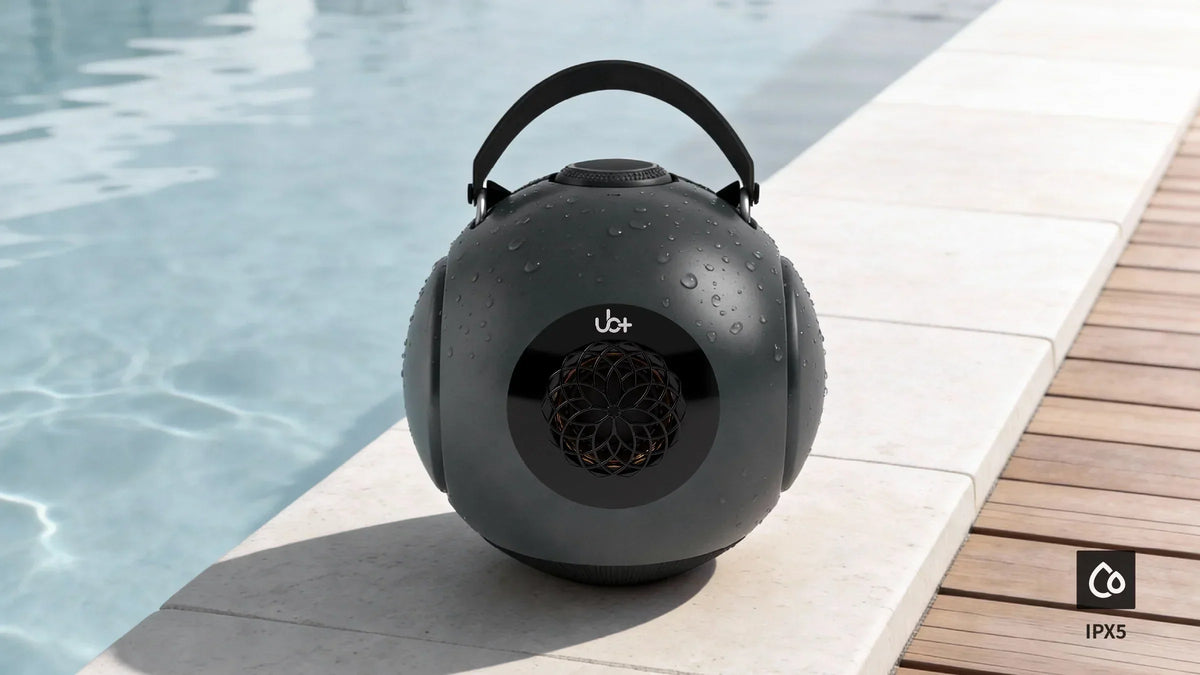
The UB+ dB1 DoubleBass uses a patented spherical acoustic chamber inspired by the Helmholtz Resonance principle. The spherical geometry distributes internal air pressure more evenly than conventional rectangular enclosures with parallel internal surfaces, helping reduce standing-wave behavior and associated phase distortion while supporting harmonic reproduction.
At the center of the architecture is a 4.5-inch long-stroke mid-bass driver firing downward into the chamber. Its movement pressurizes the internal air volume and activates two symmetrical passive radiators positioned on opposing sides.
The combined passive-radiator surface area is approximately 3.5× that of the active woofer, increasing the amount of air the system can move at low frequencies.
The opposing radiators also form a self-cancelling vibration architecture. Their symmetrical movement reduces unwanted mechanical energy transferred into the enclosure while directing more of the system's movement toward acoustic output.
The driver incorporates a 90 mm oversized neodymium magnet, 35 mm long-stroke voice coil, 20 mm piston movement, aluminum shorting ring, and 18 mm extra-wide surround.
The system is specified at approximately 40 Hz–20 kHz and around 93 dB SPL. Bluetooth 5.3 handles wireless connectivity, while onboard DSP monitors system behavior and protects the hardware rather than artificially generating the low-frequency response.
Does Wireless Automatically Mean Lower Sound Quality?
No.
The assumption that every wired speaker must sound better than every Bluetooth speaker is no longer technically defensible.
The connection method is only one part of the system.
A Bluetooth speaker can deliver excellent sound when its:
- Driver is properly engineered
- Amplification is appropriately matched
- Enclosure controls resonance
- Acoustic tuning is accurate
- Wireless implementation is stable
- Digital processing is appropriately applied
At the same time, a wired speaker can perform poorly if the drivers, enclosure, crossover, amplifier, or room integration are poorly designed.
The better comparison is between complete systems rather than cable versus Bluetooth in isolation.
Where Wired Still Has an Advantage
Wireless technology has improved substantially, but wired systems retain several technical advantages.
Dedicated Source Compatibility
A component-based listening room can accommodate a wider range of sources.
For example, a traditional system can be integrated with:
- Turntables
- CD players
- Dedicated DACs
- Network streamers
- Preamplifiers
- External amplifiers
- Professional audio interfaces
A Bluetooth-only design may offer fewer physical input options.
Upgradeability
Component-based wired systems can often be upgraded individually.
You might replace an amplifier while keeping the speakers, or upgrade the source without changing the entire audio system.
An integrated wireless speaker generally packages more components into one product.
That makes it simpler but potentially less modular.
Continuous Power
A conventional powered speaker connected to mains electricity does not depend on a battery for operation.
For a permanent listening-room installation, this can be an advantage.
There is no need to monitor remaining battery capacity before a long listening session.
Where Bluetooth Has the Advantage
Wireless systems reverse several of those priorities.
Placement Freedom
The biggest practical benefit is freedom from signal cables.
You can position the speaker on a shelf, console, desk, side table, or another suitable location without routing a cable back to the audio source.
This can be especially useful in minimalist interiors.
Faster Setup
A Bluetooth system can often be operational within minutes.
Pair the source, select the speaker, and begin playback.
There is no requirement to install a rack of components before listening.
Multiple Personal Sources
A household may have several people using the same speaker.
One person can stream from a phone while another uses a laptop or tablet at another time.
That makes Bluetooth particularly convenient for shared spaces.
Wireless Latency in Real-World Listening
Latency deserves context.
For music, a delay of several milliseconds between pressing play and hearing the first sound is usually irrelevant.
The more important issue occurs when audio must remain synchronized with another signal.
Examples include:
- Movies
- YouTube videos
- Gaming
- Live performance
- Musical instrument monitoring
Video applications can compensate for some latency by delaying the visual signal.
However, not every application handles synchronization equally well.
For a listening room used primarily for music, Bluetooth latency is usually a minor consideration.
For a room used equally for music, television, and gaming, connection architecture becomes more important.
Bluetooth Stability Matters More Than Maximum Range
Wireless specifications can emphasize theoretical range, but real-world performance depends on the environment.
Walls, interference, other wireless devices, source hardware, and physical positioning can influence reliability.
A good wireless audio system should maintain a stable connection during normal household use.
Practical stability is more important than a headline range number that assumes ideal conditions.
Wired vs Bluetooth for Different Listening Habits
|
Listening Situation |
Wired |
Bluetooth |
|
Dedicated critical listening |
Excellent |
Very good |
|
Casual music |
Very good |
Excellent |
|
Smartphone streaming |
Moderate |
Excellent |
|
Turntable setup |
Excellent |
Depends on system |
|
Gaming |
Excellent |
Depends on latency |
|
TV watching |
Excellent |
Depends on latency |
|
Multi-device household |
Moderate |
Excellent |
|
Minimalist room |
Cable management required |
Excellent |
|
Fixed installation |
Excellent |
Very good |
|
Frequent repositioning |
Less convenient |
Excellent |
|
Portable listening |
Poor |
Excellent |
The ideal architecture depends on the primary use case.
What About Audiophile Listening?
Audiophile listeners often prioritize characteristics such as:
- Low distortion
- Tonal accuracy
- Frequency response
- Dynamic range
- Soundstage
- Imaging
- Driver integration
- Resonance control
None of these characteristics inherently requires a physical cable.
A wireless speaker can be designed around serious acoustic engineering.
However, audiophiles who prefer separate DACs, amplifiers, sources, and upgradeable components may still prefer a wired architecture because it gives them greater control over the signal chain.
This is less about one technology being universally superior and more about how much control the listener wants over the system.
Soundstage and Channel Separation
A traditional stereo system normally uses separate left and right speakers positioned around the listener.
This creates a physical stereo image with dedicated channels.
Many Bluetooth speakers use a different approach.
Some are designed as mono systems, while others use multiple drivers or internal channel arrangements to create a wider presentation.
A wireless stereo speaker system can therefore offer a convincing presentation, but buyers should examine how the speaker actually produces channel separation rather than assuming every wireless enclosure creates conventional stereo imaging.
For dedicated critical listening, physical speaker placement remains important.
Bass Is Not Determined by the Connection Type
One of the most persistent misconceptions is that wired speakers automatically produce deeper bass.
The connection does not create bass.
The acoustic system does.
Low-frequency performance depends on:
- Driver displacement
- Enclosure volume
- Resonance tuning
- Passive-radiator design
- Amplifier capability
- Driver control
- Distortion
- Room interaction
A wired speaker can have weak bass.
A Bluetooth speaker can have strong bass.
The engineering architecture determines the result.
Convenience Has a Real Economic Value
A listening system should be used frequently enough to justify its cost.
A technically impressive setup that takes several steps to operate may be used less often than a system that starts playing immediately.
Bluetooth reduces friction.
For many households, that means more frequent listening.
The value of wireless audio is therefore not limited to eliminating cables. It changes how easily people interact with their music.
For commercial buyers comparing wireless home speakers, this usability factor should be included alongside traditional audio specifications.
Which One Should You Buy?
Choose Wired If You:
- Want a dedicated component-based system
- Use multiple physical sources
- Prioritize extremely low latency
- Want maximum upgrade flexibility
- Prefer permanent installation
- Use external amplification or DACs
- Want direct control over the signal chain
Choose Bluetooth If You:
- Stream primarily from phones and computers
- Want minimal cable clutter
- Move the speaker between locations
- Share the system with multiple household users
- Prioritize quick setup
- Want flexible placement
- Prefer an integrated audio solution
Choose Based on Your Actual Room
A dedicated listening room used exclusively for critical music listening may justify the complexity of a traditional component system.
A modern living room used for music, podcasts, streaming, work, and casual entertainment may benefit more from wireless flexibility.
The physical room should influence the decision just as much as the audio source.
Wired vs Bluetooth Speaker Comparison
|
Category |
Wired System |
Bluetooth System |
|
Signal path |
Physical |
Wireless |
|
Cable requirement |
High |
Minimal |
|
Setup |
More involved |
Simple |
|
Placement freedom |
Limited by cables |
High |
|
Latency |
Very low |
Codec/system dependent |
|
Codec dependency |
Lower |
Higher |
|
Source flexibility |
Usually high |
High for compatible wireless sources |
|
Component upgrades |
Strong |
More limited |
|
Portability |
Low |
High |
|
Everyday convenience |
Moderate |
High |
|
Battery operation |
Usually no |
Possible |
|
Minimalist installation |
More difficult |
Easier |
|
Dedicated hi-fi integration |
Excellent |
System dependent |
Buying Checklist
Before choosing between wired and Bluetooth audio for your listening room, check:
1. Source Compatibility
Identify every device you expect to connect.
2. Latency Requirements
If you watch video or play games, investigate synchronization performance.
3. Codec Support
Check which codecs both your source and speaker actually support.
4. Acoustic Architecture
Do not evaluate connectivity separately from the speaker's driver and enclosure design.
5. Placement
Determine whether cables will restrict your preferred speaker position.
6. Power
Consider whether permanent AC power or battery operation better suits your listening habits.
7. Upgrade Path
Component-based listeners may prefer equipment that can be replaced individually.
8. Daily Convenience
A system that is easier to operate is more likely to be used regularly.
Frequently Asked Questions
Is wired audio always better than Bluetooth?
No. Wired transmission removes wireless compression and latency concerns, but overall sound quality depends on the complete audio system, including drivers, amplification, enclosure, tuning, and room interaction.
Does Bluetooth reduce sound quality?
Bluetooth can involve lossy compression depending on the codec, but modern implementations can provide very high-quality playback. The practical difference also depends heavily on the speaker itself.
Is Bluetooth good enough for an audiophile listening room?
It can be, particularly when the speaker uses high-quality drivers, controlled acoustics, appropriate amplification, and a stable wireless implementation. Listeners who require external components and maximum upgrade flexibility may still prefer wired systems.
Is wired better for bass?
Not inherently. Bass performance is primarily determined by the speaker's acoustic architecture, driver displacement, enclosure design, amplification, and tuning rather than whether the signal arrived by cable or Bluetooth.
Is Bluetooth better for a minimalist home?
Usually. Eliminating the source-to-speaker signal cable provides substantially more flexibility when positioning the speaker and maintaining a clean visual layout.
Final Verdict
The wired vs bluetooth speaker for home audio decision is not really a choice between "better sound" and "more convenience." Modern wireless systems can deliver serious acoustic performance, while wired systems continue to provide advantages for dedicated component-based listening.
Choose wired when signal-chain control, physical sources, extremely low latency, and upgradeability are priorities.
Choose Bluetooth when placement flexibility, simplified setup, device compatibility, and everyday usability matter more.
For a modern listening room, the most important distinction is therefore not the presence of a cable. It is whether the complete speaker system is engineered to reproduce the music accurately in the environment where you will actually use it.
Explore Your UB+ Options
→ Compare dB1 vs dB Mini
Review the differences in design, acoustic performance, placement, and intended use.
→ Explore UB+ Speakers
See the complete UB+ range at UB+.
→ Check Current Price
Review current product information, specifications, pricing, and availability.
Choose the connection that fits your listening habits and the acoustic design that fits your room.


Commenta
Questo sito è protetto da hCaptcha e applica le Norme sulla privacy e i Termini di servizio di hCaptcha.