
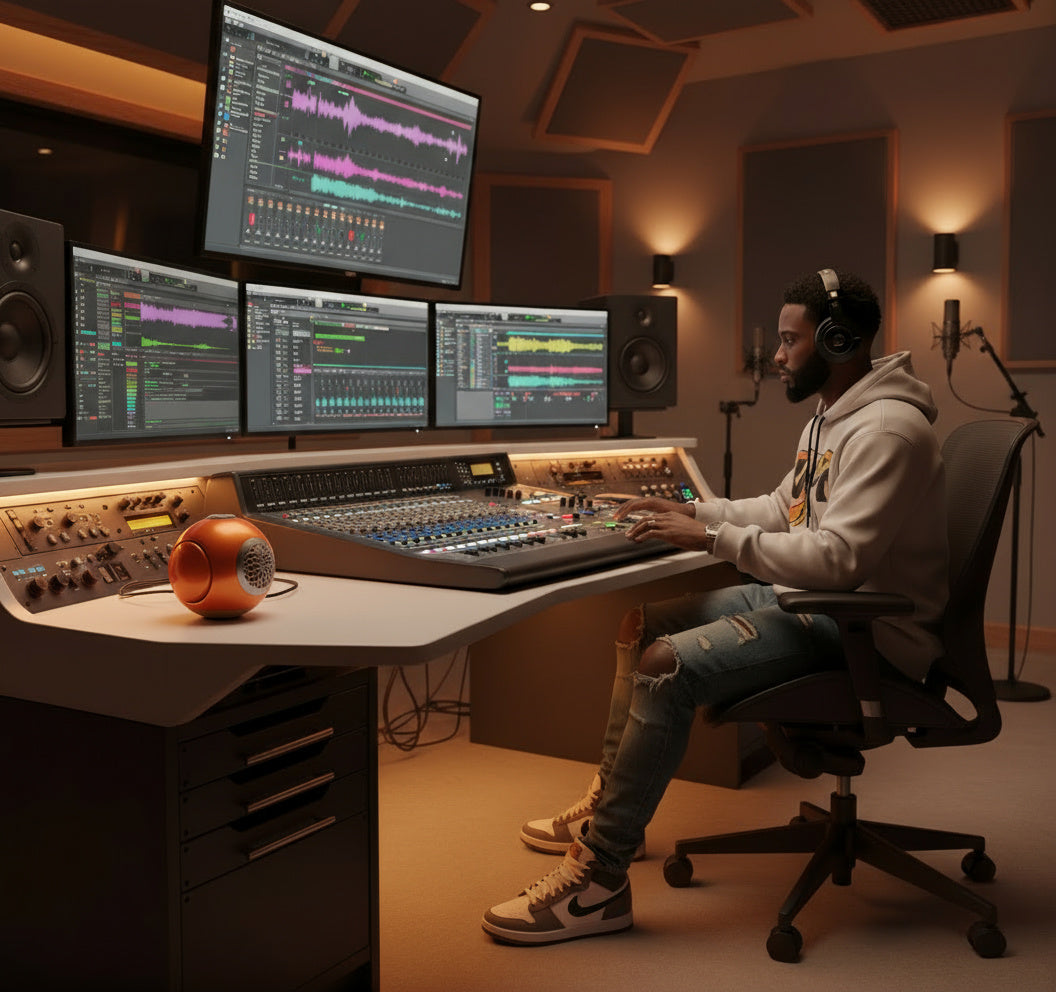
Finding the best speakers for small apartments and studios is not simply a matter of choosing the smallest speaker available. Compact rooms create their own acoustic challenges: limited floor space, reflective walls, close listening distances, and furniture that can quickly become crowded with electronics. The right speaker needs to deliver enough sound to fill the space without requiring a large stereo system or taking over the room.
For many compact living spaces, a portable Bluetooth speaker can provide a practical combination of sound, flexibility, and minimal footprint. But different compact speakers solve different problems. A room-focused speaker should prioritize sound distribution and bass performance, while an ultra-portable model may prioritize size and mobility.
The UB+ dB1 DoubleBass and dB Mini represent two different approaches. The dB1 uses a spherical acoustic architecture and broad sound dispersion for room-oriented listening, while the dB Mini is designed around compact portability. Understanding that difference makes it easier to choose the right speaker for an apartment, studio, desk, bedroom, or small gathering.
Why Speaker Size Matters in a Small Apartment or Studio

Small spaces change how you experience sound.
In a large room, listeners may be several meters away from the speaker, and a larger system may be needed to provide sufficient acoustic output. In a studio apartment or compact bedroom, the listening distance is usually much shorter.
That means maximum loudness is not necessarily the most important specification.
Instead, consider:
- How much physical space the speaker occupies
- How widely it distributes sound
- How well it handles bass in a confined room
- Whether it can be placed on a shelf, table, or desk
- How easily you can move it between rooms
- Whether it works for both personal listening and small gatherings
A compact speaker can also reduce the need for multiple pieces of equipment. Instead of dedicating floor space to separate components, a single portable system can handle music, podcasts, movies, work sessions, and casual listening.
For more guidance on matching speaker size to a room, see how to choose the right speaker size for your room.
What Makes a Good Speaker for a Small Room?

A good small-room speaker needs to balance acoustic performance with physical practicality.
Bass is particularly important. Small rooms can reinforce low frequencies because nearby walls and surfaces interact with the sound. Excessive bass can therefore become boomy or uneven, while insufficient low-frequency extension can make music sound thin.
Dispersion also matters.
If you normally sit directly in front of your speaker, a conventional front-firing design may work well. But if you move around the apartment while listening, broader dispersion can make the listening experience more consistent.
This is where a 360-degree Bluetooth speaker can be particularly useful. Instead of creating one narrow listening position, it distributes sound around the enclosure.
Spherical Design and 360° Sound for Compact Rooms
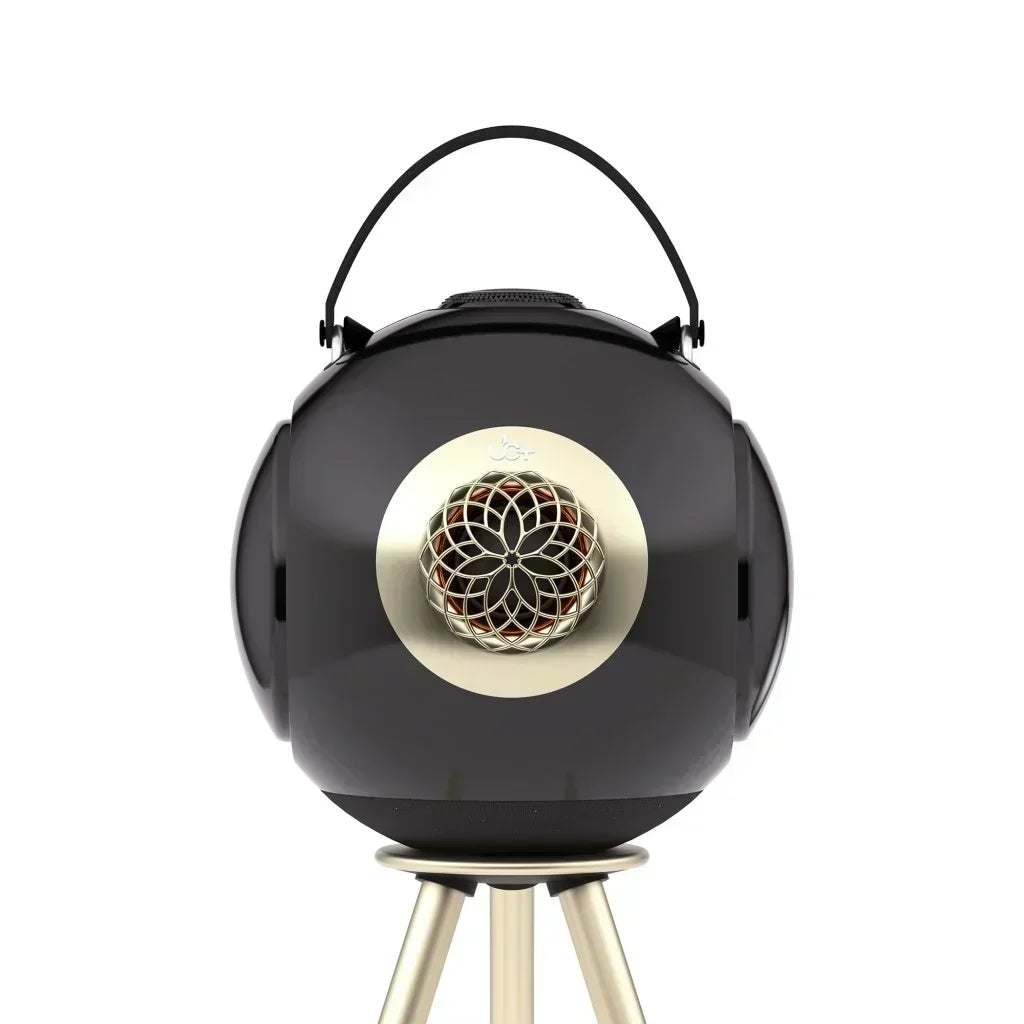
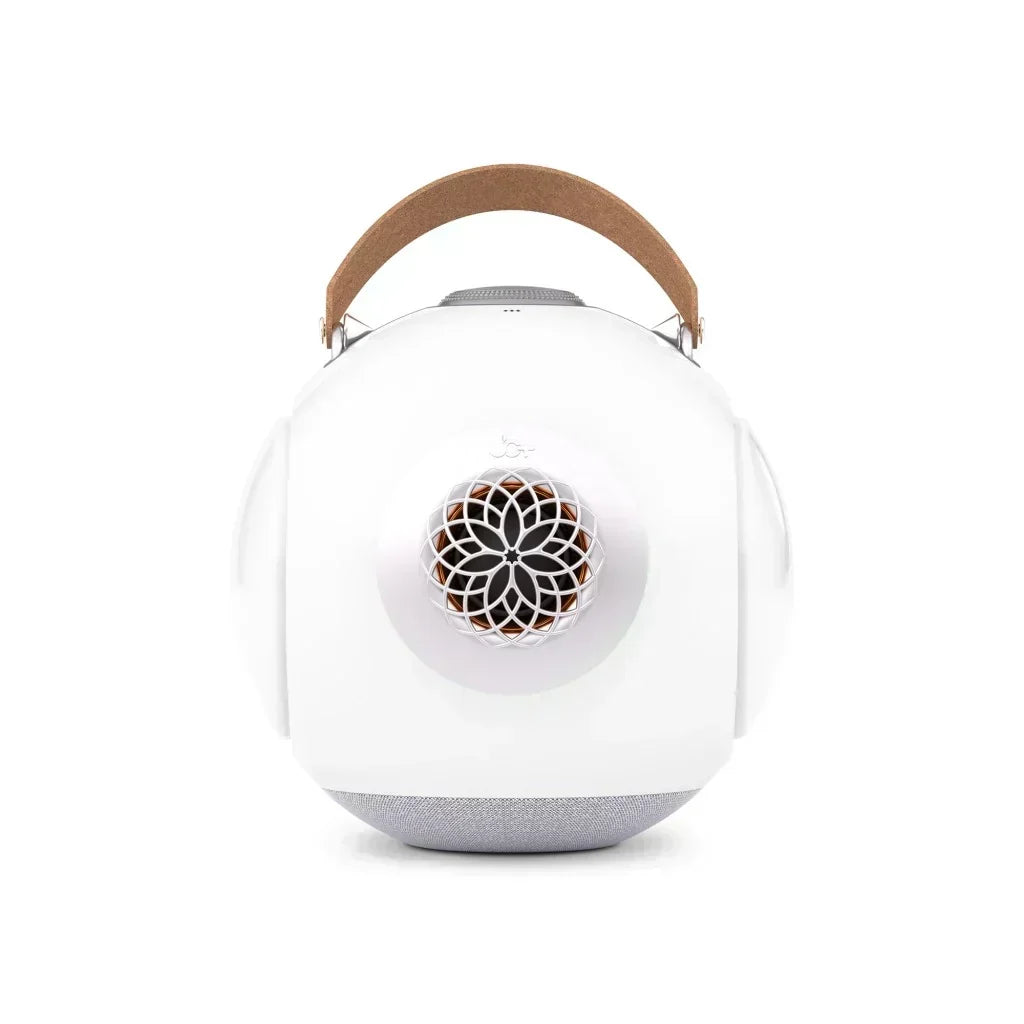
The UB+ dB1 DoubleBass takes a different approach from the conventional rectangular speaker.
Its spherical enclosure is part of the acoustic system, not simply a visual design choice. The spherical chamber is inspired by the Helmholtz resonance principle and is designed to distribute internal air pressure more evenly while reducing problematic internal standing-wave behavior.
The external shape also supports the dB1's 360° spherical sound dispersion.
For a small apartment, this can be useful because the speaker does not need to be aimed precisely toward one seating position. Music can remain present as you move from a desk to a sofa, kitchen, or dining area.
This is particularly useful in open-plan apartments where one compact speaker may serve several areas.
You can learn more about the relationship between spherical construction and acoustic performance in spherical speakers and modern home audio.
How the dB1 DoubleBass Creates Room-Filling Sound
The dB1 DoubleBass is designed around more than simply increasing amplifier power.
Its central 4.5-inch long-throw mid-bass driver works into the spherical acoustic chamber, while two opposing passive-radiator plates respond to the internal air pressure.
The combined passive-radiator surface area is approximately 3.5× the active woofer area.
This architecture gives the enclosure a mechanical approach to bass production. The opposing radiators also help balance the mechanical forces generated by the speaker system, reducing the tendency for those forces to translate into unwanted cabinet movement.
The result is a compact speaker designed to produce substantial low-frequency output without relying primarily on aggressive electronic bass boosting.
For a deeper explanation of the technology, see passive radiators versus ported speaker designs.
Why Bass Matters in a Small Room
Bass is often one of the first things people notice when moving from a small portable speaker to a more capable compact system.
A speaker with limited low-frequency extension can make drums, basslines, movie sound effects, and electronic music feel lightweight. But simply increasing bass through DSP is not always the answer.
Low-frequency reproduction requires physical air movement.
The dB1 uses its long-throw driver, spherical chamber, and dual passive radiators to create an acoustic system capable of supporting deeper bass from a relatively compact enclosure.
Its stated frequency response extends to approximately 40Hz, giving the speaker a useful low-frequency range for music and movie content.
For a technical explanation of what frequency response actually tells you, see bass extension explained in Hz.
The DB Mini: When Maximum Portability Matters
Not every small apartment needs a room-focused speaker.
Sometimes portability is the priority.
The UB+ dB Mini is designed for listeners who want a compact speaker that can easily move between rooms, travel with them, or fit naturally into smaller spaces.
This makes the dB Mini particularly relevant for:
- Bedroom listening
- Kitchen use
- Desk listening
- Small workspaces
- Travel
- Outdoor casual listening
- Moving between rooms
The difference between the dB1 and dB Mini is therefore less about simply deciding which speaker is “better” and more about deciding what you need the speaker to do.
If the speaker will mostly stay in one apartment and you want broad room coverage and stronger bass architecture, the dB1's design becomes more relevant. If the speaker needs to disappear into a bag or move constantly around your home, compact portability becomes a greater priority.
DB1 DoubleBass vs. DB Mini
The two UB+ models address different requirements, making a direct feature comparison useful.
|
Feature |
UB+ dB1 DoubleBass |
UB+ dB Mini |
|
Primary design goal |
Room-oriented sound and bass performance |
Maximum portability |
|
Form factor |
Spherical |
Compact |
|
Sound approach |
360° spherical dispersion |
Compact-speaker listening |
|
Acoustic architecture |
Spherical chamber with dual passive radiators |
Compact portable architecture |
|
Best for |
Apartments, studios, living rooms, small gatherings |
Bedrooms, desks, travel, moving around the home |
|
Portability |
Portable |
Highly portable |
|
Bass focus |
Deep, mechanically supported bass |
Compact-speaker performance |
|
Placement flexibility |
Broad room coverage |
Easy to move and reposition |
The choice becomes straightforward when you identify your main priority.
Choose the dB1 DoubleBass If You Want Room-Filling Sound
The dB1 makes sense when your speaker will primarily serve a room rather than a backpack.
Its spherical enclosure and 360° dispersion allow it to work naturally in spaces where people are not always sitting directly in front of the speaker. The dual passive-radiator system also gives its bass architecture a much larger acoustic footprint than the active driver alone suggests.
For a studio apartment, this can make one speaker useful across several listening positions.
Choose the dB Mini If Portability Comes First
The dB Mini is better suited to a lifestyle where the speaker moves frequently.
You might use it on your desk in the morning, move it into the kitchen during lunch, take it into another room in the evening, and pack it for a weekend trip.
Its smaller physical footprint makes that type of use practical.
Speaker Placement Matters More in a Small Room
Even an excellent compact speaker can sound different depending on where you place it.
Small rooms have more nearby surfaces, so reflections can strongly influence what you hear.
Avoid automatically placing the speaker directly against a wall or inside a tightly enclosed shelf. Give the enclosure enough open space for its acoustic output to develop naturally.
For a spherical 360-degree design, the speaker generally benefits from having open space around it rather than being pushed into a corner.
A central position on a table or open shelf can allow broader sound distribution.
For more practical placement advice, see the UB+ guide to Bluetooth speaker placement for better bass and clarity.
Desktop Listening in a Studio Apartment
A desk can serve several purposes in a small home: workstation, entertainment area, music listening position, and sometimes dining space.
That makes footprint particularly important.
A large conventional speaker may provide excellent sound but consume valuable desk or floor space. A compact Bluetooth speaker can provide a simpler setup without adding multiple components.
For near-field listening, you also do not need the same acoustic output required to fill a large room. Clarity, balanced response, and convenient placement can matter more than maximum volume.
The dB Mini is particularly suited to this kind of flexible placement, while the dB1 can work when the desk is part of a larger room that also needs broader sound coverage.
Small Apartments Need Controlled Bass, Not Just More Bass
One common mistake is assuming that a small room automatically requires a small speaker with very little bass.
That is not necessarily true.
The issue is not simply how much bass a speaker produces. It is how that bass interacts with the room.
Walls and corners can reinforce low frequencies. A speaker with uncontrolled bass can therefore sound exaggerated when placed in the wrong location.
A well-designed speaker should maintain useful low-frequency extension while keeping the overall presentation controlled.
This is one reason the dB1's acoustic architecture is important. Its spherical chamber and opposing passive radiators are designed to make the physical enclosure part of the bass solution.
360° Sound vs. Front-Firing Speakers
The choice between broad dispersion and directional sound depends on how you use the room.
|
Listening Environment |
More Relevant Design |
|
Desk with fixed listening position |
Front-facing or compact directional speaker |
|
Sofa with several listeners |
Broad dispersion |
|
Open-plan apartment |
360° or wide dispersion |
|
Kitchen and living area |
Broad sound distribution |
|
Speaker aimed toward one listener |
Front-firing design |
|
Small gathering |
Wide or 360° coverage |
A 360-degree design does not automatically produce better sound in every situation. Its advantage is that it changes how the speaker interacts with the listening environment.
For more detail, read 360° versus front-firing speaker designs.
Small Apartment Speaker Buying Checklist
Before buying a speaker for a studio or apartment, consider these questions:
How much space do I have?
Measure the area where the speaker will actually live rather than choosing based only on the manufacturer's description of portability.
How far will I sit from it?
Short listening distances require less maximum output than large-room listening.
Do I move around while listening?
If yes, broader dispersion can be valuable.
How important is bass?
If you listen to hip-hop, EDM, cinematic music, or bass-heavy recordings, examine the speaker's low-frequency architecture rather than just its advertised bass boost.
Will I use it outside?
If the speaker regularly leaves the apartment, battery performance and IP protection become more important.
Do I want one speaker to serve several rooms?
A portable, broadly dispersing speaker can be more practical than a fixed stereo setup.
dB1 DoubleBass Acoustic Spotlight
The dB1 DoubleBass combines several design decisions specifically relevant to listeners who want substantial sound from a compact enclosure.
Its spherical acoustic chamber is inspired by the Helmholtz resonance principle. A centrally positioned 4.5-inch long-throw mid-bass driver works into the chamber, while two opposing passive radiators respond to the internal pressure.
The passive radiators have a combined surface area approximately 3.5× larger than the active woofer area, allowing the acoustic system to move a substantial amount of air.
The driver system also incorporates a 90mm neodymium magnet, 35mm long-stroke voice coil, approximately 20mm piston movement, aluminum shorting ring, and 18mm-wide surround.
The dB1 is specified at approximately 40Hz–20kHz and 93dB SPL, with Bluetooth 5.3 connectivity and IPX5 water resistance.
These specifications matter because they describe a complete acoustic system rather than simply a compact speaker with a high-power amplifier.
Which Speaker Fits Your Apartment?
|
Your Priority |
Better Fit |
|
Room-filling sound |
dB1 DoubleBass |
|
360° listening |
dB1 DoubleBass |
|
Stronger bass architecture |
dB1 DoubleBass |
|
One speaker for an apartment |
dB1 DoubleBass |
|
Desk listening |
dB Mini |
|
Maximum portability |
dB Mini |
|
Moving between rooms |
dB Mini |
|
Travel |
dB Mini |
|
Small gatherings |
dB1 DoubleBass |
|
Minimal physical footprint |
dB Mini |
The important distinction is not simply size. It is how you want the speaker to function inside your space.
A speaker that stays on a central table and needs to serve several listeners has different requirements from one that travels between a desk, bedroom, kitchen, and backpack.
Frequently Asked Questions
What is the best type of speaker for a small apartment?
Look for a compact speaker with useful bass extension, controlled output, flexible placement, and suitable dispersion. For spaces where listeners move around the room, broad or 360° sound distribution can be particularly useful.
Is a 360° speaker better for a studio apartment?
A 360° speaker can be useful in a studio because sound is distributed around the enclosure rather than concentrated toward one listening direction. It can be especially practical in open-plan spaces where there is no single fixed listening position.
Is the dB1 DoubleBass too large for a small apartment?
The dB1 is designed as a compact portable speaker rather than a traditional large-room audio system. Its spherical form factor also provides broad sound distribution, making it suitable for rooms where space and placement flexibility matter.
Should I choose the dB1 or dB Mini?
Choose based on your primary use. The dB1 is oriented toward room-filling sound, 360° dispersion, and stronger bass architecture. The dB Mini prioritizes compact portability and easy movement.
Where should I place a Bluetooth speaker in a small room?
Avoid automatically placing it inside a closed shelf or tightly against a wall. Give the speaker open space where possible, and experiment with its position because nearby walls and furniture can significantly affect bass and reflections.
Explore UB+ Speakers
→ Explore the UB+ dB1 DoubleBass
→ Compare the dB1 DoubleBass with the dB Mini
For a small apartment or studio, the goal is not to fit the biggest speaker into the smallest room. It is to choose an acoustic system that makes efficient use of the space you have. The dB1 DoubleBass approaches that challenge through spherical construction, 360° dispersion, and mechanically supported bass, while the dB Mini focuses on keeping high-quality listening exceptionally easy to move.


コメントを書く
このサイトはhCaptchaによって保護されており、hCaptchaプライバシーポリシーおよび利用規約が適用されます。