
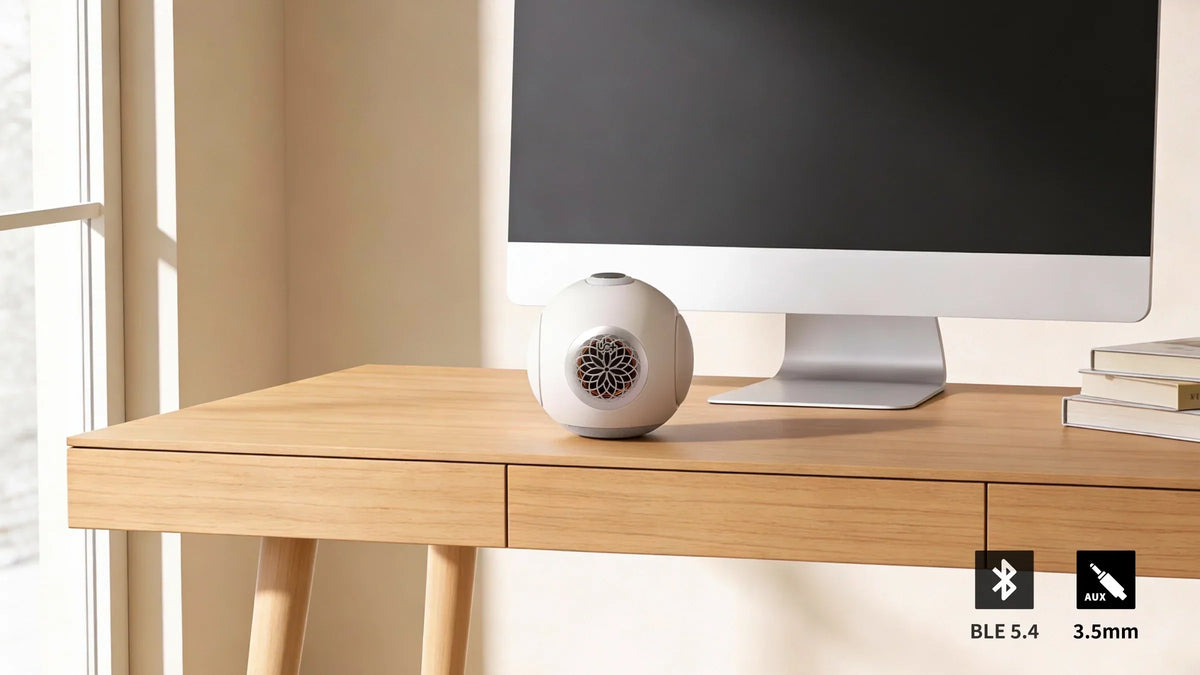
The compact vs full size bluetooth speaker decision should be based on where you actually listen, how far you sit from the speaker, and how much acoustic output you need. A compact model can be ideal for desks, bedrooms, offices, and small apartments, while a full-size system becomes more useful when you need greater bass, higher output, and more acoustic headroom for larger rooms or outdoor listening. For buyers comparing a compact Bluetooth speaker, full-size Bluetooth speaker, or portable wireless speaker, physical dimensions are only the starting point.
Compact vs Full-Size: What Is the Real Difference?
Speaker size affects the amount of internal acoustic volume, component space, and air movement available to the designer. A larger enclosure can generally accommodate more substantial acoustic hardware, while a compact speaker has to achieve its performance within tighter physical constraints.
That does not make a full-size speaker automatically better.
A large cabinet with poor resonance control can produce less accurate sound than a smaller enclosure with carefully engineered acoustics. Similarly, a compact speaker can be insufficient if it is regularly pushed beyond the output required by the listening environment.
The practical comparison should therefore consider:
- Room size
- Listening distance
- Desired volume
- Bass requirements
- Driver architecture
- Enclosure design
- Portability
- Battery requirements
- Placement
- Indoor versus outdoor use
|
Factor |
Compact Speaker |
Full-Size Speaker |
|
Physical footprint |
Minimal |
Larger |
|
Desk placement |
Excellent |
Less practical |
|
Small rooms |
Usually suitable |
May provide unnecessary capacity |
|
Large rooms |
More limited |
Better suited |
|
Bass potential |
Highly dependent on engineering |
Generally greater |
|
Portability |
Easier |
More demanding |
|
Outdoor group listening |
Smaller areas |
Larger areas |
|
Listening distance |
Short to moderate |
Moderate to long |
|
Acoustic headroom |
Moderate |
Higher |
|
Best use |
Personal and everyday listening |
Room-filling and higher-output listening |
The right choice depends on how much of the speaker's available capability you will actually use.
When a Compact Bluetooth Speaker Is the Better Choice

Compact speakers are most effective when the listener is relatively close to the system.
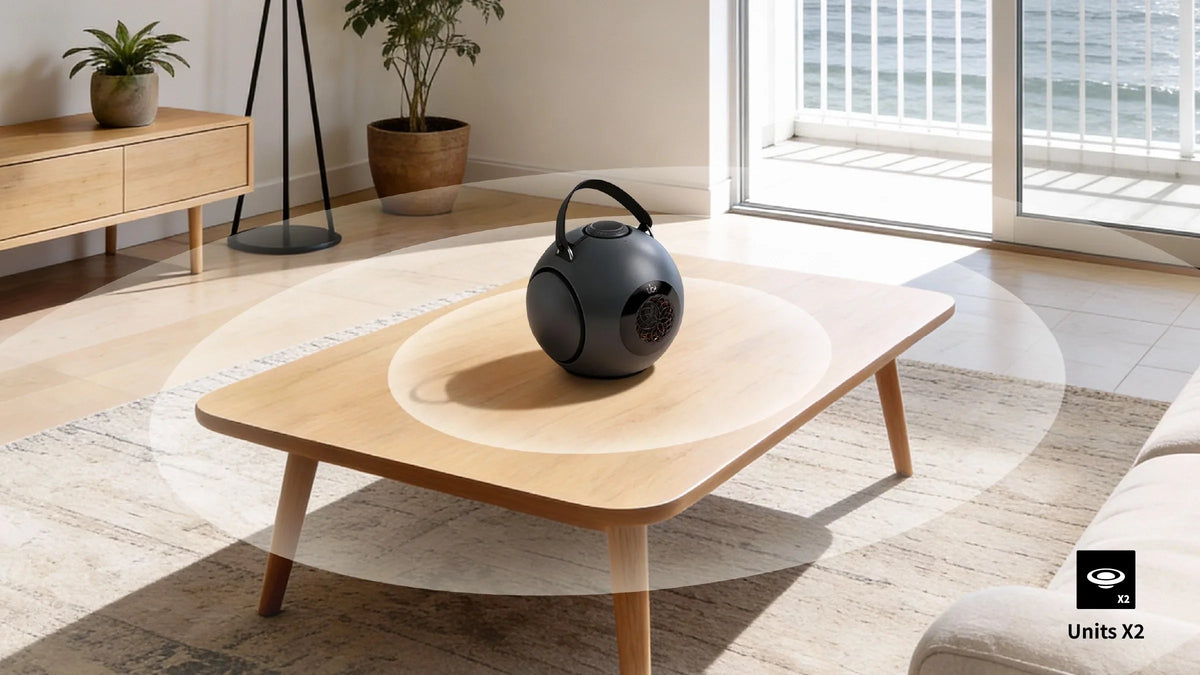
A desk, bedside table, home office, kitchen counter, or small bedroom does not require the same acoustic output as a large living room.
A small wireless speaker can therefore be the better purchase when:
- Listening distance is short
- Moderate playback levels are normal
- Space is limited
- The speaker moves between rooms
- Portability matters
- The system is primarily for personal listening
Small rooms also contain nearby boundaries. Walls, furniture, and corners can reinforce low-frequency energy, reducing the need for extreme acoustic output.
For a bedroom or office, buying a much larger speaker simply because it produces more volume can create an unnecessary trade-off in physical space.
When a Full-Size Bluetooth Speaker Makes More Sense

Larger spaces change the acoustic requirements.
As listening distance increases, more output is required to maintain the same perceived level at the listener's position.
A full-size system becomes more useful for:
- Large living rooms
- Open-plan interiors
- Large patios
- Workshops
- Outdoor gatherings
- Group listening
- Higher-volume playback
The advantage is not simply loudness.
Greater acoustic headroom allows a system to reproduce dynamic passages without constantly operating close to its maximum capability.
This can be particularly important with music containing substantial bass energy or sudden changes in volume.
A full-size wireless speaker is therefore more appropriate when coverage and output matter more than minimum physical footprint.
Acoustic Engineering Can Change the Size Equation
Physical dimensions do not tell the complete story of speaker performance.
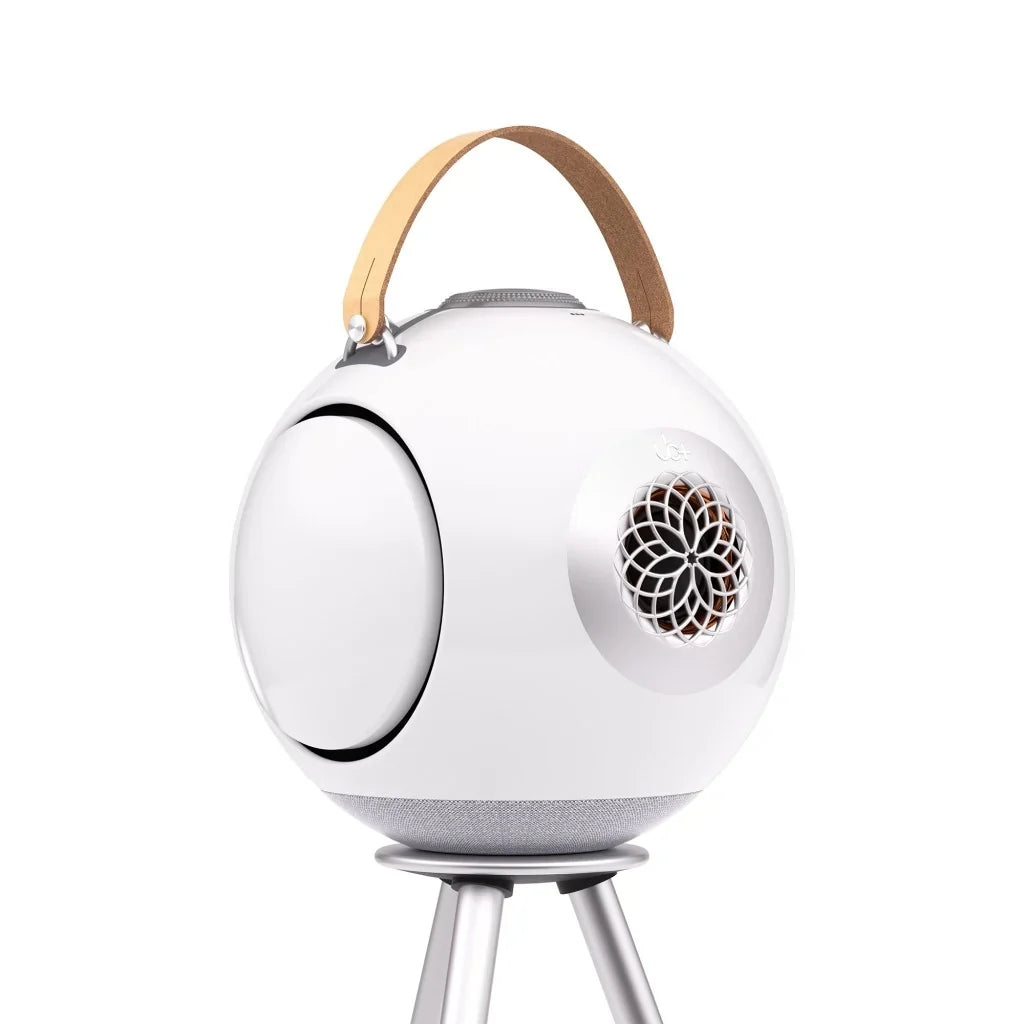
The UB+ dB1 DoubleBass uses a patented spherical acoustic chamber inspired by the Helmholtz Resonance principle. Its spherical geometry changes how internal air pressure behaves compared with conventional rectangular cabinets containing parallel internal surfaces.
The design distributes internal pressure more evenly and reduces unwanted standing-wave behavior.
This helps minimize phase distortion and supports improved harmonic reproduction.
The enclosure therefore serves an active acoustic function rather than simply acting as a container for the electronic components.
For buyers comparing a compact high-end Bluetooth speaker, this is an important distinction: two speakers with similar external dimensions can have very different acoustic performance because their internal architectures are fundamentally different.
Acoustic Spotlight: Mechanical Bass Architecture
Low-frequency reproduction creates one of the biggest engineering challenges for compact speakers.
The dB1 uses a 4.5-inch long-stroke mid-bass driver firing downward into the spherical chamber. Driver movement changes the internal air pressure, which activates two symmetrical passive radiators positioned on opposite sides of the enclosure.
The combined passive-radiator surface area is approximately 3.5× larger than the active woofer.
This architecture creates mechanical bass amplification by using the movement of air inside the chamber to drive the passive radiators.
The opposing radiator movement also produces a self-cancelling vibration architecture. Mechanical forces generated on opposing sides work against each other, reducing unnecessary cabinet movement and directing more energy toward acoustic output.
The driver system incorporates a 90 mm oversized neodymium magnet, 35 mm long-stroke voice coil, 20 mm piston movement, aluminum shorting ring, and 18 mm extra-wide surround.
The published performance is approximately 40 Hz–20 kHz with output around 93 dB SPL.
The DSP monitors system operation and provides protection and management, while the physical acoustic architecture remains the primary mechanism behind its low-frequency performance.
Why Compact Does Not Automatically Mean Weak Bass
A smaller enclosure creates physical constraints, but it does not establish a fixed ceiling for bass performance.
The important variables include:
- Driver excursion
- Internal acoustic volume
- Passive-radiator area
- Enclosure geometry
- Resonance control
- Amplifier capability
- System tuning
A conventional compact enclosure may struggle to reproduce deep frequencies at useful output levels.
A more advanced design can use mechanical acoustic principles to increase air movement without simply relying on aggressive digital bass enhancement.
This matters for buyers looking for a Bluetooth speaker with deep bass because the phrase "extra bass" does not explain how the bass is actually produced.
Matching Speaker Size to Room Size
Room size is one of the simplest ways to narrow down the choice.
|
Listening Environment |
Recommended Direction |
Primary Consideration |
|
Bedside table |
Compact |
Close listening |
|
Home office |
Compact |
Space efficiency |
|
Small bedroom |
Compact |
Short listening distance |
|
Studio apartment |
Compact or mid-size |
Room layout |
|
Medium living room |
Either |
Listening level |
|
Large living room |
Full-size |
Acoustic headroom |
|
Open-plan room |
Full-size |
Listening distance |
|
Patio |
Full-size |
Reduced boundary reinforcement |
|
Backyard gathering |
Full-size |
Area coverage |
|
Personal camping |
Compact |
Portability |
|
Outdoor party |
Full-size |
Output requirement |
These are practical guidelines rather than strict rules.
A bass-focused listener may prefer a more capable speaker in a small room, while someone who listens quietly at close range may have no reason to purchase a larger system.
Why Listening Distance Matters
Listening distance is frequently overlooked when buying a speaker.
At a desk, your ears may be less than a meter from the speaker.
In a living room, you might sit several meters away.
At an outdoor gathering, listeners can be distributed across a much larger area.
The greater the distance, the more acoustic output is required to maintain useful volume and detail.
This makes a desktop Bluetooth speaker fundamentally different from a system intended to provide room-filling sound.
The speaker should be matched to the distance at which it will normally operate.
Compact Speakers for Desks and Offices
A desk is one of the strongest use cases for compact audio.
The listener is close, the available space is limited, and maximum acoustic output is rarely necessary.
A compact speaker can provide music, podcasts, video audio, and background listening without consuming valuable workspace.
For a Bluetooth speaker for desk use, consider:
- Physical footprint
- Listening distance
- Connection reliability
- Battery requirements
- Placement flexibility
- Sound balance at moderate volume
A larger speaker may provide additional capacity, but that capacity is less valuable if it remains unused.
Full-Size Speakers for Large Living Rooms
Large rooms create a different set of requirements.
Greater distance between the speaker and listener means the system must produce sufficient output without being pushed continuously to its limits.
Open-plan interiors can be particularly demanding because there may be fewer nearby boundaries to reinforce the sound.
For these environments, additional acoustic headroom can provide a more consistent listening experience.
A full-size system is particularly appropriate for buyers who want:
- Higher playback levels
- Stronger bass
- Larger-area coverage
- Greater dynamic capability
- Group listening
Indoor vs Outdoor Performance
Indoor and outdoor listening should not be treated as identical use cases.
Inside a room, walls and ceilings reflect sound. These boundaries can reinforce certain frequencies and influence perceived bass.
Outside, those boundaries largely disappear.
The speaker therefore has to generate more acoustic output directly rather than benefiting from room reinforcement.
A portable speaker for outdoor use should therefore be evaluated according to the size of the area it needs to cover.
For personal listening on a balcony or during a quiet camping trip, compactness may be more important.
For a backyard gathering, greater output becomes considerably more useful.
Bass and Volume Are Different Specifications
"Powerful" can refer to two different things: loudness and bass.
They should not be treated as interchangeable.
A speaker may reach high volume while producing limited low-frequency extension.
Another speaker may reproduce deep bass but lack the output needed to cover a large outdoor space.
When comparing a Bluetooth speaker for bass, evaluate:
- Frequency extension
- Driver excursion
- Passive-radiator architecture
- Enclosure design
- Distortion
- Acoustic headroom
- Tonal balance
The goal should be controlled low-frequency reproduction rather than bass that simply dominates the rest of the music.
Portability Creates Real Trade-Offs
Reducing a speaker's physical size creates constraints.
There is less room for:
- Large acoustic components
- Battery capacity
- Internal acoustic volume
- Heat management
- Supporting electronics
That does not make compact speakers inferior.
It means the designer has to prioritize efficiency.
A compact speaker is usually preferable when the user moves it frequently and listens at moderate levels.
A larger system becomes more attractive when acoustic performance is more important than minimum carrying size.
For frequent travelers, a portable Bluetooth speaker can be the most practical option even when a larger model offers greater output.
Minimalist Interiors and Speaker Placement
Physical footprint becomes particularly important in modern interiors.
A speaker placed on a desk, shelf, console, or bedside table needs to work with the surrounding space rather than dominate it.
Compact designs offer more placement flexibility.
However, the smallest possible footprint should not automatically be the goal.
Placement still needs to provide enough open space for the speaker's acoustic output and prevent nearby objects from unnecessarily interfering with sound.
For buyers seeking a minimalist Bluetooth speaker, the best design balances visual footprint with actual acoustic requirements.
Compact vs Full-Size Feature Comparison
|
Feature |
Compact Design |
Full-Size Design |
|
Space efficiency |
Excellent |
Moderate |
|
Portability |
Excellent |
Moderate |
|
Desk use |
Excellent |
Less practical |
|
Small-room performance |
Strong |
Can be excessive |
|
Large-room performance |
Moderate |
Strong |
|
Outdoor group use |
Limited |
Strong |
|
Bass potential |
Model dependent |
Generally higher |
|
Acoustic headroom |
Moderate |
Higher |
|
Close listening |
Excellent |
Good |
|
Room-filling playback |
Limited |
Better suited |
Common Buying Mistakes
Buying Only on Wattage
Wattage alone does not determine real-world acoustic performance.
Driver efficiency, excursion, enclosure architecture, amplification, distortion, and tuning also affect output.
Assuming Bigger Automatically Sounds Better
A large speaker can be excessive in a small room.
If you listen close to the speaker at moderate levels, much of its additional capacity may never be used.
Assuming Smaller Automatically Means Better
Portability becomes a disadvantage if the speaker must constantly operate near its maximum output.
If you regularly fill a large room or outdoor area, a larger system may provide a better experience.
Ignoring Listening Distance
Distance should be one of the first purchasing considerations.
The farther away the listener sits, the more acoustic output is required.
Choosing for an Imaginary Use Case
Buy for your actual listening habits.
If the speaker will remain on a desk, prioritize space efficiency.
If you regularly host outdoor gatherings, prioritize acoustic headroom.
Buyer's Checklist
Before choosing between compact and full-size speakers, evaluate:
- Room size: How much area must the speaker cover?
- Listening distance: How far will you normally sit?
- Volume: What playback level do you actually use?
- Bass: How important is low-frequency extension?
- Portability: How often will you move the speaker?
- Outdoor use: Will it operate away from room boundaries?
- Placement: How much shelf or floor space is available?
- Battery: How long must it operate away from a power outlet?
- Design: Does the speaker need to integrate with the interior?
- Usage: Is it primarily for personal listening or group entertainment?
Frequently Asked Questions
Is a compact Bluetooth speaker good enough for a bedroom?
Yes. A compact model is often appropriate for bedrooms because listening distances are short and nearby boundaries can reinforce some low-frequency energy.
Is a full-size Bluetooth speaker automatically better?
No. A larger system generally provides more acoustic capacity, but actual sound quality depends on the complete driver, enclosure, amplification, and tuning system.
What is better for a small apartment?
A compact model is usually easier to position and can provide sufficient output without consuming valuable floor or shelf space.
Should I choose a full-size speaker for outdoor use?
For larger areas and group listening, greater acoustic headroom is generally useful. For personal outdoor listening, a compact model may be sufficient.
Can a compact speaker produce deep bass?
Yes. Advanced enclosure geometry, driver excursion, passive-radiator systems, and acoustic tuning can produce substantial low-frequency output from a relatively compact enclosure.
Final Verdict
The compact vs full size bluetooth speaker decision is ultimately about matching acoustic capacity to the environment.
Choose a compact model when you prioritize:
- Desk or shelf placement
- Small rooms
- Close-range listening
- Portability
- Moderate listening levels
- Minimal physical footprint
Choose a full-size system when you prioritize:
- Greater acoustic headroom
- Stronger bass
- Higher playback levels
- Large rooms
- Longer listening distances
- Outdoor gatherings
For buyers who want compact dimensions without treating the enclosure as an afterthought, advanced acoustic engineering becomes especially important. The UB+ approach demonstrates how enclosure geometry and mechanical bass architecture can influence what a space-efficient speaker can achieve.
The practical decision is simple:
dB Mini for compact-space efficiency.
dB1 DoubleBass for greater acoustic performance.
Explore Your UB+ Options
→ Compare dB1 vs dB Mini
Review the differences in design, acoustic performance, placement, and intended use.
→ Explore UB+ Speakers
See the complete UB+ range at UB+.
→ Check Current Price
Review current product information, specifications, pricing, and availability.
Because the best speaker isn't always the biggest one.
It's the one designed to move sound naturally.


コメントを書く
このサイトはhCaptchaによって保護されており、hCaptchaプライバシーポリシーおよび利用規約が適用されます。