
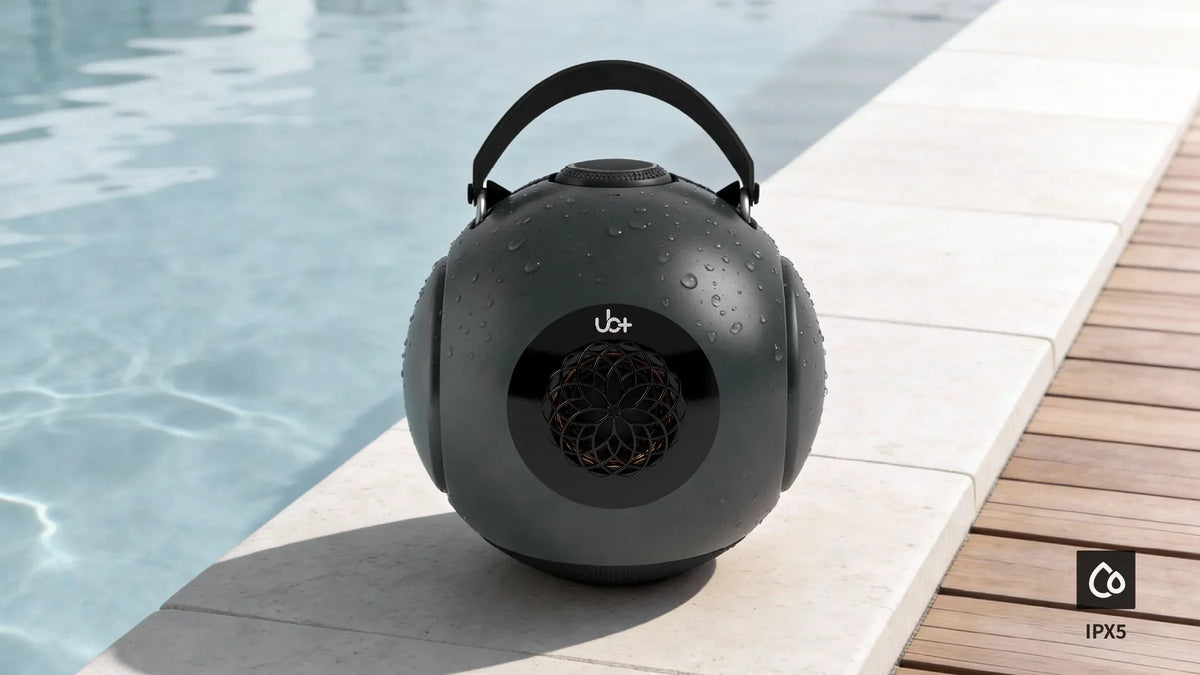
Finding the best bluetooth speaker for bathroom use requires more than choosing a speaker labeled "waterproof." Bathrooms combine humidity, condensation, splashing water, wet hands, and occasional direct spray, so the enclosure's ingress protection rating matters as much as sound quality and usability. Buyers comparing a water-resistant Bluetooth speaker, bathroom wireless speaker, or shower Bluetooth speaker should understand exactly what an IP rating protects against—and what it does not.
A speaker designed for a living room is not automatically suitable for a bathroom simply because it uses Bluetooth. Water protection must be part of the physical product design.
What Makes a Bluetooth Speaker Suitable for Bathroom Use?
Bathroom listening creates a different set of requirements from ordinary indoor audio.
The speaker may be exposed to:
- Shower spray
- Sink splashes
- Wet hands
- High humidity
- Steam
- Condensation
- Accidental water exposure
- Cleaning activities
This does not mean the speaker needs to be submersible.
In fact, that distinction is important.
A buyer should match the speaker's ingress protection rating to the actual exposure it will encounter rather than assuming that every product marketed as waterproof provides the same level of protection.
For bathroom use, evaluate five areas:
|
Factor |
Why It Matters |
|
IP rating |
Defines tested resistance to dust and water ingress |
|
Enclosure sealing |
Helps prevent water reaching internal electronics |
|
Speaker placement |
Determines how much direct water exposure occurs |
|
Wireless reliability |
Keeps playback stable around the room |
|
Acoustic performance |
Determines whether music remains clear over shower noise |
The most appropriate speaker is the one whose protection level matches the environment rather than the one with the strongest marketing language.
IP Ratings Explained for Bathroom Speakers
The IP rating is one of the most useful specifications when choosing a water-resistant speaker.
IP stands for Ingress Protection. The rating is generally written as two characters after "IP."
The first character relates to protection against solid objects and dust.
The second character relates to water.
For example, an IPX5 rating uses "X" in the first position, meaning a dust-protection rating is not specified under that marking, while the "5" identifies the tested level of protection against water jets.
This distinction is important because an IP rating describes a specific test condition. It does not mean that a speaker is immune to every form of water exposure.
What Does IPX5 Mean?

IPX5 indicates protection against water projected by a nozzle from different directions under the applicable test conditions.
For a bathroom speaker, this is relevant because shower environments can expose equipment to splashing and directed water.
The UB+ dB1 is rated IPX5, making it resistant to water jets and splashes within the conditions of that rating.
However, IPX5 does not mean the speaker is designed to be submerged.
That distinction should be clear before placing any water-resistant speaker near a bathtub, sink, or shower.
IPX5 means:
- Protection against water jets under the specified test conditions
- Greater protection than a speaker with no water-resistance rating
- Appropriate resistance for many splash-prone environments
IPX5 does not mean:
- Safe for underwater use
- Designed to be dropped into a bathtub
- Suitable for prolonged submersion
- Immune to every type of moisture exposure
A bathroom speaker should therefore be positioned where it receives the intended level of exposure rather than deliberately subjected to water beyond its rating.
IPX5 vs Higher Water-Resistance Ratings
Different IP water ratings protect against different forms of exposure.
|
Rating |
General Water Protection |
Bathroom Relevance |
|
IPX0 |
No stated water protection |
Poor choice |
|
IPX1 |
Vertically falling water |
Limited |
|
IPX2 |
Dripping water with limited tilt conditions |
Limited |
|
IPX3 |
Spraying water |
Moderate |
|
IPX4 |
Water splashes from different directions |
Useful |
|
IPX5 |
Water jets |
Strong protection for splash-prone use |
|
IPX6 |
Powerful water jets |
Higher water exposure protection |
|
IPX7 |
Temporary immersion |
Relevant where accidental submersion is possible |
|
IPX8 |
Extended immersion under specified conditions |
Specialized use |
These ratings should not be interpreted as a simple "higher is always better" purchasing hierarchy.
If your speaker sits safely on a bathroom shelf away from direct shower spray, extreme immersion protection may provide little practical benefit.
If the speaker is frequently exposed to direct water jets, a higher rating may be worth considering.
Waterproof vs Water-Resistant: The Language Matters
"Waterproof" is commonly used in consumer marketing, but buyers should look for the actual IP certification or rating rather than relying on the adjective.
There is a significant difference between:
Water-resistant
and
Submersible
A speaker rated for water jets is not necessarily designed for immersion.
This is particularly important in a bathroom because the most serious accident is often not ordinary shower spray—it is the speaker falling into a sink, bathtub, or wet floor.
The appropriate response is to select a product based on its documented ingress rating and keep it within those operating conditions.
Where Should You Place a Bathroom Bluetooth Speaker?
Even a water-resistant speaker benefits from sensible placement.
The safest locations generally provide:
- Stable support
- Adequate ventilation
- Distance from standing water
- Protection from unnecessary direct spray
- Clear wireless connection to the source
- Sufficient space for sound to disperse
A shelf outside the direct shower stream can be preferable to placing the speaker directly under a showerhead.
The goal is not to test the speaker's water resistance every time you use it.
The rating provides protection against expected exposure; intelligent placement reduces unnecessary exposure.
Bathroom Acoustics Are Different From a Living Room
Bathrooms contain hard surfaces.
Tile, glass, mirrors, ceramic fixtures, and other reflective materials can produce strong reflections.
This can make a speaker sound louder, but it can also create excessive reverberation.
Speech and vocals may become less distinct when multiple reflections arrive at the listener from different directions.
For this reason, a Bluetooth speaker for shower listening should not be evaluated only by maximum volume.
Clarity matters.
A balanced speaker can make vocals, podcasts, and music easier to follow without requiring extreme output.
Why Bathroom Size Matters
A compact bathroom generally requires less acoustic output than a large open bathroom.
The speaker's intended listening distance should therefore influence your choice.
|
Bathroom Environment |
Speaker Requirement |
|
Small bathroom |
Compact, clear near-field playback |
|
Medium bathroom |
Balanced output and broad dispersion |
|
Large bathroom |
Greater acoustic headroom |
|
Open bathroom |
Higher output may be useful |
|
Shower enclosure |
Strong water protection and clarity |
|
Bathroom with heavy tile |
Controlled tonal balance |
A speaker that sounds excellent in a quiet bedroom may behave differently in a highly reflective bathroom.
This is another reason to consider acoustic engineering rather than judging a speaker from its size alone.
Acoustic Spotlight: Why the dB1's Spherical Architecture Matters
The UB+ dB1 DoubleBass uses a patented spherical acoustic chamber inspired by the Helmholtz Resonance principle. Unlike a conventional rectangular enclosure with parallel internal surfaces, the spherical chamber distributes internal air pressure more evenly and reduces the standing-wave behavior associated with parallel boundaries. This helps minimize phase distortion and supports improved harmonic reproduction.
Its bass architecture centers on a 4.5-inch long-stroke mid-bass driver firing downward into the chamber. Driver movement pressurizes the internal air volume and activates two symmetrical passive radiators positioned on opposing sides.
The combined passive-radiator surface area is approximately 3.5× that of the active woofer. The increased radiating area allows the system to move more air at low frequencies.
Because the passive radiators operate symmetrically in opposite directions, the architecture also creates a self-cancelling vibration behavior. Mechanical forces that would otherwise transfer into the enclosure are counteracted, reducing unwanted cabinet movement.
The driver system uses a 90 mm oversized neodymium magnet, 35 mm long-stroke voice coil, 20 mm piston movement, aluminum shorting ring, and 18 mm extra-wide surround.
The resulting system is specified at approximately 40 Hz–20 kHz with around 93 dB SPL.
This architecture is relevant to bathroom listening because hard surfaces can make poorly controlled bass and resonance more noticeable. Mechanical acoustic design can contribute to controlled low-frequency reproduction without depending entirely on aggressive digital bass enhancement.
The onboard DSP monitors system behavior and protects the hardware, while the physical acoustic architecture provides the foundation for bass reproduction.
Why Bass Can Become Difficult in a Bathroom
Bass behaves differently depending on the room.
Low-frequency waves interact strongly with boundaries, and bathrooms contain many hard surfaces packed into a relatively small area.
This can produce uneven bass depending on speaker position.
One location may reinforce certain frequencies while another can create cancellations.
The result is that moving a speaker only a short distance can change the perceived bass.
This makes placement important even when the speaker itself has strong low-frequency capability.
A good bathroom setup should avoid placing the speaker directly in a corner unless the resulting tonal balance is intentional.
Do You Need a Bass-Heavy Speaker for the Shower?
Not necessarily.
A shower produces its own noise.
Running water can mask parts of the frequency range, particularly quieter vocals and details.
Increasing bass does not automatically solve that problem.
For bathroom listening, useful characteristics include:
- Clear vocals
- Strong midrange definition
- Controlled low frequencies
- Smooth high frequencies
- Sufficient output
- Wide sound distribution
A Bluetooth speaker with deep bass can be enjoyable, but bass should remain controlled rather than overwhelming the rest of the music.
Volume Matters More Than Maximum Loudness
The right question is not:
"How loud can this speaker become?"
Instead ask:
"Can it remain clear at the level I actually need?"
A bathroom speaker usually operates relatively close to the listener.
That means extreme output capability may be unnecessary for everyday shower listening.
A speaker should provide enough headroom to overcome shower noise while maintaining clarity without audible strain.
Bluetooth Connectivity in a Bathroom
Bluetooth is particularly useful for bathroom listening because the source device does not need to sit beside the speaker.
A phone can remain outside the wet area while the speaker operates nearby.
This reduces the need to expose the source device to moisture.
Modern Bluetooth implementations also improve connection reliability compared with older generations.
For a wireless bathroom speaker, consider:
- Pairing stability
- Connection range
- Source compatibility
- Reconnection behavior
- Battery life
- Controls that remain usable with wet hands
The wireless connection should simplify the environment rather than introduce another source of frustration.
Why Physical Controls Matter
Touchscreens are not always convenient around water.
Wet fingers can make smartphone operation awkward, and repeatedly reaching for a phone can increase the risk of dropping it.
Physical controls on the speaker can therefore be useful.
Look for straightforward access to:
- Power
- Volume
- Playback
- Pairing
If the speaker is positioned within reach of the shower, controls should be easy to identify without requiring prolonged interaction with a wet device.
Battery Life for Bathroom Listening
Bathroom listening generally involves shorter sessions than outdoor events.
A typical shower may last only a fraction of the operating time of a speaker.
Nevertheless, longer battery life reduces charging frequency.
The practical question is whether the speaker can operate through your normal routine without requiring constant charging.
Battery performance also depends on:
- Playback volume
- Content
- Wireless connection
- Battery age
- Operating temperature
A manufacturer-rated battery figure should therefore be treated as a test-condition measurement rather than a guarantee of identical real-world performance.
Humidity Is Not the Same as Water Exposure
Bathrooms have another environmental factor that is easy to overlook: humidity.
Steam increases moisture in the air, particularly during hot showers.
An IP rating primarily describes ingress protection under defined test conditions. It should not be interpreted as a guarantee that every electronic component is unaffected by continuous exposure to high humidity or condensation.
Practical placement remains important.
After particularly steamy showers, allowing equipment to return to normal conditions can reduce unnecessary moisture exposure.
Do not place the speaker inside enclosed areas where condensation can accumulate heavily.
What to Look for in a Bathroom Speaker
A useful purchasing checklist includes both protection and audio performance.
|
Feature |
What to Check |
|
IP rating |
Confirm the exact certified rating |
|
Water exposure |
Match rating to expected conditions |
|
Submersion requirement |
Determine whether accidental immersion is possible |
|
Sound balance |
Look for clear vocals and controlled bass |
|
Dispersion |
Useful for changing listening positions |
|
Bluetooth |
Stable connection with your source |
|
Battery |
Enough capacity for your routine |
|
Controls |
Usable around moisture |
|
Placement |
Stable and away from standing water |
|
Construction |
Enclosure appropriate for wet environments |
No single specification should determine the purchase.
Bathroom Speaker Buying Mistakes
Mistake 1: Trusting the Word "Waterproof"
Always find the actual IP rating.
"Waterproof" without a clearly stated rating provides much less useful information.
Mistake 2: Assuming IPX5 Means Submersible
It does not.
IPX5 describes resistance to water jets under specified testing conditions.
A speaker with that rating should not be deliberately submerged.
Mistake 3: Placing the Speaker Directly Under the Shower
Water resistance does not eliminate the need for sensible placement.
Minimize unnecessary direct exposure.
Mistake 4: Choosing Maximum Bass Over Clarity
Bathroom surfaces already create substantial acoustic reflection.
Excessive low-frequency emphasis can make music sound less balanced.
Mistake 5: Ignoring Listening Distance
A small bathroom usually does not require the same output as a large open space.
Mistake 6: Using the Phone in a Wet Area
One advantage of Bluetooth is that the source can remain safely away from direct moisture.
Best Placement for Different Bathroom Layouts
Small Bathroom
Place the speaker on a stable shelf or counter where it can distribute sound without being exposed to direct water.
Large Bathroom
Position it where the sound can travel across the room without excessive obstruction.
Shower Area
If the speaker is positioned close to the shower, pay particular attention to its IP rating and avoid direct exposure beyond the rating's intended conditions.
Bathtub Area
Keep the speaker away from the tub whenever possible. Water resistance is not a reason to deliberately place electronics beside standing water.
Vanity Area
A stable vanity or shelf can provide a practical listening position while keeping the speaker away from direct shower spray.
Should You Buy a Dedicated Bathroom Speaker?
If you regularly listen to music, podcasts, or radio while getting ready or showering, a water-resistant Bluetooth speaker can make more sense than repeatedly exposing a general-purpose speaker to moisture.
The important distinction is that you are buying for a defined environment.
The speaker should provide:
Documented water protection + reliable wireless connectivity + appropriate acoustic output + practical placement.
A dedicated use-case purchase is worthwhile when the speaker will spend substantial time in that environment.
How to Judge Value
Price should be evaluated against the features you will actually use.
For bathroom applications, paying more for extreme outdoor durability may not provide meaningful value if the speaker will remain on a protected shelf.
Conversely, saving money by buying a speaker with no documented water resistance can be a poor trade if it will regularly encounter shower spray.
A useful value framework is:
|
Priority |
Importance for Bathroom Use |
|
Documented IP rating |
Very high |
|
Sound clarity |
Very high |
|
Stable Bluetooth |
High |
|
Appropriate volume |
High |
|
Battery life |
Moderate to high |
|
Placement flexibility |
High |
|
Bass quality |
Moderate to high |
|
Maximum output |
Situation dependent |
|
Extreme submersion protection |
Only if required |
|
Premium cosmetic materials |
Secondary |
Spend more where the environment actually demands it.
Is the UB+ dB1 Suitable for Bathroom Listening?
The dB1's IPX5 rating makes it resistant to water jets and splashes within the applicable test conditions, making it suitable for many splash-prone listening environments.
However, it should not be described as a submersible speaker.
For bathroom use, sensible placement still matters.
Keep it away from standing water and avoid intentionally exposing it to water beyond its protection rating.
Its acoustic architecture also makes it relevant to listeners who do not want to sacrifice bass performance simply because the speaker is being used in a moisture-prone room.
The key distinction is straightforward: IPX5 provides water-jet and splash resistance, not immersion protection.
Comparison: Bathroom Speaker Priorities
|
Requirement |
Basic Water-Resistant Speaker |
Premium Bathroom-Ready Speaker |
|
Documented water protection |
Yes |
Yes |
|
Appropriate IP rating |
Varies |
Clearly specified |
|
Splash resistance |
Model dependent |
Designed for rated exposure |
|
Bluetooth connectivity |
Standard |
Stable modern implementation |
|
Sound balance |
Varies |
Engineered acoustic response |
|
Bass control |
Model dependent |
Advanced acoustic architecture |
|
Placement flexibility |
Moderate |
High |
|
Controls |
Basic |
Designed for practical use |
|
Indoor/outdoor flexibility |
Limited |
Greater |
|
Acoustic engineering |
Varies |
More advanced |
The table illustrates why water resistance should be considered alongside acoustic performance rather than separately.
Buying Checklist for a Bathroom Bluetooth Speaker
Before purchasing, confirm:
- What is the exact IP rating?
- Does the rating cover the water exposure you expect?
- Is the speaker submersible, or only splash/jet resistant?
- Where will you actually place it?
- Can your phone remain outside the wet area?
- Does it maintain clear vocals over shower noise?
- Does the bass remain controlled in a highly reflective room?
- Are the controls practical around moisture?
- Is battery capacity sufficient for your routine?
- Does the speaker's acoustic design justify its price?
These questions provide more useful purchasing information than a generic "waterproof" label.
Frequently Asked Questions
What IP rating should a bathroom Bluetooth speaker have?
The appropriate rating depends on exposure. For a speaker exposed to regular splashes or water jets, an IPX5 rating provides substantially more protection than an unrated product. However, IPX5 does not indicate protection against immersion.
Can I put an IPX5 speaker inside the shower?
An IPX5 speaker is resistant to water jets under specified test conditions, but placement should still minimize unnecessary direct exposure. Do not interpret the rating as permission to keep the speaker continuously under a shower stream.
Is IPX5 waterproof?
IPX5 is commonly described as water-resistant rather than fully waterproof or submersible. It protects against water jets under defined testing conditions but does not provide the same protection as an immersion-rated product.
Can humidity damage a Bluetooth speaker?
High humidity and condensation can expose electronics to moisture even when there is no direct water spray. Keep the speaker appropriately positioned and avoid environments where heavy condensation can accumulate.
Does a bathroom need a powerful Bluetooth speaker?
Usually not. Bathrooms are relatively small, and the listener is often close to the speaker. Clear output and sufficient headroom are generally more useful than extreme maximum volume.
Final Verdict
The best bluetooth speaker for bathroom use should be selected according to its documented water protection, actual placement, acoustic performance, and everyday usability.
For most bathroom applications, an appropriate IP rating is more meaningful than a generic waterproof marketing claim. IPX5 provides resistance to water jets and splashes under specified conditions, but it does not make a speaker submersible.
Audio performance still matters. Bathrooms have reflective surfaces and shower noise, so clear vocals, controlled bass, stable wireless connectivity, and appropriate output are valuable.
The UB+ dB1 combines documented IPX5 water-jet and splash resistance with an acoustic architecture designed around controlled mechanical bass reproduction. That makes it a practical option for listeners who want a bathroom-capable speaker without treating water protection as the only specification that matters.
The purchasing principle is straightforward:
Choose the water-protection rating for the environment. Choose the acoustic architecture for the sound. Choose the placement for safety.
Explore Your UB+ Options
→ Compare dB1 vs dB Mini
Review the differences in design, acoustic performance, placement, and intended use.
→ Explore UB+ Speakers
See the complete UB+ range at UB+.
→ Check Current Price
Review current product information, specifications, pricing, and availability.
For bathroom listening, don't buy the word "waterproof." Buy the protection rating you actually need.


댓글 남기기
이 사이트는 hCaptcha에 의해 보호되며, hCaptcha의 개인 정보 보호 정책 과 서비스 약관 이 적용됩니다.