
Finding a bluetooth speaker that sounds good at low volume requires looking beyond maximum loudness, wattage, and headline bass claims. A speaker can produce impressive sound at high volume yet become thin, harsh, or "tinny" when the volume is turned down. That usually indicates limitations in the speaker's driver, enclosure, acoustic tuning, or its ability to maintain tonal balance across different listening levels.
For bedrooms, apartments, offices, dorms, and late-night listening, low-volume performance is often more important than maximum SPL. You want clear vocals, controlled bass, natural mids, smooth treble, and consistent tonal balance without having to turn the speaker up.
The best compact Bluetooth speakers are therefore designed not merely to get loud, but to preserve useful frequency response and acoustic stability across a wide range of listening levels.
Why Some Bluetooth Speakers Sound Tinny at Low Volume

The word "tinny" usually describes a sound that feels thin, bright, hollow, or lacking in low and lower-mid frequencies.
When a speaker is played quietly, several things can contribute to this perception.
A small driver may struggle to move enough air to reproduce lower frequencies convincingly. An enclosure may not provide sufficient acoustic loading. DSP tuning may emphasize upper frequencies while reducing bass to protect the driver. And the listener's own hearing becomes less sensitive to bass and extreme treble as volume decreases.
This is why simply turning down a speaker does not always produce the same sound at a lower level.
A well-engineered speaker should maintain a convincing tonal balance even when you are listening quietly.
That is the key characteristic to look for when comparing a low-volume Bluetooth speaker.
Low Volume Changes the Way We Hear Music

Human hearing is not equally sensitive to every frequency at every volume level.
At lower listening levels, our ears become relatively less sensitive to bass and very high frequencies. As a result, music can subjectively sound thinner when the volume is reduced.
This is one reason people sometimes increase the volume simply to make a speaker sound fuller.
But there is an important distinction between normal human hearing behavior and a speaker that genuinely has poor low-volume performance.
If a speaker loses most of its bass, sounds excessively bright, or makes vocals unnaturally thin as soon as the volume is reduced, the problem may involve the speaker's acoustic design and tuning rather than your hearing alone.
A high-quality Bluetooth speaker for quiet listening should remain balanced enough that you can enjoy music without needing high SPL.
The Driver Is the First Place to Look

The speaker driver is responsible for converting electrical energy into physical air movement.
For low-frequency reproduction, moving enough air is critical.
A very small driver has limited surface area and excursion. When the enclosure is also extremely compact, there are physical constraints on how much low-frequency energy the system can reproduce.
This does not mean that a large driver automatically sounds better.
Driver design, excursion, magnet strength, suspension, enclosure loading, and acoustic tuning all work together.
For example, a long-throw driver can move substantially farther than a conventional small driver, increasing its ability to displace air without requiring a huge enclosure.
That makes driver excursion an important consideration when looking for a compact speaker that does not become thin at lower volume.
Why Bass Response Matters Even When You Listen Quietly

Many people associate deep bass with high-volume listening.
In reality, bass can be particularly important when listening quietly.
When the volume is reduced, a speaker with limited low-frequency capability may lose much of the weight that makes music sound complete. Vocals remain audible, but drums, bass guitar, electronic low frequencies, and the lower harmonics of instruments become weaker.
The result is a sound that feels smaller and more distant.
A speaker with stronger acoustic low-frequency capability can preserve more of that foundation at moderate listening levels.
This is why deep bass reproduction should not be evaluated only by asking how loud a speaker can get.
The better question is:
How naturally does the speaker reproduce low frequencies before you reach high volume?
Mechanical Bass vs. Artificial Bass Boost
One important distinction in compact Bluetooth speakers is how low-frequency output is created.
Some speakers rely heavily on DSP to make a small driver appear to produce more bass than its physical dimensions would normally allow. DSP is not inherently bad. It can be extremely useful for controlling excursion, protecting the driver, maintaining linearity, and shaping tonal balance.
The limitation is physical.
Electronic processing cannot completely replace air displacement.
If a tiny driver cannot physically move enough air, increasing the electrical signal at low frequencies eventually reaches mechanical limits.
This is why acoustic engineering matters so much in a Bluetooth speaker that sounds good at low volume.
A system that combines efficient driver movement with an appropriately designed enclosure and passive-radiator architecture can generate low-frequency output through physical air movement rather than relying exclusively on perceived bass enhancement.
How Passive Radiators Can Help
A passive radiator is an unpowered diaphragm that responds to changes in air pressure inside a speaker enclosure.
Unlike a conventional bass port, it does not require an open tube through which air flows.
When properly designed, a passive-radiator system can extend useful low-frequency output from a relatively compact enclosure.
The concept becomes particularly interesting when multiple passive radiators are used symmetrically.
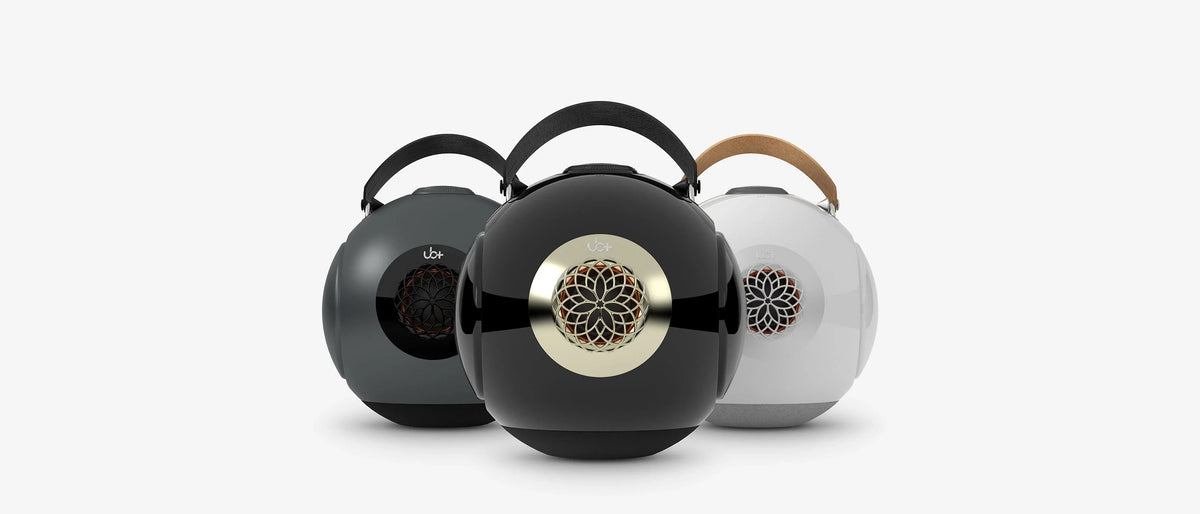
UB+ uses this approach in the dB1 DoubleBass.
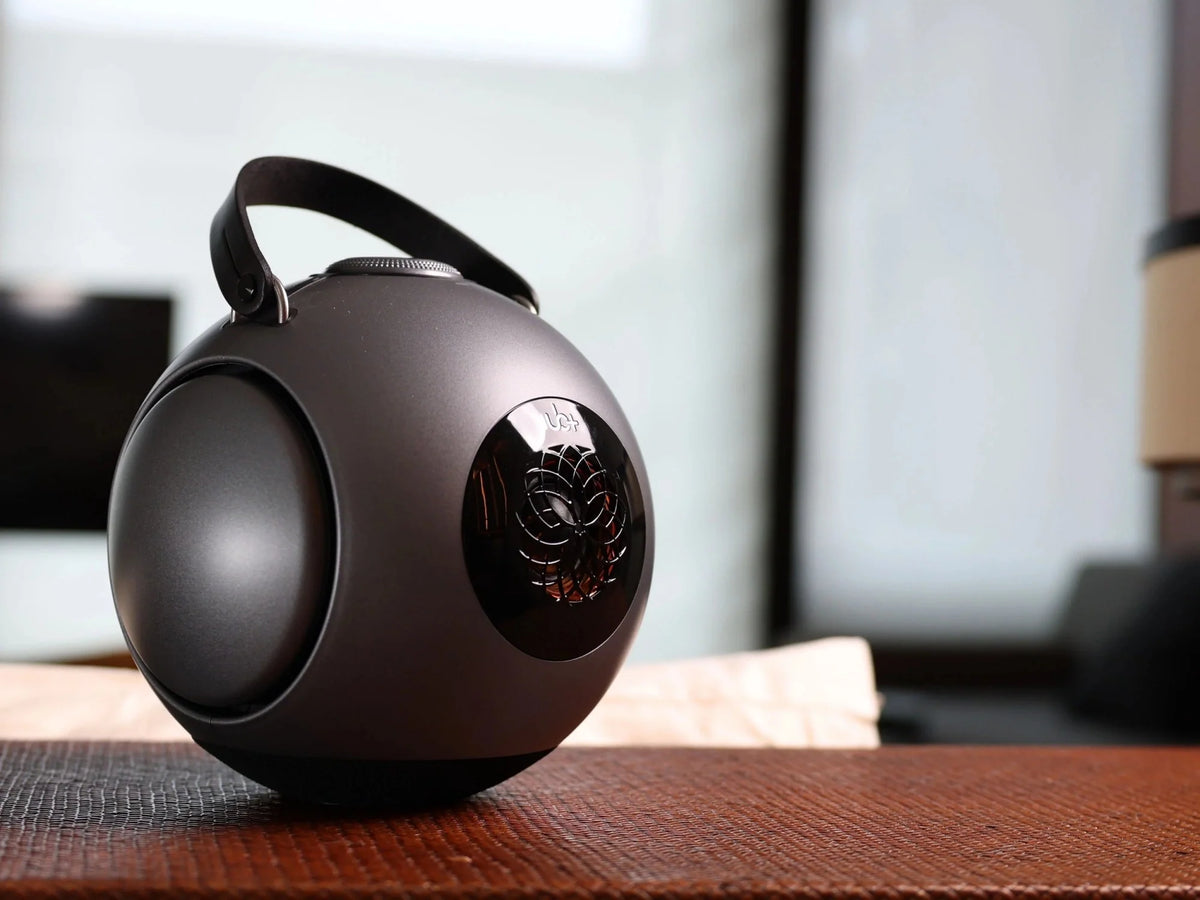
Its spherical acoustic chamber works with a central 4.5-inch long-throw mid-bass driver and two opposing passive-radiator plates. The combined passive-radiator surface area is approximately 3.5 times the area of the active woofer.
The system uses internal acoustic pressure to drive the passive radiators, creating additional mechanical air movement.
This is different from simply applying more bass EQ.
For a deeper explanation, see our guide to how passive radiators work in Bluetooth speakers.
Why Enclosure Design Affects Low-Volume Sound
The enclosure is not merely a protective shell around the driver.
It is part of the acoustic system.
A poorly controlled enclosure can introduce unwanted resonances, internal reflections, vibration, and coloration. These problems can become noticeable as changes in volume alter the relationship between the driver's direct output and the enclosure's acoustic contribution.
UB+ takes a different approach with the dB1 DoubleBass by using a spherical acoustic chamber inspired by the principles of Helmholtz resonance.
A sphere provides a different internal acoustic environment from the parallel surfaces found in many conventional rectangular enclosures. The geometry is designed to distribute internal pressure and reduce problematic standing-wave and phase behavior.
That acoustic architecture is one reason the dB1 can focus on physical bass reproduction rather than simply increasing electronic bass enhancement.
The UB+ dB1 DoubleBass Acoustic Approach
The UB+ dB1 DoubleBass combines several elements that are relevant to low-volume listening.
The acoustic system includes:
- A spherical chamber inspired by Helmholtz resonance principles
- A 4.5-inch long-throw mid-bass driver
- Two symmetrical passive radiators
- Approximately 3.5× the woofer's surface area across the passive radiators
- A 90 mm neodymium magnet
- A 35 mm long-stroke design
- Approximately 40 Hz–20 kHz frequency response
- 360-degree sound distribution
The opposing passive-radiator arrangement also helps manage mechanical vibration because the radiators move in opposing directions.
This is particularly useful in a compact speaker. Unwanted cabinet movement can waste mechanical energy and cause surfaces around the speaker to vibrate.
Acoustic Architecture and Low-Volume Performance
|
Design Element |
Acoustic Function |
Why It Matters at Low Volume |
|
Long-throw driver |
Produces greater physical excursion |
Supports meaningful low-frequency output |
|
Spherical chamber |
Manages internal acoustic pressure |
Helps control internal acoustic behavior |
|
Dual passive radiators |
Converts internal pressure into additional air movement |
Supports bass without relying solely on DSP |
|
Large radiator area |
Increases effective radiating surface |
Helps produce physical low-frequency energy |
|
Opposing radiator movement |
Helps balance mechanical forces |
Reduces unwanted enclosure vibration |
|
360° dispersion |
Distributes sound broadly |
Helps maintain a consistent experience around the room |
|
DSP support |
Monitors and protects the system |
Helps maintain controlled operation |
The important point is that these features work as a system. No single specification guarantees good low-volume sound.
What Makes a Speaker Sound Full at Quiet Levels?
When evaluating a speaker for quiet listening, pay attention to several parts of the frequency range.
Bass
Bass should provide weight without sounding artificially boosted.
If kick drums disappear completely when you reduce the volume, the speaker may have limited low-frequency capability.
Lower Midrange
The lower midrange contributes body to vocals, guitars, piano, strings, and many acoustic instruments.
A speaker can technically reproduce bass while still sounding thin if this region is poorly balanced.
Midrange
Vocals should remain natural and intelligible.
If a speaker sounds acceptable for instrumental music but makes voices sound nasal or recessed at low volume, its tonal balance may be uneven.
Treble
Treble provides detail and definition, but excessive upper-frequency emphasis can create the classic "tinny" character.
A speaker that uses too much treble to create the perception of detail may sound impressive initially but become fatiguing during long listening sessions.
Don't Judge a Speaker by Wattage Alone
Wattage is one of the least useful standalone measurements when trying to predict low-volume sound quality.
Two speakers with similar power ratings can sound dramatically different.
Why?
Because acoustic output depends on more than amplifier power. Driver efficiency, cone area, excursion, enclosure design, passive-radiator tuning, DSP limits, and frequency response all contribute.
For this reason, a buyer searching for a best Bluetooth speaker for sound quality should examine the entire acoustic architecture rather than choosing the highest wattage number.
Our guide to whether speaker watts actually matter explains why power ratings need context.
Frequency Response Is Useful—but Read It Carefully
Frequency response can help you understand how low and high a speaker is designed to reproduce.
For example, a specification extending toward 40 Hz indicates substantially deeper potential low-frequency reproduction than a compact speaker whose response begins much higher.
But frequency range alone does not tell you how evenly those frequencies are reproduced.
A speaker could technically reach a certain frequency while producing it at a very low level.
Therefore, use frequency response as one part of the evaluation rather than treating it as a guarantee of sound quality.
Our speaker specifications guide explains how to interpret specifications more intelligently.
Why Room Placement Still Matters
Even an excellent speaker can sound thin or boomy because of its position.
Low frequencies interact strongly with walls and room boundaries.
A speaker placed directly in a corner may receive additional boundary reinforcement. Depending on the room, this can make some bass frequencies sound stronger while leaving others relatively weak.
Placing the speaker in a more open location can produce a more balanced response.
For quiet listening, this matters because you are already operating at lower acoustic output. Room interaction can therefore have a noticeable effect on perceived tonal balance.
See our guide to speaker placement for better bass and clarity for practical positioning principles.
360-Degree Sound Can Improve Everyday Listening
Low-volume listening often happens while you move around a room.
You may be working at a desk, cooking, reading, lying in bed, or sitting somewhere away from the speaker.
A narrow front-firing speaker can sound substantially different when you move away from its primary axis.
A 360-degree speaker design changes that relationship.
The dB1's spherical architecture distributes sound around the enclosure rather than concentrating the listening experience toward one front-facing direction.
That can make quiet listening more consistent because you are less dependent on sitting directly in front of the speaker.
Our article on spherical speaker design and sound explores this design philosophy in greater detail.
How to Test a Bluetooth Speaker at Low Volume
If you are comparing speakers in person, do not begin by turning them up.
Start quietly.
Play a familiar song with vocals, acoustic instruments, bass, and percussion.
Then listen for several characteristics.
Do vocals remain natural?
If voices become thin or excessively bright, the speaker may have an uneven tonal balance.
Can you still hear bass lines?
The bass does not need to dominate. It should provide enough foundation to keep the music from feeling hollow.
Do cymbals and high frequencies become harsh?
Excessive treble can make a compact speaker sound detailed at first but unpleasant over time.
Does the speaker vibrate the surface underneath it?
Some physical movement is unavoidable, but excessive cabinet vibration can indicate that mechanical energy is being transferred into the desk or shelf rather than being efficiently converted into acoustic output.
Does the music still sound complete?
This is ultimately the most useful test.
You should be able to recognize the character of the recording without needing to turn the volume up.
Quiet Listening Is Different From Nighttime Listening
It is worth separating these concepts.
Quiet listening means you want a speaker to sound balanced at a lower output level.
Nighttime listening adds another requirement: the speaker should provide enough clarity and tonal completeness without disturbing other people.
That makes controlled bass particularly valuable.
An overly aggressive bass system can travel through walls and floors even when the overall volume seems moderate.
A well-controlled speaker gives you more flexibility to enjoy music at a comfortable level without relying on extreme bass enhancement.
What About DSP?
DSP should not be treated as the enemy of good sound.
Modern DSP can perform important jobs:
- Driver protection
- Excursion management
- Tonal optimization
- System linearity
- Dynamic control
- Protection at higher output
The question is how heavily the speaker depends on DSP to compensate for physical limitations.
A sophisticated system combines DSP with strong physical engineering.
In the dB1, the acoustic architecture does much of the low-frequency work, while DSP can support system protection, linearity, and tonal balance.
That is a more useful way to think about computational audio: DSP should support the acoustic system rather than being expected to replace it.
Why Compact Speakers Often Struggle With Bass
There is a simple physical reason.
Low frequencies require the movement of significant quantities of air.
A small driver has limited surface area. To compensate, it needs sufficient excursion, and the enclosure needs to manage the resulting pressure effectively.
If those elements are not engineered together, the speaker may have to rely more heavily on electronic processing.
At moderate or high volume, that can create noticeable compression or distortion.
At low volume, the opposite problem can appear: the speaker simply sounds thin because there is not enough physical low-frequency energy.
This is why compact speaker bass performance should be evaluated as a complete system rather than by driver diameter alone.
A Better Way to Compare Speakers
When comparing speakers for low-volume listening, use a hierarchy rather than a single specification.
|
What to Evaluate |
Why It Matters |
|
Tonal balance |
Determines whether music remains natural when quiet |
|
Driver excursion |
Influences physical low-frequency capability |
|
Enclosure design |
Controls acoustic pressure and internal behavior |
|
Passive-radiator system |
Can extend bass from a compact enclosure |
|
Frequency response |
Indicates the intended operating range |
|
Dispersion |
Determines how consistent sound remains around the room |
|
DSP implementation |
Helps manage protection and tonal balance |
|
Cabinet vibration |
Affects mechanical efficiency and coloration |
|
Maximum SPL |
Useful, but less important for quiet listening |
|
Placement flexibility |
Determines how easily you can achieve balanced sound |
This approach is much more useful than simply asking which speaker has the most watts.
The dB1 for Listeners Who Prefer Lower Volume
The UB+ dB1 DoubleBass is built around a central idea that is especially relevant to this use case: acoustic performance should not depend entirely on playing loud.
Its spherical chamber, long-throw driver, and opposing passive-radiator system provide a physical foundation for low-frequency reproduction.
The result is intended to preserve the weight and structure of music without requiring the speaker to rely exclusively on artificial bass enhancement.
Its 360-degree sound distribution also makes it practical for everyday listening where the listener may not remain in one fixed position.
For someone choosing a Bluetooth speaker that sounds good at low volume, that combination is more relevant than a simple maximum-volume specification.
What About the UB+ dB Mini?
For listeners who prioritize a smaller footprint, the UB+ dB Mini is another option within the UB+ range.
The choice between the two should be based on the balance you want between physical size, acoustic performance, room coverage, and low-frequency capability.
If deep bass and a more substantial acoustic architecture are central to your decision, the dB1 deserves closer consideration.
If compactness is the dominant requirement, the dB Mini may be more appropriate.
You can compare the UB+ dB1 and dB Mini before choosing.
Common Buying Mistakes
Choosing Maximum Volume Instead of Tonal Balance
A speaker that gets extremely loud may still sound poor when played quietly.
Looking Only at Frequency Range
A quoted frequency range does not tell you how evenly those frequencies are reproduced.
Assuming More Bass Means Better Bass
Excessive low-end boost can make a small room sound muddy.
Ignoring the Enclosure
The cabinet is part of the acoustic system. Its geometry and internal behavior matter.
Treating DSP as a Complete Solution
DSP can optimize a speaker, but it cannot remove the physical limitations of driver displacement and air movement.
Testing Only at High Volume
If you normally listen quietly, test the speaker quietly.
That is the environment that actually matters.
FAQ
What is the best Bluetooth speaker that sounds good at low volume?
The best choice depends on your listening environment and priorities, but a speaker with strong acoustic bass capability, balanced tuning, good driver excursion, and controlled enclosure behavior is generally better suited to quiet listening. The UB+ dB1 DoubleBass is designed around these principles.
Why does my Bluetooth speaker sound tinny when I turn it down?
Low volume reduces perceived bass because human hearing becomes less sensitive to lower frequencies. However, an overly small driver, limited excursion, weak enclosure design, or aggressive tonal tuning can make the problem more noticeable.
Does a bigger speaker always sound better at low volume?
No. Physical size can provide acoustic advantages, but driver design, enclosure architecture, tuning, and dispersion are equally important. A well-engineered compact speaker can outperform a larger but poorly designed model.
Does a passive radiator improve bass at low volume?
A properly designed passive-radiator system can support low-frequency output by using internal acoustic pressure to move an additional diaphragm. Its effectiveness depends on the complete driver, enclosure, and tuning system.
Is DSP bad for low-volume sound?
No. DSP can improve protection, linearity, tonal balance, and system performance. The important issue is whether DSP complements strong physical acoustic engineering rather than being used primarily to compensate for insufficient driver or enclosure capability.
Final Takeaway
Choosing a bluetooth speaker that sounds good at low volume requires a different mindset from shopping for the loudest portable speaker.
The most important question is not how much sound a speaker can produce.
It is how naturally it reproduces music when you do not need much sound.
Look for a system with meaningful driver excursion, controlled bass, a well-designed enclosure, balanced midrange and treble, appropriate DSP, and useful dispersion. Pay attention to how the speaker handles low frequencies physically rather than assuming that a strong bass setting automatically means deep bass.
For listeners who want compact dimensions without sacrificing acoustic substance, the UB+ dB1 DoubleBass demonstrates how spherical enclosure design, long-throw driver technology, dual passive radiators, and mechanical bass engineering can work together.
The result is a speaker designed not simply to get louder, but to make music remain complete, controlled, and enjoyable across everyday listening levels.
Explore UB+ Speakers


댓글 남기기
이 사이트는 hCaptcha에 의해 보호되며, hCaptcha의 개인 정보 보호 정책 과 서비스 약관 이 적용됩니다.