
A speaker does not need to point directly at every listener to create an enjoyable listening experience. In a shared room, a more useful design can distribute sound around the listening area so people sitting in different positions hear a consistent presentation. That is the central appeal of a 360 degree bluetooth speaker: instead of concentrating its output in one forward-facing direction, it is designed to make listening less dependent on where the speaker is pointed.
However, 360-degree sound is not simply a matter of putting drivers around a circular enclosure. Acoustic dispersion, driver placement, enclosure geometry, frequency response, room reflections, and bass reproduction all influence how effectively a speaker fills a space. A speaker can spread sound broadly while still having limited output, uneven tonal balance, or weak low-frequency performance.
UB+ offers several portable speaker designs worth considering when comparing room coverage, compactness, and everyday listening. The important distinction is understanding what each model is designed to offer rather than assuming that every round or portable speaker provides the same acoustic experience.
For listeners who prioritize spherical sound distribution and a dedicated low-frequency architecture, the UB+ dB1 DoubleBass deserves particular attention. Its spherical acoustic chamber, central driver arrangement, and opposing passive radiators make it a distinctive option within the UB+ range. Other models, including the UB+ dB Mini and UB+ S2 Alphorn, can also be considered according to portability and everyday requirements.
This guide explains how omnidirectional sound works, what actually determines room coverage, and how to compare UB+ models before choosing a speaker for a living room, bedroom, office, or shared listening space.
What Is a 360-Degree Bluetooth Speaker?

A 360-degree speaker is designed to distribute sound around the speaker rather than directing most of its output toward a single listening position. This approach is commonly described as omnidirectional or wide-angle sound dispersion, although the exact radiation pattern varies by product and frequency.
A conventional forward-facing speaker typically uses drivers positioned to project sound toward the front. This can work very well when the listener sits within the intended listening area. However, people positioned to the side or behind the speaker may hear a different balance because the enclosure and driver orientation affect how sound reaches them.
A spherical or omnidirectional design approaches the problem differently. By arranging the acoustic system to distribute sound around the enclosure, it can make placement and listener position less restrictive.
The practical advantages can include:
- Shared listening: People sitting in different directions can hear the speaker without everyone needing to face its front.
- Flexible placement: The speaker does not always need to be aimed precisely toward a sofa, desk, or chair.
- More consistent coverage: A suitable dispersion pattern can reduce the difference between listening positions around the room.
- Social environments: Music can remain part of the atmosphere when people move around or sit in different areas.
- Less directional setup: The speaker can be positioned as part of the room rather than treated like a traditional front-facing audio system.
It is important to distinguish 360-degree dispersion from the idea that sound becomes perfectly identical in every direction. Real speakers have frequency-dependent radiation patterns. High frequencies, for example, are generally more directional than lower frequencies, and the enclosure can influence how sound spreads.
A manufacturer's 360-degree description should therefore be understood as a design objective, not a guarantee that every seat will receive precisely the same frequency response and volume.
360-Degree Sound vs. Traditional Directional Speakers

The main difference is how the speaker distributes its acoustic output around the listening area.
A traditional directional speaker is often designed around a preferred listening axis. Its driver arrangement, cabinet shape, and orientation influence where the strongest and most balanced sound is delivered. This can be beneficial for focused listening, particularly when speakers are positioned as a stereo pair.
A speaker designed for broader dispersion is more concerned with distributing sound across multiple listening positions. This can be useful when music is played for a group rather than for one person sitting in a fixed location.
|
Feature |
Traditional directional speaker |
360-degree or omnidirectional design |
|
Main sound direction |
Primarily toward a preferred listening area |
Designed to distribute sound around the enclosure |
|
Placement |
Often benefits from careful aiming |
Can offer more flexible placement |
|
Listening positions |
Strongest presentation may be concentrated in front |
Intended to serve listeners in multiple directions |
|
Shared-room use |
May require listeners to face the speaker |
Can be convenient for people positioned around it |
|
Stereo presentation |
Often designed for a defined left-right listening position |
Depends on the specific acoustic architecture |
|
Room coverage |
Influenced strongly by speaker orientation |
Influenced by dispersion pattern and room reflections |
Neither approach is automatically superior. A directional speaker may be preferable for focused listening, while an omnidirectional design can be more convenient for shared spaces.
The right choice depends on how people use the room. If one listener sits in a fixed position and wants a defined stereo image, a conventional stereo arrangement may be more suitable. If music needs to reach people sitting around a room, broad sound dispersion can be a practical advantage.
What Actually Makes a Speaker Fill a Room?

A speaker can distribute sound broadly without producing enough output to fill a large room. Dispersion and acoustic output are related, but they are not the same thing.
Room-filling performance depends on several factors working together. A speaker needs appropriate output capability, controlled frequency response, adequate low-frequency reproduction, and a radiation pattern that suits the environment.
Sound Dispersion and Driver Placement

Driver placement influences how sound spreads from the enclosure. A forward-facing driver directs much of its energy toward the front, while specially arranged drivers and acoustic structures can distribute output more broadly.
A spherical enclosure can support a design in which sound is distributed around the speaker. However, the actual result depends on driver orientation, acoustic openings, enclosure geometry, and the frequency range being reproduced.
For listeners comparing omnidirectional Bluetooth speakers, it is useful to ask whether the design provides broad coverage across the frequencies that matter for everyday music, not just whether the product uses the word 360-degree.
Sound Pressure Level and Output Capability
Sound pressure level (SPL) describes the acoustic pressure produced by a speaker. It is commonly expressed in decibels (dB).
A speaker with broad dispersion still needs sufficient output to serve the intended room. A compact model may work well in a bedroom or small living space but struggle to maintain the same perceived loudness in a larger open area.
Maximum SPL is useful as a specification, but it should not be considered independently of distortion, listening distance, and the conditions under which the measurement was taken.
A room-filling speaker should maintain a usable balance between volume and clarity. Producing a high sound level briefly is less useful if the speaker becomes harsh, compressed, or distorted during normal listening.
Frequency Response and Tonal Balance

Frequency response describes how a speaker reproduces different parts of the audible spectrum. A balanced response helps vocals, instruments, and bass work together.
A speaker that emphasizes the midrange may make voices easy to hear but sound thin with bass-heavy music. Another may emphasize upper bass to create a fuller impression but lose clarity if the low frequencies dominate the mix.
For shared-room listening, a balanced tonal presentation is often more useful than extreme emphasis in one frequency region. Music should remain enjoyable whether the listener is hearing vocals, acoustic instruments, electronic bass, or percussion.
Bass Extension and Low-Frequency Output

Bass contributes to the sense of scale and fullness in music. However, compact speakers face physical limitations when reproducing low frequencies.
Low-frequency output depends on diaphragm area, driver excursion, enclosure volume, acoustic tuning, and available amplifier power. A small speaker cannot overcome every physical limitation through digital equalization alone.
Passive radiators can help a compact enclosure produce additional low-frequency output by responding to pressure changes generated by the active driver. Their effectiveness depends on the complete acoustic system rather than their presence alone.
This is one reason to examine the internal design of a speaker instead of judging it only by its exterior shape.
Room Acoustics and Placement
The room itself affects perceived coverage. Walls, furniture, reflective surfaces, and room dimensions change how sound reaches different listening positions.
A speaker placed in a corner may produce more perceived bass because nearby boundaries reinforce certain low frequencies. A speaker placed in the middle of a room may distribute sound differently, with less boundary reinforcement.
Reflections can also influence clarity. A room with many hard surfaces may sound more reflective, while soft furnishings can absorb some acoustic energy.
For this reason, no portable speaker can guarantee identical sound throughout every room. A good dispersion design can make coverage more convenient, but the environment remains part of the acoustic system.
Why a Spherical Speaker Design Is Worth Considering

A spherical enclosure offers a different approach from a conventional rectangular cabinet. Its geometry changes the way internal surfaces are arranged and can help designers manage acoustic behavior.
In a rectangular enclosure, parallel internal walls can support standing-wave patterns at particular frequencies. These patterns may contribute to unwanted internal reflections and resonances. Designers can manage them through damping, internal structures, enclosure proportions, and other techniques.
A spherical enclosure does not have the same arrangement of parallel internal walls. This provides a different acoustic environment for the driver and enclosed air.
The sphere also supports a design philosophy in which sound distribution can be considered around the enclosure rather than along one dominant front-facing axis. That does not automatically make every spherical speaker omnidirectional, but it gives designers another way to approach dispersion and internal acoustic control.
The external shape is only part of the story. The driver, acoustic chamber, openings, radiator arrangement, and tuning must all work together.
For buyers comparing a spherical Bluetooth speaker with a conventional box-shaped model, the useful question is how the geometry contributes to the complete acoustic system. Shape alone does not establish sound quality, but it can provide the foundation for a different engineering approach.
UB+ dB1 DoubleBass: A Distinctive Round Speaker for Broad Sound Distribution
The UB+ dB1 DoubleBass is the most relevant UB+ model to examine when the priority is a spherical acoustic design combined with broad sound distribution and a dedicated bass system.
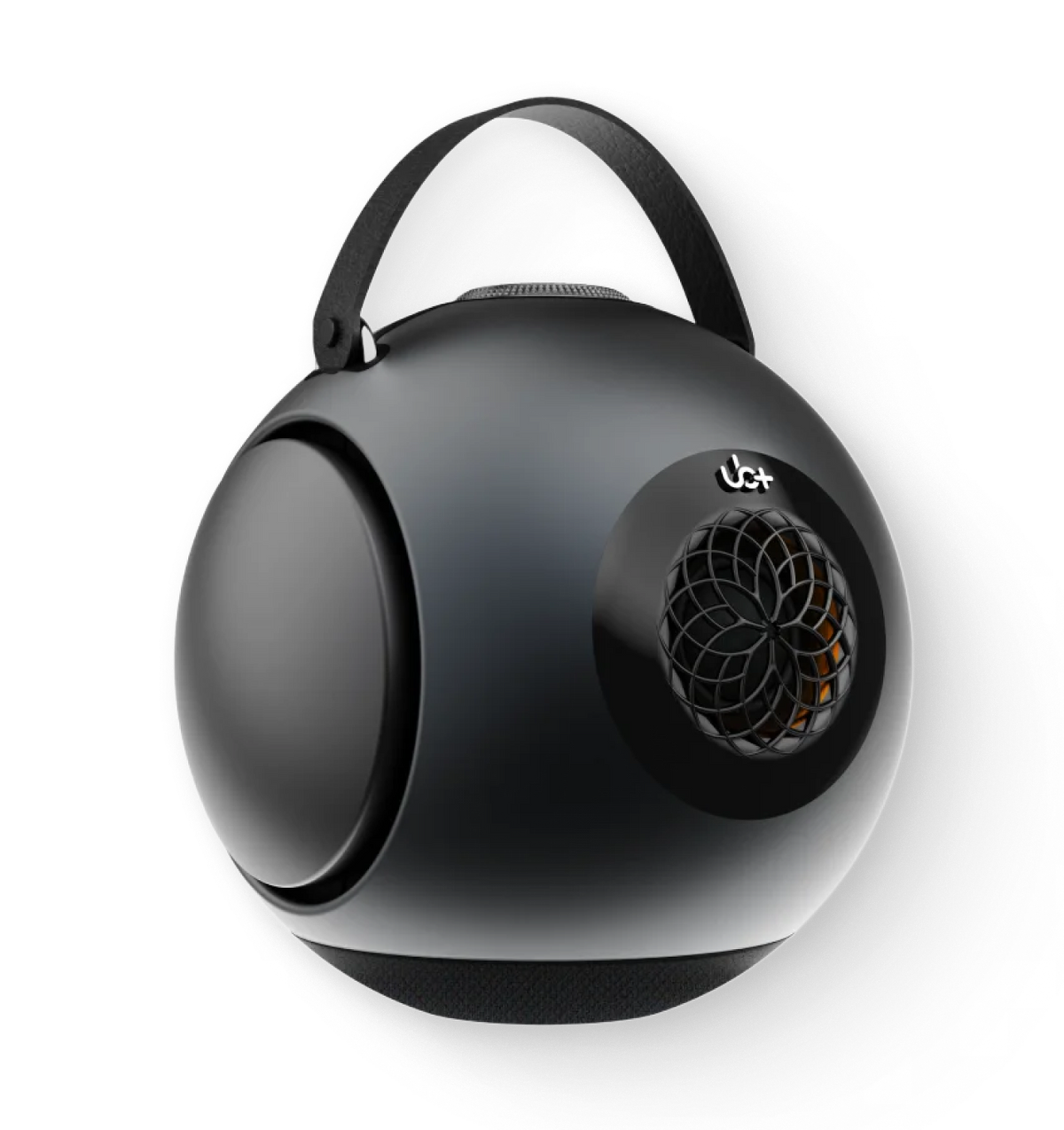
Its design brings together a spherical acoustic chamber inspired by the Helmholtz resonator principle, a centrally positioned mid-bass driver, and two opposing passive radiator plates. These components are intended to work as one acoustic system rather than as separate features added to a conventional enclosure.
The spherical chamber uses enclosed air and a controlled opening as part of its acoustic behavior. The Helmholtz-inspired principle describes how an air volume and an opening interact to create resonance. In a speaker, this type of acoustic behavior can be incorporated into enclosure design to influence low-frequency performance.
The spherical geometry also avoids the parallel-wall arrangement found in conventional rectangular cabinets. This changes the internal acoustic environment and can help reduce certain unwanted standing-wave patterns.
How the dB1's Bass Architecture Works
The dB1 uses a centrally positioned, downward-firing 4.5-inch mid-bass driver. Its movement creates pressure changes inside the spherical chamber, which drive two passive radiator plates mounted on opposite sides of the enclosure.
The combined surface area of the passive radiators is approximately 3.5 times the woofer's surface area. This arrangement provides substantial radiating area relative to the active driver.
The passive radiators do not use separate voice coils or receive independent electrical signals. Instead, they respond mechanically to the pressure changes produced inside the chamber.
Their opposing movement is also relevant to cabinet behavior. Because the radiator plates move in opposite physical directions, their reaction forces can help reduce mechanical vibration transmitted to the supporting surface. This is a self-balancing approach, not a claim that all vibration disappears.
The driver assembly includes a 90mm neodymium magnet and a 35mm long-stroke voice coil. These components support controlled driver movement within the system's intended operating range.
DSP also contributes to the design. It can support linearity, tonal balance, and driver protection, while the spherical chamber and passive radiator arrangement provide the underlying mechanical acoustic approach.
The dB1's specifications include:
- 4.5-inch mid-bass driver
- 90mm neodymium magnet
- 35mm long-stroke voice coil
- 40Hz–20kHz stated frequency response
- 93dB SPL
- Bluetooth 5.3
- Up to 20 hours of maximum playback
- IPX5 water resistance
- Wired and TF-card playback support
- Stereo pairing
Why the dB1 Is Relevant to 360-Degree Listening
The dB1 combines a spherical enclosure with a design intended for 360-degree spherical sound dispersion. This makes it particularly relevant for listeners who want a speaker that does not rely on a single front-facing listening direction.
Its low-frequency architecture also matters because room-filling sound is not only about spreading treble and midrange around a space. Music needs a coherent tonal balance, including bass that contributes weight without overwhelming vocals and instruments.
For a shared living area, the combination of broad sound distribution and dedicated bass engineering makes the dB1 an interesting option to compare with conventional portable speakers.
It is still important to match the speaker to the room. A compact portable speaker is not a replacement for a large multi-speaker system in every environment. Room size, listening distance, desired volume, and background noise all affect the result.
For buyers who want to explore this design in detail, the UB+ dB1 DoubleBass is the clearest starting point in the UB+ range for examining spherical acoustic engineering and 360-degree sound distribution.
UB+ dB Mini: A Compact Alternative for Everyday Listening
The UB+ dB Mini is another model to consider when comparing portable speaker options. Its compact positioning makes it relevant to buyers who value convenient everyday use and want to compare different sizes and product designs.
Its maximum stated playback time is 20 hours. This is useful when evaluating how a portable speaker may fit into a typical day of listening.
However, it is important not to assume that every compact UB+ model shares the dB1's spherical acoustic chamber, dual passive-radiator arrangement, or 360-degree dispersion design. These are specific design characteristics and should be evaluated according to the individual model.
When comparing the dB Mini with the dB1, consider the following:
- Whether you prioritize compact everyday portability or a dedicated spherical acoustic design.
- How much room coverage you need.
- Your preferred listening volume.
- Whether bass architecture is a major part of your buying decision.
- How important battery performance is for your routine.
The UB+ dB Mini is worth comparing if portability and everyday listening are central to your requirements. Buyers should review the product's individual design and specifications rather than assuming that a smaller speaker will deliver the same acoustic behavior as the dB1.
UB+ S2 Alphorn: Compare the Design With Your Listening Needs
The UB+ S2 Alphorn provides another option within the UB+ speaker range. Its maximum stated playback time is 16 hours.
When comparing the S2 Alphorn with the dB1, the decision should be based on the actual product design, intended placement, and listening requirements. A speaker's exterior form does not by itself establish whether it provides omnidirectional dispersion or the same bass architecture as another model.
Consider the S2 Alphorn if you are comparing different UB+ speaker designs and want to evaluate which one fits your space and routine. Review its product information for the specific connectivity, placement, and operating features that matter to you.
The UB+ S2 Alphorn is a useful model to include when exploring the wider UB+ lineup, particularly when comparing product design and maximum playback time with other options.
Which UB+ Model Should You Choose?
The right choice depends on what you mean by room-filling sound. If your priority is a spherical acoustic design with a specific 360-degree sound-distribution approach, the dB1 is the strongest match among the models discussed here.
If your main requirement is a compact everyday speaker, the dB Mini is another model to compare. If you want to explore a different UB+ design, the S2 Alphorn can be considered alongside it.
|
Buying priority |
UB+ model to examine |
Main consideration |
|
Spherical acoustic design and 360-degree dispersion |
Spherical chamber, broad sound distribution, and dual passive-radiator architecture |
|
|
Compact everyday portability |
Compact speaker option and up to 20 hours of maximum playback |
|
|
Comparing another UB+ design |
Different product design and up to 16 hours of maximum playback |
The dB1 is the most directly relevant choice for someone specifically seeking a spherical speaker with 360-degree sound distribution. The dB Mini and S2 Alphorn should be evaluated according to their own product characteristics rather than treated as identical alternatives.
Choosing by Room Size
Room size influences how much output you need and how you should position a speaker.
- Bedrooms and smaller rooms: A compact portable speaker may provide sufficient output for personal listening. Placement convenience and balanced sound can be more important than maximum loudness.
- Living rooms: Broad dispersion can be useful when people sit in different positions. A spherical design such as the UB+ dB1 DoubleBass is worth examining if shared listening is a priority.
- Open-plan spaces: Larger spaces require more output and can involve greater listening distances. A single compact speaker may not deliver uniform volume throughout the entire area, regardless of its dispersion pattern.
- Outdoor areas: Outdoor listening lacks many of the reflections and boundary effects found indoors. Consider output capability, battery performance, and water resistance alongside dispersion.
A speaker should be selected according to the actual listening area, not simply the largest room size mentioned in a product description.
How to Position a 360-Degree Speaker for Better Room Coverage
Even a well-designed omnidirectional speaker benefits from sensible placement. Positioning influences how sound interacts with walls, furniture, and listening positions.
Give the Speaker Space
Avoid placing the speaker directly against a wall unless the manufacturer recommends that position. Nearby surfaces can change the perceived frequency balance, particularly in the bass region.
A little space around the enclosure can help listeners evaluate the speaker's intended dispersion more effectively.
Consider the Main Listening Area
For shared listening, position the speaker where people can hear it from multiple directions. A central location may be useful in some rooms, but it is not automatically the best position in every environment.
Consider furniture, obstacles, and the distance between the speaker and listeners. A speaker hidden behind furniture may not provide the same listening experience as one placed in a more open position.
Avoid Unnecessary Obstructions
Large objects between the speaker and listeners can affect the direct sound reaching different parts of the room. Try to position the speaker where its acoustic output is not blocked by shelves, cabinets, or other furniture.
Test Different Listening Positions
Listen from the sofa, a nearby chair, and the other side of the room. Pay attention to changes in vocal clarity, bass balance, and overall volume.
A speaker intended for broad dispersion should make these differences less restrictive, but room reflections and frequency-dependent directivity still matter.
Adjust Placement Before Increasing Volume
If a speaker sounds weak in one part of the room, moving it may be more useful than immediately increasing the volume. Placement can influence how sound reaches the listening area, while higher volume may introduce distortion or make the sound uncomfortable near the speaker.
Common Myths About 360-Degree Bluetooth Speakers
Myth: 360-Degree Sound Means Identical Sound Everywhere
A speaker can be designed to distribute sound around its enclosure, but this does not guarantee identical frequency response and volume at every position. Driver direction, frequency, room reflections, and obstructions all influence what listeners hear.
Myth: A Round Speaker Is Automatically Omnidirectional
A circular or spherical exterior does not prove that a speaker distributes sound evenly around itself. The internal driver arrangement and acoustic design determine the actual dispersion pattern.
Myth: Wider Dispersion Always Means More Volume
Dispersion describes how sound is distributed, while output capability describes how much sound the speaker can produce. A speaker may spread sound broadly without having enough output for a large room.
Myth: 360-Degree Speakers Do Not Need Careful Placement
Placement still matters. Walls, corners, furniture, and room dimensions can influence sound. Broad dispersion offers flexibility, but it does not make the room acoustically irrelevant.
Myth: Strong Bass Is the Main Requirement for Filling a Room
Bass adds fullness, but room-filling music also needs clear vocals, controlled midrange, and suitable high-frequency reproduction. Excessive bass can make music less balanced and reduce clarity.
Frequently Asked Questions
What is a 360-degree Bluetooth speaker?
It is a portable or wireless speaker designed to distribute sound around its enclosure rather than concentrating most of its output toward one front-facing direction. The exact dispersion pattern depends on its driver arrangement and acoustic design.
Are 360-degree speakers better for living rooms?
They can be convenient in living rooms where people sit in different directions or move around while listening. A broad dispersion pattern can make speaker placement less restrictive, although room size and output capability still matter.
Does a 360-degree speaker sound the same from every direction?
Not necessarily. Real speakers have frequency-dependent radiation patterns, and room reflections can change the sound at different listening positions. Omnidirectional design aims for broad coverage, not perfect acoustic uniformity everywhere.
Which UB+ model is most relevant for spherical 360-degree sound?
The UB+ dB1 DoubleBass is the most directly relevant model discussed in this guide. Its spherical acoustic chamber and design for 360-degree spherical sound dispersion make it a strong option to examine for shared-room listening.
Does a spherical speaker produce better bass?
Not automatically. Bass performance depends on the driver, enclosure volume, acoustic tuning, excursion, and available power. A spherical enclosure provides a different acoustic structure, but the complete system determines the result.
Can a compact 360-degree speaker fill a large room?
It depends on the speaker's output capability, listening distance, room layout, and background noise. A compact model may work well in a smaller room but may not provide sufficient volume across a large open space.
Explore UB+ Speaker Options for 360-Degree Listening
Choose the UB+ speaker that best matches your room, listening preferences, and everyday requirements:
- Explore UB+ dB1 DoubleBass: Discover its spherical acoustic chamber, Helmholtz-inspired design, 360-degree sound dispersion, and dual passive-radiator architecture.
- Compare UB+ dB Mini: Explore a compact portable speaker option with up to 20 hours of maximum playback.
- Discover UB+ S2 Alphorn: Compare another UB+ speaker design with up to 16 hours of maximum playback.
- Browse All UB+ Speakers: Explore the UB+ range and compare available speaker options.
When choosing a speaker for a shared room, consider more than its shape or advertised coverage. Sound dispersion, output capability, bass control, placement, and the room itself all contribute to the listening experience. If spherical design and broad sound distribution are your main priorities, the UB+ dB1 DoubleBass is the most relevant model to examine first.


Laat een reactie achter
Deze site wordt beschermd door hCaptcha en het privacybeleid en de servicevoorwaarden van hCaptcha zijn van toepassing.