
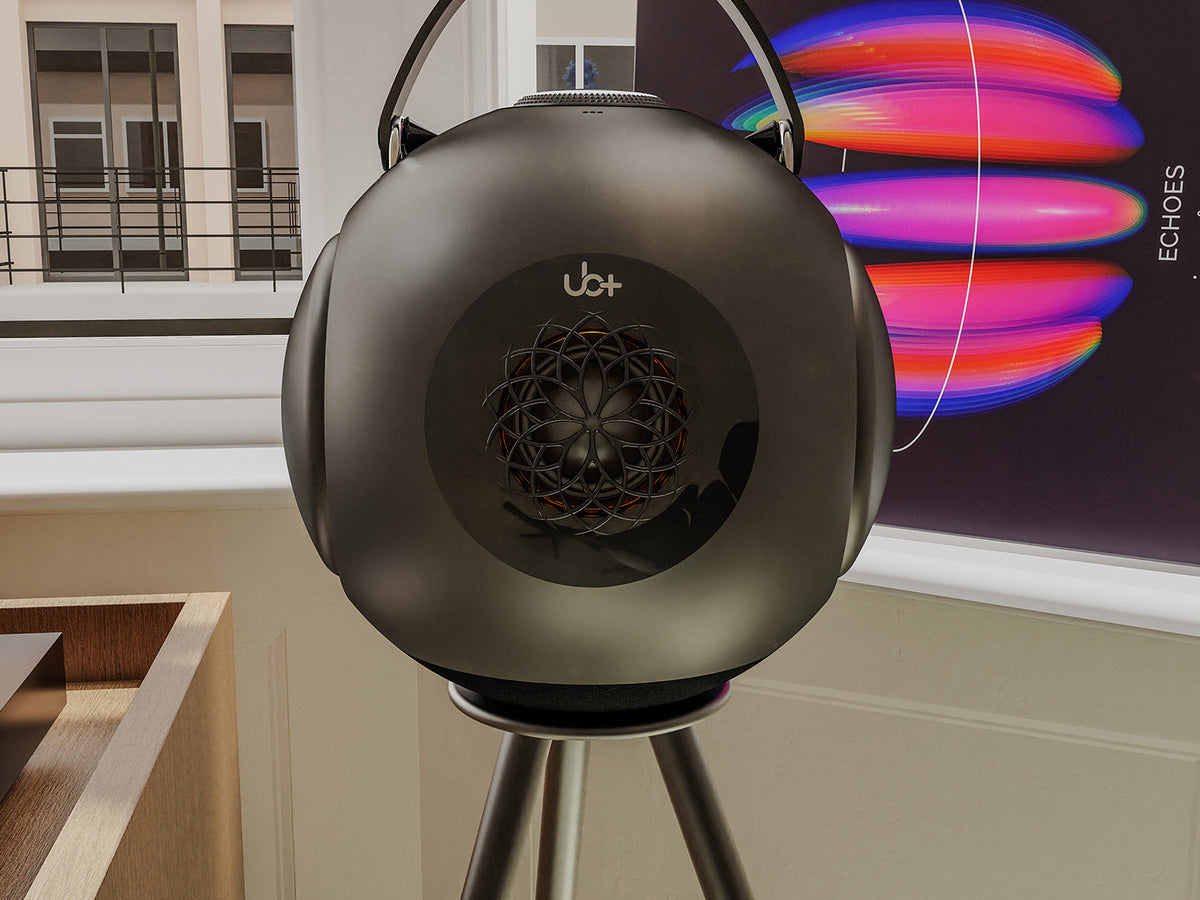
A portable speaker is easy to position on a desk, shelf, or table, but those locations are not always ideal. During outdoor gatherings, presentations, home entertainment, or shared listening sessions, placing a speaker at the right height can make a noticeable difference to how sound reaches the audience.
This is where a tripod stand becomes useful.
A Bluetooth speaker with tripod stand setup allows a compatible speaker to be elevated above furniture, positioned more strategically, and directed toward the intended listening area. Instead of sitting close to the floor or being partially blocked by objects, the speaker can deliver sound from a more open position.
However, not every portable Bluetooth speaker is designed for tripod mounting. Some speakers include dedicated mounting sockets, while others require a compatible bracket, cradle, or platform. A speaker's shape, weight, mounting interface, and center of gravity all influence whether it can be positioned safely.
The decision is particularly important when comparing distinctive portable designs such as the UB+ dB1 DoubleBass, UB+ dB Mini, UB+ S1 Circle, and UB+ S2 Alphorn.
Each model has its own product design, so tripod compatibility should be evaluated individually rather than assumed from appearance or size. A suitable stand can improve placement flexibility, but it should never compromise the enclosure, driver arrangement, or stability of the speaker.
This guide explains how tripod stands work, what they add to a portable audio setup, which mounting options to consider, and how to evaluate the UB+ product range for different listening environments.
What Is a Bluetooth Speaker Tripod Stand?

A speaker tripod stand is a support structure designed to elevate a compatible speaker above the floor. Most designs use three legs and a central support column, with a mounting interface at the top.
Depending on the product, the speaker may connect through:
- A dedicated pole-mount socket.
- A threaded mounting point.
- A manufacturer-approved mounting bracket.
- A compatible cradle or platform.
- A purpose-built adapter designed for the speaker's shape and weight.
The main purpose is to provide a stable elevated listening position.
A speaker placed directly on the floor may have its sound partially obstructed by furniture, people, or other objects. Raising it can create a clearer path toward the listeners and make the setup more practical for group environments.
A tripod does not automatically improve the speaker's sound quality or increase its amplifier power. Its value comes from better positioning and, in suitable situations, improved coverage of the listening area.
Why mounting compatibility matters
A standard tripod is not universally compatible with every speaker.
Before purchasing an adapter or mounting accessory, confirm:
- Whether the speaker has a dedicated mounting socket.
- Whether the manufacturer supports an external mounting bracket.
- Whether an appropriate cradle can securely support its enclosure.
- Whether the stand's load capacity is sufficient.
- Whether the mounting arrangement allows normal operation of the speaker's drivers, ports, and radiators.
A speaker should never be attached using an improvised clamp that could damage its housing or obstruct moving acoustic components.
What Does a Tripod Stand Actually Add to a Speaker Setup?

A tripod stand is not simply a taller place to put a speaker. It changes the speaker's physical position in relation to the listeners and surrounding objects.
This can be useful in several situations.
Better sound-path clearance
When a speaker sits on the floor or behind furniture, its direct sound path may be obstructed.
Elevating it can help reduce obstructions from:
- Sofas and chairs.
- Tables and counters.
- People standing in front of it.
- Equipment and storage boxes.
- Other objects in a crowded room.
This is particularly useful in group environments where listeners are not necessarily sitting directly in front of the speaker.
More practical coverage for groups
A speaker positioned too low may direct much of its output toward furniture or the lower part of the room.
An elevated position can make it easier for sound to reach seated and standing listeners. This does not guarantee uniform coverage, because dispersion still depends on the speaker's driver arrangement and the room.
For a small gathering, the goal is to place the speaker where music can be heard comfortably without requiring excessive volume.
Greater placement flexibility
Tripod stands can be adjusted to suit different spaces.
For example:
- A living room may benefit from a stand positioned near the gathering area.
- A backyard setup may require elevation above chairs or other obstacles.
- A presentation area may need the speaker positioned where everyone can hear clearly.
- A temporary event may require the speaker to be repositioned as the audience changes location.
A suitable stand makes these adjustments easier without requiring a permanent installation.
A cleaner floor-level setup
An elevated speaker can also reduce the likelihood of accidental contact with feet, bags, and other objects on the floor.
However, stability remains essential. The tripod should have a suitable base, the speaker must be properly secured, and the arrangement should not create a tipping hazard.
For more practical positioning advice, see tripod Bluetooth speaker placement: height, bass, and projection.
Does Elevating a Speaker Improve Sound Quality?

It can improve the listening experience, but the result depends on the room, speaker design, and mounting height.
A tripod does not change the speaker's internal acoustic architecture. It does not make a small driver larger, increase amplifier power, or extend the speaker's frequency response.
What it changes is the relationship between the speaker and the environment.
Height and listening position
Sound reaching a listener is influenced by the direct path from the speaker and reflections from surrounding surfaces.
Raising the speaker can:
- Reduce obstruction by furniture.
- Improve the direct path to listeners.
- Change the balance of direct and reflected sound.
- Make the sound easier to hear across a shared space.
The best height depends on the speaker's dispersion and the audience's position. A higher position is not automatically better, and the enclosure should not be raised beyond what the stand can safely support.
Height and bass response
Bass is frequently misunderstood in discussions about speaker stands.
Low-frequency sound has relatively long wavelengths and is influenced by room boundaries, speaker placement, and the listening position. Simply raising a speaker does not automatically produce deeper or stronger bass.
In some rooms, elevation may change the perceived bass balance. In others, the difference may be small.
The correct approach is to compare positions using familiar music and listen for balanced sound rather than assuming that a particular height will produce more bass.
For additional guidance, read Bluetooth speaker placement tips for bass and clarity.
Types of Tripod Stands and Speaker Mounting Options

Different stands are designed for different speakers. Understanding the mounting options is essential before purchasing accessories.
Standard pole-mount tripod stands
These are common in professional PA systems and event audio.
They typically use a pole or mounting interface designed to fit a compatible socket in the bottom of the speaker.
Potential advantages include:
- Elevated positioning.
- Adjustable height.
- Convenient setup for temporary events.
- A relatively small footprint when properly positioned.
However, many compact Bluetooth speakers do not have a standard PA-style pole socket.
A stand's physical dimensions are not enough to establish compatibility. The speaker must have the correct mounting interface or an approved adapter.
Threaded mounting systems
Some speakers and accessories use threaded mounting points.
These can provide a direct attachment when the thread specification and mounting arrangement match.
Before using one, confirm:
- Thread size and type.
- Mounting depth.
- Supported load.
- The manufacturer's installation guidance.
Do not force a screw into a mounting point simply because it appears to fit.
Universal speaker cradles
A cradle supports the speaker rather than attaching directly through a dedicated socket.
This can be useful for speakers with rounded, sculptural, or unusual enclosures.
A suitable cradle should:
- Match the speaker's physical dimensions.
- Support its weight securely.
- Prevent slipping or tipping.
- Avoid putting excessive pressure on the housing.
- Leave drivers and acoustic openings unobstructed.
Cradles are not universally compatible. The actual shape and balance of the speaker must be considered.
Tabletop stands versus floor tripods
A tabletop stand and a floor tripod solve different placement problems.
|
Stand type |
Main purpose |
Potential advantage |
Important consideration |
|
Floor tripod |
Elevates a speaker above the floor |
Adjustable placement and greater clearance |
Requires a suitable mounting interface or secure cradle |
|
Threaded mounting stand |
Attaches through a compatible thread |
Direct attachment when supported |
Thread specification must match |
|
Speaker cradle |
Supports the enclosure externally |
Can accommodate some non-standard shapes |
Must provide secure support without obstruction |
|
Tabletop stand |
Raises a speaker above a desk or shelf |
Convenient for smaller listening spaces |
Limited height adjustment |
|
Fixed wall bracket |
Provides permanent elevated placement |
Keeps floor space clear |
Requires compatible hardware and secure installation |
For portable speakers, the best option is the one that provides secure support without damaging or obstructing the product.
What to Check Before Buying a Bluetooth Speaker Tripod Adapter
Compatibility should always come before appearance.
A stand may look suitable in a product photograph but still be unsafe or impractical for a particular speaker.
Use the following checklist before purchasing.
Mounting interface
Check whether the speaker has:
- A manufacturer-specified tripod socket.
- A compatible threaded point.
- An approved mounting accessory.
- A suitable external cradle option.
If none of these is documented, do not assume standard tripod compatibility.
Weight and load capacity
A stand should support the complete speaker and any attached accessory within its specified load limit.
Consider:
- Speaker weight.
- Adapter weight.
- Stand load rating.
- The stability of the speaker's center of gravity.
- Whether the stand is suitable for the intended environment.
A stand that technically supports the weight may still be unstable if the speaker's shape creates an unsuitable balance.
Enclosure protection
The mounting arrangement should not damage the product.
Avoid:
- Tight clamps placed directly over vulnerable enclosure areas.
- Pressure on passive radiators.
- Attachments that cover drivers or acoustic openings.
- Adapters that interfere with charging ports or controls.
- Improvised mounting solutions that allow the speaker to slide or rotate.
Height and adjustment
An adjustable stand can be useful, but the highest possible setting is not always the best.
Choose a height that:
- Provides a clear sound path.
- Suits the listeners' positions.
- Keeps the center of gravity manageable.
- Allows the stand to remain stable on the floor.
Indoor and outdoor stability
A tripod used indoors should still be placed on a level surface with its legs fully spread.
Outdoor use introduces additional risks:
- Uneven ground.
- Wind.
- Accidental contact.
- Loose soil or grass.
- People moving around the stand.
Never rely on a lightweight tripod to support an elevated speaker in exposed or windy conditions without checking its suitability.
Which UB+ Models Should You Consider?
The UB+ range includes several different speaker designs. The important point when choosing a tripod-related setup is that the models should not all be treated as having the same physical construction or mounting compatibility.
The dB1 DoubleBass, dB Mini, S1 Circle, and S2 Alphorn each deserve individual consideration.
No dedicated tripod socket or approved tripod adapter has been established for these models in the product information available here. Therefore, none should be advertised as confirmed direct tripod-compatible without checking its official mounting specifications.
UB+ dB1 DoubleBass

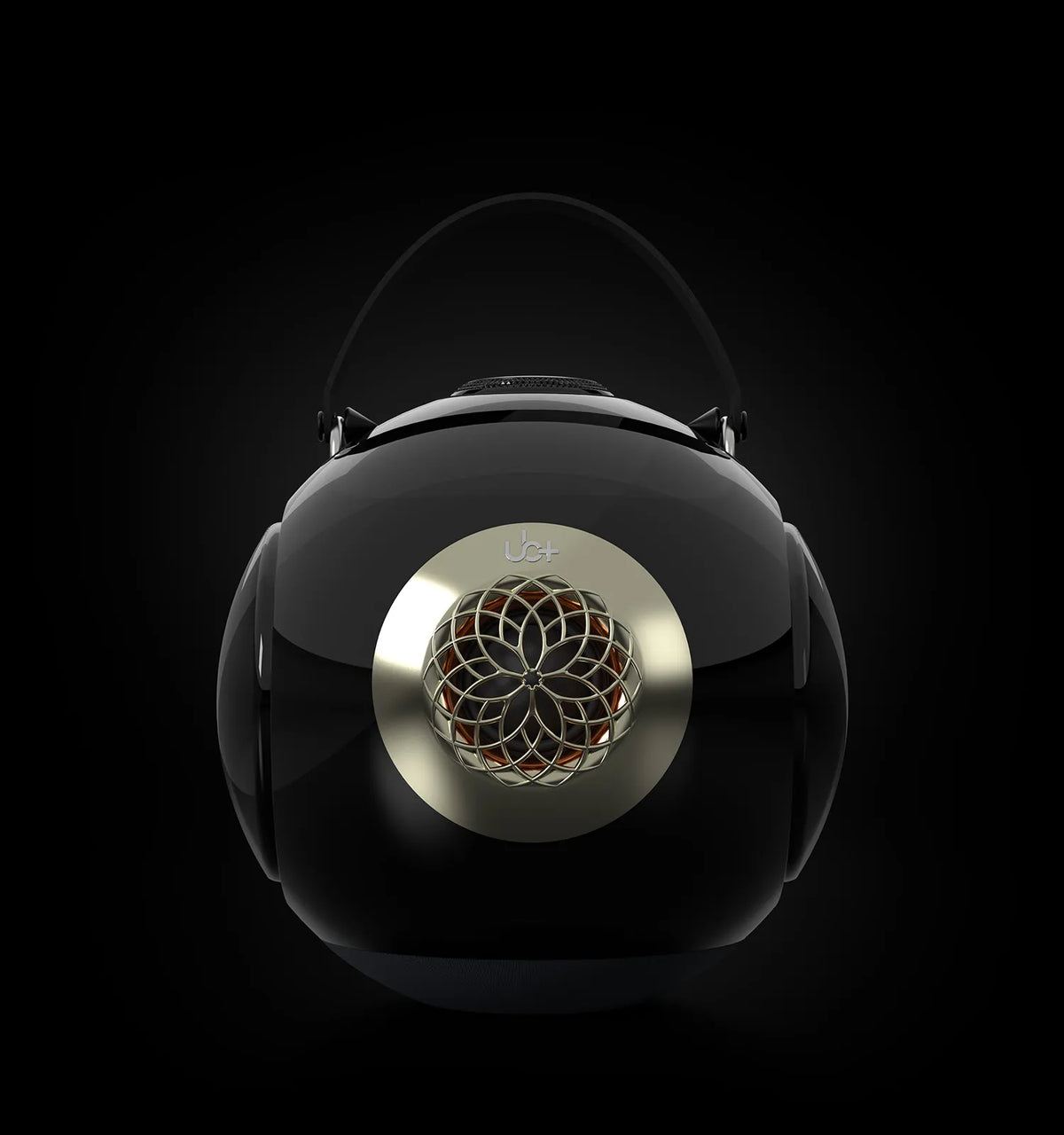
The dB1 is the most technically distinctive model in this comparison. Its spherical acoustic chamber, central mid-bass driver, and two symmetrical passive radiators make its enclosure architecture particularly important when considering external mounting.
For a tripod arrangement, the key consideration is secure support without interfering with the acoustic components.
- Avoid placing clamps over either passive-radiator plate.
- Do not obstruct the downward-firing driver.
- Do not assume that a conventional PA pole can attach directly to the enclosure.
- Consider only a properly dimensioned and secure support designed for the product.
The dB1's spherical form makes mounting geometry particularly important. A cradle or platform should be evaluated for contact points, balance, and clearance before use.
Its acoustic design is best understood through its Helmholtz-inspired spherical chamber and dual passive-radiator architecture, rather than treating a tripod as an acoustic upgrade.
UB+ dB Mini

The dB Mini is another model to consider when comparing compact portable audio options. Its physical dimensions, weight, and actual mounting provisions should guide any decision about an external stand.
For this model, evaluate:
- Whether its enclosure can be securely supported by a suitable cradle.
- Whether the support allows access to controls and charging connections.
- Whether the stand maintains balance without excessive pressure.
- Whether the arrangement suits the intended listening height.
Do not assume the dB Mini has the dB1's spherical chamber or dual passive-radiator configuration.
Explore the dB Mini product page for its model-specific design and specifications.
UB+ S1 Circle

The S1 Circle provides another design in the UB+ collection for buyers considering the relationship between speaker appearance, placement, and everyday use.
Its circular form makes the physical support arrangement an important consideration.
Before using a tripod:
- Check whether the product documentation specifies a mounting interface.
- Consider whether a suitable cradle can hold the speaker securely.
- Ensure the support does not interfere with the enclosure or intended sound path.
- Verify the balance of the mounted product before raising it.
The S1 Circle should be evaluated using its own product specifications. The dB1's driver and passive-radiator features should not be attributed to it.
See the UB+ S1 Circle product page for its individual product details.
UB+ S2 Alphorn

The S2 Alphorn is another UB+ model worth considering when reviewing the complete speaker range. Its individual form and dimensions should determine the appropriate placement method.
For tripod use, the important questions are:
- Does the model have a manufacturer-approved mounting point?
- Can a suitable cradle support its full shape?
- Does the proposed mounting position maintain balance?
- Will the stand interfere with the speaker's acoustic openings or intended orientation?
A direct tripod-mounting claim should not be made without model-specific confirmation.
Review the UB+ S2 Alphorn for available product information and model details.
UB+ Model Comparison: What to Consider for Tripod Placement
The following table separates the known model identities from mounting compatibility. It is a practical assessment guide, not a claim that every model has been tested with a specific tripod.
|
UB+ model |
Product page |
Design consideration |
Tripod decision |
|
dB1 DoubleBass |
Spherical chamber, central downward-firing driver, two symmetrical passive radiators |
Check approved support and ensure all acoustic components remain unobstructed |
|
|
dB Mini |
Compact portable design |
Verify dimensions, mounting provisions, and cradle compatibility |
|
|
S1 Circle |
Circular design |
Check secure support and product-specific mounting guidance |
|
|
S2 Alphorn |
Distinctive model design |
Confirm mounting interface and stability before using a tripod |
The key distinction is between a speaker that can be positioned on a suitable external support and one that has a manufacturer-approved direct tripod mount. Those are not necessarily the same thing.
How Tripod Height Influences Speaker Placement
The ideal height depends on the room, the speaker's design, and where the listeners are located.
For casual listening, an elevated position may help the speaker project sound above furniture. For a presentation or gathering, height may be selected to improve the direct path toward the audience.
Low positioning
A speaker positioned low may be partially obstructed by furniture or people.
This can be appropriate when:
- The speaker is used close to the listener.
- The enclosure is designed for a particular downward or upward acoustic orientation.
- The floor or furniture provides the intended placement surface.
Medium elevation
A moderate height can be useful for shared listening when furniture or seated listeners obstruct a low placement.
The objective is to improve the path between speaker and listeners without creating unnecessary instability.
Higher positioning
Higher placement may be useful in certain event situations, but it also changes the stand's stability requirements.
As the speaker is raised, the overall center of gravity increases. The stand must remain suitable for the speaker's weight and physical dimensions.
Avoid raising a portable speaker simply to make it look more professional.
Choosing a suitable height
|
Environment |
Placement objective |
Practical consideration |
|
Bedroom |
Clear sound toward the listening area |
A desk or tabletop position may be sufficient |
|
Living room |
Reduce obstruction by furniture |
Moderate elevation may be useful |
|
Small gathering |
Improve listening coverage |
Test from different seating positions |
|
Outdoor event |
Provide a clear sound path |
Use a stand suited to the ground and weather conditions |
|
Presentation area |
Direct sound toward the audience |
Consider audience position and speaker dispersion |
The tripod Bluetooth speaker placement guide offers additional insight into elevation and placement decisions.
Does a Tripod Stand Improve Bass Projection?
This is one of the most common misunderstandings about speaker stands.
A tripod does not create additional bass or change the speaker's acoustic tuning. It changes the speaker's position relative to the floor, walls, furniture, and listeners.
Bass frequencies have long wavelengths, which means they interact with room boundaries differently from higher frequencies.
Depending on the speaker and its location, elevation may change the perceived bass balance. However, it is not a universal bass-enhancement technique.
For stronger and more controlled bass, the speaker's internal acoustic design remains essential.
Important factors include:
- Driver surface area.
- Available diaphragm excursion.
- Enclosure volume.
- Passive-radiator or port tuning.
- Motor design.
- Amplifier capability.
- DSP-supported system protection.
The dB1 DoubleBass provides an example of how physical acoustic engineering addresses low-frequency reproduction through its spherical chamber and dual symmetrical passive radiators. A tripod does not replace or improve those internal design elements.
For an additional technical explanation, explore 40 Hz bass in Bluetooth speakers explained.
When Is a Tripod Stand Worth Buying?
A tripod is most useful when the speaker's location needs to change frequently or when floor-level placement creates practical problems.
Consider a stand when:
- You regularly host small gatherings.
- Furniture blocks the speaker's sound path.
- You need a more adjustable temporary setup.
- The speaker is used for presentations or shared listening.
- You want to keep the speaker away from floor-level obstacles.
- You have a properly compatible mounting arrangement.
A tripod may be unnecessary when the speaker remains on a desk, shelf, or side table and already provides the desired coverage.
It is also worth remembering that a stand is an accessory, not a substitute for choosing a speaker with appropriate output, dispersion, and acoustic performance.
Common Tripod Mounting Mistakes to Avoid
An unsuitable mounting arrangement can damage a speaker or create a safety hazard.
Avoid these mistakes:
Assuming all Bluetooth speakers use standard pole mounts. Many compact speakers do not have a professional PA mounting socket.
Using an oversized or poorly fitting clamp. Excessive pressure can damage the enclosure or restrict moving acoustic components.
Blocking passive radiators. A support should not interfere with the movement of a passive radiator.
Ignoring the center of gravity. A speaker may be within the stand's weight rating but still be unstable because of its shape or mounting position.
Raising the speaker too high. Higher positioning increases stability demands and is not automatically acoustically preferable.
Using an indoor stand in unsuitable outdoor conditions. Uneven ground and wind can make an otherwise acceptable arrangement unsafe.
Assuming an elevated speaker always sounds better. Placement needs to be tested in the actual listening environment.
Choose the Speaker First, Then the Stand
A tripod stand can make a portable audio setup more flexible by improving placement options, reducing obstruction, and helping direct sound toward the intended listening area. It can be particularly useful for temporary gatherings, presentations, and rooms where furniture limits placement choices.
However, the stand should complement the speaker rather than determine which speaker you purchase.
The UB+ range offers several different designs to evaluate:
- UB+ dB1 DoubleBass: A distinctive spherical acoustic design with a central mid-bass driver and dual symmetrical passive radiators.
- UB+ dB Mini: Another compact portable option to compare according to its individual specifications.
- UB+ S1 Circle: A circular design within the UB+ collection.
- UB+ S2 Alphorn: Another distinctive UB+ model to consider when comparing the complete product range.
No direct tripod-mount compatibility should be assumed for these models without model-specific confirmation. A suitable cradle or mounting solution must support the enclosure securely, maintain balance, and leave the acoustic components unobstructed.
The most useful buying sequence is simple:
- Decide where and how you plan to use the speaker.
- Choose the model whose acoustic performance and physical design suit that environment.
- Check the manufacturer's mounting provisions.
- Select an appropriately rated tripod or approved support.
- Test stability and listening coverage before regular use.
Explore the UB+ dB1 DoubleBass, dB Mini, S1 Circle, and the UB+ product collection to compare the different designs.
A tripod can improve how a speaker fits into a space. The speaker's acoustic engineering determines what it can deliver once it gets there.
Frequently Asked Questions
Can any Bluetooth speaker be used with a tripod stand?
No. A speaker needs a compatible mounting interface or a suitable manufacturer-approved external cradle. Check the speaker's weight, dimensions, center of gravity, and mounting instructions before attaching it to a tripod. Never assume that a universal clamp is suitable.
Does putting a Bluetooth speaker on a tripod make it louder?
Not directly. A tripod does not increase amplifier power or the speaker's maximum output. However, elevating a speaker can reduce obstructions and improve the direct sound path toward listeners, which may make the music easier to hear in certain environments.
Does a tripod stand improve bass performance?
Not automatically. Elevation changes the speaker's relationship with the room and its boundaries, which can affect perceived bass in some situations. Actual bass performance depends on the driver, enclosure, acoustic tuning, passive radiators or ports, and listening environment.
Can the UB+ dB1 DoubleBass be attached directly to a standard speaker tripod?
Direct compatibility should not be assumed without confirmation from the product's mounting specifications. The dB1's spherical enclosure and opposing passive-radiator plates make support design particularly important. Any external support must securely hold the speaker without obstructing the downward-firing driver or passive radiators.
Which UB+ models should I compare when considering an elevated speaker setup?
Consider the dB1 DoubleBass, dB Mini, S1 Circle, and S2 Alphorn. Each has a different product design, so review their individual dimensions, construction, and mounting information before selecting a tripod or cradle. Do not assume that one model's mounting arrangements or acoustic architecture apply to another.
Explore the UB+ Product Range
UB+ dB1 DoubleBass — Explore the patented spherical acoustic chamber and dual symmetrical passive-radiator architecture.
UB+ dB Mini — Compare another compact portable speaker design.
UB+ S1 Circle — Discover another distinctive design in the UB+ range.
UB+ S2 Alphorn and product collection — Explore the available UB+ models.


Laat een reactie achter
Deze site wordt beschermd door hCaptcha en het privacybeleid en de servicevoorwaarden van hCaptcha zijn van toepassing.