
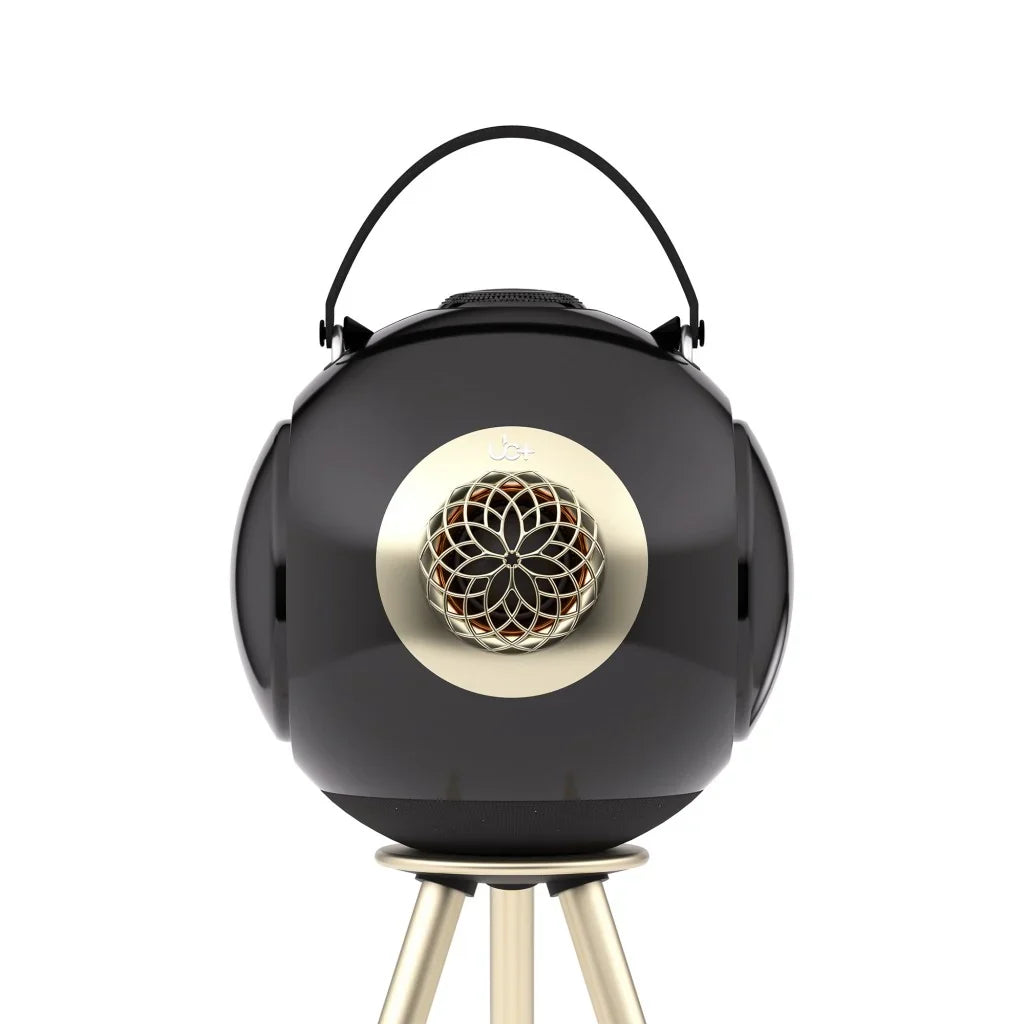
Modern speakers are increasingly designed to be seen as well as heard. A sphere speaker can become part of a living room, office, bedroom, or creative workspace rather than something hidden on a shelf. Its curved enclosure and glossy finish make the speaker visually distinctive, but they also make dust, fingerprints, smudges, and fine scratches easier to notice.
A spherical Bluetooth speaker therefore needs a slightly more careful cleaning routine than a conventional rectangular speaker. The basic principle is simple: remove dust before wiping, use soft materials, control moisture, and avoid applying pressure to acoustic components.
For a design such as the UB+ dB1 DoubleBass, maintenance also means being careful around the speaker's passive radiators and other exposed acoustic areas. The goal is not complicated maintenance. It is consistent, gentle care that protects the enclosure while keeping the speaker ready for everyday use.
Why a Spherical Speaker Requires Careful Cleaning

A glossy curved enclosure reflects light across a much larger continuous surface than a typical matte speaker cabinet. Fine scratches that might go unnoticed on a textured enclosure can become obvious when light reflects across a glossy sphere.
Dust can also become abrasive when it is dragged across a surface during dry wiping. Small particles caught between a cloth and the finish can create fine marks over repeated cleaning.
This is why the safest approach is not simply to wipe the speaker whenever it looks dusty. Instead, remove loose particles first and then clean the surface with a suitable microfiber cloth.
The acoustic design also matters. The UB+ dB1 DoubleBass uses a spherical acoustic chamber inspired by the principles of Helmholtz resonance, together with dual passive radiators. Understanding these components helps you avoid accidentally pressing, blocking, or wetting areas that are intended to move or remain unobstructed.
You can learn more about the acoustic thinking behind spherical speaker construction in UB+’s guide to spherical Bluetooth speaker design.
The Acoustic Areas You Should Protect

The enclosure is only one part of a modern speaker. Areas involved in sound production should be treated differently from the main exterior surface.
The dB1's spherical acoustic architecture uses a central mid-bass driver together with two passive radiator plates positioned on opposite sides. The passive radiators respond to pressure generated inside the acoustic chamber and contribute to the speaker's low-frequency performance.
This means they should never be treated like ordinary surfaces that can be scrubbed or pressed.
When cleaning around these components, the objective is simply to remove loose dust without restricting their movement or introducing moisture into openings.
The same principle applies to other acoustic openings, seams, controls, charging areas, and connection points. Keep liquids away from areas where they could enter the enclosure.
What You Need to Clean a Glossy Speaker

You do not need an extensive collection of cleaning products.
For routine care, use:
- A clean, high-quality microfiber cloth
- A second dry microfiber cloth
- A soft detailing brush
- Distilled water for light damp cleaning when appropriate
- An electronics-safe cleaning solution only when specifically suitable for the speaker's exterior
The most important item is the microfiber cloth. It should be clean and free of trapped particles. A cloth that has previously collected dirt or grit can create scratches even when the material itself is soft.
Avoid rough towels, paper towels, tissues, abrasive pads, and household scrubbing materials.
How to Clean the Glossy Exterior Safely
Begin by turning the speaker off and disconnecting it from its charging cable or other connections. This reduces the risk of moisture reaching powered electrical components during cleaning.
Next, remove loose dust using a soft brush or an appropriate air blower. Do not aggressively blow debris into acoustic openings. The objective is to lift particles away from the surface rather than redistribute them around the enclosure.
Once loose dust has been removed, lightly dampen a microfiber cloth. The cloth should be damp rather than wet. You should never have enough liquid on the cloth for it to drip.
Gently wipe the exterior without applying heavy pressure. Allow the cloth to pick up fingerprints and surface residue rather than trying to polish the enclosure through force.
Afterward, use a clean, dry microfiber cloth to remove remaining moisture and fingerprints.
For a glossy sphere speaker, gentle contact is more important than speed. A few light passes are preferable to repeatedly rubbing the same area with pressure.
Avoid Cleaning a Glossy Finish When It Is Dry and Dusty
One of the easiest ways to create micro-scratches is to take a dry cloth and immediately rub a dusty speaker.
The problem is not necessarily the cloth. It is the particles sitting between the cloth and the surface.
As the cloth moves, those particles can behave like very fine abrasives. Repeating this process over months can gradually reduce the visual quality of a glossy finish.
If the speaker has visible dust, remove the loose particles first. Then use a clean microfiber cloth for the remaining surface residue.
This simple habit is particularly important for a glossy spherical enclosure because its continuous surface makes fine marks easier to see.
For more general guidance on maintaining glossy speaker surfaces, see UB+’s guide to cleaning glossy speakers without scratching.
Cleaning Around Passive Radiators
Passive radiators require more care than the main enclosure.
The dB1 uses two large passive radiator plates that respond to pressure changes inside the spherical acoustic system. They are mechanical components, so pressing, pushing, or trying to manually move them is not an appropriate cleaning method.
Instead, remove dust around these areas with a soft brush.
Do not force a cloth into gaps around the radiators. Do not spray cleaner directly onto them, and avoid allowing liquid to collect around their edges.
The same approach applies to any exposed acoustic openings. Cleaning should remove surface contamination without interfering with the component's normal movement.
For a deeper explanation of how passive radiators work in Bluetooth speakers, see how passive radiators work.
Cleaning Materials to Avoid
Some common household cleaning habits are unsuitable for glossy electronics.
Paper towels: They can be rougher than they appear and may leave fibers behind.
Abrasive cloths: Anything designed for scrubbing can damage a glossy finish.
Household glass cleaners: Products containing strong solvents or other chemicals may not be suitable for the speaker's particular finish.
Excessive water: More moisture does not mean better cleaning. Liquid should be controlled and kept away from openings.
Direct spraying: Never spray cleaning liquid directly onto the speaker. Apply a suitable amount to the cloth instead when the manufacturer's care instructions permit damp cleaning.
Compressed air at excessive pressure: Strong airflow can push dust into unwanted areas or place unnecessary stress on delicate components.
When in doubt, the safest option is a clean microfiber cloth and minimal moisture.
Do Not Press the Speaker's Acoustic Components
A common mistake is assuming that every visible component can be wiped or pushed in the same way as the enclosure.
Passive radiators are designed to move. They should not be used as surfaces for pressing, polishing, or testing by hand.
The same principle applies to exposed driver areas and other acoustic components. If dust is visible, remove it gently from the surrounding surface rather than trying to clean the component through physical pressure.
A speaker's acoustic system is engineered to operate under controlled movement. Good maintenance preserves that design instead of introducing unnecessary mechanical stress.
Protecting the Glossy Finish During Everyday Use
Cleaning is only part of maintaining a glossy speaker. Preventing unnecessary contamination and physical damage is even better.
Place the speaker on a stable surface where it is unlikely to fall or be knocked over. Avoid positioning it where keys, metal objects, or other hard items can repeatedly contact the enclosure.
Clean hands also help. Fingerprints and oils are especially noticeable on glossy finishes, and repeatedly wiping heavy residue increases the amount of physical contact with the surface.
If the speaker is moved between rooms or taken outdoors, use appropriate protective packaging or a padded case during transportation. Do not place the speaker loose in a bag with chargers, keys, cables, or other hard objects.
The UB+ dB1 DoubleBass is designed for portable use, so protecting the exterior during transportation is just as important as cleaning it once you return home.
Keep the Speaker Away From Excessive Heat and Direct Sunlight
Long-term exposure to intense sunlight can affect some exterior finishes and can also increase the temperature of the electronics and battery inside a portable speaker.
For everyday storage, choose a stable location away from prolonged direct sunlight and excessive heat.
This is especially relevant when a glossy speaker is used as part of an interior design setup. A visually prominent position may look excellent, but it should still provide a sensible environment for the electronics.
The same principle applies outdoors. A speaker can be used outside without being left exposed unnecessarily for extended periods.
Understanding the dB1 Acoustic Architecture
The dB1's spherical form is part of its acoustic engineering rather than simply a styling choice.
Its chamber draws on the principles of Helmholtz resonance, while the internal geometry is designed to manage air pressure within the enclosure. The speaker uses a 4.5-inch long-throw mid-bass driver and two opposing passive radiators.
The combined passive-radiator surface area is approximately 3.5 times the area of the active woofer. This provides substantial radiating area for the low-frequency system.
The dB1 also incorporates a 90mm neodymium magnet, a 35mm long-stroke voice coil, 20mm piston movement, and an aluminum shorting ring as part of its driver architecture.
These components are not things that require user maintenance. Their importance is simply a reason to avoid aggressive cleaning around the acoustic system.
For more detail on the relationship between speaker construction and premium audio performance, see the science behind premium audio technology.
Cleaning and Care Comparison
|
Care Area |
Conventional Box Speaker |
Spherical Glossy Speaker |
|
Exterior |
Often flat or textured |
Continuous curved surface |
|
Dust removal |
Generally straightforward |
Requires careful surface wiping |
|
Scratch visibility |
Depends on finish |
Often more visible on glossy surfaces |
|
Cleaning material |
Soft cloth recommended |
Clean microfiber particularly important |
|
Passive-radiator care |
Depends on design |
Avoid pressing or obstructing moving radiators |
|
Moisture control |
Important |
Especially important around openings |
|
Transportation |
Protect corners and cabinet |
Protect the entire curved finish |
|
Long-term care |
Regular dust removal |
Regular dust removal plus finish protection |
The key difference is not that a spherical speaker is difficult to maintain. It is that a glossy curved surface rewards a more controlled cleaning routine.
A Simple Maintenance Routine
For normal indoor use, speaker maintenance can remain simple.
Remove visible dust regularly with a soft brush or clean microfiber cloth. When fingerprints or surface residue appear, use a lightly dampened microfiber cloth if appropriate for the enclosure finish, followed by a dry cloth.
Inspect the areas around passive radiators and acoustic openings periodically. If dust accumulates, remove it gently without pressing into the moving components.
During travel, protect the enclosure from hard objects and unnecessary friction.
There is no advantage to excessive cleaning. The objective is to keep the speaker free from accumulated dust and residue while minimizing unnecessary contact with the finish.
What About Outdoor Use?
Outdoor use introduces additional contaminants such as dust, pollen, moisture, and dirt.
If a speaker has been used outside, allow obvious moisture to clear according to the manufacturer's instructions before storing it. Remove surface dirt gently rather than rubbing it across the enclosure.
The UB+ dB1 has an IPX5 rating, which means it is designed to resist water jets from applicable directions. It should not be treated as a submersible speaker.
After outdoor use, inspect the exterior and acoustic areas before placing the speaker into storage or a carrying case.
For more outdoor speaker considerations, see UB+’s guide to outdoor Bluetooth speakers.
Frequently Asked Questions
What is the safest cloth for cleaning a glossy speaker?
A clean, high-quality microfiber cloth is the preferred option for routine exterior cleaning. Make sure the cloth is free from dust, grit, and other particles before using it.
Can I use glass cleaner on a glossy Bluetooth speaker?
Do not assume that household glass cleaner is safe for the speaker's finish. Cleaning chemicals can react differently with coatings and materials. Follow the manufacturer's care instructions and use only products appropriate for the specific exterior.
Can I press a passive radiator while cleaning?
No. Passive radiators are moving acoustic components and should not be pressed, pushed, or manually manipulated. Remove dust around them gently instead.
Should I use water to clean a spherical speaker?
A lightly dampened microfiber cloth can be appropriate for exterior cleaning when compatible with the manufacturer's instructions. Avoid excessive moisture and never allow liquid to enter acoustic openings, controls, charging ports, or other openings.
How can I prevent scratches on a glossy speaker?
Remove loose dust before wiping, use a clean microfiber cloth, avoid abrasive materials, and do not place hard objects against the enclosure. Regular gentle cleaning is safer than aggressive cleaning after heavy buildup.
Final Thoughts
A glossy spherical speaker combines acoustic engineering with industrial design, so maintaining it involves protecting both.
The safest approach is straightforward: remove loose dust first, use a clean microfiber cloth, control moisture, avoid harsh chemicals, and never press or obstruct passive radiators or other moving acoustic components.
For the UB+ dB1 DoubleBass, the spherical acoustic chamber, dual passive-radiator system, and precision driver architecture are all part of the product's design. Good care helps preserve the condition of the enclosure while allowing those components to continue operating as intended.
A speaker that is designed to remain visible deserves maintenance that protects its appearance without compromising the acoustic system.
Explore UB+ Options
→ Explore the UB+ dB1 DoubleBass
→ Compare the dB1 DoubleBass with the dB Mini
→ Explore UB+ Speakers
→ Check Current Price



Laat een reactie achter
Deze site wordt beschermd door hCaptcha en het privacybeleid en de servicevoorwaarden van hCaptcha zijn van toepassing.