
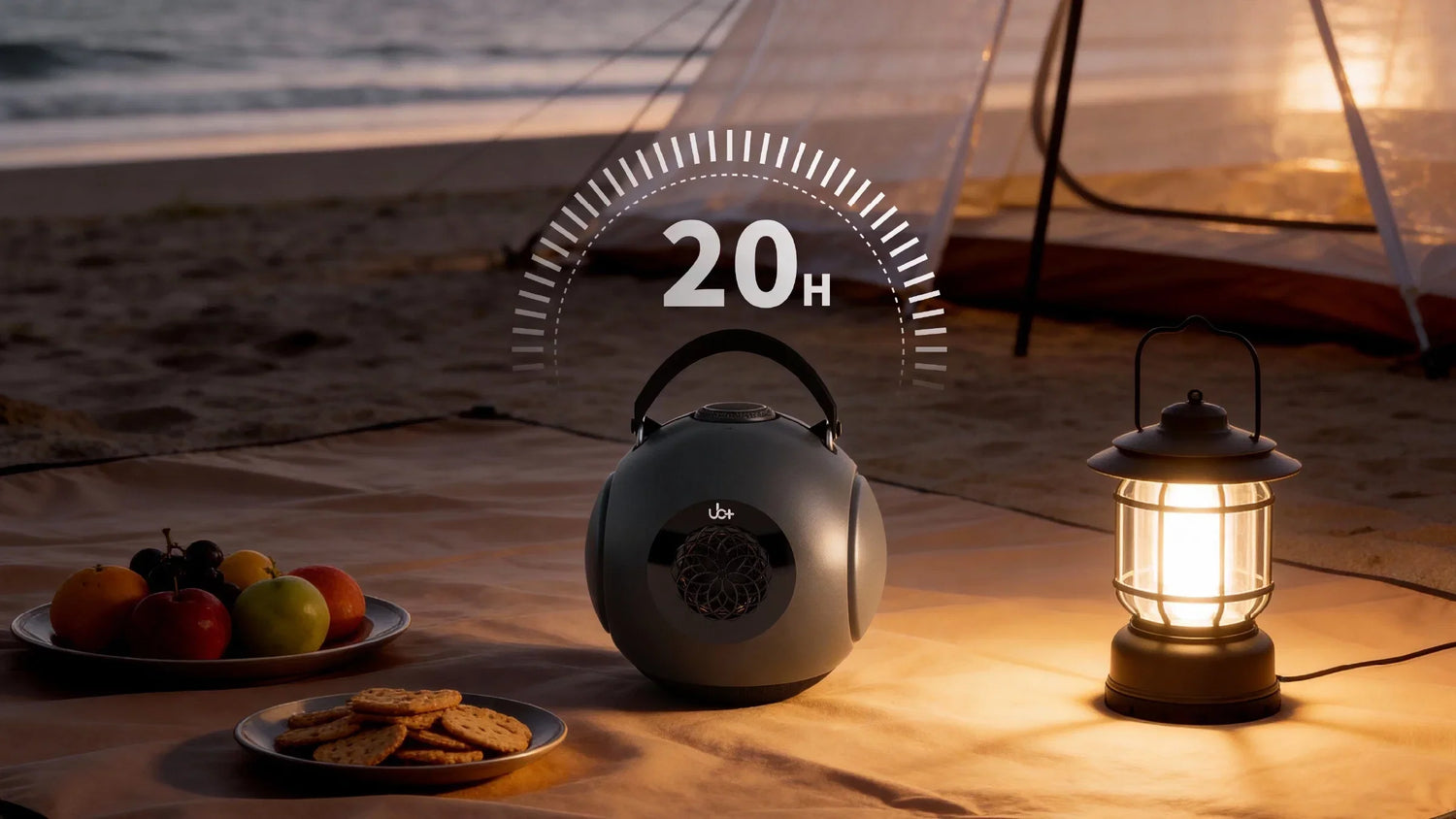
Choosing the best bluetooth speaker for beach use requires more than finding a compact speaker with a high-volume rating. Sand, saltwater, direct sunlight, wind, open-space acoustics, and limited access to power all create different demands from indoor listening. A good beach speaker needs dependable water protection, sufficient battery capacity, clear sound at outdoor listening distances, controlled bass, stable wireless connectivity, and a construction that can tolerate being transported repeatedly.
For buyers comparing best portable bluetooth speaker, waterproof bluetooth speakers, Bluetooth speakers with good bass, and rugged outdoor models, the most important question is how the speaker's physical design matches the environment. A speaker that sounds excellent in a small living room may not perform the same way beside an open shoreline.
What Makes a Bluetooth Speaker Suitable for the Beach?
Beach use combines several conditions that expose weaknesses in ordinary portable speakers.
The most important factors are:
- Water and splash resistance
- Protection against environmental exposure
- Battery life
- Wireless reliability
- Outdoor sound dispersion
- Bass performance without room reinforcement
- Portability
- Construction quality
- Ease of cleaning
- Physical stability
A beach speaker also needs to be easy to handle. A model that sounds excellent but is difficult to transport, position, or protect from sand may not be the best practical choice.
The strongest options balance acoustic performance with environmental durability.
Water Resistance Should Be Your First Check

The word "waterproof" is frequently used too loosely in consumer audio marketing.
Instead of relying on a product description, check its actual IP rating.
An IP rating identifies the level of protection against solids and liquids under defined testing conditions. The rating matters because resistance to splashing is not the same as protection against immersion.
For example, the UB+ dB1 carries an IPX5 rating.
That means it is designed to withstand water jets under specified testing conditions. It should not be treated as a fully submersible speaker or deliberately placed underwater.
For beach use, this distinction is important.
A speaker can encounter:
- Sea spray
- Splashing water
- Wet hands
- Light rain
- Damp surfaces
- Accidental spills
But an IP rating does not mean sand and saltwater exposure should be ignored. The speaker should still be handled carefully and cleaned according to the manufacturer's guidance.
Sand Is a Different Problem From Water
Water resistance gets most of the attention, but sand can be equally problematic.
Fine particles can enter:
- Buttons
- Charging ports
- Seams
- Grilles
- Passive-radiator openings
- Mechanical joints
A beach-friendly speaker should therefore have a construction that minimizes unnecessary exposed openings.
After use, avoid aggressively brushing sand into the speaker grille or charging connection. If the product has been exposed to saltwater spray, follow its cleaning instructions before storing it.
A speaker that survives water exposure but is repeatedly contaminated with sand can still develop usability problems over time.
Why Outdoor Bass Is More Difficult

Indoor listening benefits from room boundaries.
Walls, ceilings, and floors reflect acoustic energy. Depending on the room, these reflections can reinforce certain frequencies and make a compact speaker appear fuller.
A beach provides almost none of that reinforcement.
The speaker is operating in a comparatively open acoustic environment, so low-frequency energy disperses more freely.
This creates a practical challenge for anyone searching for best bass bluetooth speaker performance outdoors.
The answer isn't necessarily a larger volume number.
The acoustic system must be capable of moving enough air while maintaining driver control.
Acoustic Spotlight: UB+ dB1 DoubleBass
The UB+ dB1 DoubleBass approaches compact bass reproduction through a patented spherical acoustic chamber inspired by Helmholtz Resonance.
The spherical geometry distributes internal air pressure more evenly than a conventional rectangular enclosure and reduces the parallel internal surfaces that can encourage standing-wave behavior.
The design is intended to reduce phase distortion and support more accurate harmonic reproduction.
At the center of the acoustic system is a 4.5-inch long-stroke mid-bass driver firing downward into the spherical chamber.
Driver movement creates pressure changes inside the enclosure, which activate two large passive radiators positioned symmetrically on opposing sides.
Their combined radiating surface area is approximately 3.5× larger than the active woofer.
The opposing movement produces a self-cancelling vibration architecture, reducing unwanted cabinet movement and allowing mechanical energy to contribute more directly to acoustic output.
This creates mechanical bass amplification through the physical acoustic system rather than depending primarily on artificial bass generation.
The driver system incorporates a 90 mm oversized neodymium magnet, 35 mm long-stroke voice coil, 20 mm piston movement, 18 mm extra-wide surround, and aluminum shorting ring. The system is specified at approximately 40 Hz–20 kHz and around 93 dB SPL.
Its DSP monitors system performance and provides optimization and protection, while the fundamental bass mechanism remains mechanical.
For a beach listener, the relevance is straightforward: outdoor bass cannot rely on room reinforcement, so the physical acoustic architecture becomes particularly important.
Why Bass Quantity Isn't the Same as Bass Quality
Many portable speakers advertise enhanced or "extra" bass.
That can be useful, but buyers should distinguish between bass quantity and bass quality.
Bass quantity describes how prominent low frequencies are.
Bass quality involves:
- Extension
- Control
- Distortion
- Transient response
- Integration with vocals
- Consistency at different volumes
A speaker can have strong bass while producing muddy vocals or masking instruments.
For beach listening, controlled bass is particularly useful because wind, conversation, and open surroundings already make some musical details harder to perceive.
A well-balanced speaker can therefore be more satisfying than one that simply emphasizes the lowest frequencies.
Sound Dispersion Matters at the Beach
Indoor listening often involves one or two preferred listening positions.
Beach listening is different.
People may sit:
- In front of the speaker
- Beside it
- Several feet away
- Around a picnic area
- Near a beach chair
- In a small group
A speaker with useful dispersion can provide a more consistent experience as listeners move around.
This is one reason spherical acoustic concepts are interesting for portable applications.
The enclosure geometry and driver arrangement can influence how acoustic energy interacts with the surrounding environment.
For buyers considering a 360 degree bluetooth speaker, however, it is important to distinguish actual acoustic dispersion from marketing terminology. A product should be evaluated based on its driver arrangement and measured behavior rather than the label alone.
Battery Life Matters More at the Beach
A beach trip may last several hours, and access to a power outlet is usually limited.
Battery capacity should therefore be considered alongside actual listening conditions.
Maximum advertised playback time is normally measured under particular conditions. Higher volume, bass-heavy music, wireless activity, and environmental temperature can affect real-world operating time.
A practical buyer should consider:
|
Usage |
Battery priority |
|
Short beach visit |
Moderate |
|
Half-day outing |
High |
|
Full-day beach trip |
Very high |
|
Weekend travel |
High |
|
Camping near the beach |
Very high |
|
Frequent outdoor use |
High |
Do not choose a speaker solely because it advertises the highest possible number of hours.
Look at whether the battery performance is appropriate for your typical listening level and usage pattern.
Bluetooth Reliability at the Beach
Bluetooth performance matters because a beach speaker may be positioned several feet away from the phone or tablet.
The environment can also include other wireless devices.
Modern Bluetooth implementations can provide improved connection management and energy efficiency, but actual range depends on the source device, antenna design, obstacles, interference, and implementation.
The UB+ dB1 uses Bluetooth 5.3.
For everyday beach listening, the practical objective is simple: connect the speaker, place it where people can hear it, and avoid unnecessary interruptions.
Portability: The Speaker Has to Reach the Beach
Theoretical performance means little if the speaker is inconvenient to carry.
Consider:
- Weight
- Dimensions
- Carrying method
- Bag compatibility
- Charging requirements
- Physical stability
- Storage after use
A very large speaker may be appropriate for a beach party but inconvenient for someone walking several hundred meters from a parking area.
A compact model may be preferable for individual or small-group listening.
The portable bluetooth speaker category therefore covers several different use cases rather than one ideal size.
Small Speakers vs Larger Beach Speakers
|
Speaker type |
Advantages |
Limitations |
|
Ultra-compact |
Easy to carry |
Limited bass and output |
|
Compact premium |
Good balance of size and sound |
Higher price |
|
Medium portable |
More output and bass |
More weight |
|
Large outdoor speaker |
Strong output for groups |
Less convenient to transport |
|
Party speaker |
High volume and coverage |
Usually unsuitable for minimalist travel |
For most beach trips, the best choice depends on group size.
One person sitting near a speaker has very different requirements from ten people gathered around a picnic area.
Should You Prioritize Bass or Volume?
Neither should automatically come first.
A speaker for a large beach gathering needs enough acoustic output to remain intelligible over:
- Wind
- Waves
- Conversations
- Foot traffic
- General outdoor noise
But excessive volume does not automatically improve sound.
If the speaker reaches its limits quickly, increasing volume can increase distortion rather than useful clarity.
A properly engineered system should maintain reasonable control as the listening level increases.
What About Vocals and Podcasts?
Beach speakers aren't used exclusively for music.
People also listen to:
- Podcasts
- Audiobooks
- Sports commentary
- News
- Video content
- Voice messages
For these applications, midrange clarity is critical.
A speaker with excessive bass emphasis can make spoken content sound less intelligible.
If the recipient uses the speaker for mixed entertainment, choose balanced reproduction instead of a model tuned solely for maximum bass.
Best Beach Speaker Features by Priority
|
Feature |
Importance |
What to look for |
|
Water protection |
Very high |
Verified IP rating |
|
Battery |
Very high |
Realistic playback expectations |
|
Portability |
Very high |
Practical weight and size |
|
Bass control |
High |
Physical driver/enclosure engineering |
|
Dispersion |
High |
Consistent coverage |
|
Bluetooth |
High |
Modern, reliable implementation |
|
Construction |
High |
Durable enclosure |
|
Maximum volume |
Medium–high |
Appropriate for group size |
|
Appearance |
Medium |
Personal preference |
|
Smart features |
Low–medium |
Only if genuinely useful |
Waterproof vs Water-Resistant: What Buyers Should Know
Search results often use "waterproof" as a broad commercial keyword, but buyers should use technical ratings when making a purchase.
A speaker can be:
- Splash resistant
- Resistant to water jets
- Resistant to temporary immersion
- Designed for deeper or longer immersion
These are not interchangeable.
If you are specifically searching for best waterproof bluetooth speaker, verify the manufacturer's actual certification.
Do not assume that a speaker rated for water jets can safely be submerged.
For beach use, also remember that saltwater is an environmental contaminant. Even when the product has appropriate water protection, proper cleaning and drying remain important.
Beach Speaker vs Outdoor Speaker
The two categories overlap, but the requirements aren't identical.
An outdoor speaker may be designed for:
- Backyard use
- Camping
- Hiking
- Patio listening
- Poolside use
A beach speaker additionally has to deal with:
- Fine sand
- Saltwater
- Wind
- Direct sunlight
- Open acoustic space
That means a good beach speaker should combine outdoor durability with acoustic performance that does not depend heavily on indoor room reinforcement.
How to Compare JBL, Bose, UE, Sony and UB+
The brand name alone should not determine your decision.
Different manufacturers use different acoustic architectures and product sizes.
A useful comparison should examine:
|
Category |
What to compare |
|
Water protection |
Actual IP rating |
|
Bass |
Extension, control and distortion |
|
Outdoor output |
Performance in open spaces |
|
Dispersion |
Coverage around the speaker |
|
Battery |
Expected real-world use |
|
Portability |
Weight and dimensions |
|
Bluetooth |
Version and connection behavior |
|
Enclosure |
Acoustic and physical construction |
|
Warranty |
Regional coverage |
|
Price |
Performance relative to cost |
For JBL, Bose, Ultimate Ears, Sony, or other brands, compare the specific model rather than assuming every speaker from the company has the same capabilities.
This is particularly important with bass because enclosure volume, driver size, passive-radiator configuration, and amplifier power vary significantly across a manufacturer's range.
Best Bluetooth Speaker for Different Beach Situations
For Solo Beach Listening
Choose a compact model with good battery life and balanced sound.
Maximum output is less important when you are sitting close to the speaker.
For Couples
A premium compact speaker can provide enough coverage without adding unnecessary weight to your beach bag.
For Small Groups
Look for stronger outdoor output and wider dispersion.
Bass control becomes increasingly important as listening distance increases.
For Large Beach Gatherings
A larger outdoor or party speaker may be more appropriate.
The priority shifts toward acoustic output, battery capacity, and coverage.
For Beach Camping
Durability, battery life, water protection, and portability should receive equal consideration.
Common Mistakes When Buying a Beach Speaker
Buying the Loudest Speaker
Maximum volume does not guarantee clean sound.
Ignoring the IP Rating
A product described as "waterproof" may have substantially less protection than you assume.
Forgetting About Sand
Water resistance does not automatically mean the speaker is designed to tolerate unlimited sand exposure.
Choosing Based Only on Bass
Deep bass is useful, but poor midrange reproduction can make music and speech less enjoyable.
Ignoring Battery Conditions
Advertised maximum battery life may not represent playback at high volume.
Buying Too Large
A powerful speaker that remains at home because it is inconvenient is not a successful beach speaker.
Buying Too Small
An ultra-compact speaker may struggle to maintain bass and clarity in an open environment.
Beach Bluetooth Speaker Buying Checklist
Before purchasing, check these points:
- Actual IP rating verified
- Suitable for the expected exposure to water
- Practical protection against outdoor use
- Battery capacity matches trip duration
- Compact enough to transport
- Adequate acoustic output
- Controlled bass
- Clear vocals
- Useful sound dispersion
- Reliable Bluetooth connection
- Charging method is convenient
- Construction suits repeated outdoor use
- Price matches the actual engineering
Frequently Asked Questions
What is the best Bluetooth speaker for beach use?
The best option combines verified water protection, useful battery life, portability, outdoor sound dispersion, controlled bass, and reliable Bluetooth connectivity. The ideal size depends on whether you are listening alone or with a group.
Is IPX5 enough for the beach?
IPX5 can provide protection against water jets under defined testing conditions, but it does not mean the speaker is submersible. For beach use, you should still avoid deliberately immersing the speaker and follow the manufacturer's care instructions.
Do Bluetooth speakers need more bass outdoors?
Outdoor spaces do not provide the same boundary reinforcement as indoor rooms, so low-frequency reproduction can seem less powerful. A well-engineered bass system can compensate more effectively than simply applying aggressive digital bass boost.
Is a small Bluetooth speaker good for the beach?
Yes, if you mainly listen at close range. For larger groups or greater distances, a speaker with greater acoustic output and better dispersion is usually more suitable.
What should I look for in a waterproof Bluetooth speaker?
Check the actual IP rating, battery life, construction, charging protection, portability, and acoustic performance. Do not rely solely on the word "waterproof" in product marketing.
Final Verdict
The best bluetooth speaker for beach use should be selected according to the environment rather than the specification sheet alone.
For individual listening, portability and battery life may be the most important factors. For groups, acoustic output and dispersion become more important. For frequent exposure to water, the actual IP rating matters more than generic "waterproof" terminology. For music-focused listeners, bass control and enclosure engineering deserve greater attention than maximum advertised volume.
The UB+ dB1 DoubleBass is particularly interesting for buyers who want a premium portable speaker where the acoustic architecture is a major part of the product proposition. Its spherical enclosure, mechanical bass system, and symmetrical passive-radiator architecture address the physical challenges of producing controlled low-frequency output from a compact design.
That does not make every UB+ application better than every competing speaker. A large party-oriented model from JBL, Bose, Sony, Ultimate Ears, or another manufacturer may be more appropriate when maximum group output is the primary requirement.
The right purchase comes down to water protection, portability, acoustic output, bass control, battery performance, and the environment in which the speaker will actually be used.
For a premium beach speaker, those are the specifications worth paying for
Explore UB+
→ Compare dB1 vs dB Mini
Compare UB+'s portable speaker options and choose the model that fits your listening environment.
→ See Color Options
Explore available finishes for indoor and outdoor listening setups.
→ Check Current Price
Visit UB+ for current product specifications, pricing, and availability.


Оставить комментарий
Этот веб-сайт защищается hCaptcha. Применяются Политика конфиденциальности и Условия использования hCaptcha.