
Finding the best bluetooth speaker gift audiophile listeners will genuinely appreciate requires looking beyond price, brand recognition, and attractive packaging. Audiophiles tend to pay attention to details that ordinary product descriptions often overlook: the way a speaker manages bass, how clearly it reproduces vocals, whether its enclosure supports the drivers effectively, and how well its acoustic design maintains balance across different listening levels. A thoughtful speaker gift should offer something meaningful in those areas rather than relying on a premium price tag to communicate quality.
Buying audio equipment for someone who cares deeply about music can feel intimidating. A speaker that sounds impressive to a casual listener may not satisfy someone who notices muddy bass, harsh high frequencies, compressed dynamics, or a lack of separation between instruments. At the same time, a technically sophisticated product does not automatically make the right gift. Portability, listening habits, design preferences, connectivity, and the recipient's existing audio setup all matter.
The most useful approach is to evaluate a speaker as a complete acoustic system. Driver design, enclosure geometry, passive radiators, amplification, digital signal processing (DSP), wireless connectivity, and physical construction work together to shape the listening experience. Understanding these elements makes it easier to distinguish meaningful engineering from features that merely look impressive on a specification sheet.
For a gift that stands out, focus on what makes the speaker different, how that difference affects the sound, and whether the recipient will enjoy using it in everyday life.
What Audiophiles Actually Appreciate in a Speaker Gift

An audiophile does not necessarily want the largest speaker, the most expensive model, or the product with the longest list of features. Many enthusiasts care more about engineering decisions that produce audible benefits than about specifications that look impressive in isolation.
A thoughtful gift should demonstrate that you understand what makes good audio equipment valuable.
Balanced sound rather than exaggerated bass
Bass is an important part of music, but more bass does not automatically mean better sound. Excessive low-frequency emphasis can mask vocals, interfere with the perceived detail of instruments, and make different recordings sound more alike than they should.
A well-balanced speaker aims to reproduce bass with sufficient depth and control while preserving the midrange information that gives voices, guitars, pianos, and many orchestral instruments their character.
Look for a design that offers:
- Defined bass: Low notes should have a clear beginning and decay rather than sounding like one continuous rumble.
- Natural midrange: Vocals and instruments should sound clear without becoming hollow, nasal, or overly forward.
- Controlled treble: High frequencies should retain detail without becoming harsh during longer listening sessions.
- Consistent tonal balance: The sound should remain enjoyable across different musical genres instead of being optimized for a narrow selection of tracks.
- Usable performance at everyday volumes: A speaker should remain engaging when the listener wants background music rather than a loud demonstration.
A speaker's actual performance depends on its drivers, enclosure, tuning, amplification, and listening environment. No single specification can fully describe all these characteristics.
Clarity and separation between instruments
Listeners who care about sound quality often notice whether different elements of a recording remain distinguishable. A vocal, bass line, percussion pattern, and guitar part should not collapse into an indistinct mass when the arrangement becomes complex.
Clarity and separation are influenced by several interacting factors, including driver behavior, distortion, frequency response, enclosure resonances, and signal processing. Stereo presentation also depends on the speaker configuration and the spatial information in the recording.
When evaluating a gift, listen to familiar music containing a combination of vocals, percussion, and low-frequency instruments. Ask whether each component sounds clear enough to follow without making the overall presentation unnaturally analytical.
For more context on the characteristics that distinguish premium audio equipment, see what makes a speaker premium: the materials behind the sound.
Look Beyond Driver Size: The Engineering Behind Better Sound

Driver size is one of the most visible details on a speaker specification sheet, but it is not a reliable standalone measure of sound quality. A larger driver does not automatically outperform a smaller one, and a compact enclosure can place substantial demands on the acoustic system.
What matters is how the complete design uses the driver, enclosure, available internal volume, and amplification.
Driver capability and excursion
A speaker driver converts an electrical signal into mechanical motion, moving air to reproduce sound. Its performance depends on more than its diameter.
Relevant design factors include:
- Motor strength and control.
- Voice-coil construction.
- Cone or diaphragm behavior.
- Suspension design and available excursion.
- Thermal management.
- The relationship between the driver and the enclosure.
- Distortion at the intended listening level.
Excursion is especially important for low frequencies. As frequency decreases, reproducing the same perceived output can require substantial diaphragm movement, depending on the design and acoustic conditions. A driver must handle that movement within its mechanical and thermal limits.
A premium speaker is not defined simply by having a large driver. It benefits from a driver system that works effectively within its operating range and is supported by the surrounding acoustic architecture.
Why enclosure design matters
The enclosure is not just a protective container for the electronics. Its geometry, volume, internal structure, and acoustic loading influence how the speaker operates.
An enclosure can affect internal pressure distribution, resonance behavior, structural vibration, and the way energy is delivered through the driver and any auxiliary acoustic elements. Poorly controlled resonances can color the sound, while a well-integrated enclosure can support more predictable performance.
Different architectures solve different engineering problems. A conventional ported box uses an opening and the air mass within it to contribute to low-frequency output. A passive-radiator system uses a moving diaphragm instead of an open port. Other designs combine particular driver placements and enclosure geometries to influence pressure and sound distribution.
The best choice depends on the complete design. Audiophile gifting is an opportunity to choose a product with a clear engineering rationale rather than assuming that one shape or speaker category is universally superior.
Explore the science behind premium audio technology to understand how acoustic design decisions can affect the final listening experience.
Acoustic Spotlight: The UB+ dB1 DoubleBass Technical Blueprint

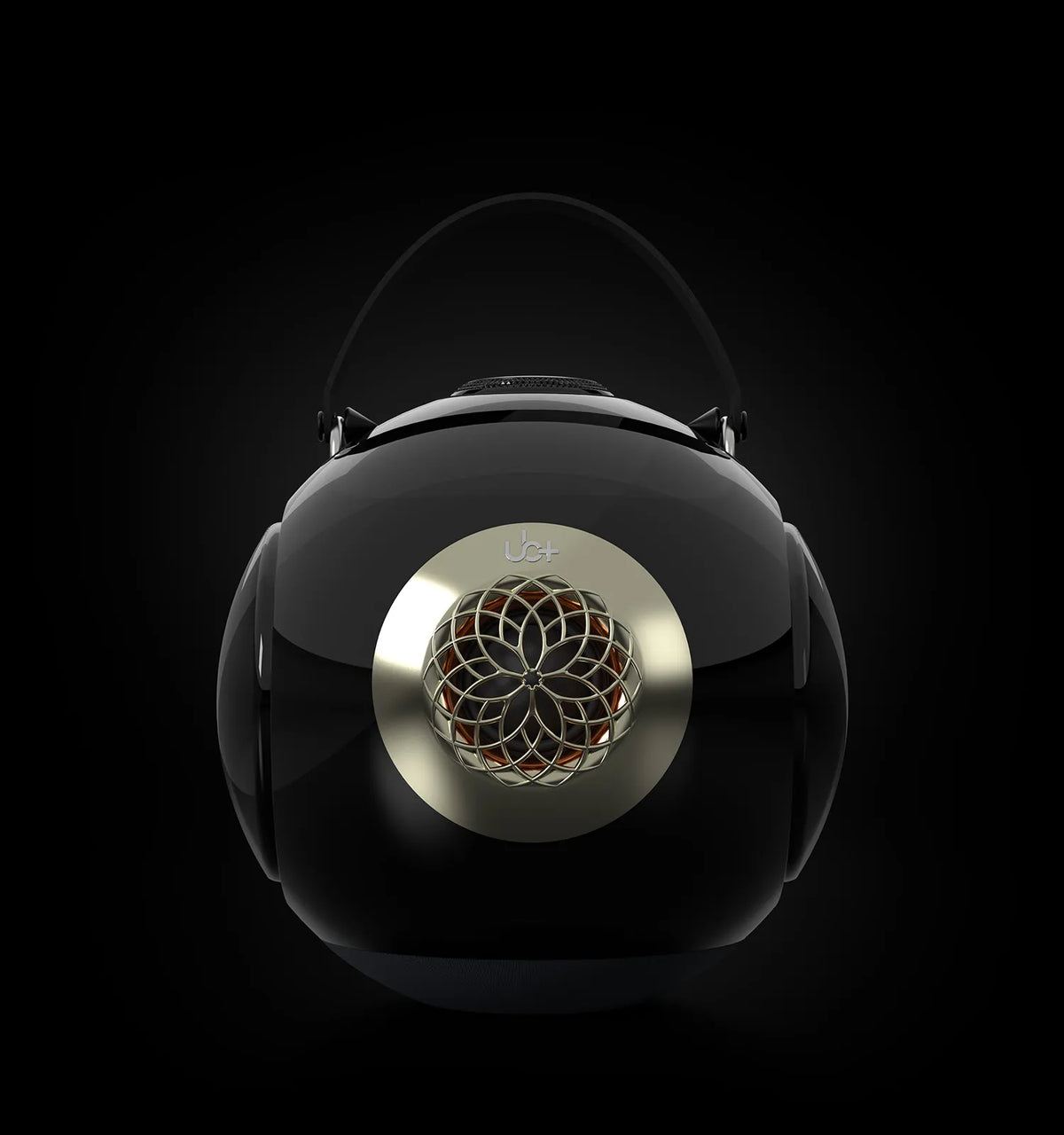
One reason a speaker can make a distinctive gift for a technically minded listener is that its underlying engineering offers something worth understanding. The UB+ dB1 DoubleBass provides a useful example of a design in which enclosure geometry, driver placement, and passive-radiator architecture form a coordinated acoustic system.
Its technical approach is particularly relevant when evaluating products beyond their price. Rather than treating the enclosure as a neutral shell, the design uses a spherical acoustic chamber and a symmetrical radiator arrangement as parts of the mechanism for producing sound.
The Helmholtz-Inspired Chamber
The dB1 uses a patented spherical acoustic chamber inspired by the Helmholtz resonator principle associated with Hermann von Helmholtz. In acoustic systems, resonance depends on factors such as the geometry of the chamber, the compliance of the air volume, and the behavior of the connected air mass or radiating elements.
The dB1's spherical enclosure is intended to influence the internal acoustic environment and support the interaction between the central driver and passive radiators.
The potential significance of this approach lies in the engineering rather than the shape alone:
- A sphere provides a geometry that differs from the parallel surfaces of a conventional rectangular box.
- Enclosure geometry influences how internal pressure and acoustic energy behave.
- Internal resonance and damping remain important considerations even when the enclosure is spherical.
- The design must be evaluated as a complete system rather than assuming that a sphere automatically eliminates standing waves or distortion.
For an audiophile, this makes enclosure design a meaningful topic of consideration. The value of the architecture comes from how it supports controlled, balanced sound—not simply from looking different.
The central mid-bass driver
The dB1 architecture uses a centrally positioned, downward-firing 4.5-inch mid-bass driver within the spherical acoustic structure. This driver is responsible for generating the principal acoustic signal that interacts with the enclosure and passive-radiator system.
Several aspects of the documented driver construction are worth understanding:
- 90 mm oversized neodymium magnet: The motor uses a substantial magnetic structure intended to support the driver's force-producing mechanism.
- 35 mm long-stroke voice coil: The voice-coil configuration is part of the design for controlling the driver's movement and power handling.
- Approximately 20 mm piston movement: The stated movement relates to the driver's mechanical capability; movement figures should always be interpreted according to the manufacturer's measurement convention.
- Aluminum shorting ring: This is an element of motor design that can influence electromagnetic behavior and distortion, depending on how the motor is implemented.
- 18 mm extra-wide surround: The surround supports diaphragm movement and is part of the suspension system.
These details do not independently guarantee a particular listening experience. Their importance comes from how they are integrated with the driver, suspension, motor, enclosure, and electronic tuning.
For an enthusiast, a technically informed gift can be more interesting when the design has a clear acoustic purpose rather than merely listing a larger driver or more powerful amplifier.
Dual symmetrical passive radiators

The dB1 also uses two large passive-radiator plates positioned symmetrically on opposite sides of the enclosure. Passive radiators are moving diaphragms that respond to changes in internal air pressure. They can contribute to low-frequency output without requiring a conventional open bass-reflex port.
The combined surface area of the dB1's passive radiators is specified as approximately 3.5 times the area of its woofer. That proportion helps explain why radiator area is a prominent part of the design.
The acoustic principles are worth understanding:
- The active driver generates pressure changes within the enclosure.
- Those pressure changes cause the passive radiators to move.
- Their movement contributes to low-frequency output through the system's tuned response.
- The radiators' mass, suspension, available excursion, enclosure volume, and tuning influence the resulting behavior.
- The system still has operating limits; passive radiators do not guarantee unlimited bass extension or output.
The opposing arrangement is also intended to counterbalance some mechanical forces. Symmetrical motion may help reduce certain enclosure vibrations, although it does not eliminate every source of vibration under all conditions.
This is an example of mechanical design contributing to acoustic performance. The central idea is that low-frequency output depends on coordinated movement of air and radiating surfaces, not solely on increasing electronic bass emphasis.
For a deeper explanation of this design category, read passive radiators versus ported boxes in spherical-speaker bass systems.
DSP as a supporting tool, not a substitute for acoustic design
Digital signal processing is sometimes described as though it must be either the problem or the solution to speaker quality. A more accurate approach is to evaluate what the processing does and how it interacts with the physical design.
DSP can help a speaker maintain tonal balance, manage driver behavior, compensate for aspects of its response, and apply protection when the system approaches its limits. Poorly judged processing can produce undesirable effects, but DSP itself is not inherently incompatible with natural sound.
The dB1's design uses DSP as part of the wider system. The acoustic enclosure, active driver, passive radiators, amplifier, and processing work together. It would be misleading to claim that the speaker creates bass without any electronic involvement.
The useful design question is whether the complete system achieves its intended response while keeping distortion, excursion, and tonal balance under control.
The dB1 specification snapshot
The technical information provided for this particular model includes the following figures and features.
|
Technical element |
dB1-specific information |
Why it matters |
|
Acoustic chamber |
Patented spherical chamber inspired by the Helmholtz resonator principle |
Makes enclosure geometry part of the acoustic design |
|
Main driver |
4.5-inch mid-bass driver |
Produces the primary sound signal |
|
Passive radiators |
Two symmetrical plates, with combined surface area approximately 3.5× the woofer area |
Contribute to low-frequency output |
|
Driver construction |
90 mm neodymium magnet and 35 mm long-stroke voice coil |
Provides context for the motor and movement design |
|
Additional driver elements |
Approximately 20 mm piston movement, aluminum shorting ring, 18 mm extra-wide surround |
Describes aspects of the driver's mechanical and electromagnetic architecture |
|
Stated frequency range |
Approximately 40 Hz–20 kHz |
Gives a broad indication of the listed response range; measurement conditions matter |
|
Stated sound-pressure level |
93 dB SPL |
Indicates a listed sound-pressure figure; the measurement method and conditions should be confirmed from the specification sheet |
|
Wireless connection |
Bluetooth 5.3 |
Identifies the supported Bluetooth version |
|
Water protection |
IPX5 |
Indicates protection against water projected by a nozzle under specified test conditions, not submersion or dust protection |
These are model-specific details for the dB1 and should not be assumed to describe every UB+ product. They also do not replace listening tests, independent measurements, or checking the manufacturer's current product information.
The dB1's value as a gift is therefore not just its feature list. It is the opportunity to give someone a speaker whose physical acoustic architecture provides a concrete subject for listening, comparison, and technical appreciation.
What Different Speaker Designs Offer an Audiophile
Not every audiophile has the same listening habits. Some value a traditional home system for seated listening, while others want well-engineered portable audio for a desk, bedroom, studio, or outdoor setting.
The table below compares general design approaches rather than making unsupported claims about all products in a category.
|
Design approach |
Potential strengths |
Important considerations |
Best fit |
|
Conventional ported enclosure |
Port tuning can support low-frequency output within a compact design |
Port noise, tuning, enclosure resonances, and output limits depend on implementation |
Listeners wanting an established bass-reflex design |
|
Passive-radiator enclosure |
Can contribute to low-frequency output without an open bass port |
Radiator mass, tuning, excursion, and suspension remain important |
Listeners interested in compact bass-system engineering |
|
Spherical acoustic enclosure |
Geometry differs from a rectangular box and may support a distinctive internal acoustic strategy |
Spherical shape alone does not guarantee better sound or eliminate resonances |
Design-focused listeners interested in acoustic architecture |
|
Conventional front-firing portable speaker |
Can provide a straightforward listening direction and practical placement |
Coverage may vary across the listening area |
Desk use or listening from a preferred direction |
|
Broad-dispersion portable speaker |
Can make shared listening more convenient when the design supports wider coverage |
Actual dispersion depends on driver layout and frequency |
Shared listening around a room or gathering area |
|
Traditional home stereo system |
Can provide separate left and right channels and flexible system matching |
Usually requires more space and is less portable |
Dedicated home listening |
An audiophile gift should be selected according to how the recipient listens. A traditional stereo speaker may be the right choice for someone building a dedicated listening room, while a thoughtfully engineered portable model may be more useful to a listener who moves between a desk, bedroom, and social settings.
How to Choose the Right Gift for the Recipient
Technical performance matters, but it does not determine whether the gift will be used. A speaker must suit the recipient's space, habits, and preferences.
For the listener who enjoys technical details
Choose a speaker with a clear engineering story that can be explained through its actual construction. A design that combines a distinctive chamber, a considered driver system, and passive radiators may give this recipient more to appreciate than a product whose appeal rests mainly on appearance.
Useful details include:
- A documented explanation of the acoustic architecture.
- Meaningful driver and enclosure information.
- A clear distinction between measured specifications and marketing language.
- A design where components have identifiable roles in the system.
- Product information that allows the recipient to research the engineering further.
The goal is not to impress an audiophile with the largest number of technical terms. It is to offer a product whose features have a reasonable relationship to how it produces sound.
For someone who enjoys music throughout the day
A portable speaker can be a practical addition to a home office, bedroom, kitchen, or creative workspace. In this situation, ease of use, balanced tonal performance, reliable wireless connectivity, and a design that fits the room may matter as much as maximum output.
Think about whether the recipient listens quietly while working, plays albums in the evening, or prefers louder music when entertaining. A speaker that performs well at the listener's normal volume can be a more thoughtful gift than one that is designed primarily to demonstrate its maximum loudness.
For the design-conscious audiophile
Physical design matters when a speaker remains visible in a room. Materials, proportions, finish, control placement, and enclosure form all influence whether the product fits the recipient's environment.
However, attractive design and good acoustic engineering should not be treated as interchangeable. A pleasing exterior does not prove that a speaker measures well or sounds balanced, just as an unusual enclosure does not automatically result in better performance.
The strongest products treat appearance, usability, and acoustic requirements as parts of the same design problem. Explore designer speakers versus regular speakers for a broader discussion of how industrial design and audio expectations intersect.
For someone who already owns expensive home audio equipment
This recipient may not need another large speaker. Consider whether a compact portable model offers a different use case rather than trying to replace their existing system.
A portable gift may be useful for:
- Background listening while working or moving around the home.
- Listening in a bedroom or personal space.
- Bringing music into areas without a permanent audio system.
- Taking music outdoors or while travelling.
- Enjoying a standalone speaker without arranging separate components.
The key is to give the recipient a complementary listening option. A portable speaker has different constraints from a full-sized stereo system, and it should be evaluated for the context in which it will be used.
Price Versus Performance: What Are You Actually Paying For?
A higher retail price can reflect many factors: research and development, materials, manufacturing complexity, acoustic design, industrial design, support, distribution, and brand positioning. Price alone cannot reveal how much of that investment contributes to audible performance.
Likewise, an inexpensive speaker is not automatically poor, and a premium speaker is not automatically excellent. The important question is whether the product delivers meaningful value for the recipient's needs.
Look for a coherent engineering approach
A coherent design has components that work toward an identifiable acoustic goal. The driver, enclosure, passive-radiator system, amplifier, and DSP should not be treated as independent features. They form an interacting system.
When reviewing a speaker, ask:
- Does the enclosure have a clear purpose beyond protecting the electronics?
- Is the driver appropriate for the intended size and output?
- If passive radiators are used, is their role explained clearly?
- Are the stated performance figures supported by enough information to interpret them?
- Are there sensible explanations of how processing supports the physical design?
- Does the product's intended use align with its size, weight, and connectivity?
A premium speaker may justify its price through the quality of its overall execution rather than through one spectacular specification.
Interpret specifications carefully
A specification sheet is useful when it is read in context. Individual figures should not be used as simple rankings of sound quality.
For example:
- Frequency response: A range such as 40 Hz–20 kHz does not fully describe response flatness, distortion, output level, or measurement conditions.
- Sound-pressure level: A 93 dB SPL figure is difficult to interpret without knowing distance, test signal, frequency, distortion limit, or whether it represents a peak or continuous measurement.
- Driver diameter: Diameter alone does not tell you the available excursion, sensitivity, motor behavior, or usable bass output.
- Bluetooth version: The version identifies a part of the wireless standard, but it does not independently guarantee audio fidelity, connection range, or battery life.
- Passive-radiator area: A larger combined area can be relevant to air displacement, but performance also depends on tuning, moving mass, suspension, and excursion.
- Water-resistance rating: An IP rating describes specified protection tests, not universal resistance to every environment.
For a more systematic approach, review this guide to seven key speaker specifications. It helps frame specifications as evidence to interpret rather than figures to compare without context.
Common Mistakes When Buying an Audiophile Speaker Gift
A gift can be technically impressive and still disappoint if the buying decision overlooks the recipient's actual preferences.
Buying by price alone
The assumption that an expensive speaker must sound better is unreliable. Price may reflect elements that are not the recipient's priority, including materials, styling, or additional functionality.
Choose according to the quality and characteristics that matter most to the listener.
Treating bass as the only sign of quality
Strong bass can make an immediate impression during a short demonstration. However, balanced sound, low distortion, convincing midrange, and consistent performance often matter more over extended listening.
Listen across different genres instead of judging a speaker by one bass-heavy track.
Overlooking the listening environment
A speaker intended for a desk, bedroom, or small shared space has different needs from a dedicated home stereo. A product should be suitable for its expected surroundings.
Consider where the recipient is likely to place it, how close they will sit, and whether they listen alone or with other people.
Trusting marketing terms without context
Descriptions such as audiophile-grade, studio quality, deep bass, and 360-degree sound do not all represent the same kind of evidence.
Look for explanations of the design, useful specifications, and listening results where available. Technical terms should clarify what the product does rather than simply make the description sound advanced.
Ignoring ease of everyday use
A thoughtful gift should be enjoyable to use. If pairing is frustrating, controls are inconvenient, or the product does not fit the recipient's available space, impressive engineering may not translate into frequent enjoyment.
Check everyday usability, connectivity, charging arrangements, physical controls, and the manufacturer's support information.
A Practical Audiophile Gift Checklist
Before choosing a final model, use the following checklist to keep the decision focused.
Sound performance
- Look for balanced bass, clear vocals, and controlled treble.
- Consider clarity and separation on complex recordings.
- Evaluate performance at normal listening levels, not only at maximum volume.
- Avoid judging sound quality from one specification.
Acoustic engineering
- Understand how the driver and enclosure work together.
- Check whether a passive-radiator or ported design is used and what role it serves.
- Look for meaningful technical explanations rather than unsupported superiority claims.
- Treat DSP as a design tool whose effectiveness depends on implementation.
Practical compatibility
- Identify where the recipient is most likely to use the speaker.
- Check wireless compatibility and available playback options.
- Consider portability, charging, and available space.
- Think about whether the gift complements an existing audio system.
Confidence in the purchase
- Confirm the product's current specifications.
- Review warranty and support terms.
- Choose a retailer or manufacturer with clear product information.
- Make sure the design and features suit the recipient rather than simply matching a high price point.
A gift chosen against these criteria is more likely to feel personal and considered because it reflects how the recipient listens, not simply how much the product costs.
Give Engineering That Has a Purpose
The best bluetooth speaker gift audiophile enthusiasts can receive is not necessarily the most expensive product in a category. It is a speaker that balances acoustic performance, thoughtful construction, practical usability, and a design that offers something meaningful to the listener.
The dB1 provides a useful example of how engineering can become part of the appeal of a gift. Its Helmholtz-Inspired Chamber, central 4.5-inch mid-bass driver, symmetrical passive-radiator architecture, and DSP-supported tuning describe a specific technical approach to portable audio. The combined radiator area, motor construction, and enclosure arrangement give technically curious listeners concrete features to explore rather than a generic promise of premium sound.
At the same time, the right purchase should be based on the complete product. Specifications need context, acoustic architecture should not be treated as a guarantee of superior sound in every situation, and a portable speaker should be chosen for the recipient's listening habits.
Explore the UB+ dB1 DoubleBass for a closer look at this spherical acoustic approach, or browse the UB+ product collection to compare the available designs. A well-chosen speaker is more than an object with an impressive price tag: it is an opportunity to give the recipient music, thoughtful engineering, and a listening experience they can enjoy well beyond the moment of unwrapping.
Frequently Asked Questions
What should I look for when buying a Bluetooth speaker for an audiophile?
Focus on balanced sound, low distortion, useful bass control, clarity across the midrange, and a well-integrated acoustic design. Consider the recipient's listening habits and existing equipment. Driver size, advertised power, and price should not be used as standalone indicators of audio quality.
Does a more expensive Bluetooth speaker always sound better?
No. Price can reflect materials, research and development, styling, construction, support, and brand positioning, but it does not guarantee better sound. Compare the actual acoustic design, available measurements, listening performance, and practical features to determine whether a product's price represents value for the intended use.
Why do passive radiators matter in a portable speaker?
Passive radiators use moving diaphragms that respond to pressure changes inside an enclosure. They can contribute to low-frequency output without requiring a conventional open bass port. Their effectiveness depends on factors such as radiator mass, suspension, excursion, enclosure volume, and tuning.
What is special about the dB1's Helmholtz-Inspired Chamber?
The dB1 uses a patented spherical acoustic chamber inspired by the Helmholtz resonator principle. Its enclosure geometry forms part of a broader system involving a central 4.5-inch mid-bass driver and two symmetrical passive radiators. The sphere does not automatically eliminate all internal resonances; the acoustic result depends on the complete design and its tuning.
Is a portable Bluetooth speaker suitable for a serious music listener?
Yes, provided its limitations and intended role are understood. A portable speaker may not replace a dedicated stereo system for every listening situation, but it can provide a convenient additional option for a desk, bedroom, or other personal space. Choose one with a coherent acoustic design, useful tonal balance, and practical features that suit the recipient.



Оставить комментарий
Этот веб-сайт защищается hCaptcha. Применяются Политика конфиденциальности и Условия использования hCaptcha.