
When people search for the best portable Bluetooth speaker, they often compare battery life, driver size, volume, and bass output. Those specifications matter, but they are only part of the listening experience.
One of the most overlooked factors is where the speaker is placed.
The same wireless Bluetooth speaker can sound noticeably different on a desk, beside a wall, in the center of a room, or near a corner. Room boundaries affect bass reinforcement, reflections influence clarity, and the direction in which a speaker distributes sound determines how consistently different listeners hear it.
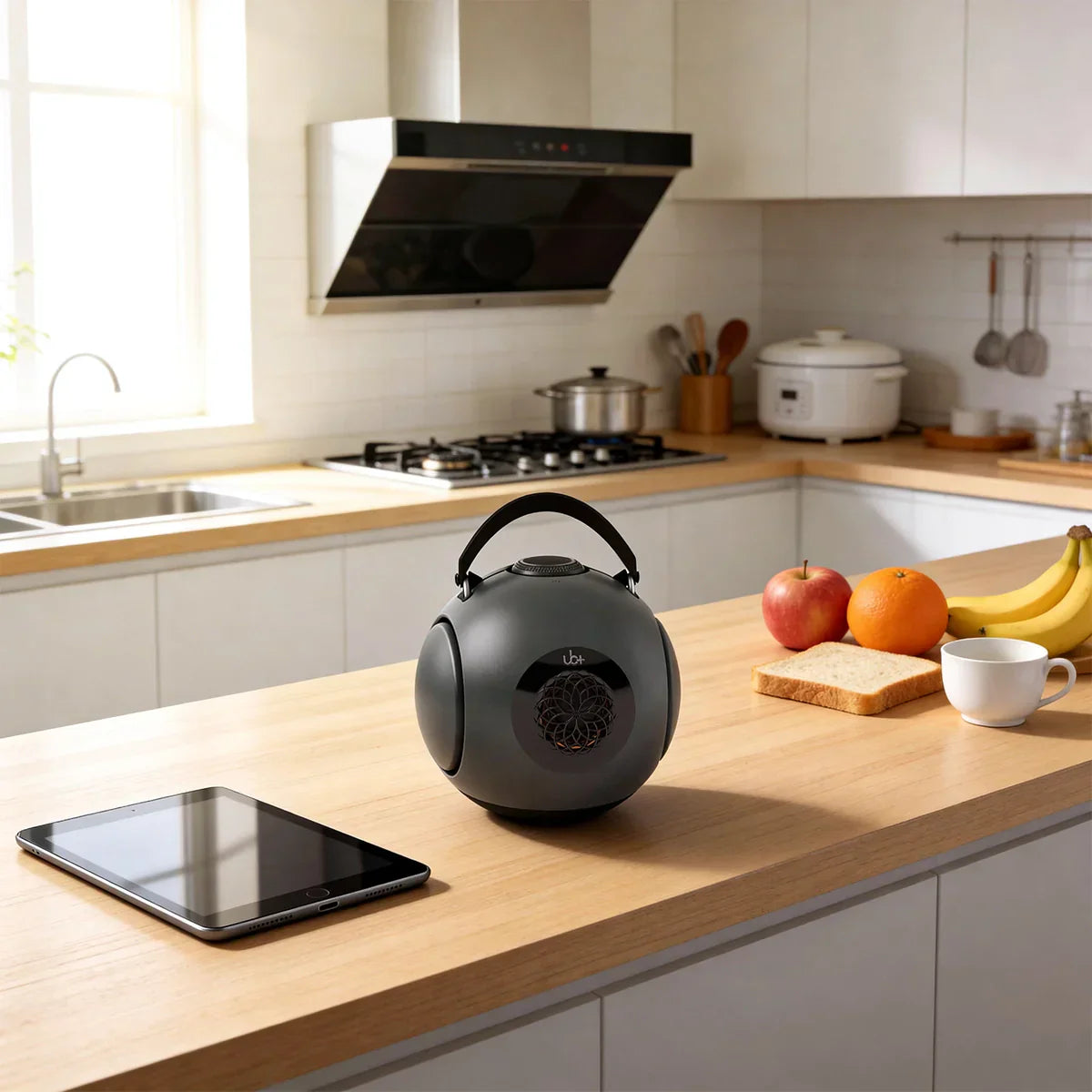
This is particularly relevant to acoustically engineered designs such as the UB+ dB1 DoubleBass, which combines a spherical acoustic chamber, dual passive radiators, and a centrally positioned mid-bass driver. Its enclosure is designed around air movement and resonance rather than simply forcing more output through electronic processing.
Understanding placement helps you get more from any speaker. It can also explain why a speaker that sounds impressive in one location may seem weaker or less balanced somewhere else.
Why Speaker Placement Matters

A speaker does not operate in isolation. Once sound leaves the enclosure, it interacts with the room.
Walls, floors, ceilings, furniture, and other surfaces can reflect and reinforce different frequencies. Low frequencies are especially affected because bass wavelengths are much longer than those of midrange and high frequencies.
This is why two identical speakers can produce different results in two different rooms.
Room acoustics can influence:
- Bass strength and consistency
- Vocal clarity
- Perceived loudness
- Soundstage and imaging
- Reflections and echoes
- The balance between direct and reflected sound
If you want a deeper explanation of why the same speaker can sound different in different spaces, UB+ also covers the fundamentals in its guide to room acoustics and speaker performance.
The important point is simple: speaker placement is part of the audio system.
How Walls Change Bass Response

Bass behaves differently from higher frequencies because its wavelengths are much longer. As a result, nearby boundaries can reinforce low-frequency energy.
A speaker placed away from walls generally produces a more open presentation. Moving it closer to a wall can increase the amount of bass reaching the listening area. Moving it into a corner can increase bass even further, although the result may become excessive depending on the room and speaker.
A simple way to think about the three positions is:
Open-room placement
The speaker has plenty of space around it.
Typical result:
- More open presentation
- Less boundary reinforcement
- Useful for balanced listening
Near-wall placement
The speaker is relatively close to one wall.
Typical result:
- Greater perceived bass
- More weight in the lower frequencies
- Potentially useful when a speaker sounds thin in open space
Corner placement
The speaker is close to two boundaries.
Typical result:
- Stronger bass reinforcement
- Greater low-frequency energy
- Increased possibility of boominess
The goal isn't automatically to maximize bass. It is to find the position where the bass has enough weight without overwhelming the rest of the music.
Free-Space Placement for Balanced Listening

If your room allows it, start by giving the speaker some breathing room.
Placing a speaker away from walls reduces the amount of boundary reinforcement and lets you hear more of its natural tonal balance. This can be particularly useful when evaluating a new speaker because it gives you a relatively neutral starting position.
For a compact speaker used on a desk, shelf, or side table, experiment with small movements rather than immediately changing EQ settings.
A difference of several inches can sometimes change the relationship between direct sound and reflections.
This is one reason the portable Bluetooth speaker buying guide approach should include placement as well as specifications. Portability gives you the ability to experiment with location, so take advantage of it.
Near-Wall Placement for More Bass

If your speaker sounds light or lacks low-frequency presence, moving it closer to a wall can provide some natural reinforcement.
This doesn't mean pushing the speaker directly against the surface.
Instead, leave enough room around the enclosure for its acoustic system to operate normally. The exact distance depends on the speaker, room, and listening position, so small adjustments are more useful than following one universal measurement.
Try moving the speaker:
- A little closer to the wall
- A little farther away
- Slightly to the left or right
Then listen to the same section of music.
You are looking for a position where bass becomes fuller without becoming boomy or masking vocals.
Why Corners Can Be Too Much
Corners combine two boundaries, so they can produce stronger low-frequency reinforcement than a single wall.
That can initially sound impressive. More bass often feels like an immediate improvement.
But excessive reinforcement can make certain frequencies dominate the presentation. Instead of hearing a tight kick drum or bass guitar, you may hear a prolonged low-frequency emphasis.
This is particularly noticeable in smaller rooms.
For that reason, corner placement is better treated as an adjustment tool rather than a default position. If your speaker sounds too heavy in the corner, move it away from one of the boundaries and listen again.
The Role of Enclosure Geometry
Placement is only one part of the equation. The speaker's physical construction also affects how it interacts with the room.
Traditional portable speakers commonly use rectangular cabinets. This format is practical, but parallel internal surfaces can create internal reflections and standing-wave behavior that designers must control.
The UB+ dB1 DoubleBass takes a different approach with a true spherical acoustic chamber inspired by Helmholtz resonance principles.
The spherical geometry is part of the acoustic design rather than simply an aesthetic choice.
Its internal architecture is intended to:
- Distribute pressure more evenly
- Reduce problematic parallel internal surfaces
- Support controlled low-frequency resonance
- Work with the dual passive radiator system
- Provide broad sound distribution
For readers interested specifically in the difference between these enclosure approaches, the UB+ article on spherical versus box speakers explores the subject in more detail.
How the dB1 DoubleBass Produces Bass
The dB1 does not depend on a conventional single bass port to produce its low-frequency response.
Its acoustic system combines a centrally positioned mid-bass driver with two large passive radiator plates positioned symmetrically on opposite sides of the spherical chamber.
As the driver energizes the internal air volume, pressure moves the passive radiators.
The basic sequence is:
- The driver creates pressure changes inside the chamber.
- Internal air pressure distributes through the spherical volume.
- The two passive radiators respond to that pressure.
- Their symmetrical movement converts the pressure into acoustic output.
- Opposing mechanical movement helps reduce unwanted cabinet vibration.
The combined passive-radiator surface area is approximately 3.5 times the area of the woofer. That provides substantial moving surface for low-frequency air displacement without requiring the driver itself to do all of the work.
For a deeper explanation of this type of architecture, see the UB+ guide to passive radiators versus ported speaker designs.
Placement and 360° Sound Distribution
A speaker that radiates sound broadly gives you more flexibility when positioning it.
Front-firing speakers are typically optimized around the direction in which the driver faces. Moving off-axis can change what reaches the listener.
A spherical acoustic approach allows sound to spread more evenly around the enclosure.
The dB1's 360° spherical dispersion is useful in shared listening environments because listeners do not necessarily have to sit directly in front of a conventional speaker.
That can matter in:
- Living rooms
- Open-plan spaces
- Kitchens
- Offices
- Small gatherings
- Outdoor seating areas
However, 360° dispersion does not eliminate room acoustics. Walls and furniture still affect the sound after it leaves the speaker.
Speaker Placement on a Desk
Desktop listening creates a different acoustic environment from a living room.
The desk itself becomes a boundary. The nearby wall behind the desk can also reinforce certain frequencies.
Start by keeping the speaker clear of clutter and avoiding enclosed shelving.
If you're using a compact speaker for work, try several positions:
- Near the center of the desk
- Slightly behind your monitor
- Away from the immediate edge of the desk
- With some space between the enclosure and the wall
Listen at your normal working volume rather than turning the speaker up dramatically.
For more ideas about combining a compact speaker with a clean workspace, the minimalist desk setup and powerful sound guide provides another useful reference.
Speaker Placement for Movie Watching
Movie audio contains dialogue, music, environmental effects, and low-frequency impact. Placement therefore needs to preserve more than just bass.
For a single speaker, positioning it near the television can help keep the audio visually connected to the screen.
Avoid putting the speaker inside a closed cabinet. Restricted space can alter reflections and interfere with the way sound reaches the room.
A stable, open position is generally a better starting point.
If you're dealing with Bluetooth synchronization as well as placement, those are separate issues. Physical positioning cannot correct an actual transmission delay between the video and audio. UB+ has a separate guide covering Bluetooth audio delay when watching movies.
Speaker Placement in a Bedroom
Bedrooms are usually smaller than living rooms, so boundary effects can become more noticeable.
A speaker placed directly in a corner may produce considerably more bass than the same speaker placed closer to the center of the room.
For a bedroom setup:
- Avoid burying the speaker in bedding or soft materials
- Keep passive radiators unobstructed
- Avoid enclosed furniture
- Experiment with distance from the nearest wall
- Listen from your normal position
A small movement can sometimes produce a more noticeable change than increasing the volume.
Placement for Open Spaces
Outdoor listening is different because there are fewer boundaries to reinforce low frequencies.
A speaker that sounds bass-heavy indoors can feel lighter outdoors. Conversely, a speaker designed around efficient acoustic air movement may retain a more convincing low-frequency presence without depending entirely on digital bass boosting.
This is one reason outdoor speakers need to be evaluated differently from indoor systems.
UB+'s outdoor and travel speaker guide looks at the broader requirements of outdoor use, including battery performance, water resistance, and bass behavior.
Placement Mistakes That Can Change Your Sound
Many disappointing listening experiences come from placement rather than a fundamental problem with the speaker.
Common mistakes include:
Blocking the Speaker
Placing a speaker inside a cabinet, behind objects, or directly against other equipment can interfere with its intended acoustic output.
Putting It Directly in a Corner
Corner reinforcement can add bass, but too much reinforcement can make the sound less balanced.
Ignoring the Listening Position
A speaker may sound excellent from one chair and less balanced from another because the room creates different reflections and bass response at different positions.
Changing Volume Instead of Position
If the bass feels weak, increasing the volume is not always the solution. Try changing the speaker's location first.
Blocking Passive Radiators
With passive-radiator designs, the moving radiator surfaces need appropriate clearance. Do not place objects directly against them.
Placement and the dB1's Mechanical Stability
The dB1's dual passive radiators are arranged symmetrically around the central acoustic system.
As the radiators move, their opposing mechanical behavior helps cancel unwanted vibration rather than transferring as much energy into the surrounding surface.
That distinction matters because cabinet vibration can become audible, particularly at higher output levels.
The objective isn't simply to make the speaker louder. It is to convert more of the system's mechanical energy into controlled acoustic output.
This is part of the broader engineering philosophy behind the DoubleBass design: let the air movement do more of the work rather than relying exclusively on electronic bass enhancement.
Placement Comparison: What Changes Where You Put the Speaker?
|
Placement |
Main Acoustic Effect |
Potential Benefit |
Potential Issue |
|
Open room |
Less boundary reinforcement |
More open, balanced presentation |
Bass may feel lighter |
|
Near one wall |
Moderate reinforcement |
Added low-frequency weight |
Can become too warm |
|
Near a corner |
Strong boundary reinforcement |
Maximum bass reinforcement |
Possible boominess |
|
Enclosed shelf |
Restricted reflections and airflow |
Saves space |
Can reduce clarity |
|
Open desk |
Desk and wall interaction |
Good nearfield setup |
Strong reflections possible |
|
Near TV |
Audio stays visually connected |
Useful for movies |
Furniture can affect reflections |
|
Outdoor/open area |
Minimal boundary reinforcement |
Wide, natural presentation |
Bass can feel less reinforced |
The table is a starting point rather than a strict formula. Room size, materials, furniture, listening distance, and speaker design all affect the final result.
A Simple Method for Finding the Best Position
You don't need measurement equipment to begin experimenting.
Use the same song or movie scene and make one change at a time.
Start in an Open Position
Place the speaker away from corners and listen at a normal volume.
Move It Toward a Wall
Move the speaker closer in small increments and listen for changes in bass weight.
Try a Different Height
A change in height can alter reflections and the relationship between the speaker and your ears.
Change the Listening Position
Sit where you normally listen rather than judging the sound while standing directly beside the speaker.
Keep the Position That Sounds Balanced
The loudest position is not necessarily the most accurate position. Look for a combination of bass weight, vocal clarity, and overall balance.
Why Placement Can Matter More Than More Power
It is easy to assume that a speaker with more watts will automatically sound better.
But acoustic output is determined by much more than amplifier power.
Driver efficiency, enclosure design, air displacement, resonance, room interaction, and placement all contribute to what you actually hear.
A speaker placed poorly can sound less convincing than the same speaker positioned carefully at a lower volume.
That is why understanding speaker specifications and the seven key factors that matter is useful, but specifications should always be considered alongside the environment in which the speaker will be used.
Placement Is Part of the Speaker Experience
Good speaker placement isn't about finding one universal position that works for every room.
It is about understanding the relationship between:
- Enclosure geometry
- Air movement
- Room boundaries
- Listening distance
- Surface reflections
- Bass reinforcement
- Sound dispersion
The UB+ dB1 DoubleBass is designed around this relationship. Its spherical acoustic chamber, dual symmetrical passive radiators, and centrally positioned driver create an acoustic system that behaves differently from a conventional rectangular portable speaker.
But even sophisticated acoustic engineering cannot override the laws of room acoustics. The room remains part of the system.
The advantage of understanding placement is that you can work with those characteristics rather than constantly compensating for them with volume or EQ.
Frequently Asked Questions
Does speaker placement really affect bass?
Yes. Walls and corners can reinforce low frequencies, while open placement generally provides less boundary reinforcement. Moving a speaker even a short distance can change the amount of bass reaching your listening position.
Should I put a Bluetooth speaker in a corner for more bass?
A corner can increase bass because two boundaries reinforce low-frequency energy. However, too much reinforcement can make the sound boomy or unbalanced. Try a corner temporarily, then compare it with a position farther from the walls.
Is a spherical speaker easier to place?
A spherical speaker can provide broader sound dispersion and does not depend on a single forward-facing listening direction in the same way as many conventional box speakers. However, room boundaries still affect its sound.
Can speaker placement improve weak bass?
It can. Moving a speaker closer to a wall may provide additional natural bass reinforcement. If bass remains weak, the issue may involve the speaker's acoustic design, room dimensions, listening position, or content rather than placement alone.
Where should I place a speaker for movies?
For a single-speaker movie setup, place it in an open position near the television and avoid enclosing it in furniture. Keep it positioned so the sound remains connected to the screen while allowing the enclosure to radiate freely.
Does a passive-radiator speaker need space around it?
Yes. Passive radiators are moving acoustic components, so they should not be blocked by walls, objects, or furniture. Give the radiators sufficient clearance for normal movement.
Small Position Changes Can Make a Big Difference
You don't always need a new speaker to improve your listening experience.
Sometimes the most effective upgrade is simply moving the speaker.
Try changing its distance from the wall, moving it out of a corner, giving the enclosure more open space, or adjusting your listening position. These small changes can alter bass reinforcement, reflections, clarity, and perceived spaciousness.
For a speaker such as the UB+ dB1 DoubleBass, placement becomes especially interesting because its spherical acoustic chamber and symmetrical passive-radiator architecture are designed around controlled air movement rather than conventional box construction.
The goal isn't simply more bass.
It is better-controlled sound in the space where you actually listen.
Explore the UB+ DoubleBass
→ Compare dB1 vs dB Mini
→ See available color options
→ Check current price




Оставить комментарий
Этот веб-сайт защищается hCaptcha. Применяются Политика конфиденциальности и Условия использования hCaptcha.