
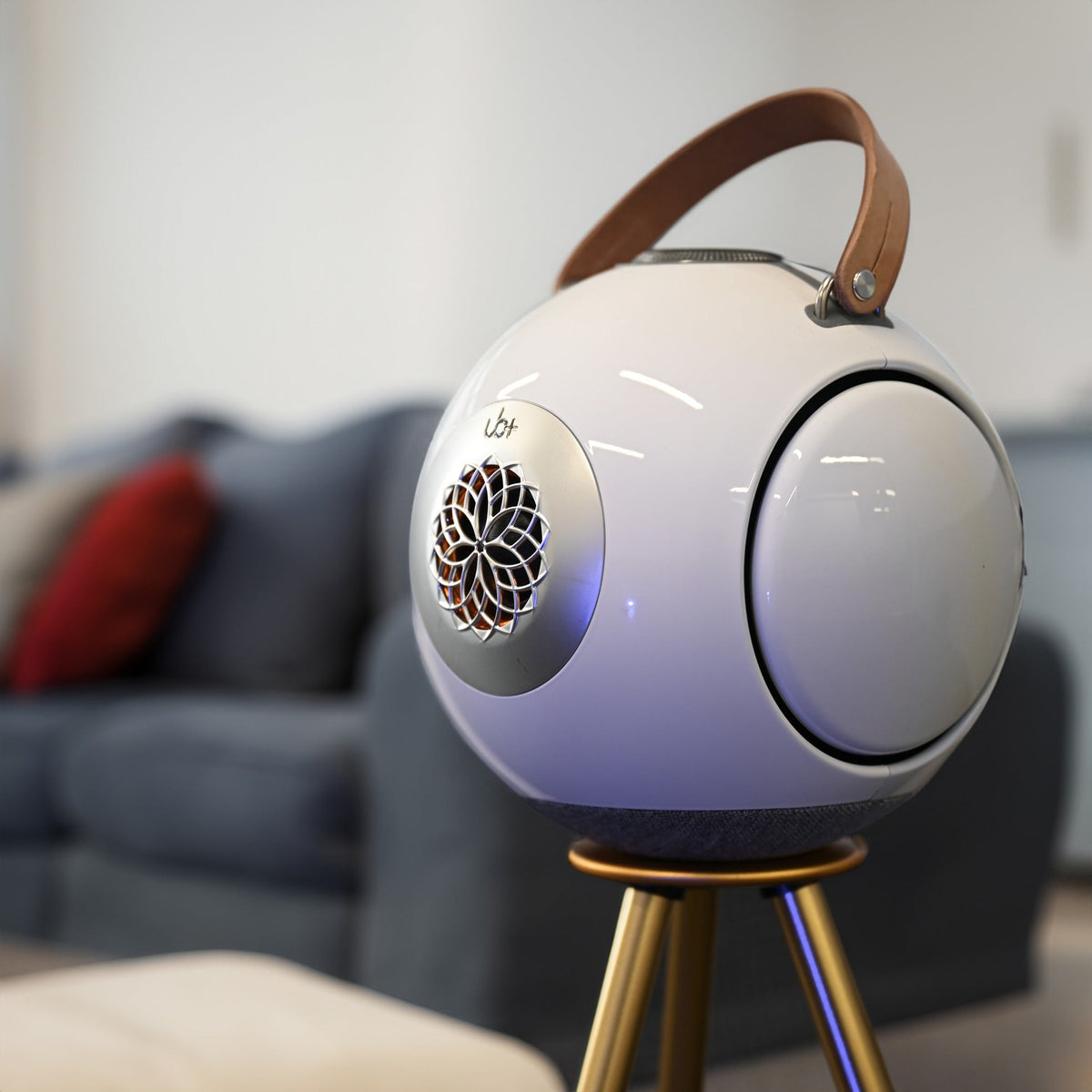
Choosing a Bluetooth speaker in 2026 is less about finding the biggest wattage number and more about understanding how the speaker is designed to produce, control, and distribute sound. The Bluetooth speaker buying guide 2026 approach should therefore look beyond volume and consider frequency response, driver architecture, bass extension, SPL, battery performance, IP protection, Bluetooth connectivity, size, portability, and where the speaker will actually be used.
A compact speaker can sound very different from another speaker of the same size because enclosure design, driver excursion, passive radiators, internal air volume, DSP, and dispersion all affect the final result. Form factor matters too. A round Bluetooth speaker such as the UB+ dB1 DoubleBass uses a spherical acoustic architecture rather than simply placing conventional components inside a rectangular box.
This guide explains what the specifications actually mean, which features matter for different listening situations, and how to compare speakers without relying on marketing numbers alone.
What Should You Look for in a Bluetooth Speaker?

There is no single specification that determines whether a Bluetooth speaker will sound good. A useful buying decision comes from looking at several specifications together.
|
Factor |
What It Tells You |
Why It Matters |
|
Power / Watts |
Electrical power delivered to the system |
Provides context for output capability, but does not directly equal loudness |
|
Frequency Response |
The range of frequencies the speaker can reproduce |
Helps indicate bass extension and treble reach |
|
SPL |
Sound pressure level produced under a stated measurement condition |
Helps compare potential output |
|
Driver Size |
Physical size of the active driver |
Influences excursion, efficiency, and low-frequency capability |
|
Bass Architecture |
How the enclosure produces and reinforces low frequencies |
Strongly affects bass depth, control, and distortion |
|
Dispersion |
How sound spreads into the surrounding space |
Important for rooms, groups, and outdoor listening |
|
Battery |
How long the speaker can operate between charges |
Determines practical portability |
|
IP Rating |
Resistance to solids and water |
Important for outdoor and poolside use |
|
Bluetooth Version |
Wireless technology generation |
Relevant to connectivity, compatibility, and supported features |
|
Size & Form Factor |
Physical footprint and acoustic configuration |
Affects portability, placement, and sound distribution |
The key is to consider these specifications as a system rather than choosing a speaker because one number looks impressive.
1. Start With How You Will Use the Speaker

The right Bluetooth speaker depends heavily on where and how you listen.
A speaker for a bedroom does not need the same acoustic output as one used at an outdoor gathering. A desk speaker needs a compact footprint and controlled dispersion. A travel speaker needs battery endurance and protection against the environment. A speaker intended for serious music listening needs more than just high volume—it needs controlled bass, clean midrange reproduction, and low distortion.
Before comparing models, define your primary use case.
|
Use Case |
Priorities |
|
Bedroom / living room |
Tonal balance, bass control, placement flexibility |
|
Desktop |
Compact size, clarity, near-field performance |
|
Travel |
Portability, battery, durability |
|
Outdoor listening |
Output, dispersion, battery, water resistance |
|
Small gathering |
Output, bass, wide sound coverage |
|
Movies / TV |
Dialogue clarity, low latency, connectivity |
|
Audiophile-focused listening |
Driver quality, enclosure design, distortion, frequency response |
This is why there is no universal specification that makes one speaker suitable for everyone.
For a deeper explanation of how room size affects speaker selection, see how to choose the right speaker size for your room.
2. Watts: What Does Speaker Power Actually Mean?
Wattage is one of the most commonly misunderstood Bluetooth speaker specifications.
More watts do not automatically mean better sound, and they do not provide a universal measurement of how loud a speaker will be. Actual acoustic output also depends on driver sensitivity, enclosure design, amplifier efficiency, frequency, distortion limits, and how the manufacturer measures power.
That means comparing two speakers solely by their watt ratings can be misleading.
A better question is:
How much usable acoustic output does the speaker produce while maintaining control and acceptable distortion?
For portable speakers, the relationship between amplifier power and acoustic design is particularly important. A well-engineered enclosure can make more effective use of available amplifier power than a poorly designed enclosure with a larger nominal wattage.
3. Frequency Response: How Deep and How High Can It Play?
Frequency response describes the range of frequencies a speaker is designed to reproduce.
Human hearing is commonly described as extending from approximately 20 Hz to 20 kHz, although actual hearing varies by person and age. For a Bluetooth speaker, the lower end of the published range is particularly useful when evaluating bass performance.
For example, the UB+ dB1 DoubleBass is specified at approximately 40 Hz–20 kHz.
However, frequency response should not be interpreted as simply:
Lower number = better speaker.
The measurement conditions and tolerance matter. A frequency-response specification without its measurement tolerance tells you less than it appears to.
Bass performance also depends on how the enclosure handles the air movement required to reproduce low frequencies. A speaker can have a large quoted frequency range while producing weak or uncontrolled bass in practice.
For more detail, see the UB+ guide to bass extension and what Hz really means.
4. Driver Size: Why the Driver Is Only Part of the Story
The driver is the component that converts electrical energy into acoustic movement.
A larger driver can generally move more air at lower frequencies, but driver diameter alone does not determine performance. Magnet strength, voice-coil design, excursion, suspension, enclosure volume, and acoustic loading all contribute.
The dB1 DoubleBass, for example, uses a 4.5-inch long-throw mid-bass driver, supported by a large magnetic motor and substantial excursion capability.
This is important because compact speakers face a fundamental challenge: producing meaningful low-frequency output from a small physical enclosure.
The solution is not necessarily to make the driver physically enormous. It can involve a combination of driver excursion, enclosure geometry, acoustic loading, and passive-radiator design.
5. Passive Radiators vs. Traditional Ports
Bass reproduction is one of the biggest differences between Bluetooth speaker designs.
A conventional port uses an opening and a column of air to create a tuned resonant system. A passive radiator uses a moving diaphragm instead of an open port to interact with the enclosure's internal air volume.
The result can be a compact enclosure with useful low-frequency extension without requiring a large physical port.
The dB1 DoubleBass takes this concept further through its spherical acoustic chamber and dual opposing passive radiators.
The two passive radiators work with the internal pressure generated by the central driver. Their opposing movement also contributes to a mechanically balanced enclosure rather than concentrating the reaction forces on one side.
If you want to understand the underlying technology in more detail, see how passive radiators work in Bluetooth speakers.
6. Why Enclosure Shape Matters
A speaker enclosure is not simply a container for the electronics.
Its internal geometry affects how air pressure behaves, how resonances develop, and how the driver interacts with the enclosed air.
Traditional rectangular enclosures can create internal reflections and standing-wave behavior. A spherical enclosure changes that acoustic environment by avoiding large parallel internal surfaces.
The dB1 DoubleBass uses a spherical acoustic chamber inspired by the Helmholtz resonance principle. The geometry is designed to distribute internal air pressure more evenly while reducing problematic standing-wave behavior.
This is one reason speaker shape can be an acoustic engineering decision rather than purely an aesthetic one.
The relationship between spherical geometry and bass performance is explored further in spherical speakers and modern home audio.
7. SPL: How Loud Is the Speaker?
SPL stands for Sound Pressure Level and is measured in decibels (dB).
It provides information about acoustic output, but the number must always be considered alongside the measurement conditions. A quoted maximum SPL is not necessarily comparable across manufacturers unless the measurement method, distance, frequency, and distortion criteria are known.
The dB1 DoubleBass is specified at approximately 93 dB SPL.
The useful question is not simply:
Which speaker has the highest dB number?
Instead, consider whether the speaker can achieve the required output while maintaining the clarity and bass control you want.
For a more detailed explanation, read how loud a Bluetooth speaker should be and how SPL works.
8. Bass Quality Is More Than “More Bass”
Bass is often used as a selling point for portable speakers, but quantity and quality are different things.
A speaker can emphasize bass through DSP equalization, but increasing low-frequency output places additional demands on the driver and amplifier. If the hardware cannot physically reproduce the required movement, aggressive processing can eventually lead to compression, distortion, or reduced headroom.
A mechanically efficient acoustic design approaches the problem differently.
The dB1 DoubleBass uses its spherical chamber, central driver, and dual passive-radiator architecture to generate low-frequency output acoustically. Its DSP can then focus on functions such as linearity, protection, and tonal balance rather than relying on artificial bass enhancement as the primary mechanism.
That distinction matters when evaluating deep bass Bluetooth speakers.
9. 360° Sound vs. Front-Firing Speakers
Speaker placement can dramatically change what listeners hear.
A conventional front-firing speaker directs most of its acoustic energy toward a particular listening area. This can work extremely well when the speaker and listener remain in predictable positions.
A 360-degree design distributes sound more broadly around the enclosure.
This can be particularly useful when people are sitting around a table, moving around a room, or listening outdoors rather than sitting directly in front of the speaker.
The dB1's spherical architecture is designed around 360° sound dispersion, making its physical orientation less restrictive than a conventional front-facing enclosure.
You can compare the two approaches in our guide to 360-degree versus front-firing speakers.
10. Battery Life: Look Beyond the Maximum Number
Battery life matters whenever a Bluetooth speaker is genuinely portable.
However, advertised maximum playback time is normally dependent on conditions such as volume level, content, connectivity, EQ settings, and other operating variables.
Instead of treating one maximum battery figure as a universal measurement, consider:
- How often you will use the speaker away from a charger
- Your typical listening volume
- Whether you need it for short sessions or full-day events
- Charging time
- Whether performance changes at high volume
- Whether the speaker remains practical to transport
A speaker with excellent sound but insufficient battery capacity may not be practical for travel. Conversely, a speaker with exceptional battery endurance may not be the right choice if acoustic performance is your primary requirement.
11. IP Ratings: Understand What “Waterproof” Really Means
IP ratings are another area where Bluetooth speaker marketing can create confusion.
An IP code describes protection against specific types of intrusion. The letters and numbers have defined meanings, and the rating must be interpreted as a complete code.
The IPX5 rating used by the dB1 DoubleBass indicates protection against water jets under specified test conditions. The “X” means that a solid-particle protection rating is not specified by that particular code.
IPX5 therefore does not mean the speaker is designed for submersion.
For poolside, beach, camping, and outdoor use, the practical question is whether the speaker's tested water resistance matches the environment in which you intend to use it.
That distinction is important when comparing portable speakers marketed as “waterproof.”
12. Bluetooth Version: Why Bluetooth 5.3 Matters
Bluetooth technology has progressed significantly, but the version number alone does not tell you everything about real-world connection quality.
The device, operating system, supported profiles, implementation, radio environment, and physical obstructions can all affect performance.
The UB+ dB1 DoubleBass uses Bluetooth 5.3, providing a current wireless platform for compatible devices.
When comparing speakers, also consider whether you need:
- Stable everyday wireless playback
- Low-latency performance
- Wired playback
- TF card playback
- Multiple-device compatibility
- Reliable connection at the distance you normally use
A newer Bluetooth version can be useful, but it should be evaluated alongside the speaker's complete connectivity implementation.
13. Wired Playback Can Still Matter
Bluetooth is convenient, but wireless playback is not always the only useful connection method.
Depending on the speaker and use case, wired or local playback can provide another way to access music. This can be useful when wireless interference is a concern or when a source device does not offer the desired wireless functionality.
The dB1 DoubleBass supports Bluetooth 5.3 as well as wired and TF playback, giving it more than one way to access audio.
For most everyday users, Bluetooth will remain the simplest option. But flexibility becomes more valuable when a speaker is used across different environments.
14. Distortion and Headroom: The Numbers That Often Get Ignored
A speaker can be loud and still sound poor.
Distortion occurs when the output no longer accurately follows the input signal. At higher playback levels, a driver may approach its mechanical limits, while the amplifier can also approach its electrical limits.
Headroom is therefore important.
A speaker with sufficient acoustic and electrical headroom can reproduce transient peaks without constantly operating at its limits. This helps preserve vocal clarity, bass definition, and separation as volume increases.
This is also why driver design matters so much. Features such as long excursion, motor strength, suspension design, and enclosure loading work together to determine how effectively a small speaker can produce demanding low-frequency content.
For a deeper technical explanation, read speaker distortion explained.
15. Speaker Size vs. Portability
Smaller does not automatically mean better, and larger does not automatically mean better.
A larger enclosure can provide more acoustic volume and may accommodate larger drivers or more substantial batteries. A smaller speaker is easier to carry and position but has less physical space available for acoustic components.
The real design challenge is achieving the desired acoustic performance within the available volume.
This is why modern compact Bluetooth speakers can differ dramatically in performance despite having similar external dimensions.
When comparing size, ask:
- How often will I carry it?
- How much bass do I actually want?
- How large is the listening area?
- Will people sit around the speaker or mainly in front of it?
- Will I use it indoors, outdoors, or both?
- Does the enclosure design support the performance I'm looking for?
16. Choosing a Bluetooth Speaker by Use Case
For Home Listening
Prioritize balanced sound, bass control, dispersion, and placement flexibility.
A speaker that works well in a home environment does not necessarily need maximum SPL. Tonal consistency and controlled low frequencies can matter more for extended listening.
For a Desktop
Look for a compact enclosure with strong vocal and midrange clarity.
Desk listening occurs at relatively short distances, so excessive output is rarely the most important factor. Footprint and how the speaker distributes sound can be more important.
For Travel
Weight, physical size, battery performance, wireless connectivity, and environmental protection become major considerations.
The best travel speaker is one you will actually carry rather than one that remains at home because it is too large.
For Outdoor Listening
Outdoor environments remove much of the acoustic reinforcement provided by walls and corners.
This makes output capability, dispersion, bass efficiency, battery life, and water resistance more important.
For a broader outdoor comparison, see the UB+ guide to outdoor Bluetooth speakers.
For Small Gatherings
Look for a speaker that combines sufficient SPL with useful bass extension and broad coverage.
Maximum loudness alone is not enough. If the speaker becomes harsh or loses bass definition as volume increases, a higher maximum number may not translate into a better listening experience.
17. How the UB+ dB1 DoubleBass Approaches the Problem
The UB+ dB1 DoubleBass is an example of why specifications need to be considered together rather than individually.
Acoustic Spotlight
The dB1 uses a spherical acoustic chamber inspired by Helmholtz resonance principles. Its central 4.5-inch long-throw mid-bass driver works into the spherical enclosure, while two opposing passive-radiator plates handle the resulting air pressure.
The combined passive-radiator surface area is approximately 3.5× the area of the active woofer. Their symmetrical placement helps balance mechanical forces, while the spherical enclosure distributes internal pressure rather than relying on a conventional rectangular box architecture.
The driver system also incorporates a 90 mm neodymium magnet, 35 mm long-stroke voice coil, approximately 20 mm piston movement, aluminum shorting ring, and 18 mm-wide surround.
The result is an acoustic system designed to produce substantial low-frequency output from a relatively compact spherical enclosure without making DSP-generated bass the primary source of the effect.
The broader concept is explained in UB+'s guide to passive radiators versus ported speaker designs.
18. UB+ dB1 DoubleBass: Key Specifications
|
Specification |
UB+ dB1 DoubleBass |
|
Acoustic architecture |
Spherical chamber |
|
Acoustic principle |
Helmholtz-inspired |
|
Main driver |
4.5-inch long-throw mid-bass |
|
Passive radiators |
Dual, opposing |
|
Passive-radiator area |
Approximately 3.5× active woofer area |
|
Frequency response |
Approximately 40 Hz–20 kHz |
|
Maximum SPL |
Approximately 93 dB |
|
Wireless |
Bluetooth 5.3 |
|
Playback |
Bluetooth, wired, TF |
|
Water resistance |
IPX5 |
|
Dispersion |
360° spherical |
|
Bass approach |
Mechanical/acoustic reinforcement with DSP support |
These specifications are more useful when viewed as a complete acoustic system. A 40 Hz specification, for example, tells you about the stated frequency range; it does not by itself explain how that low-frequency output is generated or controlled.
19. A Better Way to Compare Bluetooth Speakers
Instead of asking:
“Which Bluetooth speaker has the most watts?”
ask:
“Which speaker's complete acoustic system matches how I intend to listen?”
A useful comparison looks like this:
|
Priority |
What to Examine |
|
Deep bass |
Frequency response + enclosure + driver excursion |
|
High volume |
SPL + amplifier + driver/headroom |
|
Clean sound |
Distortion + driver design + DSP |
|
Outdoor use |
SPL + dispersion + battery + IP rating |
|
Portability |
Size + weight + battery |
|
Group listening |
Dispersion + output + bass |
|
Desk listening |
Footprint + clarity + near-field performance |
|
Design-conscious spaces |
Form factor + finish + acoustic architecture |
|
Flexible playback |
Bluetooth + wired/local playback |
|
Long-term use |
Build quality + battery + environmental protection |
This approach prevents one impressive specification from dominating the buying decision.
20. What Makes a Good Bluetooth Speaker in 2026?
The best Bluetooth speaker for one person may be completely different from the right speaker for another.
A travel-focused listener may prioritize portability and battery life. Someone building a home listening setup may care more about tonal balance and bass control. Someone hosting outdoor gatherings may need higher acoustic output and wider sound distribution.
The important point is that sound quality is the result of an entire system.
Driver, amplifier, enclosure, acoustic loading, passive radiators, DSP, power supply, and dispersion all interact. The enclosure shape can influence internal acoustics, while driver excursion determines how much air can be moved. Passive radiators can extend low-frequency performance, while DSP can help maintain linearity and protect the hardware.
That is why a useful Bluetooth speaker buying guide 2026 should teach you how to interpret specifications instead of simply listing the largest numbers.
Frequently Asked Questions
1. What should I look for when buying a Bluetooth speaker in 2026?
Start with your use case, then compare frequency response, driver design, SPL, bass architecture, battery performance, IP rating, Bluetooth connectivity, size, and dispersion. No single specification determines overall sound quality.
2. Are more watts better for a Bluetooth speaker?
Not necessarily. Wattage describes electrical power, but acoustic output also depends on driver efficiency, enclosure design, sensitivity, excursion, amplifier behavior, and distortion limits.
3. What frequency response is good for a Bluetooth speaker?
A wider published range can indicate broader reproduction, but the measurement tolerance and actual acoustic performance matter. The lower-frequency limit is particularly relevant when evaluating bass extension.
4. Is IPX5 waterproof enough for outdoor use?
IPX5 provides protection against water jets under specified test conditions. It is useful for many outdoor environments, but it does not mean the speaker is designed for submersion.
5. Is a round Bluetooth speaker better than a rectangular speaker?
Neither shape is automatically better. Shape affects acoustic geometry, dispersion, placement, and internal air behavior. A spherical design such as the dB1 uses its geometry as part of the acoustic system rather than treating shape as purely visual.
Explore UB+ Options
→ Explore the UB+ dB1 DoubleBass
→ Compare the dB1 DoubleBass with the dB Mini
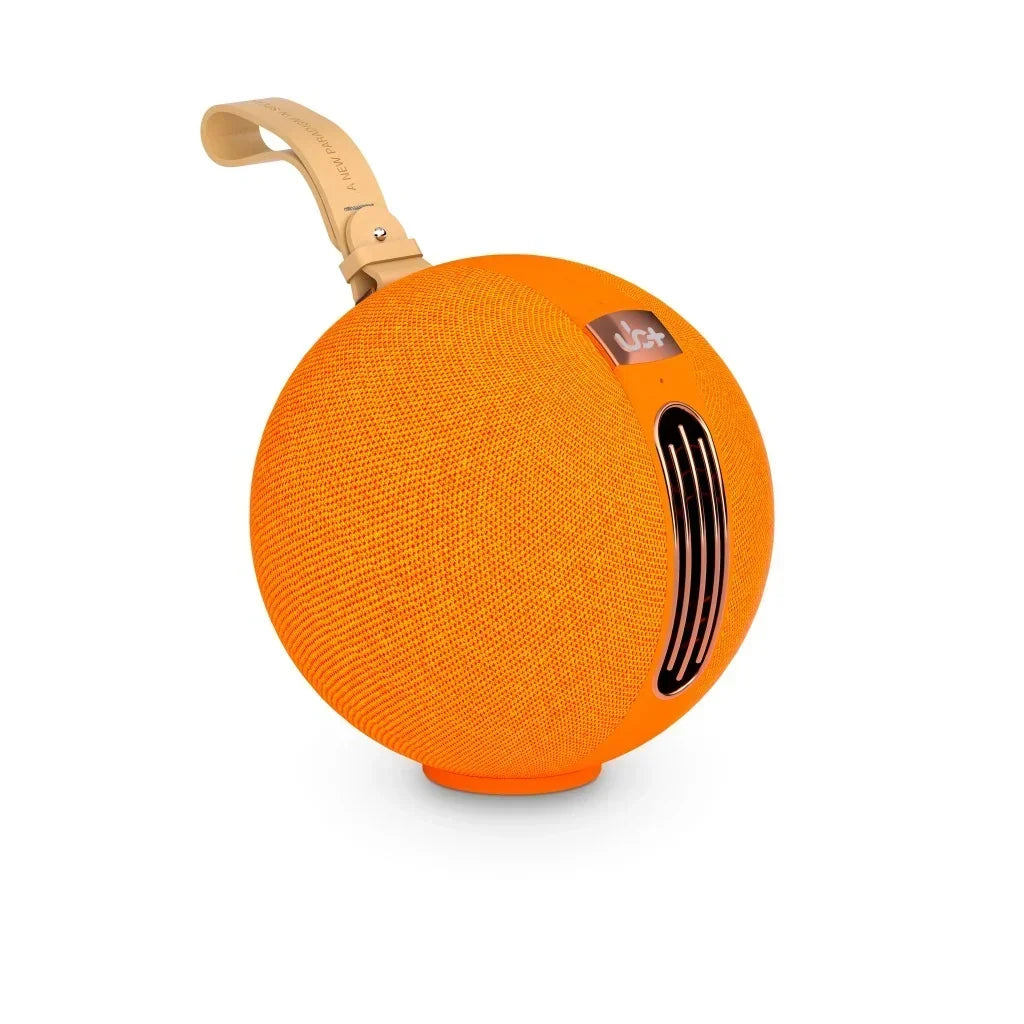
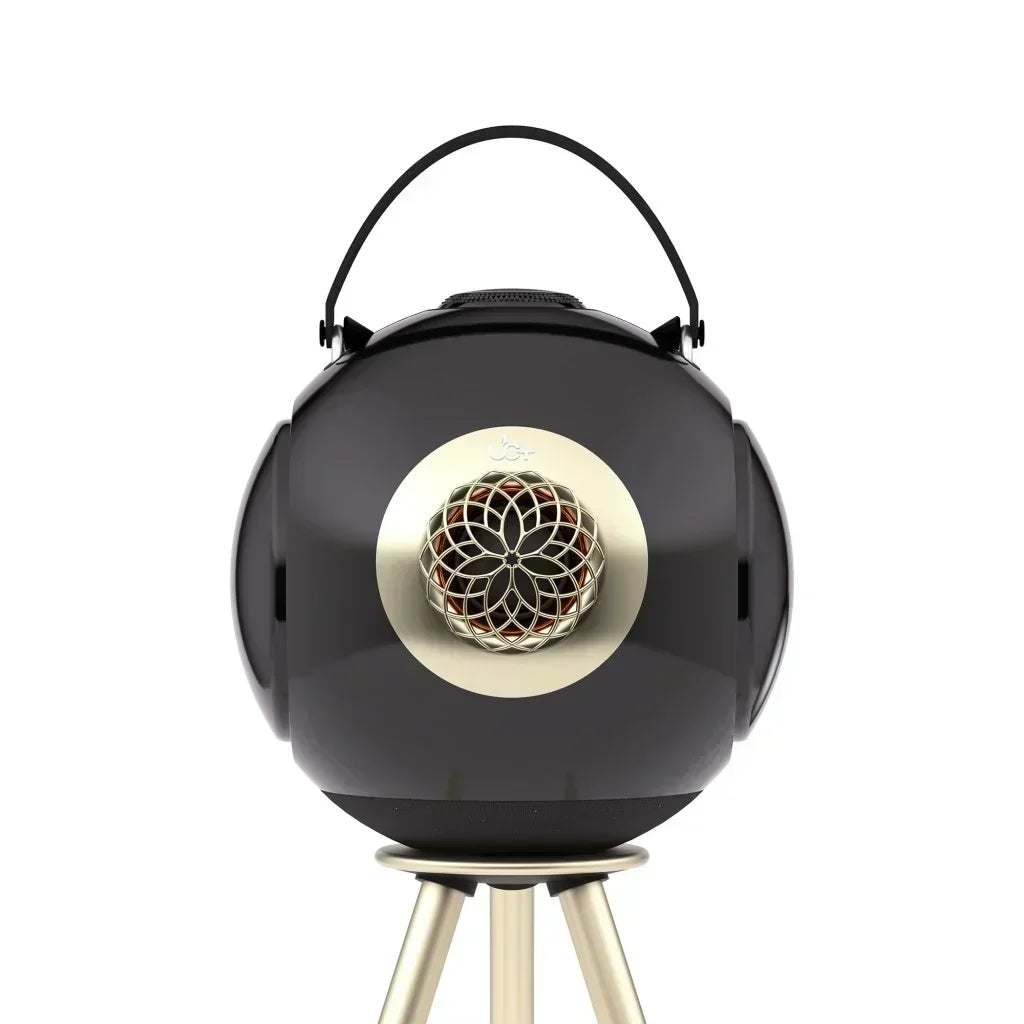
→ See available dB1 color options
A good Bluetooth speaker is not defined by one specification. It is the combination of acoustic design, driver capability, bass architecture, connectivity, portability, and real-world usability that determines whether the speaker fits the way you listen.


Оставить комментарий
Этот веб-сайт защищается hCaptcha. Применяются Политика конфиденциальности и Условия использования hCaptcha.