
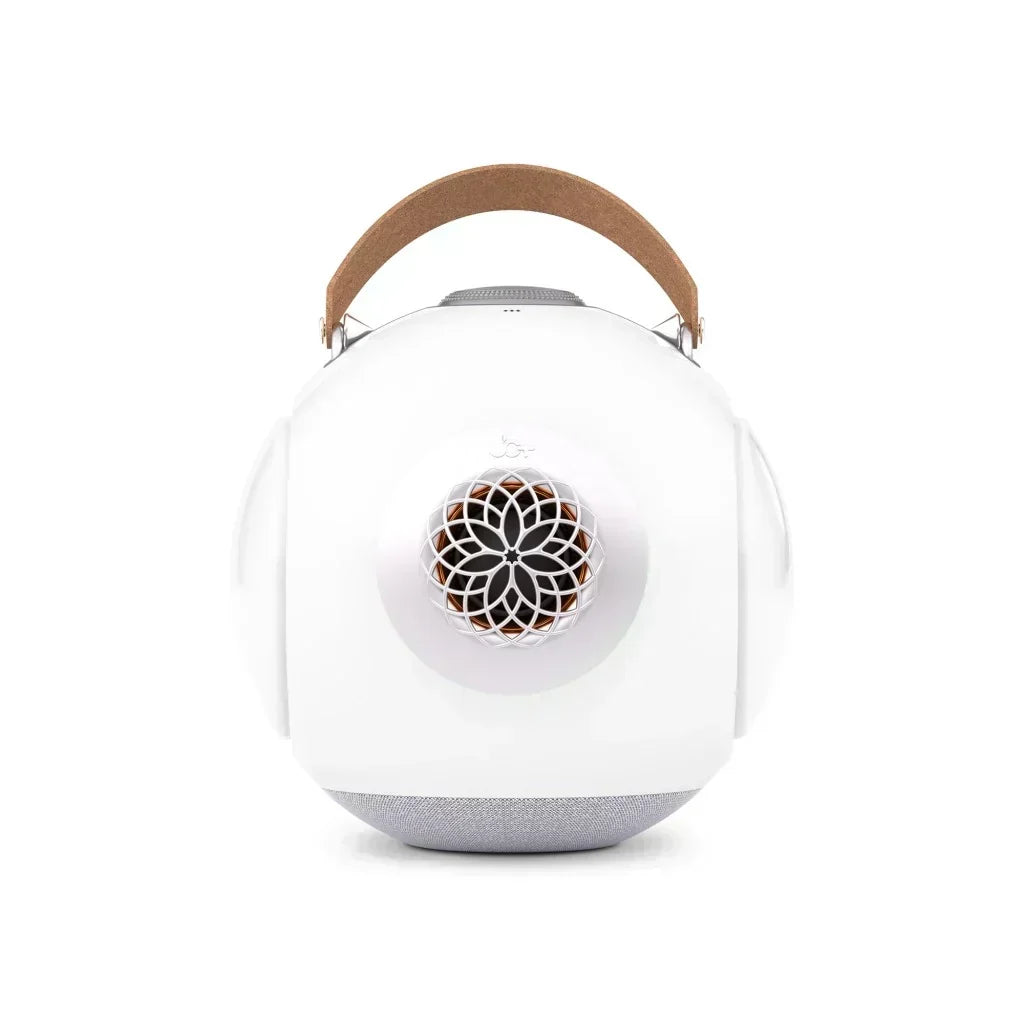
Choosing between two compact portable Bluetooth speakers is not only about comparing specifications. The more useful question is how you intend to use the speaker. Do you want a compact system capable of delivering broad, room-filling sound, or is maximum portability the priority?
The UB+ dB1 DoubleBass and UB+ dB Mini are designed around different priorities. The dB1 focuses on a more substantial acoustic system, with a spherical chamber, dual passive radiators, and 360° sound dispersion. The dB Mini is the smaller option for listeners who place greater value on compactness and easy movement.
This comparison looks at the design, acoustic approach, portability, connectivity, and practical use cases of both models so you can determine which fits your listening environment.
Two Different Approaches to Portable Audio

Portable speakers have changed considerably from the simple small boxes that were once associated with Bluetooth audio. A modern portable speaker may need to work at a desk, in a bedroom, around an apartment, outdoors, or while traveling.
That creates a trade-off between physical size and acoustic capability.
The dB1 DoubleBass and dB Mini approach that trade-off differently. The dB1 uses a larger acoustic architecture to support deeper bass and broader room coverage. The dB Mini emphasizes a smaller form factor that makes it easier to carry and reposition.
The important distinction is therefore not simply dB1 vs dB Mini. It is room-oriented performance vs maximum portability.
Spherical Design and 360° Sound

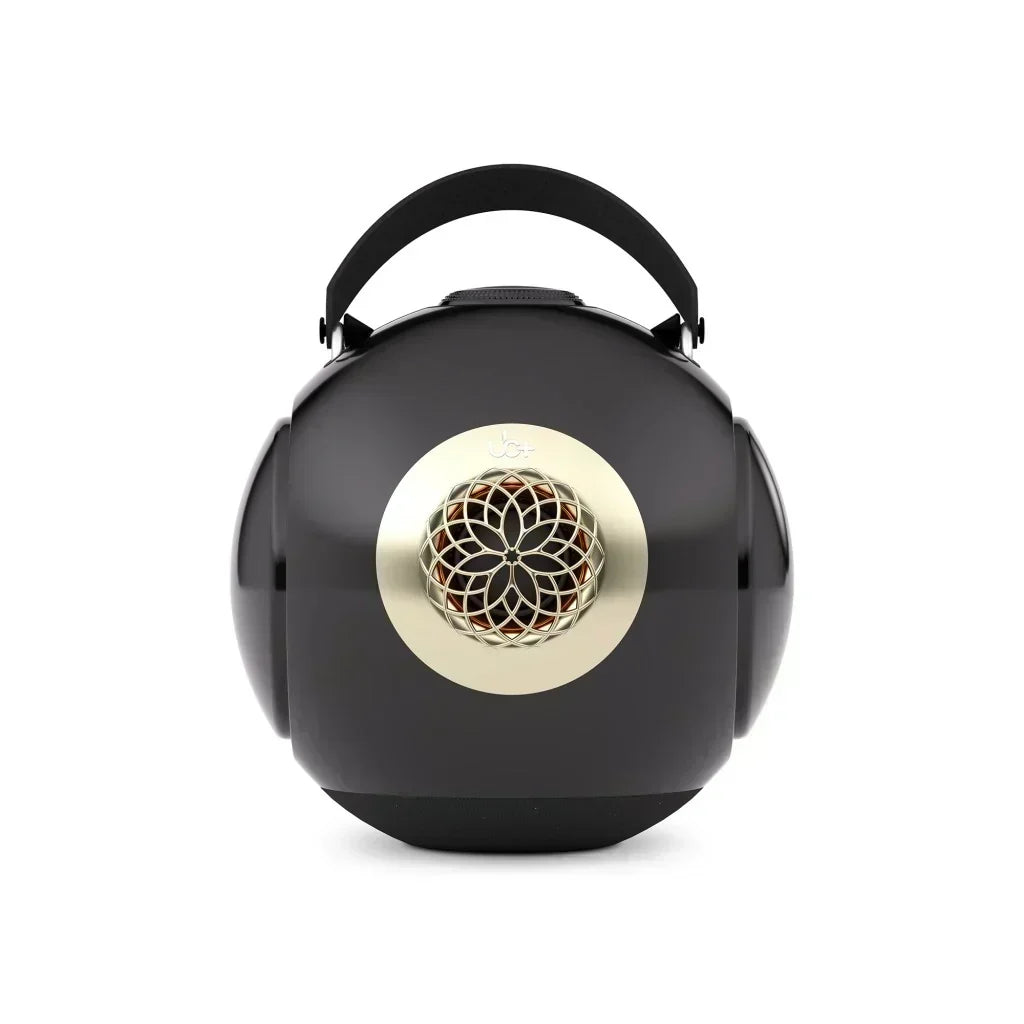
One of the defining characteristics of UB+ speakers is the use of spherical forms rather than conventional rectangular enclosures.
For the dB1, the spherical enclosure is also an important part of the acoustic architecture. Its internal chamber is inspired by the Helmholtz resonance principle and is designed to distribute internal air pressure more evenly while reducing problematic standing-wave behavior.
The spherical form also supports broad sound dispersion.
Instead of requiring the listener to remain directly in front of the speaker, the dB1 is designed to distribute sound around the enclosure. That can be particularly useful in an apartment, studio, living room, or small gathering where people may be positioned in different directions.
For more background, see how spherical speaker design affects sound.
UB+ dB1 DoubleBass: Built Around Acoustic Performance

The dB1 DoubleBass is the more technically substantial of the two designs.
Its acoustic system centers around a long-throw mid-bass driver working into a spherical chamber. Two passive radiators are positioned on opposite sides of the enclosure and respond to the internal air pressure generated by the active driver.
The combined passive-radiator surface area is approximately 3.5× the area of the active woofer.
This matters because bass reproduction is ultimately a physical problem. Moving more air at low frequencies requires an appropriate combination of driver excursion, enclosure volume, acoustic loading, and radiator area.
The dB1's architecture uses those elements mechanically rather than relying primarily on aggressive DSP-based bass enhancement.
Its opposing passive radiators also create a balanced mechanical arrangement that helps reduce unwanted cabinet movement.
dB1 Acoustic Spotlight
The dB1 DoubleBass incorporates:
|
Acoustic Element |
dB1 DoubleBass |
|
Enclosure |
Spherical acoustic chamber |
|
Acoustic principle |
Helmholtz-inspired chamber |
|
Active driver |
4.5-inch long-throw mid-bass driver |
|
Passive radiators |
Two opposing radiators |
|
Radiator area |
Approximately 3.5× active woofer area |
|
Magnet |
90mm neodymium magnet |
|
Voice coil |
35mm long-stroke |
|
Piston movement |
Approximately 20mm |
|
Frequency response |
Approximately 40Hz–20kHz |
|
Maximum SPL |
Approximately 93dB SPL |
|
Wireless |
Bluetooth 5.3 |
|
Water resistance |
IPX5 |
The combination is intended to produce a compact speaker with meaningful low-frequency extension, broad dispersion, and controlled mechanical behavior.
UB+ dB Mini: Compactness Comes First

The dB Mini serves a different purpose.
Its smaller physical format makes it easier to move between rooms, place on a desk, pack for travel, or use when you simply do not want a larger speaker occupying the space.
That makes the dB Mini particularly relevant for:
- Desk listening
- Bedrooms
- Small personal spaces
- Travel
- Moving between rooms
- Casual outdoor listening
- Listeners who prioritize compact size
The original comparison supplied for this article describes the dB Mini as a smaller, lower-output alternative to the dB1. However, the specific numerical claims in the source—such as 60Hz–20kHz, 85dB SPL, exact battery duration, and pocket-sized dimensions—are not part of the technical information currently established for the dB Mini here, so they should not be presented as confirmed specifications.
What can be stated confidently from the comparison is the fundamental positioning: the dB Mini is the more portability-focused model, while the dB1 is the more performance-oriented model.
Sound Quality: Bass, Clarity, and Scale
The biggest practical difference between the two speakers is how much acoustic hardware each model can dedicate to producing sound.
The dB1's larger acoustic system is specifically designed around bass reproduction and broad sound distribution. Its approximately 40Hz lower frequency limit gives it access to low-frequency content that smaller portable speakers may struggle to reproduce.
This is useful for music where bass contributes significantly to the character of the recording, including electronic music, hip-hop, cinematic soundtracks, and recordings with substantial acoustic bass or kick-drum energy.
The dB1 also combines its bass architecture with broad dispersion, so its performance is not dependent on having one listener positioned directly in front of it.
The dB Mini takes a different approach. Its value comes from delivering a compact listening solution that can go where a larger speaker is less convenient.
For a deeper explanation of passive-radiator technology, see how passive radiators work in Bluetooth speakers.
dB1 vs dB Mini: Key Differences
|
Feature |
UB+ dB1 DoubleBass |
UB+ dB Mini |
|
Primary priority |
Acoustic performance and room coverage |
Compact portability |
|
Form factor |
Spherical |
Compact portable design |
|
Sound distribution |
360° spherical dispersion |
Compact listening format |
|
Bass architecture |
Spherical chamber + dual passive radiators |
Smaller portable architecture |
|
Best environment |
Apartments, living spaces, small gatherings |
Desk, bedroom, travel, personal listening |
|
Portability |
Portable |
More portability-focused |
|
Low-frequency focus |
Strong emphasis |
More compact approach |
|
Mechanical bass system |
Yes |
Not established from the supplied source |
|
Bluetooth |
5.3 |
Specific version not established from the supplied source |
|
Water resistance |
IPX5 |
Specific rating not established from the supplied source |
The table makes the underlying difference clearer: these models should not be treated as identical speakers at two different sizes.
Portability: How Often Will You Move It?
Portability has more than one meaning.
A speaker can be portable because it has a battery and can be carried, but there is still a difference between a speaker that is easy to move around a home and one designed primarily around minimal physical size.
The dB1 is portable enough to move between locations, but its acoustic design makes it particularly appropriate when you want one speaker to serve a room.
The dB Mini is the logical fit when the speaker itself needs to be part of your everyday carry.
Think about your routine:
Mostly stays at home:
The dB1's larger acoustic architecture may be more relevant.
Moves between rooms:
Either can work, depending on how much acoustic output you need.
Travels frequently:
The dB Mini's compact form becomes more important.
Used for gatherings:
The dB1's room-oriented sound distribution is more relevant.
Battery Life: Look Beyond the Number
Battery life matters for both speakers because portability only becomes useful when the speaker can operate without being connected to a wall outlet.
However, battery duration is affected by listening volume, content, wireless operation, and other operating conditions. A single maximum playtime number should therefore not be treated as a universal real-world result.
The more useful question is how you will use the speaker.
For a speaker that normally sits in your apartment and is occasionally moved around, battery operation provides flexibility.
For a speaker intended for travel or outdoor use, battery performance becomes a much more central part of the buying decision.
The supplied comparison states long playtime for both models, but because exact current battery specifications for the dB Mini are not established in the available technical reference, it is better to verify the current product specification before publishing a precise number.
Where the dB1 DoubleBass Makes More Sense
The dB1 is designed for listeners who want a compact speaker to function as a serious room audio system.
It is particularly relevant for:
Apartment and Living Room Listening
The spherical enclosure and broad dispersion allow the dB1 to work naturally in spaces where listeners are not always sitting in one fixed position.
Music With Strong Bass Content
The long-throw driver, spherical chamber, and dual passive-radiator system are designed to support meaningful low-frequency reproduction without depending primarily on artificial bass enhancement.
Small Gatherings
A broad sound field can be useful when several people are positioned around the room rather than directly in front of a speaker.
Minimalist Audio Setups
The dB1 can provide a substantial listening experience without requiring a conventional collection of separate components.
Where the dB Mini Makes More Sense
The dB Mini is better suited to situations where the speaker needs to stay out of the way.
Desk and Personal Listening
Its compact form makes it appropriate for workspaces where desk real estate is limited.
Bedroom Listening
A smaller speaker can provide convenient everyday listening without requiring a larger audio setup.
Travel
When the speaker needs to fit easily into your travel setup, physical size becomes a major consideration.
Moving Around the Home
If you regularly carry your speaker from one room to another, a smaller design can make that routine easier.
Which Speaker Should You Choose?
The decision becomes easier when you start with your primary use rather than the specification sheet.
|
If Your Priority Is... |
Consider |
|
Room-filling sound |
dB1 DoubleBass |
|
Deep bass architecture |
dB1 DoubleBass |
|
360° spherical sound |
dB1 DoubleBass |
|
Apartment or living-room use |
dB1 DoubleBass |
|
Small gatherings |
dB1 DoubleBass |
|
Maximum portability |
dB Mini |
|
Travel |
dB Mini |
|
Desk listening |
dB Mini |
|
Moving frequently between rooms |
dB Mini |
|
Small personal listening space |
dB Mini |
This is not simply a matter of choosing the larger or smaller speaker. It is about choosing the acoustic architecture that matches how you actually listen.
Frequently Asked Questions
What is the main difference between the UB+ dB1 and dB Mini?
The dB1 DoubleBass is designed around stronger acoustic performance, bass reproduction, and broad 360° sound distribution. The dB Mini places greater emphasis on compact portability.
Which UB+ speaker is better for a small apartment?
The dB1 is particularly suited to apartment use when you want one compact speaker to provide broad room coverage and stronger bass performance.
Which UB+ speaker is better for travel?
The dB Mini is the more portability-focused option and is designed for situations where keeping the speaker compact and easy to carry is important.
Does the dB1 have 360° sound?
Yes. The dB1 is designed around 360° spherical sound dispersion, allowing sound to spread broadly around the speaker rather than being concentrated toward one listening direction.
Why does the dB1 use two passive radiators?
The two opposing passive radiators respond to pressure generated inside the spherical acoustic chamber. Their combined surface area is approximately 3.5× that of the active woofer, supporting the dB1's mechanical approach to bass reproduction while the opposing arrangement helps balance mechanical forces.
Explore UB+ Speakers
→ Explore the UB+ dB1 DoubleBass
→ Compare dB1 DoubleBass and dB Mini
The dB1 DoubleBass and dB Mini are designed for different listening priorities. The dB1 puts more of its physical design toward acoustic performance, bass reproduction, and broad room coverage. The dB Mini puts more emphasis on keeping the speaker compact and easy to carry. The right choice depends on whether your speaker needs to primarily fill a space or travel with you.


Оставить комментарий
Этот веб-сайт защищается hCaptcha. Применяются Политика конфиденциальности и Условия использования hCaptcha.