
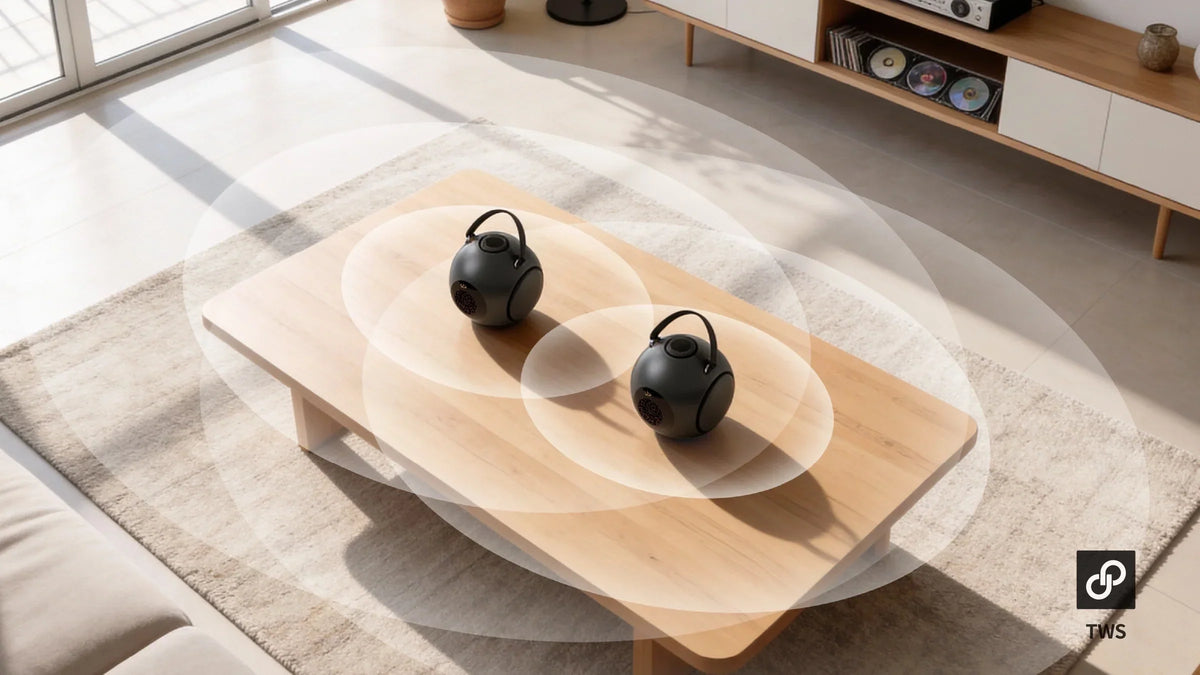
When comparing pair two speakers vs one bluetooth speaker, the main question is not simply whether two speakers produce more sound. The real issue is whether a paired setup delivers enough improvement in stereo separation, coverage, bass distribution, and listening flexibility to justify the additional cost.
A single high-quality Bluetooth speaker can provide strong output, simple setup, and excellent portability. Two compatible UB+ speakers, however, may create a wider soundstage, improve left-right separation, and distribute sound more evenly across a room or outdoor gathering. The better choice depends on the size of the listening space, the type of music you play, and whether you value simplicity or a more expansive listening experience.
This guide compares one speaker with a two-speaker UB+ setup, explains the technical differences, and helps determine when stereo Bluetooth speakers are worth the investment.
One Bluetooth Speaker vs Two: The Basic Difference

A single speaker is an all-in-one audio system. It combines the amplifier, drivers, enclosure, wireless connection, and sound processing in one unit.
A paired setup uses two compatible speakers working together. Depending on the system, the speakers may operate as a stereo pair, with one handling the left channel and the other handling the right channel. Some systems can also operate in a linked or synchronized mode, where both speakers reproduce similar content for wider coverage.
The difference is most noticeable in how sound is distributed.
|
Feature |
One Bluetooth Speaker |
Two Paired UB+ Speakers |
|
Initial cost |
Lower |
Higher |
|
Setup |
Simple |
Requires pairing and positioning |
|
Portability |
Easier to carry |
More equipment to transport |
|
Stereo separation |
Limited or simulated |
True left-right separation when supported |
|
Soundstage |
More centralized |
Wider and more spacious |
|
Coverage |
Focused around one enclosure |
Can cover a broader area |
|
Bass distribution |
Concentrated in one location |
Can be spread across two positions |
|
Battery management |
One battery |
Two batteries |
|
Flexibility |
Best for quick listening |
Better for dedicated setups |
|
Ideal use |
Casual listening and travel |
Music-focused listening and gatherings |
The important point is that two speakers do not automatically sound twice as good. Their value comes from stereo imaging, placement flexibility, and the ability to distribute acoustic output across a larger listening area.
What Does Pairing Two Bluetooth Speakers Actually Do?
Pairing two speakers can mean different things depending on the manufacturer and the wireless system.
In a true stereo arrangement, one speaker reproduces the left audio channel while the other reproduces the right channel. This creates spatial separation between instruments, vocals, and effects.
For example:
- A guitar may appear toward the left.
- A keyboard may occupy the right side.
- Vocals may remain near the center.
- Ambient effects may extend beyond the physical position of either speaker.
This creates a more convincing Bluetooth stereo pair experience than a single enclosure can usually provide.
However, stereo performance depends on speaker placement. If both speakers are placed directly beside each other, the improvement may be limited. To create a useful stereo image, the speakers need some distance between them and should face the listening position appropriately.
If the speakers are used outdoors or in a crowded room, stereo imaging may be less important than broad coverage. In those situations, synchronized playback may be more useful than strict left-right separation.
The Main Advantage: A Wider Soundstage
A single speaker places most of the sound in one physical location. Even if it uses multiple drivers or DSP processing, the sound remains concentrated within one enclosure.
Two speakers create a wider acoustic arrangement. When positioned correctly, they produce a more expansive soundstage.
A wider soundstage can make music feel:
- More open
- More spacious
- Better separated
- More immersive
- Easier to follow instrument by instrument
This is especially useful for recordings with clear stereo production, live performances, orchestral music, electronic music, and detailed acoustic arrangements.
A single speaker can still sound excellent, particularly when it uses a well-designed spherical enclosure or wide-dispersion system. But two physically separated speakers provide a greater distance between the left and right channels, which helps create more realistic spatial information.
For a deeper explanation, see What Is Soundstage in a Speaker System?.
Is Stereo Separation Always Better?
Not necessarily.
Stereo separation is valuable when the listener is positioned between the two speakers. This is often called the listening sweet spot. From that position, the left and right channels reach the listener with a more balanced timing and volume relationship.
Outside the sweet spot, the stereo image may become less consistent. Someone standing close to the left speaker may hear more of the left channel, while someone near the right speaker may hear more of the right channel.
A single wide-dispersion speaker can sometimes provide a more consistent experience for a group of people positioned around it.
This creates an important buying distinction:
- Choose two speakers for a focused, immersive stereo experience.
- Choose one wide-dispersion speaker for simple, flexible group listening.
- Choose two synchronized speakers for broader coverage when strict stereo imaging is not the priority.
The best configuration depends on how people will use the system.
When One UB+ Speaker Makes More Sense
A single UB+ speaker may be the better choice when convenience, portability, and flexible placement are more important than stereo width.
1. You Want a Simple Setup
One speaker requires fewer steps. There is no need to position two enclosures, manage two batteries, or reconnect a stereo pair.
This is useful for:
- Work-from-home listening
- Bedrooms
- Small apartments
- Kitchens
- Casual outdoor use
- Travel
- Quick background music
A single speaker can be placed wherever it is needed without considering left and right channel alignment.
2. You Move the Speaker Frequently
If you regularly carry the speaker between rooms, take it outdoors, or travel with it, one unit is easier to manage.
Two speakers may provide better sound in a fixed location, but they increase the amount of equipment that must be transported and charged.
3. You Listen in a Small Room
In a compact room, a single speaker may already provide sufficient output and coverage. Two speakers can create a wider image, but the room may not have enough space for proper separation.
In some small rooms, placing two speakers too close to walls or corners can also create uneven bass.
4. You Prefer Broad Sound Distribution
A spherical speaker can distribute sound around its enclosure rather than focusing output toward one narrow front-facing zone.
A design such as the UB+ dB1 DoubleBass can be useful when listeners are sitting or moving around the speaker. Its spherical architecture is intended to provide a broad acoustic presentation, reducing the need to aim the speaker toward one particular listener.
For more information, read Spherical Speakers and Modern Home Audio.
When Two UB+ Speakers Are Worth the Extra Cost
A paired setup becomes more attractive when the listening environment or the type of music benefits from separation and placement flexibility.
1. You Want a More Immersive Music Experience
Two speakers can reproduce a wider stereo image than one enclosure. This makes the system more suitable for focused listening sessions where the listener can sit between the speakers.
The improvement is especially noticeable when the recording contains meaningful left-right information.
2. You Have Enough Space for Proper Placement
Two speakers need physical separation. A practical setup usually places them apart from each other and directs them toward the listening area.
The exact distance depends on the room and speaker design, but the speakers should not be crowded together. If they are too close, the stereo image may collapse toward the center.
3. You Want More Flexible Sound Coverage
Two speakers can be positioned in different areas of a room or outdoor space. This may help reduce the difference between the sound heard near the speaker and the sound heard farther away.
For example, one speaker may be positioned on the left side of a gathering and the other on the right. This can distribute sound more evenly than placing one speaker at the center and increasing its volume.
However, placement should be planned carefully. Two speakers positioned too far apart may create uneven volume or an inconsistent stereo image.
4. You Want Greater Headroom
Two speakers can share the workload. Each enclosure does not necessarily need to operate as hard as a single speaker attempting to fill the same space.
This can help improve perceived clarity at higher listening levels, although the result depends on amplifier power, driver design, DSP behavior, and how the system is configured.
Two speakers do not guarantee double the loudness. A meaningful improvement depends on whether the speakers can operate cleanly and whether their output combines effectively in the listening area.
5. You Have a Dedicated Listening Area
A paired setup is most worthwhile when it can remain positioned correctly.
A living room, media room, studio, office, or dedicated music space may benefit more from two speakers than a constantly changing setup. Once the speakers are positioned and connected, the system can provide a consistent listening experience.
How Two Speakers Affect Bass
Many buyers assume that two speakers automatically produce twice the bass. The reality is more complicated.
Bass performance depends on:
- Enclosure design
- Driver size
- Driver excursion
- Acoustic loading
- Passive radiator or port configuration
- Amplifier output
- DSP protection
- Speaker placement
- Room boundaries
- Distance between the speakers
Two speakers can increase total low-frequency output because both systems are producing bass. They can also distribute bass across a wider area, reducing the concentration of low-frequency energy in one location.
However, the result is not always a simple doubling of bass. Low-frequency waves interact with each other and with the room. Depending on the distance between the speakers and the listening position, some frequencies may reinforce while others may partially cancel.
Bass Distribution Versus Bass Extension
It is important to distinguish between bass distribution and bass extension.
Bass extension describes how low the speaker can reproduce sound. A speaker capable of reaching lower frequencies may deliver deeper bass.
Bass distribution describes where that bass is heard and how evenly it spreads through the listening area.
Pairing two speakers may improve distribution without significantly changing the lowest frequency the system can reproduce.
For example, if one speaker reaches a particular low-frequency limit, two identical speakers may provide more output in that range, but they do not necessarily extend the system to a substantially lower frequency.
For a technical explanation of low-frequency performance, see Bass Extension Explained: Understanding Hz in Speaker Design.
Why UB+ Spherical Design Changes the Comparison
A conventional two-speaker setup often depends on directional cabinets placed toward a listening position. A spherical speaker approaches sound distribution differently.
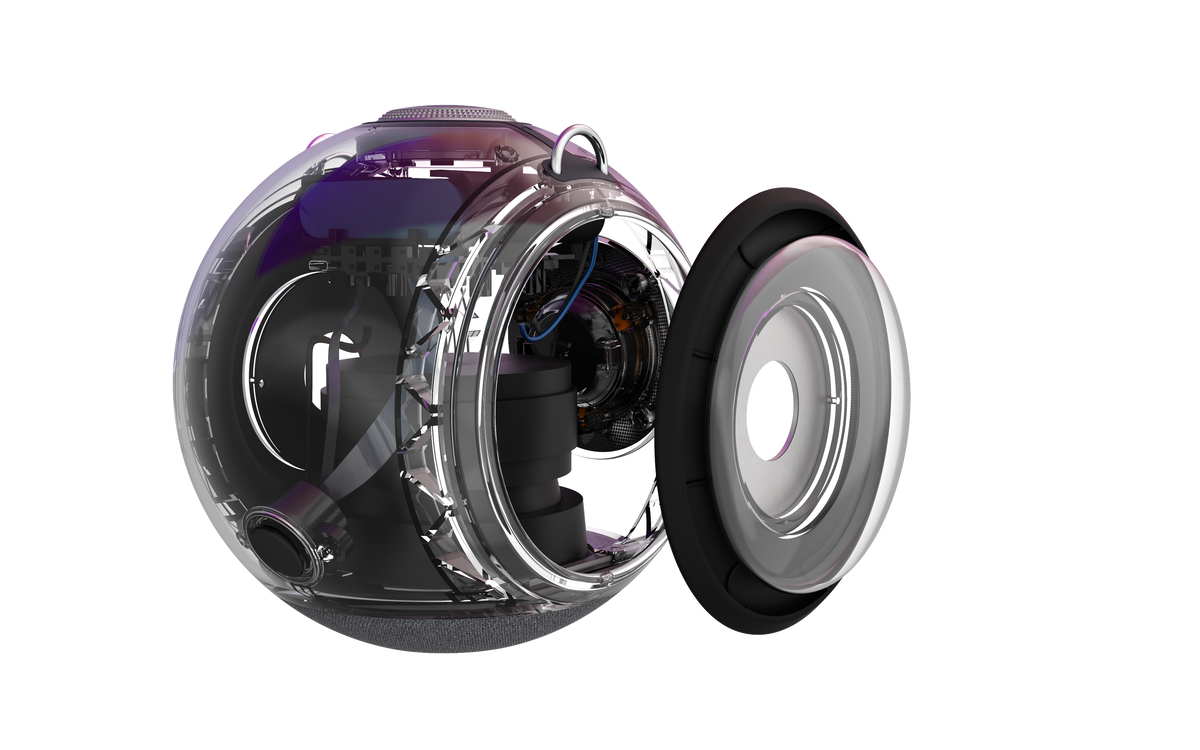
The UB+ dB1 DoubleBass uses a spherical acoustic chamber inspired by the Helmholtz resonance principle. The spherical enclosure is designed to distribute internal air pressure and reduce certain standing-wave and phase-distortion effects.
Its acoustic system includes:
- A central mid-bass driver
- A spherical internal chamber
- Two opposing passive radiator plates
- A large combined passive-radiator surface area
- A mechanically balanced enclosure structure
- DSP for monitoring, protection, and tonal optimization
The opposing passive radiators help reduce unwanted cabinet movement while contributing to low-frequency output. This is different from relying solely on electronic bass enhancement.
Because of this design, one dB1 may already provide a broad and substantial listening experience. A second unit may add stereo separation, greater placement flexibility, and additional output, but the improvement should be judged against the quality of the single-speaker experience—not against the assumption that one speaker is incomplete.
One dB1 Versus Two dB1 Speakers
A single dB1 is generally the more convenient option for listeners who want portable, broad-distribution sound from one enclosure.
Two dB1 speakers may be more appropriate for buyers who want:
- A wider stereo presentation
- More separation between instruments
- Greater flexibility in speaker placement
- More output across a larger listening area
- A dedicated home or event setup
- The ability to create a more expansive soundstage
The value of the second speaker depends on the use case.
For casual listening, the additional cost may not be justified. If the speaker is used while working, cooking, traveling, or moving between rooms, one unit may be more practical.
For focused music listening, larger rooms, or gatherings where two placement points are useful, the second speaker may provide a noticeable improvement.
One Speaker vs Two for Different Listening Situations
|
Listening Situation |
Better Choice |
Reason |
|
Bedroom or small office |
One speaker |
Simple setup and sufficient coverage |
|
Apartment living room |
One or two, depending on space |
One may be enough; two improve stereo width |
|
Dedicated music listening |
Two speakers |
Better left-right separation and soundstage |
|
Outdoor gathering |
One or two, depending on crowd size |
Two can improve coverage across a wider area |
|
Travel |
One speaker |
Lower weight and easier charging |
|
Work-from-home use |
One speaker |
Convenient background and focused listening |
|
Large room |
Two speakers |
Better placement flexibility and broader coverage |
|
Listeners surrounding the speaker |
One wide-dispersion speaker |
More consistent distribution |
|
Audiophile-style listening position |
Two speakers |
More accurate stereo presentation |
|
Quick casual playback |
One speaker |
Fewer setup requirements |
Does Two Speakers Mean Twice the Volume?
No. Adding a second speaker can increase overall acoustic output, but perceived loudness does not scale directly with the number of speakers.
The result depends on:
- Whether the speakers are reproducing the same or separate channels
- Their distance from one another
- Listener position
- Phase relationship
- Amplifier limits
- DSP limiting
- Room acoustics
- Frequency range
If two speakers reproduce correlated signals and their output combines constructively at the listening position, the system may produce a meaningful increase in level. But the increase will vary by frequency and position.
A stereo pair is therefore best understood as an improvement in soundstage and system flexibility, not simply a volume multiplier.
If maximum output is the main objective, examine the speakers’ clean SPL performance, driver limits, and amplifier behavior rather than relying only on the number of units.
Placement Tips for a Paired UB+ Setup
Correct placement is essential if the second speaker is going to provide a worthwhile improvement.
Create Physical Separation
Place the speakers apart from each other rather than side by side. The distance should suit the room and listening position.
Keep the Speakers at Similar Heights
Matching the height of the two speakers can help maintain a more stable stereo image. If one speaker is much higher than the other, the soundstage may become uneven.
Aim Directional Speakers Carefully
If the speakers are front-firing, angle them toward the listening position. Spherical speakers may require less precise aiming, but their placement still affects the final sound.
Avoid Corner Placement
Corners can increase low-frequency energy and create uneven bass. If one speaker is placed in a corner and the other is not, the tonal balance may differ between channels.
Keep the Listening Position Centered
For a traditional stereo arrangement, sit or stand approximately between the two speakers. This helps maintain left-right balance.
Test at Realistic Volume
A setup that sounds balanced at low volume may behave differently when played loudly. Listen for distortion, compression, excessive bass, or a collapsing stereo image.
For additional guidance, read Bluetooth Speaker Placement Tips for Better Bass and Clarity.
The Cost Question: Is the Second Speaker a Good Investment?
The second speaker is worth the extra cost when it solves a real listening problem.
It may be a strong investment if you:
- Regularly listen to music in a dedicated room
- Want a wider stereo image
- Host gatherings
- Need more flexible placement
- Want to distribute sound across a larger area
- Prefer a more immersive experience
- Already enjoy the sound of the first speaker
The second speaker may not be worth the cost if you:
- Mostly listen casually
- Travel frequently
- Have limited space
- Rarely sit in a stereo listening position
- Prefer simple setup
- Already receive sufficient coverage from one speaker
- Mainly use the speaker for podcasts, calls, or background audio
A second speaker should improve how you use the system, not simply increase the equipment count.
A Practical Decision Framework
Ask these five questions before purchasing a second UB+ speaker:
1. Do I Need Stereo Separation?
If you listen carefully to music and want clear left-right placement, two speakers may be worthwhile.
2. Is My Listening Space Large Enough?
If there is no practical space to separate the speakers, the improvement may be limited.
3. Do I Need Wider Coverage?
If one speaker struggles to cover a room or gathering evenly, two units may help.
4. Will I Use Both Speakers Regularly?
If the second speaker will remain stored most of the time, the additional cost may not make sense.
5. Is Portability More Important Than Immersion?
One speaker is easier to carry, charge, and reposition. Two speakers provide greater flexibility but require more planning.
Final Verdict: One or Two UB+ Speakers?
When considering pair two speakers vs one bluetooth speaker, the best choice depends on what you want the system to accomplish.
One UB+ speaker is usually the better option for portability, convenience, flexible placement, and broad everyday listening. A well-designed spherical speaker can provide substantial bass and wide sound distribution without requiring a second enclosure.
Two paired UB+ speakers are more compelling when you want a wider soundstage, stronger stereo separation, more flexible coverage, or a dedicated listening setup. The second speaker can improve the experience, but only when the speakers are positioned correctly and the listening environment supports the arrangement.
The extra cost is therefore justified by the use case—not by the assumption that two speakers are automatically twice as good. If you value immersion and have the space to create a proper stereo setup, pairing two UB+ speakers can be a meaningful upgrade. If you prioritize simplicity and portability, one high-quality speaker may deliver the better overall value.
Frequently Asked Questions
1. Is it better to pair two Bluetooth speakers or use one?
Pairing two Bluetooth speakers is better when you want a wider soundstage, stronger stereo separation, or broader coverage. One speaker is often better for portability, quick setup, and casual listening.
2. Do two paired speakers produce twice the bass?
Not necessarily. Two speakers can increase overall bass output and distribute low frequencies across a wider area, but the result depends on speaker design, placement, phase interaction, and room acoustics.
3. Is one UB+ dB1 enough for a living room?
One UB+ dB1 may be sufficient for many living rooms, particularly when broad sound distribution and simple placement are important. A second unit may be worthwhile if you want a wider stereo image or have a larger room.
4. Do two speakers always create better stereo sound?
No. The speakers must be compatible, correctly paired, and positioned with enough separation. If they are too close together or placed unevenly, the stereo improvement may be limited.
5. Is a second UB+ speaker worth the extra cost?
It is worth considering if you want immersive stereo listening, wider coverage, or a dedicated setup. If you mainly need portable background audio, one speaker may offer better value and convenience.
Explore UB+ Options
→ Explore the UB+ dB1 DoubleBass


Leave a comment
เว็บไซต์นี้ได้รับการคุ้มครองโดย hCaptcha และมีการนำนโยบายความเป็นส่วนตัวของ hCaptcha และข้อกำหนดในการใช้บริการมาใช้