
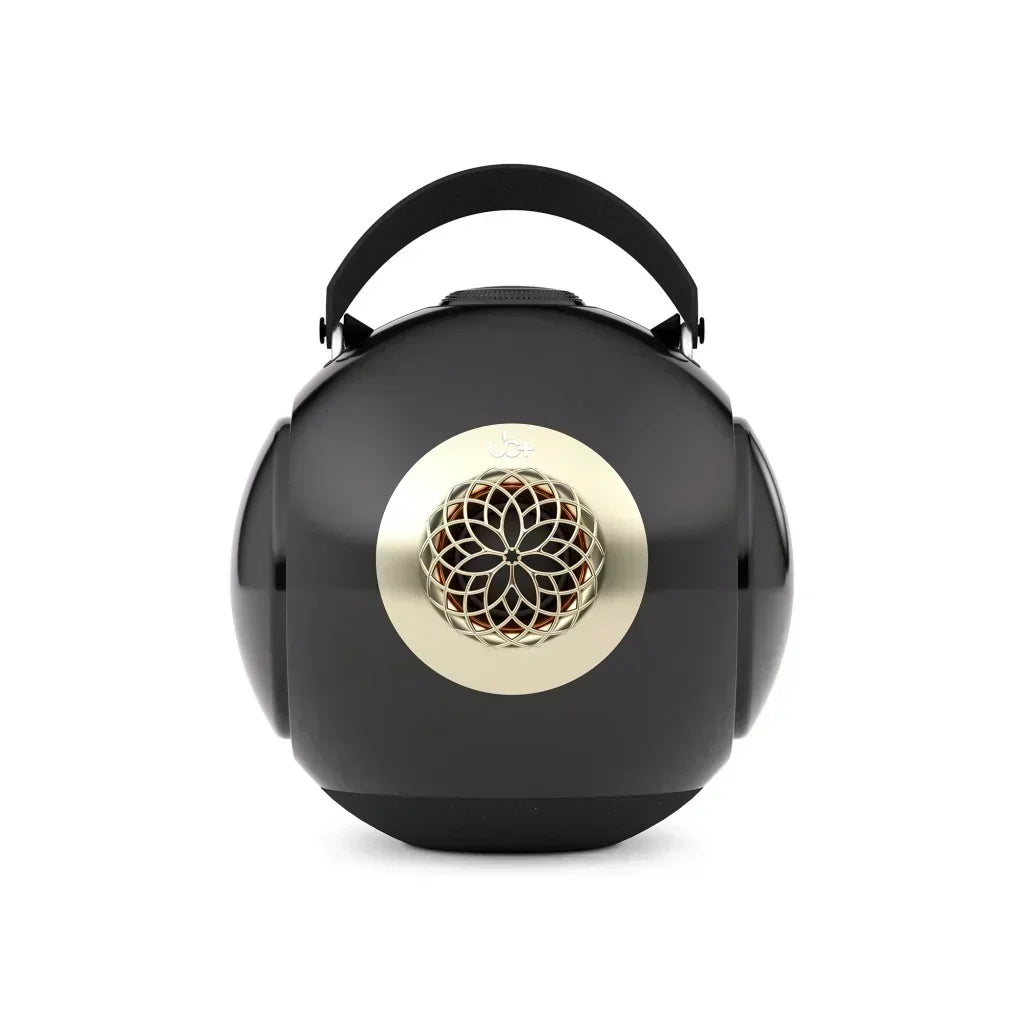
In portable audio, the familiar speaker shape is usually the box. It is practical to manufacture, easy to position, and deeply established across the industry. UB+ approached the dB1 DoubleBass from a different starting point: how can enclosure geometry itself contribute to better acoustic behavior?
That question led to the sphere.
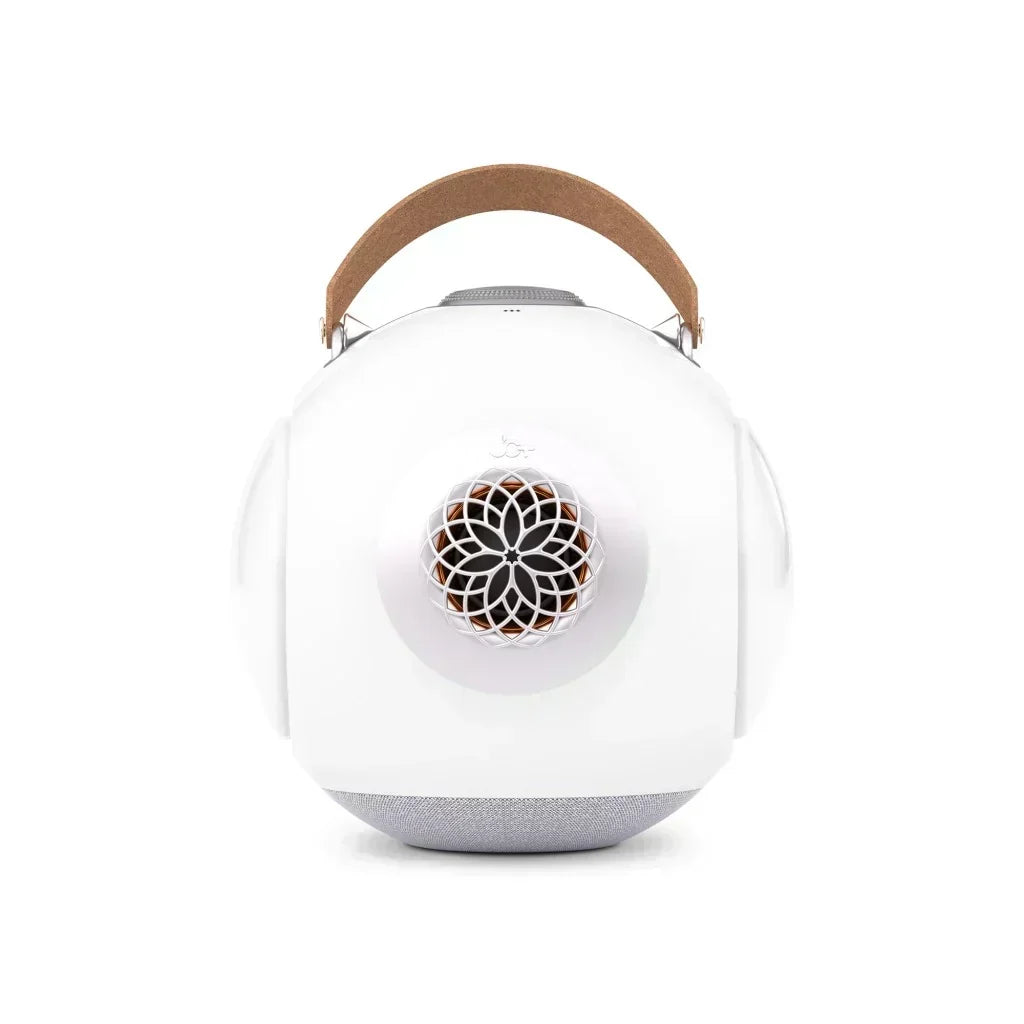
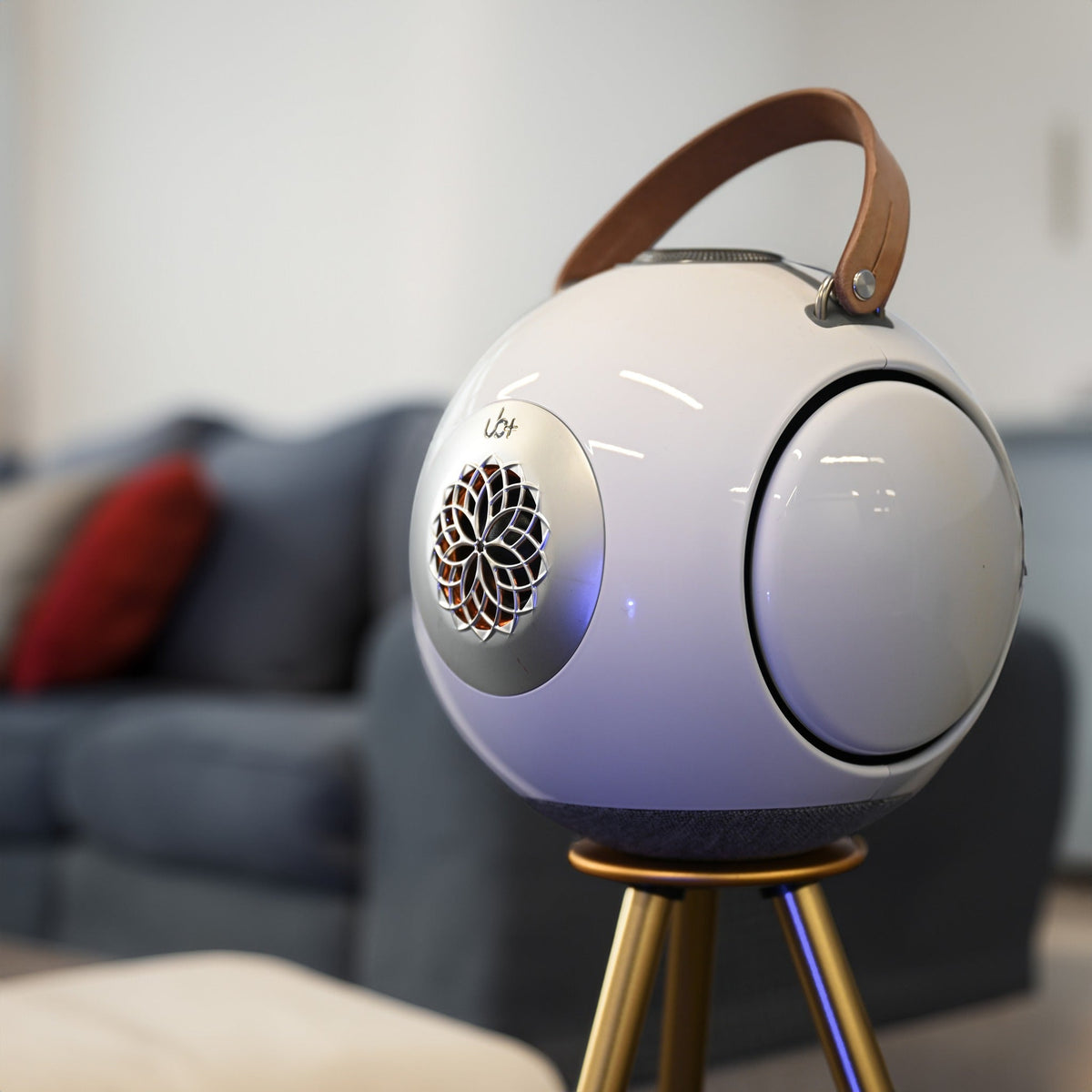
The UB+ dB1 DoubleBass is a spherical Bluetooth speaker because its shape is directly connected to its acoustic architecture. The spherical chamber, Helmholtz-inspired design, centrally positioned long-throw driver, and symmetrical passive-radiator system work together as one system.
The result is not simply a speaker with an unusual exterior. The enclosure itself becomes part of the engineering.
Beyond the Box: Rethinking Speaker Geometry

Rectangular enclosures remain common because they are practical. But acoustically, a box introduces internal parallel surfaces that can contribute to standing-wave behavior and unwanted internal reflections.
Speaker designers can address these effects through damping, bracing, enclosure treatments, and digital processing. UB+ instead explored whether changing the geometry could address some of the problem at the source.
A sphere has no opposing parallel internal walls. Its geometry allows internal pressure to distribute around a continuous cavity rather than repeatedly reflecting between flat surfaces.
This is the foundation of the dB1's design philosophy.
The sphere is not an aesthetic shell placed around conventional speaker hardware. The sphere is the speaker.
For more on the engineering behind spherical speaker construction, see spherical speakers and modern home audio.
The Helmholtz-Inspired Chamber
The dB1 DoubleBass draws from the principles associated with the Helmholtz resonator a classic acoustic concept in which an enclosed volume of air interacts with an opening or controlled acoustic path to reinforce particular frequencies.
UB+ applies that principle to the geometry of the dB1's spherical acoustic chamber.
The goal is not simply to make the enclosure resonate. It is to use the enclosed air volume as an active part of the acoustic system.
Internal pressure generated by the driver interacts with the chamber and the passive radiators. This creates a mechanical pathway for producing low-frequency output rather than depending entirely on electronic bass enhancement.
That distinction is important.
DSP can shape a speaker's response, provide protection, and help maintain tonal balance. But it cannot replace the physical requirements of moving air. The dB1's approach puts mechanical acoustics at the center of bass reproduction.
For a broader technical explanation, see the science behind premium audio technology.
The Sphere Is Part of the Acoustic System

A conventional enclosure can be thought of as a container for the drivers.
The dB1 takes a different approach.
The enclosure determines how air pressure develops, how the driver loads the internal volume, how the passive radiators respond, and how mechanical energy is transferred into acoustic output.
That makes the physical geometry inseparable from the speaker's performance.
This is also why simply comparing enclosure dimensions does not tell the whole story. Two speakers can occupy similar physical space while having very different acoustic architectures inside.
The dB1 uses its spherical cavity as an acoustic component rather than treating the enclosure as passive packaging.
Controlling Resonance Through Symmetry
The second major part of the dB1's engineering story is its dual symmetrical passive-radiator system.
Inside the spherical architecture, the central mid-bass driver generates pressure within the chamber. That pressure drives two passive radiators positioned on opposite sides of the enclosure.
The radiators move in opposing directions, creating a mechanically balanced system.
This matters because producing substantial bass also produces mechanical forces. If those forces are allowed to act unevenly on a compact enclosure, some of the energy can become unwanted cabinet movement.
The dB1's opposing radiator arrangement is designed to balance those forces.
The combined passive-radiator surface area is approximately 3.5× the area of the active woofer. This provides substantial radiating area for the low-frequency system while the opposing configuration helps maintain mechanical balance.
The result is a different way of thinking about bass:
Most speakers try to push harder. dB1 lets the air do more of the work.
For a deeper look at this technology, read how passive radiators work in Bluetooth speakers.
The Downward-Firing Driver
At the center of the dB1's acoustic architecture is a 4.5-inch long-throw mid-bass driver that fires downward into the spherical chamber.
Instead of directing the driver's output immediately toward one side of the room, the driver energizes the internal acoustic volume.
The chamber then becomes the environment in which pressure develops and interacts with the passive-radiator system.
The driver incorporates a 90mm neodymium magnet, a 35mm long-stroke voice coil, approximately 20mm of piston movement, an aluminum shorting ring, and an extra-wide surround.
These components are not independent features. They work together to give the driver the excursion and control required by the acoustic system.
This is one reason the dB1 should not be evaluated simply as a small Bluetooth speaker with a larger amplifier. Its engineering is built around the interaction between driver, air volume, enclosure geometry, and passive radiators.
Why Passive Radiators Matter for Compact Bass
Low-frequency reproduction requires moving a meaningful amount of air.
A small active driver has physical limits. One way to extend its low-frequency capability is to use a passive radiator that responds to pressure generated by the active driver.
The dB1 expands this idea with two radiators working symmetrically.
Because the passive-radiator surface area is approximately 3.5× the active woofer area, the system has substantial radiating area relative to the size of the active driver.
This is part of what allows the dB1 to target deep bass from a compact enclosure.
The stated frequency response reaches approximately 40Hz–20kHz, giving the speaker access to substantial low-frequency content while maintaining a broad overall frequency range.
For more context on low-frequency specifications, see bass extension explained in Hz.
From Mechanical Bass to Audible Results
The purpose of engineering is ultimately what reaches the listener.
A speaker's bass should not exist as an isolated effect. It should support the rest of the frequency range.
If low-frequency energy becomes excessive, it can mask vocals and instruments. If bass extension is too limited, music can lose weight and physical impact.
The dB1's architecture is intended to maintain a relationship between bass output and overall clarity.
The spherical chamber supports the acoustic loading. The long-throw driver provides controlled excursion. The passive radiators provide additional low-frequency radiation. The symmetrical arrangement helps balance mechanical forces.
These elements work toward the same result: bass that contributes to the recording without becoming the entire presentation.
360° Sound and the Listening Environment
The sphere also changes how the dB1 interacts with people in a room.
Traditional front-firing speakers concentrate much of their output toward a particular direction. That can work extremely well for a dedicated listening position, but it is less convenient when people are moving around a space.
The dB1's spherical architecture supports 360° sound dispersion.
That makes the speaker particularly useful in shared environments such as living rooms, apartments, workspaces, kitchens, and small gatherings.
You do not have to organize the entire room around one listening axis.
For a more detailed comparison of dispersion approaches, see 360° versus front-firing speakers.
Why Geometry Matters to Phase and Clarity
Speaker performance is not only about how much sound a system produces. Timing and interaction between frequencies also matter.
Internal reflections can interfere with the intended acoustic output and contribute to uneven behavior inside an enclosure.
The dB1's spherical chamber is intended to reduce the predictable parallel-surface interactions associated with conventional box geometries.
That supports the broader design goal of maintaining cleaner low- and mid-frequency reproduction.
This is also why the dB1's shape should not be separated from its sound. The unusual appearance is a direct consequence of the acoustic problem UB+ chose to solve.
Engineering the Speaker as One System
A common way to evaluate speakers is to look at individual components:
- Driver size
- Magnet size
- Passive radiator
- Frequency response
- Amplification
- Bluetooth version
- Enclosure material
Those specifications are useful, but they do not explain how the components interact.
The dB1 was engineered as a system.
The driver, spherical chamber, passive radiators, mechanical symmetry, and DSP work together.
DSP remains useful for functions such as linearity, protection, and tonal balance, but the underlying bass architecture is mechanical and acoustic.
That distinction is central to the dB1 philosophy.
The dB1 Technical Architecture at a Glance
|
Component |
dB1 DoubleBass Approach |
|
Enclosure |
Spherical acoustic chamber |
|
Acoustic principle |
Helmholtz-inspired design |
|
Active driver |
4.5-inch long-throw mid-bass driver |
|
Driver orientation |
Downward-firing into the chamber |
|
Passive radiators |
Two, positioned symmetrically |
|
Passive-radiator area |
Approximately 3.5× active woofer area |
|
Magnet |
90mm neodymium |
|
Voice coil |
35mm long-stroke |
|
Piston movement |
Approximately 20mm |
|
Frequency response |
Approximately 40Hz–20kHz |
|
SPL |
Approximately 93dB SPL |
|
Wireless connection |
Bluetooth 5.3 |
|
Water resistance |
IPX5 |
|
Sound dispersion |
360° spherical |
The important point is not any individual number. It is how the components form a single acoustic architecture.
Design as a Cultural Statement
The engineering story explains why the dB1 is spherical. The industrial design explains why the speaker can live comfortably inside modern spaces.
The form is deliberately sculptural without relying on unnecessary visual complexity.
There is no need for the speaker to resemble conventional audio equipment.
Instead, the dB1 treats the speaker as an object that can exist alongside furniture, architecture, and everyday life.
This connects with UB+'s broader interest in design, innovation, and community. The speaker is intended to become part of the environment rather than forcing the environment to revolve around the equipment.
For more on how industrial design can influence the way speakers are developed, see industrial design and speaker sound quality.
Rethinking What “Best Bass” Means
“Best bass” is often reduced to one question: how hard does the speaker hit?
That is an incomplete way to evaluate bass.
Useful bass involves several factors:
- Extension
- Control
- Distortion
- Integration with the midrange
- Mechanical stability
- Response at different listening levels
- How naturally it supports the recording
The dB1's approach is therefore less about creating the strongest possible bass effect and more about building a physical system that can reproduce low frequencies with control.
That makes the speaker particularly interesting for listeners who care about bass quality, not simply bass quantity.
A Speaker Designed Around Physics
The dB1 DoubleBass represents a straightforward engineering philosophy: start with the physical behavior of air and build the speaker around it.
The spherical chamber addresses enclosure geometry.
The Helmholtz-inspired architecture addresses acoustic resonance.
The long-throw driver provides controlled movement.
The dual passive radiators provide additional acoustic output.
The symmetrical arrangement helps manage mechanical forces.
The 360° dispersion supports flexible listening positions.
Each decision connects to the next.
That is what makes the dB1 more than a speaker housed inside a sphere.
The sphere is the acoustic architecture.
Frequently Asked Questions
Why did UB+ choose a spherical enclosure for the dB1?
The spherical form allows UB+ to use the enclosure itself as part of the acoustic system. Its continuous internal geometry avoids the parallel opposing surfaces found in conventional rectangular boxes and supports the dB1's pressure-based acoustic design.
What is the Helmholtz principle used for in the dB1?
The dB1 uses a Helmholtz-inspired spherical acoustic chamber to manage internal air pressure and resonance as part of its bass architecture.
Why does the dB1 use two passive radiators?
The two opposing passive radiators provide additional radiating area for low-frequency output while their symmetrical arrangement helps balance mechanical forces generated by the acoustic system.
Is the dB1's bass created mainly by DSP?
No. The dB1's bass architecture is primarily mechanical and acoustic. DSP can support functions such as protection, linearity, and tonal balance, but it does not replace the physical bass system.
Does the spherical shape provide 360° sound?
The dB1 is designed for 360° spherical sound dispersion, making it suitable for listening environments where people are positioned around the speaker rather than directly in front of it.
Explore the dB1 DoubleBass
→ Explore the UB+ dB1 DoubleBass
Designed as a sphere. Engineered around air, pressure, and symmetry. Built for listening that lasts.


Leave a comment
เว็บไซต์นี้ได้รับการคุ้มครองโดย hCaptcha และมีการนำนโยบายความเป็นส่วนตัวของ hCaptcha และข้อกำหนดในการใช้บริการมาใช้