
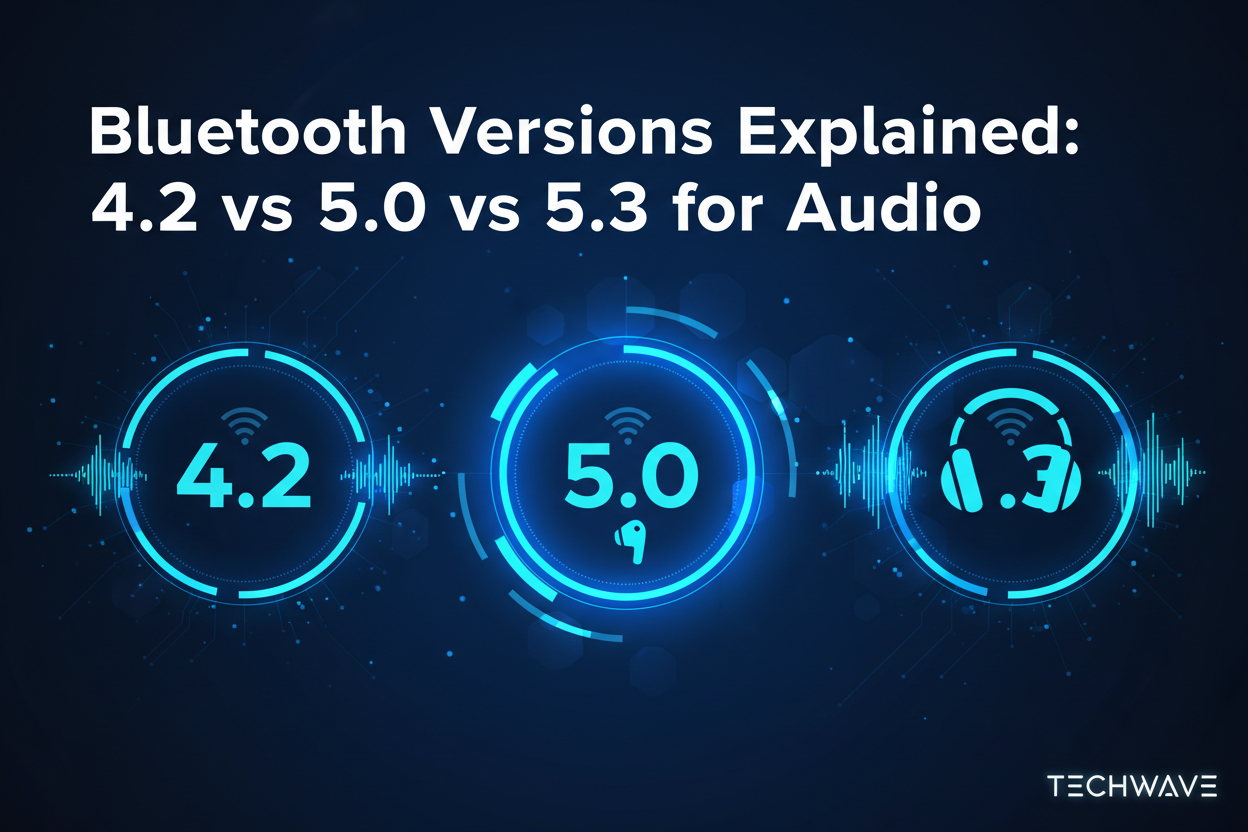
When shopping for a portable bluetooth speaker, one specification appears almost everywhere: Bluetooth version.
You'll see products advertised with Bluetooth 4.2, Bluetooth 5.0, Bluetooth 5.1, Bluetooth 5.2, or Bluetooth 5.3. Manufacturers often highlight these numbers as major selling points, implying that a newer version automatically means better sound quality.
But what do these Bluetooth versions actually mean?
Will upgrading from Bluetooth 4.2 to Bluetooth 5.3 make your music sound better?
Does Bluetooth 5.0 improve bass performance?
Will a newer Bluetooth version help you choose the best sounding bluetooth speaker?
And how important is Bluetooth version when comparing premium speakers against budget alternatives?
The reality is more nuanced than many marketing claims suggest.
Bluetooth versions influence:
- Connection stability
- Wireless range
- Power efficiency
- Device compatibility
- Latency performance
- Future-proofing
However, they do not directly determine whether a speaker sounds good.
Sound quality still depends primarily on acoustic engineering, driver design, cabinet construction, amplifier performance, and tuning.
In this guide, we'll explain the differences between Bluetooth 4.2, Bluetooth 5.0, and Bluetooth 5.3, examine how each affects real-world listening, and help you understand which specifications truly matter when choosing a wireless bluetooth speaker.
Why Bluetooth Matters for Audio

Bluetooth has transformed modern listening habits.
Before wireless audio became mainstream, users relied on:
- Auxiliary cables
- Docking stations
- Physical media connections
Bluetooth eliminated much of that complexity.
Today, nearly every portable bluetooth speaker depends on Bluetooth technology for:
- Music streaming
- Podcast playback
- Video audio
- Voice assistant connectivity
- Multi-device operation
Because Bluetooth serves as the communication bridge between source devices and speakers, its performance directly affects user experience.
What Does a Bluetooth Version Actually Mean?
Bluetooth versions represent generations of wireless communication standards.
Each new version introduces improvements to:
- Data transmission
- Signal stability
- Power management
- Security
- Connectivity efficiency
The version number does not automatically indicate sound quality.
Instead, it determines how effectively devices communicate.
Think of Bluetooth as a highway.
Newer versions create:
- Wider lanes
- Better traffic flow
- Improved reliability
The music itself remains the same.
The connection simply becomes more efficient.
Understanding Bluetooth 4.2
Bluetooth 4.2 was introduced as an improvement over earlier Bluetooth standards.
For many years it served as the foundation for wireless audio products.
Key improvements included:
- Better data transfer efficiency
- Enhanced privacy features
- Improved internet connectivity support
- Reduced power consumption
At the time, Bluetooth 4.2 represented a major advancement.
Even today, many speakers continue to use it successfully.
Advantages of Bluetooth 4.2
Reliable Basic Audio Streaming
For music playback, Bluetooth 4.2 remains perfectly functional.
Broad Compatibility
Most smartphones, tablets, and laptops support Bluetooth 4.2.
Lower Power Requirements
Battery-operated devices benefited from improved efficiency.
Affordable Implementation
Manufacturers could keep costs low.
This helped create many popular best budget bluetooth speaker options.
Limitations of Bluetooth 4.2
While still functional, Bluetooth 4.2 has limitations compared with newer versions.
Common drawbacks include:
- Shorter effective range
- Lower data efficiency
- Less robust signal handling
- Reduced multi-device capabilities
These limitations become more noticeable in larger homes or crowded wireless environments.
Understanding Bluetooth 5.0
Bluetooth 5.0 represented one of the most significant upgrades in Bluetooth history.
The improvements focused primarily on:
- Range
- Speed
- Stability
These changes had meaningful implications for audio products.
Major Improvements in Bluetooth 5.0
Increased Range
Bluetooth 5.0 significantly expanded theoretical wireless range.
Users gained greater placement flexibility.
This became especially useful for larger rooms.
Higher Data Throughput
Bluetooth 5.0 can transmit more information efficiently.
Benefits include:
- Stronger signal integrity
- Improved reliability
- Better device communication
Improved Stability
Connections became more dependable.
Dropouts decreased.
Pairing processes became smoother.
Better Battery Efficiency
Despite increased performance, Bluetooth 5.0 often reduced power consumption.
This is particularly valuable for a rechargeable bluetooth speaker.
Real-World Benefits of Bluetooth 5.0
For everyday users, Bluetooth 5.0 often provides:
- Fewer interruptions
- Better room-to-room performance
- Improved wireless reliability
- Stronger compatibility with modern devices
These improvements enhance convenience rather than sound quality itself.
Understanding Bluetooth 5.3
Bluetooth 5.3 represents one of the most refined Bluetooth standards currently available.
Instead of introducing dramatic changes, it focuses on optimizing performance.
The goal is greater efficiency and reliability.
Key Benefits of Bluetooth 5.3
Improved Connection Management
Bluetooth 5.3 handles communication between devices more intelligently.
Benefits include:
- Faster responses
- Reduced interference
- Improved stability
Enhanced Power Efficiency
Battery life improvements become increasingly important for modern wireless products.
Bluetooth 5.3 reduces unnecessary communication overhead.
This helps extend operating time.
Better Coexistence with Other Wireless Signals
Modern homes contain numerous wireless devices.
Examples include:
- Wi-Fi routers
- Smart home systems
- Wireless headphones
- Gaming devices
Bluetooth 5.3 improves signal coordination within these crowded environments.
Improved Future Compatibility
Bluetooth 5.3 provides stronger support for emerging wireless technologies.
This helps future-proof audio products.
Bluetooth 4.2 vs 5.0 vs 5.3
|
Feature |
Bluetooth 4.2 |
Bluetooth 5.0 |
Bluetooth 5.3 |
|
Wireless Range |
Good |
Excellent |
Excellent |
|
Connection Stability |
Good |
Better |
Best |
|
Power Efficiency |
Good |
Very Good |
Excellent |
|
Data Capacity |
Moderate |
High |
High |
|
Latency Improvements |
Limited |
Improved |
Advanced |
|
Multi-Device Handling |
Basic |
Better |
Advanced |
|
Future-Proofing |
Moderate |
Good |
Excellent |
|
Modern Device Support |
Good |
Excellent |
Excellent |
Does Bluetooth Version Affect Sound Quality?
This is perhaps the most misunderstood question in audio.
The answer is:
Not directly.
Bluetooth version primarily affects communication efficiency.
Sound quality depends on:
- Driver design
- Cabinet engineering
- Amplifier quality
- Tuning
- Acoustic architecture
A poorly designed speaker using Bluetooth 5.3 will still sound worse than a well-engineered speaker using Bluetooth 5.0.
Why Audio Engineering Matters More
When evaluating a best portable bluetooth speaker, focus on factors such as:
- Acoustic design
- Driver quality
- Resonance control
- Frequency balance
- Distortion management
These elements have a much greater impact on sound quality.
Understanding Audio Latency
Latency refers to the delay between:
- Audio transmission
- Audio playback
High latency can cause:
- Lip-sync issues
- Gaming delays
- Reduced responsiveness
Bluetooth improvements have steadily reduced latency over time.
Why Latency Matters for Movies and Gaming
When watching videos:
- Dialogue should match mouth movements.
When gaming:
- Sound effects should occur instantly.
Bluetooth 5.x versions generally provide better latency performance than Bluetooth 4.2.
This improves overall user experience.
Bluetooth Range: How Important Is It?
Range determines how far you can move from the speaker before signal quality degrades.
Bluetooth 5.x generally offers better range performance.
This is useful when:
- Moving between rooms
- Hosting gatherings
- Using larger living spaces
For many users, range improvements provide more noticeable benefits than sound-related specifications.
The Myth of Bluetooth Version and Bass
Many buyers assume Bluetooth 5.3 creates stronger bass.
This is incorrect.
Bass performance depends on:
- Driver capability
- Air movement
- Cabinet design
- Acoustic efficiency
Bluetooth simply transmits data.
The speaker itself creates the sound.
Why Speaker Engineering Still Comes First
Consider two hypothetical speakers.
Speaker A:
- Bluetooth 5.3
- Basic acoustic design
Speaker B:
- Bluetooth 5.0
- Advanced acoustic engineering
Speaker B will almost certainly sound better.
This illustrates why Bluetooth version should be viewed as one factor among many.
The UB+ dB1 Approach to Wireless Audio
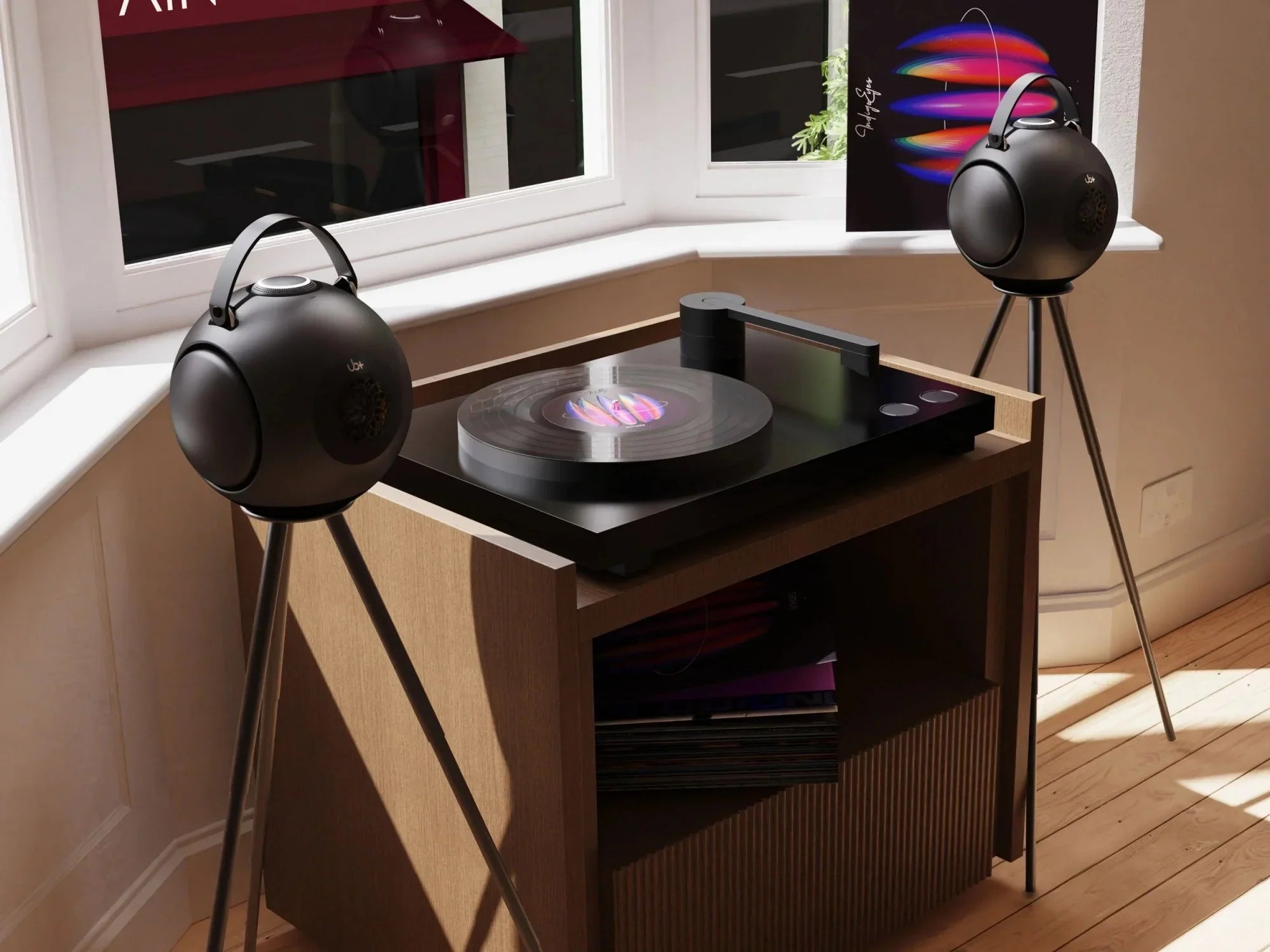
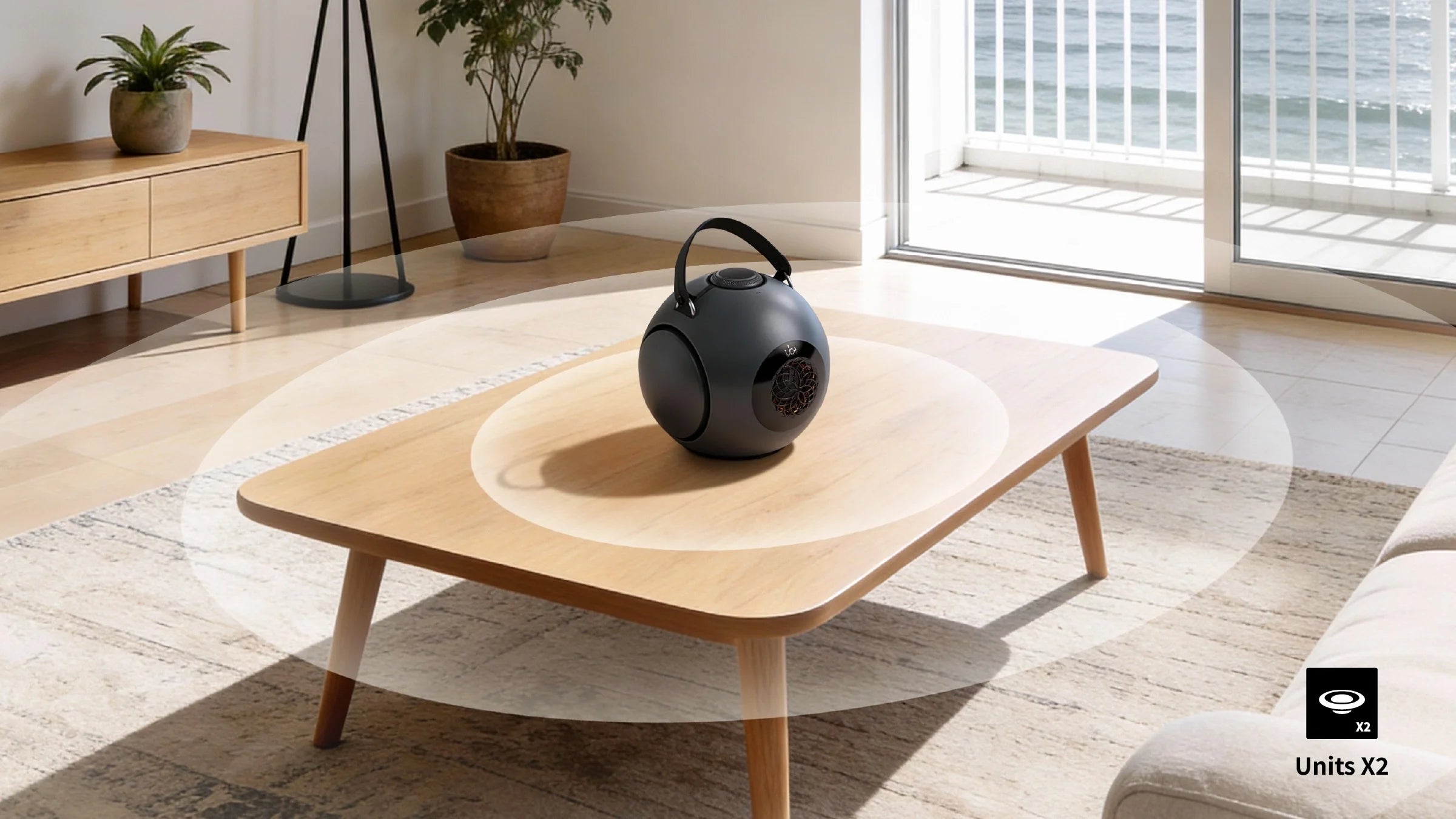
The UB+ dB1 DoubleBass demonstrates how Bluetooth technology should complement acoustic engineering rather than replace it.
While modern wireless connectivity provides convenience, the speaker's sound quality comes primarily from its physical design.
Helmholtz-Inspired Spherical Acoustic Chamber
At the heart of the dB1 lies a Helmholtz-inspired spherical acoustic chamber.
Unlike conventional rectangular enclosures:
- Internal pressure distributes more evenly
- Standing waves are minimized
- Resonance control improves
This architecture contributes significantly to sound quality.
Why Cabinet Shape Matters More Than Bluetooth Version
Many buyers compare Bluetooth specifications while overlooking enclosure design.
Yet cabinet design directly affects:
- Bass accuracy
- Clarity
- Resonance behavior
- Soundstage
The dB1's spherical architecture helps optimize these characteristics.
Mechanical Bass Amplification
Rather than relying heavily on software-based enhancement, the dB1 uses:
- Acoustic pressure management
- Passive radiator technology
- Mechanical bass amplification
This approach creates more natural low-frequency performance.
Dual Symmetrical Passive Radiators
The dB1 incorporates:
- Two large passive radiators
- Opposing placement
- Symmetrical operation
Benefits include:
- Increased air movement
- Stronger bass
- Reduced cabinet vibration
3.5× Passive Radiator Surface Area
The combined passive radiator area is approximately:
3.5 times larger than the active woofer surface area.
This enables substantial low-frequency output despite compact dimensions.
Self-Cancelling Vibration Architecture
Many speakers lose energy through cabinet movement.
The dB1 minimizes this issue.
Its symmetrical radiator arrangement creates:
- Balanced forces
- Reduced vibration
- Improved efficiency
This contributes to cleaner sound reproduction.
Premium Driver Technologies
The dB1 further enhances performance through:
90mm Neodymium Magnet
Provides strong motor control.
35mm Long-Stroke Voice Coil
Supports substantial excursion.
20mm Piston Movement
Allows meaningful air displacement.
Aluminum Shorting Ring
Reduces distortion.
Extra-Wide 18mm Surround
Improves cone stability.
Together, these technologies influence sound quality far more than Bluetooth version alone.
Bluetooth Version vs Acoustic Engineering
|
Factor |
Impact on Sound Quality |
|
Bluetooth Version |
Indirect |
|
Driver Design |
Very High |
|
Cabinet Engineering |
Very High |
|
Resonance Control |
Very High |
|
Frequency Tuning |
High |
|
Air Movement |
High |
|
Passive Radiator Design |
High |
|
Distortion Management |
High |
Future-Proofing Your Speaker Purchase
Many buyers want a speaker that remains relevant for years.
Bluetooth 5.3 offers advantages in:
- Compatibility
- Efficiency
- Wireless stability
However, future-proofing also requires durable acoustic design.
A speaker should remain enjoyable long after new Bluetooth versions emerge.
Choosing the Right Bluetooth Speaker
When comparing products, consider:
Bluetooth Version
Prefer Bluetooth 5.x when possible.
Acoustic Design
Evaluate engineering quality.
Build Quality
Look for durable construction.
Driver Technology
Advanced drivers improve long-term satisfaction.
Listening Goals
Match the speaker to your lifestyle.
Which Bluetooth Version Should You Buy?
Bluetooth 4.2
Suitable for:
- Budget-conscious buyers
- Basic listening
Bluetooth 5.0
Excellent balance of:
- Stability
- Range
- Compatibility
Bluetooth 5.3
Best choice for:
- Future-proofing
- Maximum efficiency
- Modern ecosystems
For most users, Bluetooth 5.0 and 5.3 provide the best overall experience.
Final Thoughts
Bluetooth technology has evolved significantly from version 4.2 to 5.3.
Each generation has improved:
- Stability
- Range
- Efficiency
- Latency
- Reliability
However, Bluetooth version alone does not determine sound quality.
The most important factors remain:
- Acoustic engineering
- Cabinet design
- Driver quality
- Resonance management
- Bass efficiency
A truly outstanding wireless bluetooth speaker combines modern wireless technology with sophisticated acoustic design.
Products such as the UB+ dB1 DoubleBass demonstrate this philosophy by pairing advanced wireless convenience with a Helmholtz-inspired spherical acoustic chamber, dual symmetrical passive radiators, mechanical bass amplification, self-cancelling vibration architecture, and premium driver technologies.
Ultimately, the best speaker is not simply the one with the newest Bluetooth version.
It is the one that delivers the most satisfying listening experience every day.
Frequently Asked Questions
Does Bluetooth 5.3 sound better than Bluetooth 5.0?
Not necessarily. Bluetooth 5.3 improves efficiency, stability, and device communication, but sound quality still depends primarily on the speaker's acoustic engineering. A well-designed Bluetooth 5.0 speaker can easily outperform a poorly engineered Bluetooth 5.3 speaker.
Is Bluetooth 4.2 still good for music listening?
Yes. Bluetooth 4.2 remains capable of delivering reliable audio streaming for most listeners. However, newer versions offer better range, stability, battery efficiency, and future compatibility, making them more attractive for long-term ownership.
Why does Bluetooth latency matter?
Latency affects the delay between transmitted and reproduced sound. Lower latency improves video synchronization, gaming responsiveness, and overall user experience. Newer Bluetooth versions generally offer better latency performance.
What matters more: Bluetooth version or speaker design?
Speaker design matters significantly more. Driver quality, cabinet engineering, resonance control, and acoustic tuning have a far greater impact on sound quality than Bluetooth version alone.
Is Bluetooth 5.3 worth paying extra for?
If the price difference is reasonable, Bluetooth 5.3 offers benefits in efficiency, stability, and future-proofing. However, it should not be the sole reason for choosing one speaker over another. Overall engineering quality remains the most important factor.
Discover Wireless Audio Designed Around Physics
Looking for a portable bluetooth speaker, best portable bluetooth speaker, or best sounding bluetooth speaker that combines modern wireless technology with advanced acoustic engineering?
Explore the UB+ dB1 DoubleBass and experience:
- Helmholtz-inspired spherical acoustic chamber
- Dual symmetrical passive radiators
- Mechanical bass amplification
- Self-cancelling vibration architecture
- 3.5× passive radiator surface area
- 90mm neodymium magnet
- 35mm long-stroke voice coil
- 20mm piston movement
- Aluminum shorting ring
- Extra-wide 18mm surround


发表评论
此站点受 hCaptcha 保护,并且 hCaptcha 隐私政策和服务条款适用。