
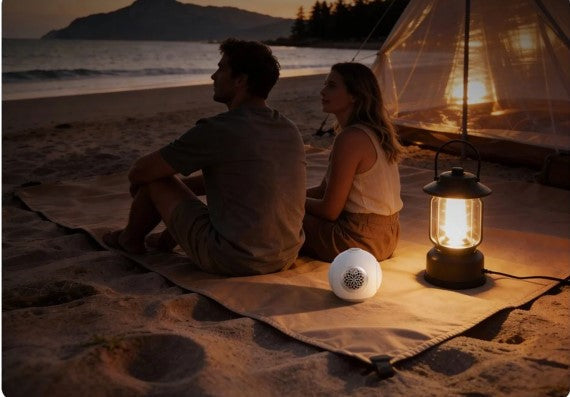
Taking a Bluetooth speaker outdoors changes the listening environment completely. Indoors, walls and ceilings naturally reflect and reinforce sound. Outside, those boundaries disappear, so a speaker has to create enough acoustic presence without relying on the room to help it.
That makes several factors especially important when choosing a portable Bluetooth speaker for travel, beaches, balconies, camping, outdoor cafés, or weekend trips. Battery performance matters, but so do water resistance, sound dispersion, bass control, enclosure design, and how efficiently the speaker converts electrical energy into acoustic output.
For anyone comparing outdoor Bluetooth speakers, travel speakers with deep bass, or a rechargeable Bluetooth speaker for everyday use, the specification sheet is only the beginning. The underlying acoustic architecture can make a significant difference.
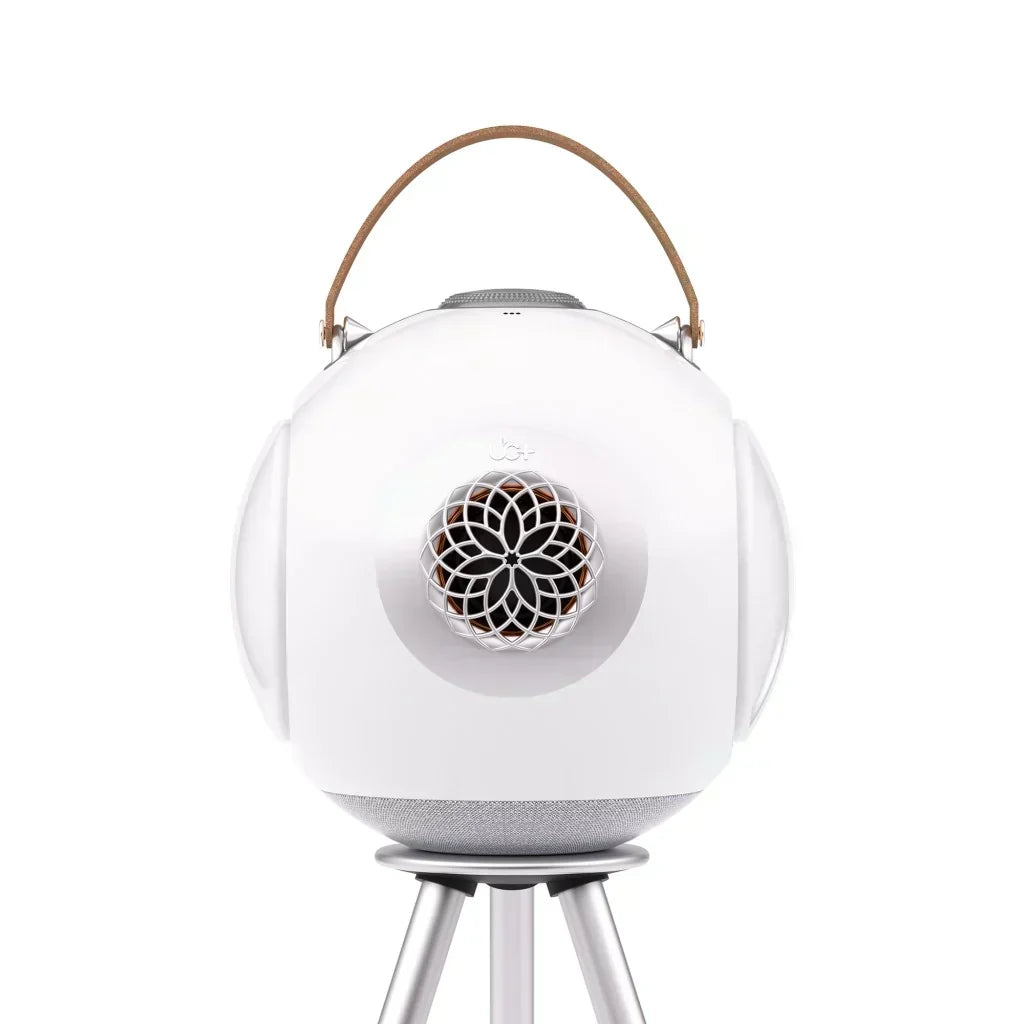
The UB+ dB1 DoubleBass takes a particularly different approach. Its spherical acoustic chamber, downward-firing mid-bass driver, and dual symmetrical passive radiators are designed as one system, using controlled internal air pressure to support low-frequency performance.
Why Outdoor Listening Is More Difficult

A speaker that sounds full in a bedroom can sound noticeably thinner on a patio or in an open park.
The reason is simple: the room is no longer reinforcing the sound.
Low frequencies are especially affected. Indoors, boundaries can contribute to perceived bass. Outdoors, sound energy spreads into a much larger space, and there are fewer surfaces to reinforce it.
This is why a speaker marketed as having strong bass can still feel surprisingly lightweight outside.
Manufacturers can compensate in several ways, including:
- Increasing output levels
- Using DSP-based bass shaping
- Applying dynamic compression
- Tuning the speaker toward stronger mid-bass impact
These approaches can be useful, but they also have limits. If the physical acoustic system cannot move enough air efficiently, increasing electronic output can eventually increase distortion, compression, or power consumption.
For outdoor listening, the more useful question is therefore not simply How loud is it?
It is:
How efficiently does the speaker create usable acoustic output in an open environment?
For a broader look at speaker design, How Passive Radiators Work in Bluetooth Speakers explains why passive-radiator systems are used to extend low-frequency performance without relying on a conventional port.
Battery Life Is About More Than the Advertised Number

Battery life is one of the first specifications people check when shopping for a travel speaker. That makes sense, but runtime alone does not tell you how the speaker will behave throughout the day.
A portable speaker may sound different at high output than it does at moderate volume. Power management can also affect dynamics and low-frequency performance as the battery approaches lower charge levels.
When comparing a rechargeable Bluetooth speaker, consider:
- Advertised playback time
- Typical listening volume
- Charging requirements
- Wireless connection stability
- Output consistency during longer sessions
- How the speaker manages power at higher volume
For travel, consistency can be more useful than a headline battery number.
The dB1 DoubleBass is designed around acoustic reinforcement rather than depending exclusively on aggressive electronic bass enhancement. Its mechanical bass architecture uses the enclosure, internal air volume, driver, and passive radiators as interconnected parts of the system.
That approach is relevant when the speaker needs to remain useful across a full day of travel rather than simply sound impressive during a short demonstration.
For another practical buying perspective, see Best Portable Speaker for Travel and Adventure.
Waterproof Does Not Mean Submersible

Outdoor speakers also need to be evaluated according to their actual protection rating.
A waterproof or water-resistant label should never be treated as a generic guarantee. Different IP ratings indicate different levels of protection, and the specific rating matters.
The UB+ dB1 has an IPX5 rating, which is designed for protection against water jets and splashes. It is not a rating for submersion.
That makes the distinction important when comparing speakers for:
- Poolside listening
- Beach trips
- Outdoor cafés
- Patios
- Light rain
- Camping and travel
If your use involves frequent exposure to water, check the actual IP rating rather than relying on the word "waterproof."
UB+ also covers the practical side of outdoor speaker protection in Best Waterproof Bluetooth Speaker, which can be useful when comparing environmental requirements.
Bass Is Often the First Thing You Notice Outdoors

When you move a speaker outside, bass can be the first part of the presentation that seems to disappear.
That does not necessarily mean the speaker has suddenly become less capable. The acoustic environment has changed.
In an open space, there are fewer boundaries to reinforce low frequencies. As a result, a compact speaker needs an efficient way of moving air if it is going to maintain convincing low-frequency presence.
This is where speaker architecture becomes more interesting than wattage alone.
The dB1 DoubleBass uses a centrally positioned mid-bass driver that fires downward into its spherical acoustic chamber. The resulting pressure interacts with two passive radiator plates positioned symmetrically on opposite sides of the enclosure.
The objective is not simply to add more bass electronically.
It is to use the internal air volume and mechanical system to help produce it.
For a deeper explanation of the relationship between frequency and perceived bass, see Bass Extension Explained: Hz and Speaker Performance.
Why the dB1 Uses Two Symmetrical Passive Radiators
Passive radiators are not new to portable audio. What is unusual about the dB1 is how they are integrated into the spherical architecture.
The system uses two large passive radiator plates positioned opposite one another.
When the internal air pressure changes, both radiators respond. Their opposing movement helps balance mechanical forces within the enclosure.
This creates a self-cancelling vibration behavior.
Rather than allowing significant mechanical energy to become cabinet movement, the opposing radiator motion helps stabilize the system while converting more of the available energy into acoustic output.
The combined passive-radiator surface area is approximately 3.5× the area of the active woofer.
That larger moving surface is important because bass reproduction ultimately involves moving air.
The principle is straightforward:
Instead of asking only the active driver to do more work, the acoustic system distributes the work across the chamber and passive radiators.
You can explore the concept in more detail in Passive Radiators vs Ported Boxes: Why Spherical Design Hits Harder Than You Think.
Why the Spherical Enclosure Matters Outdoors
The dB1's shape is not simply an industrial-design decision.
Its spherical enclosure is inspired by the principles of a Helmholtz resonator, using the internal air volume as part of the acoustic system.
Traditional rectangular cabinets have parallel internal surfaces and corners. These create conditions where internal reflections and standing-wave behavior need to be managed.
A spherical chamber provides a fundamentally different internal geometry.
The dB1's design is intended to provide:
- More even internal pressure distribution
- Reduced standing-wave behavior
- Controlled resonance
- Lower phase-related coloration
- A more consistent acoustic environment for the passive radiators
This matters outdoors because the speaker already has to deal with an environment that provides little acoustic assistance.
Instead of depending entirely on external boundaries, the enclosure contributes directly to the acoustic system.
For a deeper look at this concept, read Why UB+ Chose the Sphere: The Design and Engineering Story Behind dB1.
Mechanical Bass vs Digital Bass Boosting
There is an important difference between producing more bass through acoustic mechanics and simply increasing bass electronically.
DSP is useful in modern speakers. It can help with protection, tonal balance, linearity, and system management. But digital processing cannot eliminate the physical requirements of low-frequency reproduction.
A driver still has to move air.
The dB1 approaches this problem through mechanical bass amplification. Its downward-firing driver energizes the spherical chamber, while the internal pressure drives the symmetrical passive radiators.
The result is an acoustic system in which the enclosure itself contributes to bass reproduction.
That does not mean DSP has no role. It means the physical architecture does more of the acoustic work.
For another explanation of how speaker architecture affects perceived performance, see Why Some Speakers Sound Better Than Others.
Outdoor Speaker Design: What Should You Actually Compare?
When comparing travel and outdoor speakers, it helps to separate convenience features from acoustic performance.
|
Feature |
What to Look For |
Why It Matters Outdoors |
|
Battery |
Realistic playback expectations |
Determines how practical the speaker is for extended trips |
|
Water resistance |
Specific IP rating |
Shows what type of water exposure the speaker is designed to handle |
|
Bass architecture |
Port, passive radiator, or other acoustic system |
Influences low-frequency performance |
|
Enclosure |
Internal geometry and construction |
Affects resonance and pressure behavior |
|
Dispersion |
Broad or directional output |
Determines how sound reaches listeners around the speaker |
|
Driver design |
Excursion and driver architecture |
Influences output and distortion |
|
Vibration control |
Mechanical stability |
Helps prevent energy being lost through cabinet movement |
|
Connectivity |
Current Bluetooth implementation |
Affects everyday wireless use |
|
Portability |
Size, weight, and placement flexibility |
Important when moving between locations |
This is why best outdoor Bluetooth speaker searches can be misleading if they focus only on maximum volume.
The right choice depends on where the speaker will actually be used.
360° Sound Is Useful When People Move Around
Outdoor listening rarely happens in a perfect listening triangle.
People may stand beside the speaker, sit several feet away, walk around a patio, or gather on different sides of a table.
A directional speaker can still work well, but its presentation changes significantly as listeners move away from the primary listening axis.
A spherical design with broad sound dispersion takes a different approach.
The dB1 is designed around 360° spherical dispersion, allowing sound to spread around the enclosure rather than concentrating its output toward a single front-facing position.
This can be useful for:
- Backyard gatherings
- Outdoor dining
- Balconies
- Campsites
- Travel setups
- Shared living spaces
For a direct look at directional versus omnidirectional approaches, see 360° vs Front-Firing Speakers.
Driver Engineering Still Matters
Acoustic architecture cannot replace driver performance.
The dB1 combines its spherical chamber and DoubleBass system with a 4.5-inch mid-bass driver, a 90 mm neodymium magnet, and a 35 mm long-stroke voice-coil design.
The driver architecture is intended to maintain controlled movement while the enclosure and passive radiators handle the acoustic loading.
The system is specified for approximately 40Hz–20kHz response and up to 93dB SPL.
These numbers are useful context, but they should be interpreted alongside the entire acoustic system rather than in isolation.
Driver size, enclosure volume, excursion, radiator area, tuning, and dispersion all interact.
That is why two speakers with similar wattage or frequency specifications can produce noticeably different listening experiences.
Placement Still Matters Outdoors
Even a carefully engineered speaker benefits from sensible placement.
Outdoor surfaces can influence the sound. A hard table, wooden deck, stone surface, or soft ground can each produce different results.
Because the dB1 uses a downward-firing driver and internal acoustic chamber, placement should be considered part of the listening setup.
A few simple principles can help:
- Place the speaker on a stable surface.
- Avoid obstructing areas designed for acoustic output.
- Keep it away from loose objects that can rattle.
- Give the speaker enough open space for sound to disperse.
- Experiment with distance from walls or other nearby boundaries.
For more detailed guidance, Bluetooth Speaker Placement Tips for Bass and Clarity covers how positioning can influence what you hear.
Outdoor Travel Is About More Than Portability
A speaker can be easy to carry and still be poorly suited to travel.
True travel usability involves how easily the speaker adapts to different environments.
Consider the difference between a hotel room and a beach.
In the hotel, room boundaries can reinforce bass and create reflections. At the beach, there may be almost no nearby acoustic boundaries. At an outdoor café, people may be positioned around the speaker. On a balcony, nearby walls may strongly influence the sound.
A useful travel speaker therefore needs to be adaptable.
The dB1's spherical form and broad dispersion are designed around that kind of flexibility. It can move between indoor and outdoor environments without requiring the same fixed listening geometry as a traditional stereo setup.
If you are comparing compact and larger systems, Compact vs Full-Size Bluetooth Speakers provides another useful framework for evaluating the trade-offs.
A Technical Look at the DoubleBass Architecture
The dB1's outdoor performance can be understood by looking at how its main components interact.
The driver creates the initial pressure.
The downward-firing mid-bass driver energizes the air inside the spherical chamber.
The sphere manages the air volume.
Its geometry provides the acoustic environment in which pressure develops.
The passive radiators convert that pressure.
Two opposing radiators respond to the internal pressure changes and move air acoustically.
The symmetrical layout manages mechanical forces.
Opposing radiator motion helps reduce unwanted cabinet movement.
The result is mechanical bass reinforcement.
Instead of relying exclusively on electronic bass boosting, the physical system contributes to low-frequency output.
This is the central idea behind DoubleBass.
Most speakers try to push harder. dB1 lets air do the work.
Outdoor Durability and Sound Quality Have to Work Together
A travel speaker needs to survive movement, changing environments, and everyday handling, but durability should not be considered independently from acoustics.
Mechanical stability matters because unwanted cabinet vibration can waste energy.
The dB1's opposing passive-radiator arrangement is designed to create a self-balancing mechanical response. That matters not only for bass reproduction but also for maintaining a stable enclosure while the system is working.
Combined with its IPX5 water-resistance rating, the design is suited to everyday outdoor conditions such as splashes and water jets, while still requiring sensible protection from submersion.
For another outdoor-focused comparison, Best Outdoor Bluetooth Speakers Guide can help frame the broader category.
What Makes a Travel Speaker Feel Powerful?
Power is often reduced to wattage in product comparisons.
But perceived authority comes from multiple factors.
A speaker can have substantial electrical power and still produce loose or poorly controlled bass. Another system can achieve a convincing sense of depth through efficient acoustic loading and controlled driver movement.
For outdoor use, useful performance depends on:
- How much air the system can move
- How efficiently it moves that air
- How the enclosure controls internal pressure
- How much distortion develops at higher output
- How widely the sound disperses
- How consistently the system performs from different positions
That is why bass quality, not simply bass quantity, matters when choosing a travel speaker.
When You Should Prioritize a Different Type of Speaker
No single speaker architecture fits every outdoor situation.
If your primary requirement is maximum ruggedness for demanding environments, the IP rating, physical construction, and specific environmental requirements should take priority.
If you need a speaker for a large party, maximum usable output and coverage may matter more than compact dimensions.
If you want a connected multi-room system for the home, wireless ecosystem features may become more important.
If you want a portable speaker that combines broad dispersion with a distinctive acoustic architecture, however, the dB1's approach becomes particularly relevant.
The key is to match the design to the actual use case rather than choosing based on one specification.
What to Look for Before Buying
Before choosing an outdoor Bluetooth speaker, use this checklist:
- Battery: How long will it realistically play at your preferred volume?
- Water resistance: What does the actual IP rating permit?
- Bass: Is low-frequency output supported acoustically or primarily through DSP?
- Dispersion: Will listeners hear consistent sound from different positions?
- Driver: What type of driver and excursion design does it use?
- Enclosure: Does the cabinet contribute to acoustic performance?
- Vibration: How does the design control unwanted cabinet movement?
- Portability: Can it move easily between indoor and outdoor spaces?
- Connectivity: Is the Bluetooth implementation appropriate for your devices?
- Placement: Does the design require a specific orientation or listening position?
These questions give you a much clearer picture than comparing wattage alone.
Why the dB1 DoubleBass Takes a Different Approach
The UB+ dB1 DoubleBass brings together several physical principles that are normally discussed separately.
Its spherical enclosure provides the acoustic chamber.
Its downward-firing mid-bass driver energizes that chamber.
Its dual passive radiators respond to the resulting pressure.
Their opposing movement helps stabilize the enclosure.
And the approximately 3.5× combined radiator surface area provides a larger acoustic surface through which low-frequency energy can be converted into sound.
The system is therefore built around a simple principle:
Bass performance should come from controlled air movement, not just increased electrical force.
That philosophy is particularly relevant outdoors, where the speaker cannot rely on the room to create the impression of scale.
Final Thoughts: Choose the Speaker for the Environment
Outdoor listening exposes the strengths and weaknesses of speaker design very quickly.
Without walls and ceilings to reinforce the sound, a compact speaker has to create its own acoustic authority. Battery consistency becomes important. Water resistance becomes practical rather than optional. Dispersion becomes more noticeable because listeners rarely remain in one position. And bass architecture becomes critical because low frequencies can lose their sense of presence in open space.
For travel and outdoor use, look beyond the loudness claim.
Look at how the speaker moves air, manages resonance, controls vibration, handles power, and distributes sound.
The UB+ dB1 DoubleBass approaches those challenges through a spherical Helmholtz-inspired acoustic chamber, a downward-firing driver, and dual symmetrical passive radiators. Its architecture is designed to make the enclosure and internal air volume active parts of the acoustic system.
That gives the dB1 a distinct approach to portable outdoor audio—one centered on controlled air movement rather than simply pushing the driver harder.
Explore the UB+ dB1 DoubleBass
→ Compare dB1 vs dB Mini
→ See available color options
→ Check current price
A good outdoor speaker should not simply be portable. It should be engineered to perform when the room disappears.


Leave a comment
This site is protected by hCaptcha and the hCaptcha Privacy Policy and Terms of Service apply.