
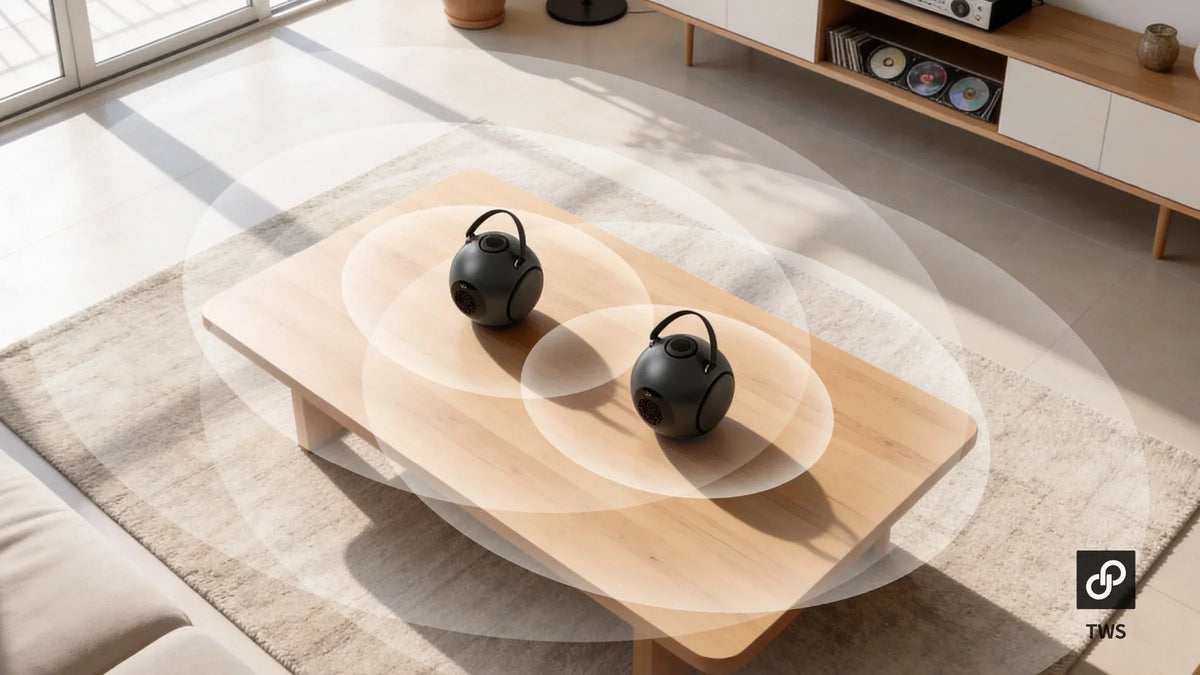
The S1 Circle vs dB1 Doublebass comparison comes down to two different priorities: portability and bass-focused acoustic performance. Both are designed for wireless listening, but choosing between them depends on how you plan to use the speaker, how much low-frequency performance you need, and whether compact mobility or larger-scale sound matters more.
For everyday listening, travel, smaller spaces, and situations where carrying the speaker easily is important, portability can be the deciding factor. For listeners who prioritize deep bass, greater acoustic headroom, and a more substantial low-frequency presentation, the dB1 DoubleBass takes a different engineering approach.
The important point is that speaker size alone does not determine sound quality. The enclosure, driver architecture, passive acoustic components, dispersion, and intended use all influence the final result.
S1 Circle vs dB1 Doublebass: The Core Difference

The simplest way to understand the comparison is to look at what each speaker is designed to prioritize.
|
Factor |
S1 Circle |
dB1 DoubleBass |
|
Primary priority |
Portability and everyday use |
Bass performance and acoustic output |
|
Form factor |
Compact circular design |
Larger spherical acoustic architecture |
|
Low-frequency focus |
Portable listening |
Deep-bass-focused reproduction |
|
Acoustic architecture |
Compact speaker approach |
Spherical chamber with passive-radiator system |
|
Mobility |
Easy to carry and reposition |
Portable, but designed around a larger acoustic system |
|
Sound distribution |
Compact listening solution |
Broad spherical dispersion |
|
Best suited to |
Travel, casual listening, smaller spaces |
Bass-focused listening, larger spaces, outdoor use |
|
Buying priority |
Convenience and portability |
Acoustic performance and bass extension |
The choice is therefore less about which specification looks better on paper and more about which set of characteristics matches your listening environment.
Portability vs Bass: Why the Trade-Off Exists

Compact speakers have an obvious physical advantage.
They take up less space, are easier to carry, and can be positioned almost anywhere. That makes them practical for travel, bedrooms, offices, kitchens, and other situations where the speaker may need to move frequently.
But low-frequency reproduction creates physical demands.
Deep bass requires the speaker system to move enough air at low frequencies. That requires a combination of driver displacement, enclosure design, acoustic loading, and sufficient radiating area.
This creates an inherent engineering challenge:
Smaller physical size favors portability. Greater acoustic capacity can favor bass extension and output.
That does not mean a compact speaker cannot have good bass. It means the acoustic system has to work harder to achieve it.
For more information about the relationship between speaker size and performance, see what size speaker you need for your room.
Where the dB1 DoubleBass Takes a Different Approach

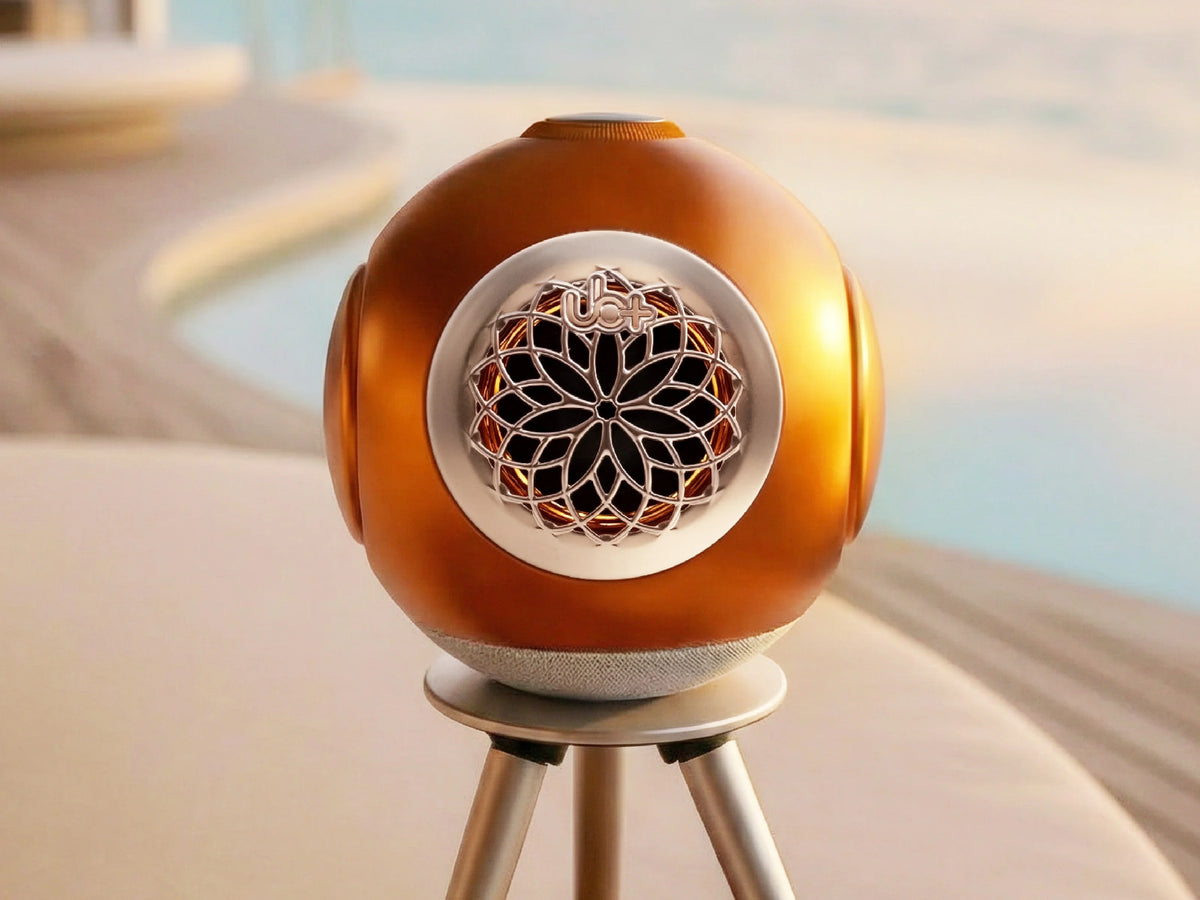
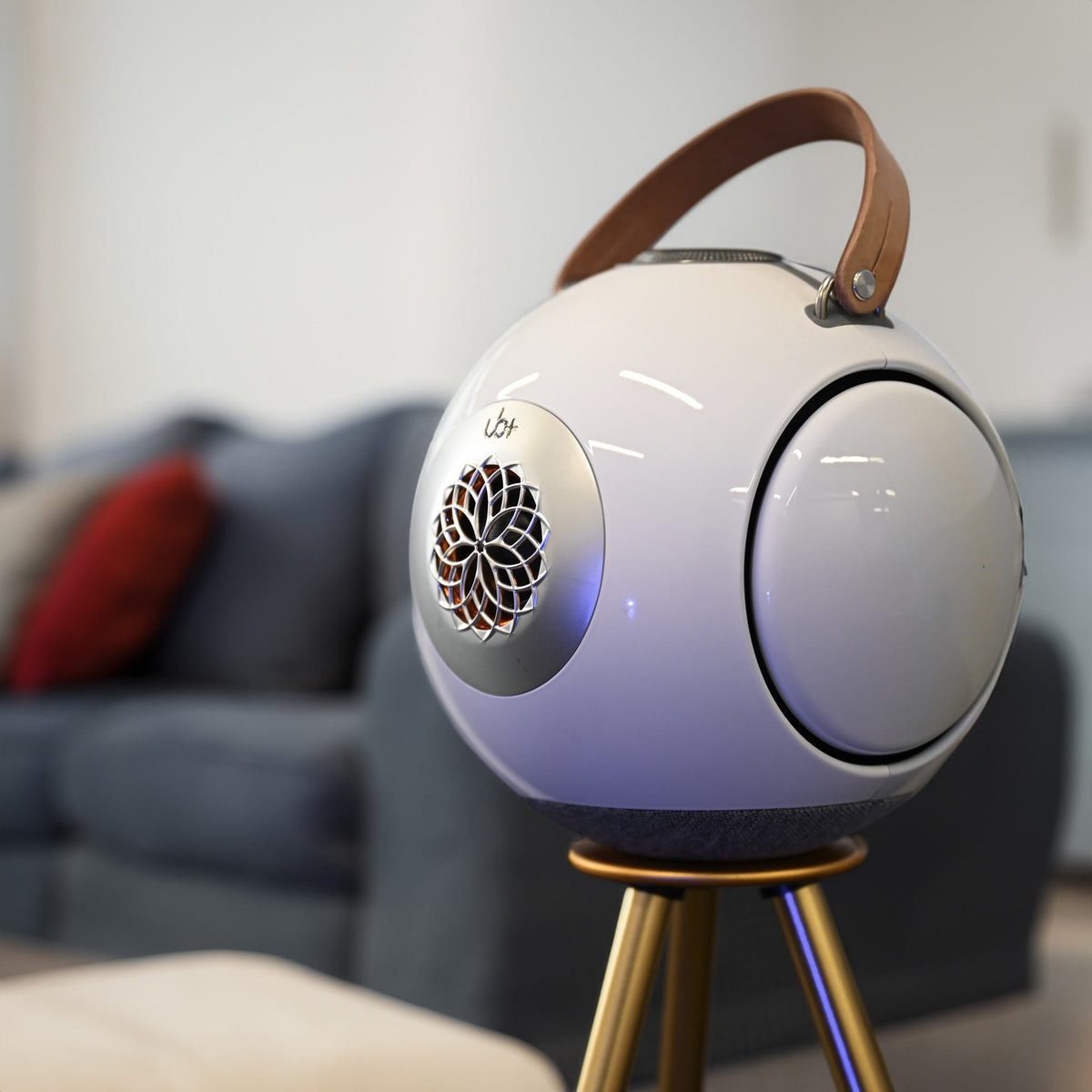
The dB1 DoubleBass is built around a patented spherical acoustic chamber inspired by the Helmholtz resonance principle.
Instead of using a conventional rectangular enclosure, the spherical chamber forms an important part of the acoustic system.
A 4.5-inch long-throw mid-bass driver works inside the sphere, while two passive radiators are positioned on opposite sides.
This architecture is designed to use internal air pressure as part of the bass-generation process.
The result is a mechanical approach to low-frequency reinforcement rather than depending primarily on artificial electronic bass enhancement.
dB1 Acoustic Spotlight
The dB1's technical architecture is important to understanding why it occupies a different position from a compact portable speaker.
|
Component |
Acoustic Function |
|
4.5-inch long-throw mid-bass driver |
Generates the primary acoustic output |
|
Spherical acoustic chamber |
Helps distribute internal air pressure |
|
Two opposing passive radiators |
Convert internal pressure changes into additional acoustic output |
|
3.5× combined passive-radiator area |
Provides substantial low-frequency radiating area |
|
90 mm neodymium magnet |
Provides strong motor force |
|
35 mm long-stroke voice coil |
Supports controlled excursion |
|
20 mm piston movement |
Enables significant air displacement |
|
Aluminum shorting ring |
Helps control motor behavior |
|
18 mm extra-wide surround |
Supports controlled driver movement |
|
DSP |
Provides protection, linearity, and tonal balance |
The two passive radiators work in opposition, creating a symmetrical architecture that helps reduce unwanted cabinet movement.
This is one of the central differences between simply adding electronic bass boost and designing the speaker around mechanical acoustic amplification.
You can explore this principle further in UB+'s article on passive radiators vs ported speaker designs.
Which Has Deeper Bass?
For buyers comparing the S1 Circle vs dB1 Doublebass specifically for bass performance, the dB1 is the model designed around greater low-frequency capability.
Its spherical chamber, long-throw driver, and dual passive-radiator architecture work together to support bass extension.
The stated dB1 frequency response is approximately 40 Hz–20 kHz.
But frequency response should not be considered in isolation. The quality of bass depends on how the speaker maintains control, output, and clarity throughout that range.
That is particularly important with music containing sustained bass, kick drums, electronic low frequencies, and bass-heavy recordings.
For a more detailed explanation of what Hz specifications actually tell you, see how bass extension works in Bluetooth speakers.
Why Passive Radiators Matter
Passive radiators are particularly useful in compact speaker engineering because they allow the enclosure to produce additional low-frequency acoustic output without requiring another actively amplified woofer.
In the dB1, the two passive radiators are positioned on opposite sides of the spherical enclosure.
As the active driver changes the pressure inside the chamber, the passive radiators respond to those pressure changes.
This creates additional radiating surfaces for bass energy.
The architecture is therefore different from a simple speaker using a small bass port.
For listeners interested specifically in the engineering behind this approach, UB+'s guide to how passive radiators work in Bluetooth speakers provides additional context.
Why the Spherical Enclosure Matters
The dB1's spherical architecture is not simply a visual design choice.
A spherical chamber can distribute internal air pressure more evenly than many conventional box geometries. The design is intended to reduce standing-wave behavior and phase-related problems inside the enclosure while supporting the movement of the passive radiators.
That acoustic structure also contributes to the speaker's broad sound distribution.
This is particularly relevant when listeners are not sitting directly in front of the speaker.
UB+ explores this concept in greater detail in its article about spherical speaker design and modern home audio.
Portability: Where the S1 Circle Has a Practical Advantage
If portability is your primary concern, the comparison changes.
A speaker intended for frequent movement needs to be convenient to pick up, carry, position, and store.
That can matter more than maximum bass capability for:
- Travel
- Small rooms
- Office listening
- Bedrooms
- Kitchens
- Personal listening
- Short outdoor trips
- Situations where space is limited
A compact speaker can also be easier to position close to the listener, reducing the amount of acoustic output required.
In these situations, choosing a larger bass-oriented design may not provide a meaningful practical advantage if you rarely need high output or deep low frequencies.
When dB1 Makes More Sense
The dB1 becomes more relevant when bass and acoustic output are major priorities.
Consider it when you want:
- More substantial low-frequency reproduction
- Greater air movement
- Stronger bass presence outdoors
- Broad sound distribution
- Higher-output listening
- A speaker designed around mechanical bass reinforcement
- A more substantial home or outdoor listening system
The dB1 is also designed for outdoor use with an IPX5 water-resistance rating. That means it can handle water jets and splashes, although it should not be submerged.
For broader outdoor buying considerations, see UB+'s outdoor Bluetooth speaker guide.
Sound Distribution: Another Important Difference
Portability and bass are not the only considerations.
Where people sit relative to the speaker can significantly affect how useful its sound is.
A conventional forward-facing speaker can work extremely well when listeners are positioned in front of it. A spherical speaker is designed around a different distribution strategy.
The dB1's spherical form supports 360-degree sound dispersion, making it useful when listeners are positioned around the speaker rather than in one fixed listening direction.
This can be particularly useful for:
- Social gatherings
- Outdoor listening
- Living rooms
- Patio setups
- Group listening
- Open spaces
Read more about 360-degree vs front-firing speaker designs.
Which Speaker Fits Your Listening Situation?
The best choice depends heavily on how you actually use your speaker.
|
Listening Situation |
Priority |
More Relevant Consideration |
|
Frequent travel |
Low weight and portability |
S1 Circle |
|
Bedroom listening |
Compact size |
S1 Circle |
|
Office listening |
Convenience |
S1 Circle |
|
Small personal spaces |
Easy positioning |
S1 Circle |
|
Bass-focused listening |
Deep low-frequency reproduction |
dB1 DoubleBass |
|
Outdoor gatherings |
Bass + dispersion + output |
dB1 DoubleBass |
|
Larger listening areas |
Acoustic capacity |
dB1 DoubleBass |
|
Group listening |
Broad sound distribution |
dB1 DoubleBass |
|
Everyday carry |
Compact portability |
S1 Circle |
This table is not about declaring one speaker universally better. It shows how the two designs address different priorities.
Does Bigger Automatically Mean Better Sound?
No.
A larger enclosure can provide more room for acoustic engineering, but size itself does not guarantee better sound.
Likewise, a small speaker can sound exceptionally well-balanced within its intended operating range.
The important question is whether the physical architecture supports the performance you need.
For example, if your priority is carrying a speaker from room to room, compactness may be more valuable than maximum bass extension.
If you regularly listen outdoors and want strong low-frequency energy, the additional acoustic capacity of a bass-focused architecture becomes more relevant.
What Should You Compare Before Buying?
When comparing the S1 Circle vs dB1 Doublebass, look beyond the basic product dimensions.
1. Bass requirements
Do you want balanced background music or a stronger low-frequency presentation?
2. Listening environment
A bedroom, office, patio, and outdoor gathering place very different demands on a speaker.
3. Portability
How often will you carry the speaker? A speaker that stays in one location has different requirements from one that travels constantly.
4. Dispersion
If several people will listen from different positions, broader sound distribution can be useful.
5. Acoustic architecture
Look at the driver, enclosure, passive radiator, and amplification system together rather than judging the product by driver size alone.
6. Water resistance
For outdoor use, check the actual IP rating rather than relying on generic waterproofing language.
7. Output and distortion
Maximum loudness is only useful if the speaker can maintain clarity as volume increases.
For a deeper look at distortion and why it matters, read speaker distortion explained.
S1 Circle vs dB1 Doublebass: Quick Buying Guide
|
If Your Priority Is... |
Consider |
|
Maximum portability |
S1 Circle |
|
Compact everyday listening |
S1 Circle |
|
Travel convenience |
S1 Circle |
|
Deep bass |
dB1 DoubleBass |
|
Stronger outdoor bass |
dB1 DoubleBass |
|
Broad sound distribution |
dB1 DoubleBass |
|
Group listening |
dB1 DoubleBass |
|
Mechanical bass reinforcement |
dB1 DoubleBass |
|
A compact personal speaker |
S1 Circle |
|
A more bass-focused acoustic system |
dB1 DoubleBass |
The important distinction is straightforward: S1 Circle emphasizes portability, while dB1 DoubleBass is engineered around deeper, more substantial acoustic performance.
Frequently Asked Questions
1. What is the main difference between S1 Circle and dB1 DoubleBass?
The comparison centers on portability versus acoustic capacity. S1 Circle is oriented toward compact, convenient listening, while dB1 DoubleBass uses a larger spherical acoustic architecture focused on bass performance and broader sound distribution.
2. Which has deeper bass, S1 Circle or dB1 DoubleBass?
The dB1 DoubleBass is the bass-focused design, using a long-throw mid-bass driver, spherical acoustic chamber, and dual passive radiators to support low-frequency reproduction.
3. Is dB1 DoubleBass portable?
Yes. The dB1 is a portable Bluetooth speaker, but its design prioritizes a more substantial acoustic system rather than the smallest possible form factor.
4. Is dB1 DoubleBass suitable for outdoor use?
Yes. The dB1 has an IPX5 rating for protection against water jets and splashes. It should not be submerged or intentionally placed in water.
5. Should I choose S1 Circle or dB1 DoubleBass?
The decision depends on your priorities. If compact portability is the main requirement, S1 Circle is the more relevant type of solution. If deeper bass, broader sound distribution, and greater acoustic capacity are more important, dB1 DoubleBass addresses those requirements.
Explore UB+ Speaker Options
The S1 Circle vs dB1 Doublebass decision ultimately comes down to how you listen.
For compact everyday use and easy portability, a smaller speaker can be the practical choice. For listeners who want a more substantial low-frequency presentation, broader dispersion, and an acoustic system specifically engineered around bass, dB1 DoubleBass offers a different approach.
→ Explore the UB+ dB1 DoubleBass
→ Compare dB1 DoubleBass with dB Mini
The right speaker is ultimately the one whose physical design matches the way you actually listen—whether that means carrying it everywhere or prioritizing the deeper acoustic performance of a dedicated bass-focused system.


Leave a comment
This site is protected by hCaptcha and the hCaptcha Privacy Policy and Terms of Service apply.