

A home gym needs more than a speaker that simply gets loud. During strength training, cardio, HIIT, stretching, or mobility work, music has to remain clear while the room gets active. A weak wireless connection, muddy bass, or distortion at higher volume can quickly become distracting.
That is why choosing the best bluetooth speaker for home gym use is less about maximum wattage and more about how the speaker handles bass, volume, movement, room coverage, and continuous listening.
In a home gym, you may be moving from one side of the room to another, exercising several feet away from the speaker, or sharing the space with equipment that changes where sound reaches you. A speaker with narrow, front-facing output can create uneven listening positions. A home gym bluetooth speaker with broader sound dispersion can make music easier to hear without constantly repositioning the speaker.
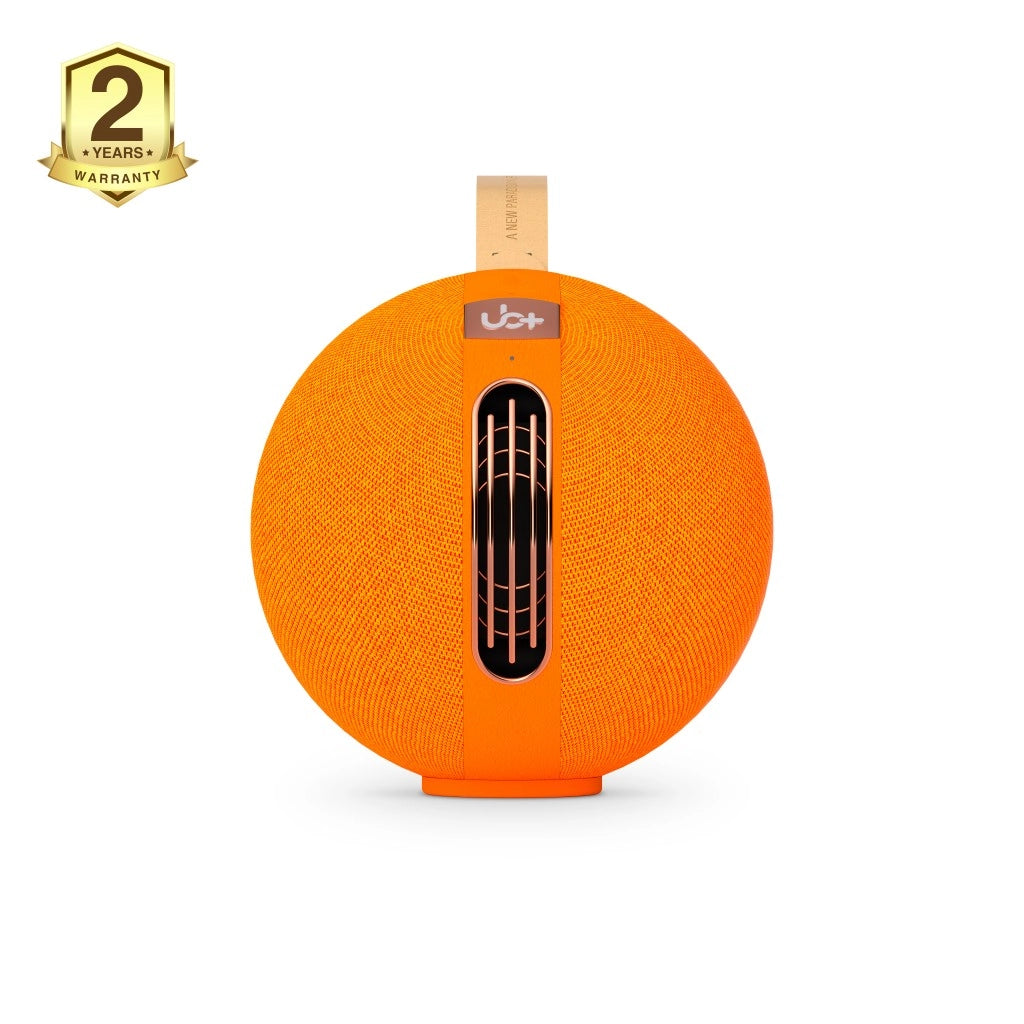
For listeners who want energetic bass without relying on excessive processing, speaker architecture matters too. The UB+ dB1 DoubleBass uses a spherical acoustic chamber, downward-firing mid-bass driver, and symmetrical passive-radiator system to approach low-frequency reproduction through acoustic and mechanical design.
What Makes a Good Bluetooth Speaker for a Home Gym?

A gym speaker has different priorities from a speaker used quietly at a desk.
You may need enough output to compete with the sound of a treadmill, rowing machine, exercise bike, or free weights. At the same time, excessive bass can become uncomfortable in a small room, particularly when the speaker is placed close to a wall or floor.
The most important factors include:
- Bass control: Music should have impact without becoming boomy.
- Clarity at higher volume: Vocals and rhythm should remain understandable when the volume increases.
- Wide sound coverage: Useful when you move around during a workout.
- Bluetooth reliability: The connection should remain stable while your phone is nearby.
- Durability: A gym environment can involve sweat, splashes, dust, and accidental contact.
- Battery life: Longer sessions should not require constant charging.
- Low distortion: Bass-heavy tracks should remain composed instead of sounding compressed or harsh.
- Placement flexibility: The speaker should work on a shelf, bench, floor, or other practical location.
These characteristics are more useful than judging a portable workout speaker by loudness alone.
Why Bass Matters During a Workout

Bass has an important psychological and physical role in workout music. Kick drums, electronic bass lines, hip-hop, rock, and other rhythm-heavy music depend heavily on low-frequency energy.
But there is a difference between bass that is powerful and bass that is uncontrolled.
A speaker can emphasize low frequencies electronically and create an immediate impression of power. At moderate volume, that may sound exciting. As the volume increases, however, the limitations of the driver and enclosure can become more noticeable.
You may hear:
- Bass becoming boomy
- Vocals becoming masked
- Kick drums losing definition
- Distortion appearing during demanding passages
- The speaker sounding strained at higher volume
For a bass bluetooth speaker for gym, the goal is therefore not simply more bass. It is controlled bass that remains usable when the music and volume demand more from the speaker.
Why Speaker Design Matters in a Home Gym

Many compact wireless speakers use small rectangular or cylindrical enclosures. These formats are practical, but the enclosure has a direct influence on acoustic behavior.
Internal reflections, enclosure volume, driver excursion, passive radiators, ports, and digital processing all contribute to the final sound.
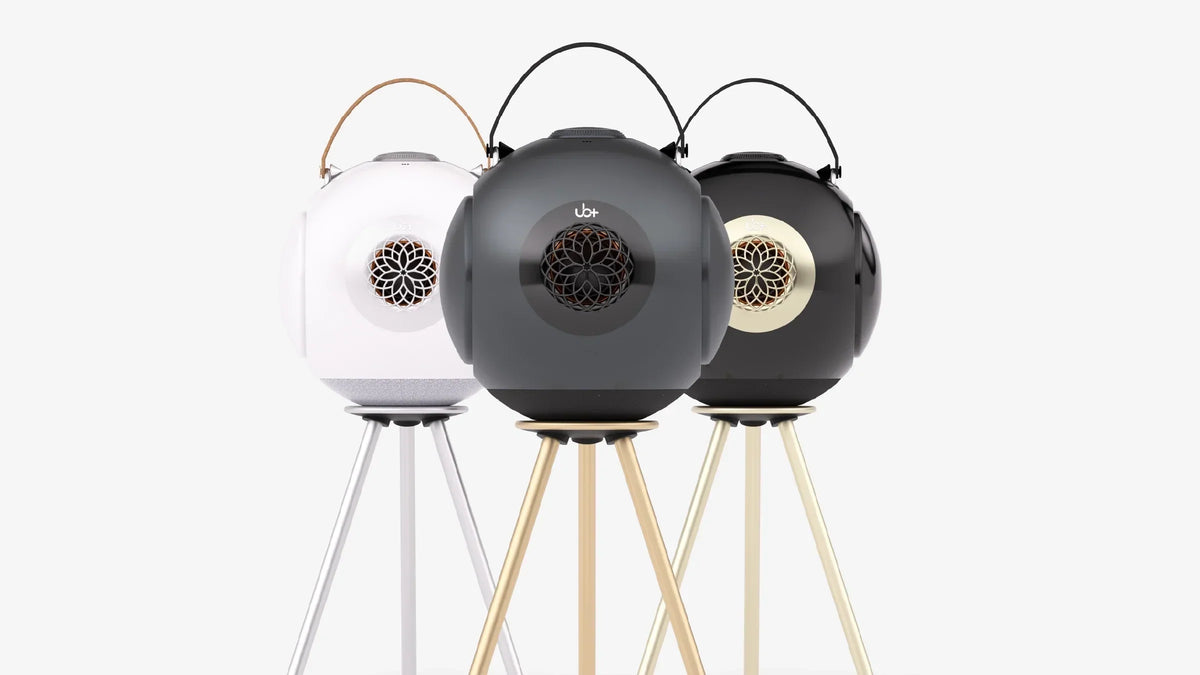
The UB+ dB1 DoubleBass takes a different approach with its spherical enclosure.
Its acoustic chamber is inspired by the principles of a Helmholtz resonator, using the enclosure and controlled air movement as part of the acoustic system. The spherical geometry helps distribute internal pressure more evenly while reducing the parallel surfaces associated with conventional box-shaped cabinets.
That approach is relevant in a gym because the objective isn't simply to create the loudest possible sound. Music needs to stay composed when you increase the volume.
For a deeper explanation of this approach, see How Spherical Speaker Design Changes Modern Home Audio.
The DoubleBass System and Workout Music
The dB1's low-frequency system is built around a central mid-bass driver and two large passive radiators positioned opposite one another.
The driver energizes the internal air volume of the sphere. The resulting pressure drives the passive radiators, converting internal acoustic energy into additional low-frequency output.
The combined passive-radiator surface area is approximately 3.5 times the area of the active woofer.
That matters because low-frequency reproduction depends on more than the size of the active driver. Air movement, excursion, enclosure volume, and radiating area all influence how a speaker handles bass.
The opposing passive-radiator arrangement also creates a mechanical balancing effect. As the radiators move in opposite directions, their mechanical forces help counteract one another.
Instead of allowing the cabinet to react strongly to the driver's movement, the design directs more of that energy toward acoustic output.
This is particularly interesting for workout music because bass-heavy tracks can place greater demands on a compact speaker.
You can read more about this architecture in Passive Radiators vs. Ported Boxes: How Spherical Speakers Produce Bass.
360° Sound for Moving Around the Gym
A home workout rarely happens from one fixed listening position.
You might start with dumbbell exercises near one wall, move to a mat for floor exercises, then finish on a treadmill or stationary bike. If the speaker is strongly directional, the sound can change noticeably as you move.
This is where a 360 degree bluetooth speaker can be useful.
The dB1 is designed around 360° spherical sound dispersion rather than concentrating the listening experience in one forward-facing direction.
That makes the design relevant to spaces where listeners move around.
|
Home Gym Requirement |
Conventional Directional Speaker |
360° Spherical Approach |
|
Moving around the room |
Sound changes with position |
Broader coverage around speaker |
|
Strength training area |
May require positioning |
Less dependent on facing the speaker |
|
Treadmill/cardio area |
Direction matters |
Designed for wider listening area |
|
Group workouts |
Front-facing listening zone |
More even coverage around the speaker |
|
Open workout space |
Placement can be important |
360° presentation can simplify placement |
|
Shared room |
One listening direction |
Sound is distributed around the speaker |
For more detail about the difference between these approaches, see 360° vs. Front-Firing Speakers.
Bass Without Excessive Distortion
One of the biggest problems with small speakers is trying to make a compact driver reproduce frequencies beyond what its physical system can comfortably handle.
When a speaker is pushed too hard, distortion can increase. The result may be audible as harshness, muddiness, or a loss of definition.
The dB1 uses a 4.5-inch mid-bass driver, an oversized 90 mm neodymium magnet, and a long-stroke motor system. Its stated frequency response reaches approximately 40Hz–20kHz.
The purpose of this architecture is not simply to make the specification sheet look impressive. The driver, spherical chamber, and passive-radiator system work together as one acoustic system.
The dB1 also uses DSP as structural support rather than making artificial bass inflation the central design strategy. Processing can assist with linearity, protection, and tonal balance while the physical acoustic system handles a significant portion of the low-frequency work.
That distinction is important when looking for a low distortion bluetooth speaker for workout music.
How Much Volume Does a Home Gym Actually Need?
More volume isn't automatically better.
A small home gym may only require moderate output, while a larger garage gym or basement workout area may require substantially more acoustic energy. Room size, ceiling height, wall materials, speaker placement, and ambient equipment noise all affect the perceived volume.
Instead of choosing a speaker solely because it advertises extreme loudness, consider how cleanly it performs at the level you actually use.
A speaker that remains controlled at workout volume can be more useful than one that becomes harsh when pushed.
The dB1 is rated at 93 dB SPL, giving it substantial output capability for a portable speaker while retaining its emphasis on controlled acoustic reproduction.
Bluetooth Connectivity During Workouts
Workout sessions are not the place for repeated connection problems.
A wireless workout speaker should connect quickly and remain stable while the phone is nearby. The dB1 uses Bluetooth 5.3, providing a current Bluetooth connection standard for compatible devices.
For everyday gym use, good connection habits still matter:
- Keep your phone reasonably close to the speaker.
- Avoid unnecessary wireless interference.
- Keep the speaker firmware updated when updates are available.
- Remove unused Bluetooth pairings if your device has accumulated a long list.
- If a connection fails, restart Bluetooth before assuming the speaker has a hardware problem.
If you're dealing with Bluetooth pairing problems, see Bluetooth Speaker Not Connecting? 9 Fixes That Work.
Water and Sweat Resistance
A home gym is not necessarily a dry environment.
Sweat, water bottles, cleaning spray, and accidental splashes can all create risks for electronics. That makes the speaker's IP rating worth checking before purchase.
The UB+ dB1 carries an IPX5 rating, meaning it is designed to withstand water jets from any direction under the applicable test conditions. It is not a submersible speaker, so IPX5 should not be interpreted as protection against being dropped into a pool or bathtub.
For a home gym, this provides useful protection against ordinary splash exposure while maintaining the dB1's focus on acoustic performance.
Placement: Where Should You Put a Gym Speaker?
Even the best speaker can sound different depending on where it is placed.
For a home gym, avoid burying the speaker behind equipment or placing it somewhere where the sound is heavily obstructed.
A few practical placement principles can help:
Near the Center of the Workout Area
If multiple people use the room, a more central position can make broad sound coverage more useful.
Away From Heavy Equipment
Large metal exercise equipment can physically obstruct sound and may create undesirable reflections. Keeping the speaker in an open position helps it radiate more freely.
Avoid Closed Cabinets
A speaker designed to fill the room should not be hidden inside furniture. Open placement allows the acoustic system to work as intended.
Experiment With Height
Different rooms respond differently. Try shelf, bench, or elevated placement and listen from several workout positions.
The goal is not to find one universally correct position. It is to find the position that produces consistent sound throughout your particular workout area.
Best Home Gym Speaker Features at a Glance
|
Feature |
Why It Matters in a Home Gym |
UB+ dB1 |
|
Bass response |
Keeps workout tracks energetic |
Approx. 40Hz–20kHz response |
|
Driver |
Determines low-frequency capability and excursion |
4.5-inch mid-bass driver |
|
Bass architecture |
Helps manage low-frequency output |
Dual opposing passive radiators |
|
Passive-radiator area |
Supports efficient air movement |
Approx. 3.5× woofer area |
|
Sound coverage |
Useful when moving around |
360° spherical dispersion |
|
Bluetooth |
Wireless convenience |
Bluetooth 5.3 |
|
Water resistance |
Helps with splashes and sweat exposure |
IPX5 |
|
Maximum output capability |
Helps maintain presence in active spaces |
93dB SPL |
|
Battery |
Important for extended sessions |
Up to 15 hours |
|
Playback options |
Useful if wireless playback is unavailable |
Bluetooth + wired/TF playback |
Home Gym Speaker vs. Ordinary Portable Speaker
Not every portable speaker needs the same acoustic architecture.
A compact speaker intended for occasional travel may prioritize small size and weight above everything else. A home gym speaker has a different job. It needs to provide enough energy for an active room while maintaining intelligibility when the listener changes position.
That is why portable speaker for exercise selection should consider the environment rather than simply looking for the smallest or loudest model.
The dB1 occupies an interesting middle ground. It is portable enough to move around the home, but its engineering is centered around a larger spherical acoustic architecture rather than extreme miniaturization.
That difference becomes especially noticeable when the music contains substantial bass information.
What Music Works Best With a Home Gym Speaker?
A good workout speaker should handle more than one genre.
Electronic music can expose weak low-frequency reproduction. Hip-hop can reveal whether the bass is controlled or bloated. Rock and metal can challenge midrange clarity. Pop can reveal whether vocals remain present when bass and drums become energetic.
For cardio sessions, rhythmic bass and percussion need to remain distinct.
For strength training, punchy kick drums can provide a strong musical foundation without requiring extreme volume.
For stretching, yoga, or mobility sessions, clarity and balance may matter more than maximum bass output.
This is another reason to look beyond the phrase best bluetooth speaker for home gym. The right choice depends partly on what you listen to and how you use the room.
Why 360° Sound Can Work Well for Home Workouts
The practical benefit of 360° sound becomes clearer when you stop thinking about the speaker as something you sit in front of.
A home gym is an active environment.
You're moving.
You're turning.
You're changing positions.
You're often facing away from the speaker.
A conventional front-firing design can still work very well, but it creates a stronger relationship between speaker orientation and listener position. A spherical approach changes that relationship by making broader sound distribution part of the design.
The dB1's spherical enclosure is therefore not simply an unusual industrial design choice. The geometry, driver arrangement, passive radiators, and dispersion characteristics are connected.
For another look at why this matters, read Why UB+ Chose the Sphere: The Design and Engineering Story Behind dB1.
Who Should Consider the dB1 for a Home Gym?
The UB+ dB1 may be worth considering if your workout setup requires several of the following:
- Strong but controlled bass
- Broad 360° sound coverage
- A portable speaker that can move between rooms
- High output capability without making loudness the only priority
- Water resistance for everyday splash exposure
- Bluetooth 5.3 connectivity
- Longer listening sessions
- A speaker designed around physical acoustic engineering rather than software tuning alone
It can also make sense if your home gym doubles as another living space. Instead of buying a speaker that only works for workouts, a spherical speaker can transition from the gym to a living room, office, bedroom, or outdoor area.
Frequently Asked Questions
What is the best Bluetooth speaker for a home gym?
The right choice depends on room size, workout style, preferred volume, bass requirements, portability, and placement. For listeners prioritizing controlled bass and broad sound coverage, the UB+ dB1 combines a spherical acoustic chamber, dual passive radiators, 360° dispersion, and Bluetooth 5.3 in a portable design.
Do I need a speaker with strong bass for a home gym?
Not necessarily, but bass is important for many workout playlists. The useful distinction is controlled bass rather than simply maximum bass. Excessive low-frequency emphasis can make music muddy or distorted at higher volume.
Is a 360° Bluetooth speaker good for workouts?
It can be particularly useful when you move around the room during exercise. A 360° design is intended to distribute sound more broadly, reducing the need to keep the speaker pointed toward your current workout position.
Can I use the UB+ dB1 around sweat and water?
The dB1 has an IPX5 rating, which provides protection against water jets and splashes under the applicable testing conditions. It should not be submerged.
How long can the dB1 play during a workout?
UB+ specifies up to 15 hours of playback, although actual battery life can vary depending on volume, playback conditions, and other usage factors.
Final Thoughts
A home gym speaker has to do more than produce music. It needs to keep pace with movement, handle bass-heavy tracks, maintain clarity as volume rises, and cover the room without forcing you to stay in one listening position.
That is why the best bluetooth speaker for home gym use should be evaluated through its complete acoustic system rather than a single specification.
The UB+ dB1 approaches the problem through a combination of spherical enclosure geometry, a downward-firing mid-bass driver, dual symmetrical passive radiators, 360° sound dispersion, and Bluetooth 5.3 connectivity. Its low-frequency architecture is designed to produce substantial bass while using mechanical and acoustic principles alongside DSP support.
For a workout space where music needs to remain energetic, controlled, and present as you move, those design choices are worth considering.
Bring Better Sound Into Your Home Gym


Laisser un commentaire
Ce site est protégé par hCaptcha, et la Politique de confidentialité et les Conditions de service de hCaptcha s’appliquent.