
Finding the best bluetooth speaker for dorm room use is not simply about buying the loudest model you can afford. A college dorm creates a very specific audio environment: limited floor space, shared walls, compact bedrooms, unpredictable room acoustics, roommates, study sessions, social gatherings, and a budget that usually has to cover much more than audio equipment.
The right speaker therefore needs to balance sound quality, bass performance, portability, room-filling sound, battery life, wireless convenience, and value without taking over the room. A speaker that sounds impressive in a large showroom may be excessive in a 10-by-12-foot dorm, while an ultra-compact model may struggle to produce satisfying low frequencies.
For students, the ideal solution sits between those extremes: compact enough for a desk or shelf, capable of producing clean sound at moderate volume, and engineered to make a small room feel acoustically larger without demanding a complicated audio system.
Why Dorm Rooms Are Different From Typical Listening Spaces

A college dorm room is usually a challenging acoustic environment.
Walls are close together. Furniture is often positioned wherever space allows rather than where it produces ideal acoustics. Beds, desks, wardrobes, windows, and hard surfaces can create reflections that alter how music sounds. Shared walls also mean that maximum volume is rarely the most useful measure of performance.
This makes small-room audio fundamentally different from outdoor or large-room listening.
A speaker does not need enormous acoustic output to sound impressive in a dorm. What matters more is how effectively it handles bass, vocals, detail, and dispersion within a limited space.
A good dorm speaker should be able to deliver:
- Clear vocals at low and moderate volume
- Controlled bass without excessive boom
- Wide sound coverage around the room
- Enough output for occasional gatherings
- Compact physical dimensions
- Simple Bluetooth connectivity
- Reliable battery operation
- A design that works on a desk, shelf, or bedside table
The difference between a mediocre compact speaker and a well-designed one becomes especially obvious when listening at lower volumes. A speaker with good acoustic engineering can maintain tonal balance without requiring you to turn it up simply to hear the bass.
For more on how room dimensions affect speaker selection, see our guide to choosing the right speaker size for your room.
What College Students Should Actually Look for

Price is important, but it should not be the only filter.
A $100 speaker that produces thin, compressed sound may provide less value than a somewhat more expensive speaker with substantially better acoustic performance and enough versatility to remain useful after graduation.
When evaluating the best bluetooth speaker for dorm room use, think about the speaker as a long-term everyday device rather than a temporary college accessory.
Sound Quality
Sound quality should come first.
A dorm speaker will probably be used for everything from music and podcasts to movies, gaming, study playlists, and casual listening. That means it needs balanced reproduction rather than exaggerated bass alone.
A useful full-range sound signature should maintain enough low-end weight to make music enjoyable while keeping vocals and instruments intelligible.
This becomes particularly important at lower listening levels. If a speaker loses its tonal balance whenever you reduce the volume, it can become frustrating for late-night listening.
Bass Without Excessive Boom
Bass is one of the hardest characteristics to get right in a compact speaker.
Small rooms naturally reinforce certain low frequencies because nearby walls and corners reflect sound back into the listening area. A speaker that already has an excessively boosted low end can therefore sound muddy when placed against a wall or in a corner.
The goal is not simply "more bass."
The goal is controlled deep bass that adds weight without masking vocals and midrange information.
UB+ explores this problem in greater detail in its guide to bass extension and speaker frequency response.
Room-Filling Dispersion
Dorm rooms are rarely arranged around one dedicated listening position.
You might be sitting at a desk while studying, lying on the bed, getting ready, or talking with friends across the room.
That makes wide sound dispersion extremely useful.
A traditional front-firing speaker tends to create a stronger listening zone in front of the enclosure. A speaker designed to distribute sound more broadly can provide a more consistent experience as you move around the room.
This is one reason 360-degree speaker designs can make sense in compact living environments. Our comparison of 360-degree and front-firing speakers explains how dispersion changes the listening experience.
Why a Compact Speaker Can Sound Bigger Than It Looks

Speaker size creates physical limitations, but enclosure design can dramatically influence what a compact speaker is capable of producing.
A conventional rectangular speaker generally uses a cabinet with internal parallel surfaces. Its driver, ports, and enclosure dimensions all have to work together to control air movement and resonance.
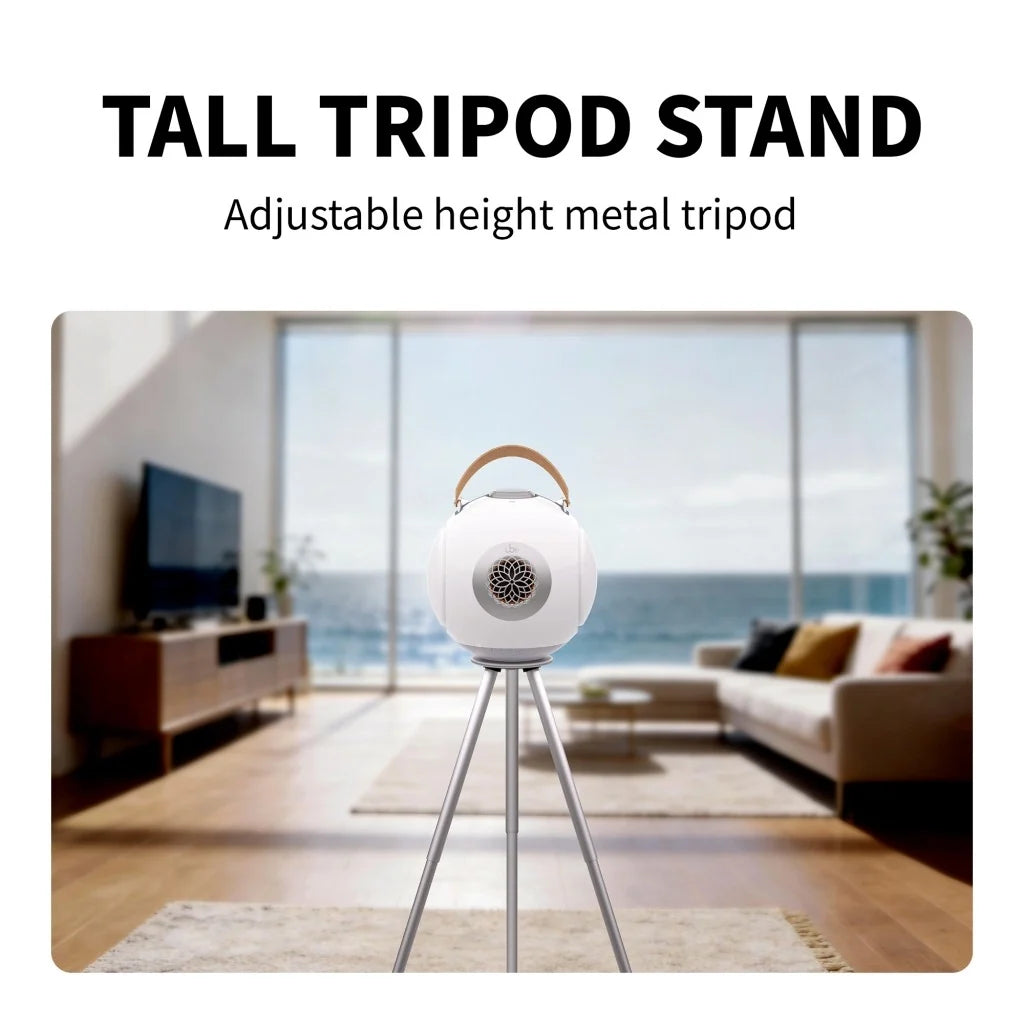
UB+ takes a different approach with the dB1 DoubleBass.
The dB1 uses a spherical acoustic chamber inspired by the principles of Helmholtz resonance. Rather than treating the enclosure simply as a container for the driver, the spherical chamber is part of the acoustic system.
The geometry helps distribute internal air pressure more evenly and is designed to reduce problematic standing-wave and phase behavior associated with conventional enclosure geometries.
That matters in a dorm room because the speaker itself has to produce convincing sound without depending heavily on the room to create the effect.
The dB1 DoubleBass Approach to Dorm-Room Audio

The UB+ dB1 DoubleBass is particularly interesting for students who want a compact wireless speaker but do not want to sacrifice serious low-frequency performance.
Its acoustic architecture combines a centrally positioned 4.5-inch long-throw mid-bass driver with two opposing passive radiator plates integrated into the spherical chamber.
The combined passive-radiator surface area is approximately 3.5 times the area of the active woofer.
This is fundamentally different from simply adding a large amount of electronic bass boost.
The driver moves air into the acoustic chamber, pressure develops inside the sphere, and that pressure drives the passive radiators. The opposing radiator arrangement also helps reduce unwanted cabinet movement because the mechanical forces work against one another.
Acoustic Architecture at a Glance
|
Acoustic Element |
UB+ dB1 DoubleBass Approach |
Why It Matters in a Dorm |
|
Enclosure |
Spherical acoustic chamber |
Helps manage internal acoustic behavior |
|
Main driver |
4.5-inch long-throw mid-bass driver |
Provides substantial acoustic displacement for a compact speaker |
|
Passive radiators |
Two opposing radiators |
Supports low-frequency output without relying on a conventional bass port |
|
Radiator area |
Approximately 3.5× active woofer area |
Allows substantial air movement |
|
Vibration behavior |
Opposing mechanical movement |
Helps reduce unwanted enclosure vibration |
|
Dispersion |
360° spherical sound distribution |
More consistent coverage around the room |
|
Bass approach |
Primarily mechanical/acoustic |
Avoids depending solely on artificial bass enhancement |
|
Connectivity |
Bluetooth 5.3 plus wired/TF playback |
Flexible for everyday student use |
|
Protection |
IPX5 |
Useful for normal splash/water-jet exposure, but not submersion |
The dB1 also uses a 90 mm neodymium magnet, a 35 mm long-stroke design, and an approximately 40 Hz–20 kHz frequency response. Its acoustic output is designed to produce meaningful bass and clarity from a relatively compact enclosure.
The important point for dorm use is not simply the specification list. It is how those design decisions affect everyday listening.
Why Mechanical Bass Matters in a Small Room

Many compact Bluetooth speakers create the impression of larger bass by combining small drivers with electronic processing.
Digital signal processing is useful. It can help maintain linearity, protect the driver, and optimize tonal balance.
But there are physical limits to how much air a small driver can move.
The dB1 approaches the low-frequency problem differently. Its passive-radiator system uses acoustic pressure generated inside the spherical chamber to support bass output.
That means the speaker's low-frequency performance is not based entirely on telling a small driver to work harder through aggressive electronic processing.
This distinction becomes important in a dorm because exaggerated DSP bass can become unpleasant quickly when the speaker is placed close to walls or furniture.
A well-controlled acoustic system can provide bass with more physical substance while maintaining the clarity needed for everyday listening.
For students interested in the underlying technology, our explanation of how passive radiators work in Bluetooth speakers provides a deeper look at the principle.
The Best Placement for a Dorm-Room Bluetooth Speaker

Even an excellent speaker can sound mediocre if it is positioned poorly.
One of the easiest mistakes is placing the speaker directly inside a corner. Corners can reinforce low frequencies, sometimes creating an exaggerated and uneven bass response.
A better starting point is an open surface with some separation from the surrounding walls.
A desk, dresser, bookshelf, or sturdy bedside surface can work well depending on the speaker's dispersion pattern.
For a conventional front-firing speaker, orienting the enclosure toward the main listening position can make a substantial difference.
For a 360-degree design, orientation becomes less critical, allowing the speaker to function more naturally in shared spaces.
Our detailed Bluetooth speaker placement guide covers the relationship between placement, reflections, bass response, and clarity.
Desk Placement
A desk is one of the most useful locations for a college speaker.
It keeps the speaker accessible while creating a natural listening position for studying, working, or gaming.
However, avoid pushing the speaker directly against the wall if possible. A little breathing room can help prevent excessive low-frequency reinforcement.
Bedside Placement
A bedside table can be excellent for quiet listening, podcasts, and late-night music.
At this distance, extreme output is unnecessary. Tonal balance becomes much more important.
This is also where a speaker with good low-volume performance has an advantage over a model that only sounds impressive when played loudly.
Shared Room Placement
If you have a roommate, speaker placement becomes a compromise.
The objective should be even coverage rather than directing all the acoustic energy toward one side of the room.
A wide-dispersion speaker can help make the sound more evenly accessible without requiring high volume.
Why Volume Isn't the Same as Sound Quality
One of the biggest mistakes in speaker shopping is assuming that the loudest speaker is the best speaker.
A high maximum SPL rating can be useful for parties or outdoor use, but dorm rooms usually impose practical limits on volume.
What matters more is clean output.
If vocals become harsh, bass becomes distorted, or the enclosure begins vibrating against the desk as volume increases, additional loudness provides little value.
The better question is:
How good does the speaker sound before you reach its limits?
That is where driver design, enclosure architecture, passive-radiator tuning, vibration control, and DSP protection all become relevant.
UB+ discusses this distinction further in its speaker SPL guide.
Bluetooth Performance Matters More Than Students Expect
A college speaker may connect to several devices throughout the day.
Your phone may be the primary source, but you might also use a laptop, tablet, or another Bluetooth-enabled device.
Bluetooth 5.3 provides a modern wireless connection platform for the dB1, while its wired and TF playback options provide additional flexibility.
Wireless stability is particularly useful in a dorm because the speaker may sit across the room rather than directly beside the source device.
For students comparing Bluetooth generations and wondering what actually changes, our guide to Bluetooth 4.2 vs. 5.0 vs. 5.3 breaks down the differences.
Battery Life Is Part of the Value
A dorm speaker should not need to remain attached to a power outlet.
You may move it from the desk to the common room, take it to a friend's room, bring it outside, or carry it home during a school break.
That makes portable Bluetooth audio more useful than a conventional desktop speaker system for many students.
Battery performance should therefore be considered alongside sound quality.
A speaker with excellent sound but poor portability can become inconvenient. Conversely, a highly portable speaker with weak audio may be replaced within a year.
The strongest value comes from a speaker that can function as a daily audio system while remaining easy to move.
Water Resistance Is Useful Beyond the Beach
A college dorm is not a beach, but water resistance still has practical value.
Students use speakers around kitchens, bathrooms, balconies, outdoor spaces, and during trips.
The dB1 carries an IPX5 rating, meaning it is designed to withstand water jets and ordinary splashing. That does not mean it is waterproof for submersion, so it should not be treated like a device that can safely be dropped into a pool or sink.
For broader outdoor considerations, see our guide to the best outdoor Bluetooth speakers.
The important distinction is that a dorm speaker does not have to be exclusively a dorm speaker. A versatile model can remain useful throughout college and beyond.
What a Tight Budget Really Means
A tight budget does not necessarily mean buying the cheapest speaker.
Instead, consider cost per year of useful ownership.
A very inexpensive speaker might initially seem attractive, but if it produces weak bass, poor vocals, unreliable Bluetooth connections, or insufficient volume, you may end up replacing it.
A better-value speaker should ideally cover multiple roles:
|
Student Need |
What to Look For |
|
Studying |
Clear vocals and balanced sound |
|
Music |
Controlled bass and good midrange |
|
Movies |
Wide dispersion and intelligible dialogue |
|
Gaming |
Low-latency wireless performance where supported |
|
Small gatherings |
Enough clean output for the room |
|
Travel |
Portable design and battery operation |
|
Outdoor use |
Appropriate water resistance |
|
Long-term ownership |
Durable construction and versatile connectivity |
This is why value Bluetooth speaker comparisons should look beyond price tags.
The question is not "What is the cheapest speaker?"
It is "Which speaker gives me the most useful performance for the money?"
When a Small Speaker Is Better Than a Large Party Speaker
College students are often tempted by oversized party speakers because their specifications promise huge output.
But a large party speaker can be completely wrong for a dorm.
It takes up valuable floor space, may be difficult to transport, and can encourage excessive volume. Its strengths are designed around environments where high SPL is the priority.
A compact high-performance speaker takes a different approach.
It prioritizes acoustic efficiency, portability, controlled bass, and useful dispersion.
For a dorm, that is often the more intelligent balance.
Our comparison of compact speakers and large party speakers explores where each type makes sense.
dB1 vs. a More Conventional Compact Bluetooth Speaker
The difference between the dB1 and a typical compact Bluetooth speaker is primarily architectural.
A conventional compact model often relies on a small driver, a small enclosure, one or more ports or passive radiators, and DSP processing to optimize the available output.
The dB1 uses a fundamentally different acoustic structure.
|
Category |
Conventional Compact Speaker |
UB+ dB1 DoubleBass |
|
Enclosure geometry |
Often rectangular/cylindrical |
Spherical |
|
Low-frequency strategy |
Driver + enclosure + DSP |
Driver + spherical chamber + dual passive radiators |
|
Passive-radiator layout |
Varies |
Opposing symmetrical radiators |
|
Bass objective |
Maximize perceived output |
Generate controlled physical low-frequency output |
|
Dispersion |
Often directional |
360° |
|
Vibration management |
Depends on enclosure design |
Opposing radiator architecture |
|
Dorm-room advantage |
Small footprint |
Small footprint with broader acoustic coverage |
This does not mean every conventional speaker is inferior. Different designs have different priorities.
But for a student specifically looking for deep bass in a small room, the dB1's architecture addresses a problem that simple enclosure miniaturization cannot solve by itself.
When the UB+ dB Mini Makes More Sense
Not every college student needs the dB1.
If your priority is maximum compactness, simple everyday listening, or a smaller physical footprint, the UB+ dB Mini may be the more appropriate option.
The decision should come down to how you intend to use the speaker.
Choose the larger dB1-oriented approach when bass performance, room coverage, and acoustic architecture are major priorities.
Consider the dB Mini when compactness and simplicity are more important.
You can also compare the dB1 and dB Mini before making the final decision.
Common Mistakes When Buying a Dorm Speaker
Choosing by Wattage Alone
Power numbers do not tell you how balanced, efficient, or clean a speaker sounds.
Acoustic design matters.
Buying the Smallest Speaker Available
Ultra-compact designs can be convenient, but physics still matters. Extremely small drivers have limited displacement, and there is only so much low-frequency output a tiny enclosure can generate.
Assuming More Bass Is Always Better
Overemphasized bass can make a small room sound boomy, especially near walls and corners.
Controlled bass is more useful than simply boosted bass.
Ignoring Dispersion
A speaker that sounds excellent directly in front of you may sound significantly different from the side.
For a dorm shared with a roommate or friends, broad coverage can be more practical.
Forgetting How You Will Use It After College
The best purchase should remain useful after graduation.
A portable speaker can move from a dorm desk to an apartment, home office, bedroom, patio, travel bag, or living room.
That makes versatility an important part of value.
Is the UB+ dB1 the Best Bluetooth Speaker for a Dorm Room?
There is no single speaker that is objectively perfect for every student.
But if your priorities include sound quality, controlled deep bass, compact design, wide dispersion, portability, and long-term usefulness, the UB+ dB1 is an unusually strong fit for the dorm environment.
Its spherical acoustic chamber and dual passive-radiator architecture address the physical limitations that often make compact speakers struggle with low frequencies. Its 360-degree sound distribution makes it less dependent on a single listening position, while Bluetooth 5.3 and portable operation make it practical for everyday student life.
Most importantly, it is not designed around the assumption that a compact speaker has to sound small.
That distinction matters.
A college dorm does not need a giant sound system. It needs a speaker that can produce convincing sound within a small footprint, remain useful at reasonable listening levels, and transition easily between studying, relaxing, entertaining, and traveling.
FAQ
What is the best Bluetooth speaker for a college dorm room?
The best choice depends on your room size, budget, listening habits, and bass requirements. For students who want strong low-frequency performance, broad sound coverage, and a compact but technically sophisticated design, the UB+ dB1 DoubleBass is a strong option.
How much should I spend on a dorm-room Bluetooth speaker?
Rather than choosing purely by price, compare sound quality, acoustic design, portability, battery performance, connectivity, and durability. A slightly higher upfront investment can make sense if the speaker is versatile enough to remain useful throughout college and afterward.
Is deep bass important in a dorm room?
Yes, but controlled bass is more important than maximum bass. Small rooms can reinforce low frequencies, so excessive bass can quickly become muddy or boomy. A speaker with efficient acoustic bass reproduction can provide weight without overwhelming vocals and other frequencies.
Is a 360-degree speaker good for a dorm?
A 360-degree speaker can be particularly useful in a dorm because students rarely listen from one fixed position. Broad dispersion allows the speaker to cover the room more evenly from a desk, shelf, bedside table, or shared space.
Should I buy a portable speaker or a desktop speaker for college?
For most students, portability provides greater flexibility. A portable Bluetooth speaker can serve as a desk speaker, bedroom speaker, travel speaker, and casual outdoor speaker without requiring a permanent setup.
Is the UB+ dB1 waterproof?
The dB1 is rated IPX5, which means it is designed to resist water jets and splashes. It should not be submerged or treated as a fully waterproof speaker.
Final Takeaway
The right college speaker is not necessarily the cheapest, smallest, or loudest model.
It is the one that fits the reality of student life.
A good dorm-room speaker needs to perform in a small acoustic space, maintain clarity at everyday listening levels, produce convincing bass without becoming overwhelming, cover more than one listening position, and remain portable enough to follow you beyond the dorm.
That is where a well-engineered compact speaker becomes more valuable than a basic budget model.
The best bluetooth speaker for dorm room use should ultimately give you more than sound. It should give you a flexible audio system that works for studying, relaxing, movies, music, friends, travel, and the years that come after college.
Explore UB+ Options
→ Explore the UB+ dB1 DoubleBass


コメントを書く
このサイトはhCaptchaによって保護されており、hCaptchaプライバシーポリシーおよび利用規約が適用されます。