
A dual driver bluetooth speaker can produce a fuller, more controlled sound than a single-driver design, but two drivers do not automatically mean twice the volume. The real difference depends on how the drivers are configured, how efficiently they use the enclosure, how much air they can move, and whether the speaker is designed to maintain clarity as output increases. For buyers comparing dual driver speakers vs single driver speakers, driver arrangement is therefore more important than simply counting the number of drivers.
In compact Bluetooth speakers, this becomes especially important when the goal is deep bass, room-filling sound, outdoor listening, or playback at higher volume. A well-designed single driver can outperform a poorly integrated multi-driver system, while a properly engineered dual-driver architecture can provide greater headroom, better separation, and more stable reproduction.
The key question is not simply whether two drivers are louder. It is whether the additional driver allows the speaker to move air more effectively and reproduce the full frequency range with less strain.
What Does a Dual Driver Bluetooth Speaker Actually Mean?

A dual driver Bluetooth speaker uses two active drivers rather than relying on a single full-range driver to reproduce most or all of the audible spectrum.
That does not necessarily mean both drivers are identical. Depending on the design, two drivers may divide responsibilities between frequencies or work together to increase acoustic output. The enclosure, crossover or DSP, amplifier configuration, and passive acoustic components all influence the final result.
A basic comparison looks like this:
|
Design |
Main Approach |
Typical Advantage |
Main Limitation |
|
Single driver |
One active driver handles most frequencies |
Simple, compact architecture |
Driver must cover a wide frequency range |
|
Dual driver |
Two active drivers share or reinforce reproduction |
More headroom and potential separation |
More complex integration |
|
Dual driver + passive radiators |
Active drivers work with passive acoustic elements |
Greater low-frequency capability |
Requires careful enclosure engineering |
|
Single driver + passive radiator |
One active driver with passive bass reinforcement |
Compact bass extension |
Active driver still handles broad frequency range |
This is why simply looking at the number of drivers is not enough when choosing a portable Bluetooth speaker with deep bass.
Does Two Drivers Really Sound Louder?
Not necessarily.
Two drivers can increase the amount of acoustic energy a speaker can produce, but perceived loudness depends on several factors, including driver sensitivity, amplifier power, excursion, enclosure design, frequency response, and distortion.
A dual-driver system can have an advantage because the workload can be distributed rather than forcing one driver to handle everything.
Think of a single driver reproducing vocals, instruments, upper bass, and lower bass simultaneously. As volume increases, that driver has to manage increasingly large excursions while maintaining midrange detail.
A properly engineered two-driver system can reduce that burden.
That can result in:
- More available headroom
- Better midrange separation
- Greater control at higher volume
- Less driver stress
- Improved reproduction of complex music
- Potentially greater perceived loudness before distortion becomes obvious
So the important distinction is:
Two drivers do not automatically equal twice the loudness. Two properly integrated drivers can give a speaker more usable output and better control.
For a deeper explanation of how speaker output should actually be evaluated, see UB+'s guide to speaker SPL and how loud a speaker really is.
Why Driver Separation Matters for Bass
Bass reproduction creates one of the biggest challenges for compact Bluetooth speakers.
Low frequencies require substantial air movement. A small enclosure cannot simply behave like a large floor-standing speaker, so manufacturers have to use driver excursion, enclosure volume, passive radiators, ports, DSP, or combinations of these technologies.
When one small driver is responsible for both bass and midrange reproduction, strong low-frequency movement can influence what happens higher in the frequency range.
This is one reason a well-designed dual driver speaker for bass can have an architectural advantage.
Instead of asking one driver to perform every task, the system can be designed so that different components contribute to different parts of the acoustic output.
However, the driver count alone does not create deep bass. The enclosure and acoustic loading determine how effectively the driver can move air at low frequencies.
Dual Driver vs Single Driver for Deep Bass
When comparing dual driver vs single driver Bluetooth speakers, bass performance should be evaluated beyond the number of drivers.
A useful comparison includes driver excursion, enclosure design, passive-radiator area, frequency response, and distortion.
|
Factor |
Single Driver |
Dual Driver |
|
Bass workload |
Concentrated on one active driver |
Can be distributed |
|
Midrange workload |
Shares the same driver |
Can have greater separation |
|
Maximum output |
Depends heavily on driver excursion |
Can benefit from additional acoustic capacity |
|
Distortion at high output |
Can increase as driver works harder |
May be reduced through workload distribution |
|
Deep-bass potential |
Strongly dependent on enclosure |
Strongly dependent on overall architecture |
|
Soundstage |
Usually more centralized |
Can provide greater spatial separation |
|
Engineering complexity |
Lower |
Higher |
|
Driver count alone |
Does not guarantee bass |
Does not guarantee bass |
For buyers specifically interested in low-frequency performance, UB+'s deep-bass Bluetooth speaker guide explains why bass extension depends on more than advertised driver size.
The UB+ Approach: Driver Architecture Plus Acoustic Engineering
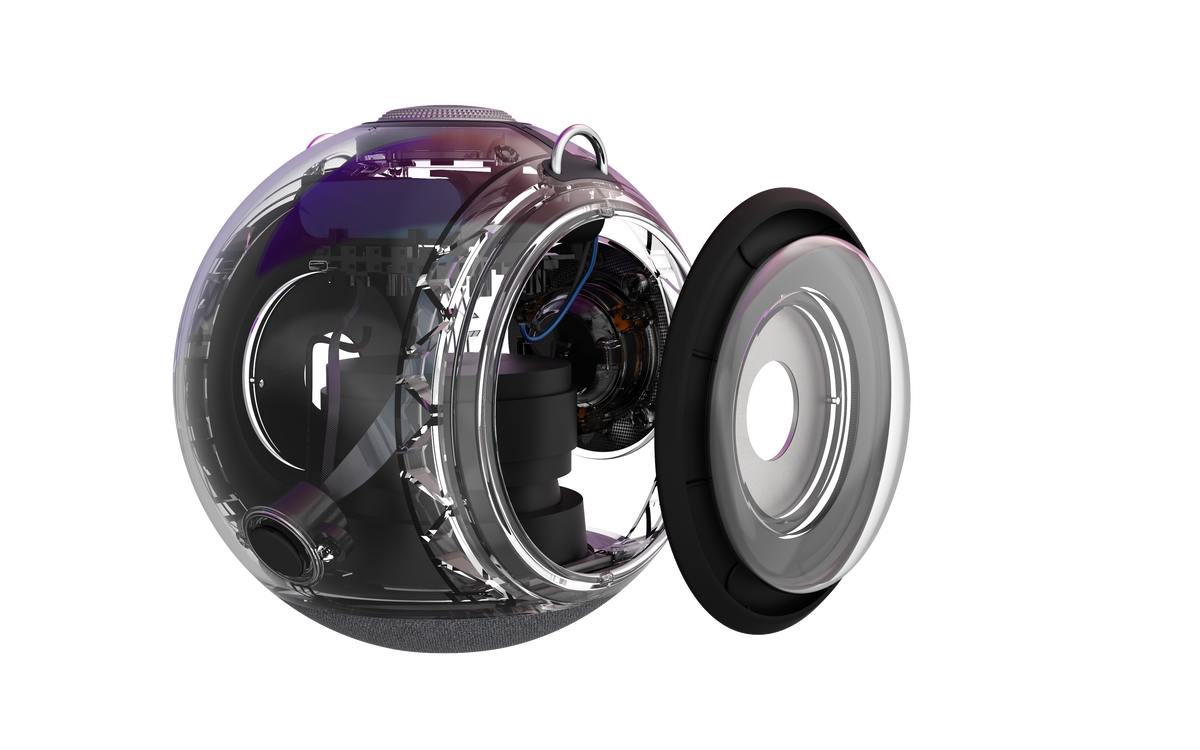
UB+ dB1 DoubleBass demonstrates why driver count should be considered together with acoustic architecture.
The dB1 uses a 4.5-inch long-throw mid-bass driver working inside a patented spherical acoustic chamber. Rather than treating the enclosure as a simple container around the driver, the spherical structure is part of the acoustic system.
The driver works with two opposing passive radiators positioned on opposite sides of the sphere. The combined passive-radiator surface area is approximately 3.5 times the active woofer area.
This creates a different approach to bass reproduction from a conventional compact box.
Acoustic Spotlight: dB1 DoubleBass
|
Component |
Engineering Role |
|
4.5-inch long-throw mid-bass driver |
Generates the primary acoustic signal |
|
Spherical acoustic chamber |
Distributes internal air pressure more evenly |
|
Dual opposing passive radiators |
Convert internal pressure movement into additional acoustic output |
|
3.5× passive-radiator surface area |
Provides substantial radiating area for low-frequency movement |
|
90 mm neodymium magnet |
Supports strong motor force |
|
35 mm long-stroke voice coil |
Allows substantial controlled excursion |
|
20 mm piston movement |
Enables significant air displacement |
|
Aluminum shorting ring |
Helps control motor behavior |
|
18 mm extra-wide surround |
Supports controlled driver movement |
|
DSP |
Supports protection, linearity, and tonal balance rather than creating bass artificially |
The spherical chamber is inspired by the Helmholtz resonance principle, using the behavior of air inside the enclosure as part of the acoustic design.
That matters because deep bass is fundamentally an air-movement problem.
Instead of relying only on electronic bass enhancement, the dB1 architecture uses mechanical and acoustic components to increase effective low-frequency output.
For more detail on this type of design, see how passive radiators work in Bluetooth speakers.
Why More Drivers Can Improve Sound Without Simply Making It Louder
One of the most important benefits of multiple drivers is not raw volume. It is harmonic stability and separation.
Music contains simultaneous information across a wide frequency range. A kick drum may occupy the low-frequency region while a vocal, guitar, piano, or cymbal is reproduced at the same moment.
If a single driver has to make large low-frequency excursions while reproducing midrange information, its physical movement can make accurate reproduction more difficult.
A properly engineered dual-driver architecture can reduce that conflict.
The result can be:
Less strain → greater headroom → cleaner reproduction → better perceived clarity at higher volume.
This is particularly relevant when listening to dense music, live recordings, electronic music, or bass-heavy tracks.
Driver Size Still Matters
It is easy to assume that two small drivers must outperform one larger driver.
That is not necessarily true.
A driver has a finite ability to move air. Its effective radiating area, excursion capability, motor strength, suspension, and enclosure all influence output.
This is why speaker driver size vs sound quality cannot be reduced to a simple larger-is-better rule.
A well-engineered driver with sufficient excursion can produce substantial low-frequency output when paired with an enclosure designed around its physical characteristics.
The same principle applies to a dual-driver system. Two drivers only create an advantage if the complete acoustic and electrical system is designed to use them effectively.
Dual Drivers and Soundstage
Driver configuration can also affect how a speaker distributes sound.
A single-driver design naturally has a more centralized acoustic source. Multiple drivers can allow a manufacturer to create a broader acoustic presentation, depending on their positioning and frequency allocation.
However, this is another area where architecture matters more than driver count.
For example, a pair of front-facing drivers is fundamentally different from a spherical design intended to distribute sound around the enclosure.
UB+'s guide to 360-degree vs front-firing speakers explains how physical orientation changes the way sound reaches listeners around a speaker.
For social environments, that distinction can matter as much as maximum SPL.
What About a Single Driver With a Passive Radiator?
This is where speaker comparisons become more complicated.
A passive radiator is not an active driver in the traditional sense. It does not receive an amplified electrical signal. Instead, pressure changes generated inside the enclosure cause it to move.
This allows a speaker to increase low-frequency acoustic output without adding another actively amplified woofer.
That means a speaker with one active driver and a well-designed passive radiator system can produce stronger bass than a basic single-driver enclosure.
Likewise, a dual-driver system without sufficient acoustic engineering may not outperform a carefully designed single-driver system.
The right comparison is therefore:
Driver architecture + enclosure + acoustic loading + amplification + excursion + DSP
—not simply:
One driver vs two drivers.
What Should You Look for When Buying a Dual Driver Bluetooth Speaker?
If you're comparing a dual driver Bluetooth speaker with a single-driver model, look beyond the product description.
1. Driver configuration
Find out what each driver actually does. Two drivers that simply duplicate the same frequency range are different from a system designed around complementary acoustic roles.
2. Driver excursion
Bass output depends heavily on how much air the driver can displace. A driver with greater controlled excursion can have an advantage even when its physical diameter looks modest.
3. Enclosure design
The enclosure affects resonance, pressure distribution, vibration, and bass extension.
A well-designed acoustic chamber can be more meaningful than adding another driver.
4. Passive radiator or port design
For compact speakers, passive radiators can provide additional low-frequency output while avoiding some of the limitations associated with very small ports.
5. SPL and distortion
Maximum loudness is not enough. Listen for what happens as the volume approaches the speaker's limits.
A speaker that becomes harsh or loses bass at high volume may have less useful output than its maximum specification suggests.
6. Frequency response
A stated frequency-response range can help establish the intended operating range, but it should not be treated as a complete measure of sound quality.
Understanding bass extension and Hz ratings can help put these specifications into context.
When Is a Single Driver Better Suited?
A single-driver Bluetooth speaker can make sense when simplicity, compactness, and portability are the priorities.
For casual listening in a bedroom, office, kitchen, or small personal space, there may be little reason to prioritize a complex multi-driver architecture.
A good single-driver speaker can also provide coherent reproduction because the majority of the audible range originates from one acoustic source.
The question becomes whether the speaker's physical size and acoustic system are sufficient for the intended listening environment.
For larger spaces or higher listening levels, the advantages of additional acoustic capacity become more relevant.
When Does a Dual Driver Design Make More Sense?
A dual-driver architecture becomes more interesting when you want:
- Higher sustained listening levels
- Greater headroom
- Better separation between frequency ranges
- More controlled reproduction at high volume
- Stronger performance with complex music
- Wider spatial presentation
- Greater acoustic flexibility
But the architecture still needs to be engineered correctly.
A poorly integrated two-driver system can introduce its own problems, including phase issues, uneven frequency response, or poor driver integration.
More components do not automatically mean better sound.
Dual Driver vs Single Driver: What Actually Matters?
The most useful buying decision is to evaluate the complete acoustic system.
|
What to Compare |
Why It Matters |
|
Driver configuration |
Shows how the speaker divides acoustic workload |
|
Driver size |
Influences potential air displacement |
|
Excursion |
Determines how much air a driver can move |
|
Magnet/motor design |
Influences driver control |
|
Enclosure architecture |
Shapes resonance and acoustic loading |
|
Passive-radiator area |
Can significantly influence bass output |
|
Frequency response |
Indicates the stated operating range |
|
SPL |
Helps evaluate potential output level |
|
Distortion |
Indicates how cleanly output is maintained |
|
Dispersion |
Determines how sound reaches listeners |
|
DSP |
Can optimize and protect the system but does not replace acoustic engineering |
This is why the answer to “does two really sound louder?” is more nuanced than simply counting drivers.
Two drivers can provide more acoustic capacity, but engineering determines whether that capacity becomes useful volume, deeper bass, cleaner sound, or simply more complexity.
Frequently Asked Questions
1. Is a dual driver Bluetooth speaker louder than a single driver?
Not automatically. A dual-driver design can provide greater acoustic headroom and output potential, but actual loudness depends on driver sensitivity, amplifier power, excursion, enclosure design, and distortion.
2. Is a dual driver Bluetooth speaker better for bass?
It can be, but driver count alone does not determine bass performance. Enclosure volume, driver excursion, passive radiators, acoustic loading, and DSP all influence low-frequency output.
3. Does a dual driver speaker have deeper bass?
Not necessarily. Deep bass depends on the complete acoustic system. A single active driver combined with a sophisticated passive-radiator or enclosure design can produce substantial bass extension.
4. What is the advantage of two drivers in a Bluetooth speaker?
The main advantages can include greater headroom, reduced workload per driver, improved separation, and better control at higher output levels. The exact benefit depends on how the drivers are integrated.
5. Should I choose a dual driver or single driver Bluetooth speaker?
Choose based on how you use the speaker. For higher-volume listening, larger spaces, complex music, and greater acoustic headroom, a well-engineered dual-driver system can be useful. For compact personal listening, a single-driver design may provide a simpler solution.
Explore UB+ Speaker Engineering
Driver count is only one part of speaker performance. The more important question is how the drivers, enclosure, passive acoustic components, and electronics work together.
→ Explore the UB+ dB1 DoubleBass
→ Compare dB1 DoubleBass and dB Mini
Because the right Bluetooth speaker is not simply the one with the most drivers. It is the one whose acoustic architecture turns those components into controlled, useful sound.


댓글 남기기
이 사이트는 hCaptcha에 의해 보호되며, hCaptcha의 개인 정보 보호 정책 과 서비스 약관 이 적용됩니다.